Decision Boundary in Machine Learning: Meaning, Intuition, and Practical Examples

Jayanti Katariya
Last Updated: Mar 11, 2026 Total View: 242

Stuck While Optimizing Your ML Model?
If you’re facing accuracy drops, misclassifications, or unstable model behavior during execution, your decision boundary may need refinement. Get expert clarity before scaling further.
- Boundary tuning strategies
- Model & algorithm alignment
- Feature space optimization
- Performance validation checks


In classification problems, machine learning models don’t just “predict labels.” They learn rules that separate one class from another. The invisible line (or surface) that separates these classes in the feature space is called the decision boundary.
Understanding decision boundaries is essential for interpreting how models behave, diagnosing errors, improving performance, and selecting the right algorithm for a problem.
In this guide, we’ll explore:
- What is a decision boundary is
- How it works in different algorithms
- Linear vs non-linear boundaries
- Visualization examples
- Code implementation in Python
- How model complexity affects decision boundaries
What is a Decision Boundary in Machine Learning?
A decision boundary is a region (line, curve, or surface) in feature space that separates different classes predicted by a machine learning model.
For example, imagine classifying emails as spam or not spam using two features:
- Number of links
- Length of message
The model will learn a boundary that divides the space into:
- One side → Spam
- Other side → Not Spam
Mathematically, it’s where:
P(class = A) = P(class = B)
At this boundary, the model is uncertain between classes.
Linear vs Non-Linear Decision Boundaries
Linear Decision Boundary
Linear models create straight-line separation (in 2D) or hyperplanes (in higher dimensions).
Examples:
- Logistic Regression
- Linear SVM
- Perceptron
Equation form:
w1x1 + w2x2 + b = 0
Everything on one side belongs to one class, the other side to another.
Non-Linear Decision Boundary
More complex models create curved or irregular boundaries.
Examples:
- Decision Trees
- Random Forest
- Neural Networks
- Kernel SVM
These models can capture complex patterns that linear models cannot.
Visualizing a Decision Boundary (Python Example)
Let’s create a simple classification problem and visualize the boundary.
import numpy as np
import matplotlib.pyplot as plt
from sklearn.datasets import make_blobs
from sklearn.linear_model import LogisticRegression

# Generate sample data
X, y = make_blobs(n_samples=200, centers=2, random_state=42)

# Train model
model = LogisticRegression()
model.fit(X, y)

# Plot decision boundary
xx, yy = np.meshgrid(
np.linspace(X[:, 0].min()-1, X[:, 0].max()+1, 200),
np.linspace(X[:, 1].min()-1, X[:, 1].max()+1, 200)
)

Z = model.predict(np.c_[xx.ravel(), yy.ravel()])
Z = Z.reshape(xx.shape)

plt.contourf(xx, yy, Z, alpha=0.3)
plt.scatter(X[:, 0], X[:, 1], c=y)
plt.title("Linear Decision Boundary")
plt.show()
This produces a straight-line boundary separating the two clusters.
Decision Boundary in Different Algorithms
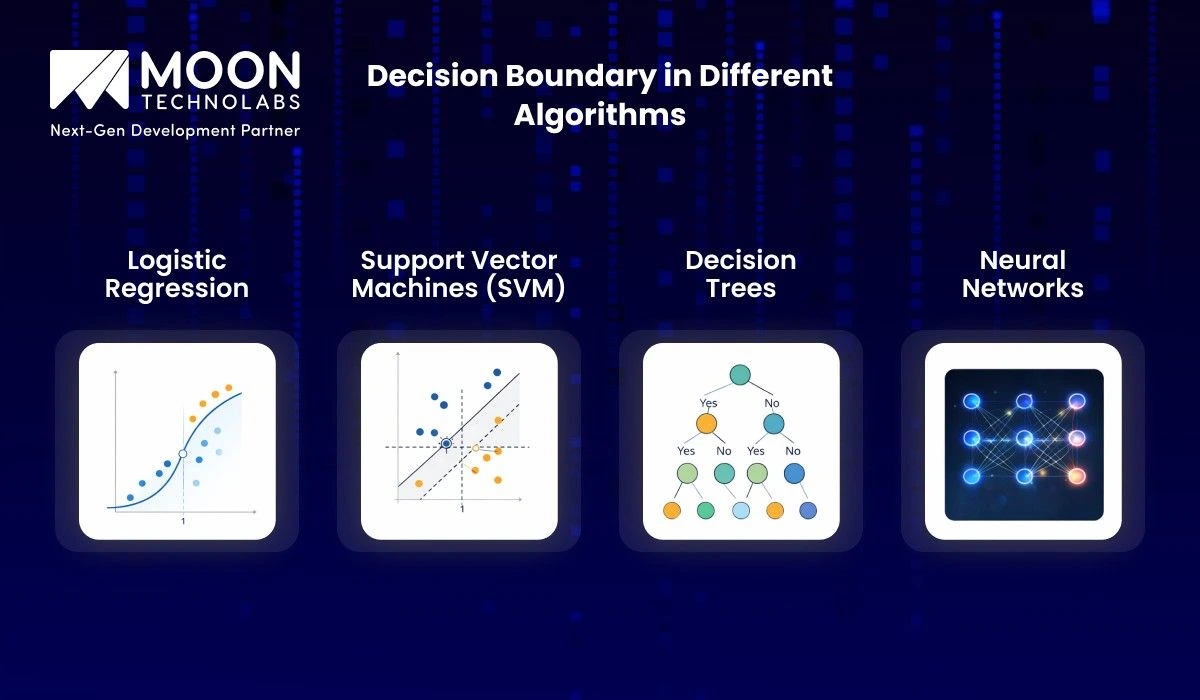
Logistic Regression
Creates a linear boundary.
Good for linearly separable data.
Boundary defined by:
theta^T x = 0
Support Vector Machines (SVM)
- Linear SVM → straight boundary
- Kernel SVM → curved boundary
SVM maximizes margin between classes.
Example (RBF kernel):
from sklearn.svm import SVC
model = SVC(kernel='rbf')
model.fit(X, y)
RBF creates flexible, curved decision regions.
Decision Trees
Decision trees split space into rectangular regions.
Their boundaries look step-like.
from sklearn.tree import DecisionTreeClassifier
tree = DecisionTreeClassifier(max_depth=3)
tree.fit(X, y)
Increasing depth makes boundary more complex.
Neural Networks
Neural networks can learn highly non-linear boundaries.
from sklearn.neural_network import MLPClassifier
mlp = MLPClassifier(hidden_layer_sizes=(10,10))
mlp.fit(X, y)
With enough layers and neurons, boundaries can approximate almost any shape.
Overfitting and Decision Boundary Complexity
Underfitting
Too simple boundary:
- High bias
- Misses patterns
- Poor accuracy
Example:
- Using logistic regression on complex data.
Overfitting
Too complex boundary:
- High variance
- Fits noise
- Poor generalization
Example:
- Deep decision tree with no pruning.
Visual intuition:
- Smooth boundary → better generalization
- Jagged boundary → likely overfitting
Mathematical Perspective
For binary classification:
A model predicts class 1 if:
f(x) > 0
The decision boundary is defined as:
f(x) = 0
For logistic regression:
P(y=1|x) = \frac{1}{1 + e^{-(w^Tx + b)}}
Decision boundary occurs at:
w^Tx + b = 0Decision Boundaries in High Dimensions
In higher dimensions:
- 2D → Line
- 3D → Plane
- nD → Hyperplane
We can’t visualize beyond 3D, but mathematically, the concept remains identical.
Why Decision Boundaries Matter in Real Systems?
Understanding decision boundaries helps in:
- Model selection
- Feature engineering
- Explaining predictions
- Debugging misclassifications
- Identifying bias
For example:
If the boundary cuts through a dense cluster, you may need better features.
Regularization and Its Impact
Regularization smooths decision boundaries.
Example:
LogisticRegression(C=0.1)
Lower C:
- Stronger regularization
- Simpler boundary
Higher C:
- Weaker regularization
- More flexible boundary
Multiclass Decision Boundaries
For multiple classes, boundaries become multiple regions.
Strategies:
- One-vs-Rest
- One-vs-One
- Softmax (neural networks)
Each class gets its own separating region.
Common Mistakes When Interpreting Decision Boundaries
- Assuming a linear boundary works for complex data
- Ignoring feature scaling
- Confusing the decision boundary with the probability threshold
- Overfitting due to high model complexity
How Moon Technolabs Applies Decision Boundary Concepts?
When building AI-driven solutions, Moon Technolabs ensures:
- Proper model selection based on boundary complexity
- Balanced bias-variance tradeoff
- Explainability integration
- Feature optimization for cleaner separation
Understanding decision boundaries leads to more stable and interpretable ML systems.
Turn Machine Learning Theory into Real-World Impact
From model design to production deployment, Moon Technolabs applies decision boundary optimization and ML best practices to build scalable AI systems.
Final Thoughts
A decision boundary is not just a theoretical concept—it represents the logic your model uses to separate classes.
Whether linear or highly non-linear, simple or complex, the shape of the decision boundary determines how well your model generalizes to unseen data.
Mastering decision boundaries helps you build better models, avoid overfitting, and make smarter algorithm choices in machine learning projects.


Jayanti Katariya is the CEO of Moon Technolabs, a fast-growing IT solutions provider, with 18+ years of experience in the industry. Passionate about developing creative apps from a young age, he pursued an engineering degree to further this interest. Under his leadership, Moon Technolabs has helped numerous brands establish their online presence and he has also launched an invoicing software that assists businesses to streamline their financial operations.
Get in Touch With Us
Submitting the form below will ensure a prompt response from us.