
 Total Views: 2302
Table of Content


Blog Summary:
Reading the entire blog allows you to explore the importance of voice technology in healthcare for improved patient outcomes. You’ll grasp the different ways it’s being applied, the benefits it brings to both providers and patients, as well as the challenges that still need to be solved.
Table of Content
Imagine you speak naturally with your patients, and your entire conversation is transcribed within seconds and seamlessly integrated into their electronic health records. It has become realistic rather than futuristic of late. This becomes possible by utilizing Voice Technology in Healthcare.
The technology has redefined the way healthcare professionals serve and deliver patient outcomes, from simplifying clinical documentation to offering fast access to patient histories.
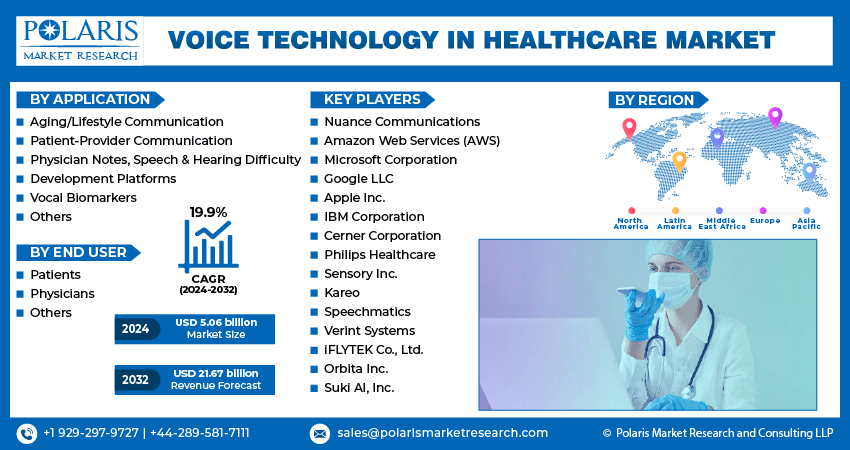
According to statistics by Polaris Market Research, the voice technology market in healthcare research is expected to reach $21.67 billion by 2032, up from $5.06 billion in 2024, growing at a CAGR of 19.9% during the forecast period.
Doctors can handle multiple tasks without any complications, including reviewing patient data, dictating notes, or scheduling follow-ups, through the implementation of voice technology.
It helps them save their valuable time, ensuring patient interaction is more meaningful. For patients, the technology enhances communication, improves treatment accuracy, and provides greater satisfaction.
In this blog, we explore how voice technology is applied in the healthcare sector and outline the various benefits for both patients and service providers.
Voice recognition technology enables the conversion of spoken words into fully structured data. It enables medical equipment to understand and process data more effectively, allowing for better responses. In the healthcare sector, this technology is utilized for various purposes, including hands-free data entry, clinical dictation, patient communication, and other applications.
Voice recognition technology eliminates manual effort, thereby reducing the need for documentation. Whether it involves natural language processing, advanced algorithms, or continually enhancing speech models, this technology relies on various components.
It provides an accessible interaction for most patients. On the other hand, it helps clinicians by streamlining workflows. The technology enables voice recognition as a key patient-centric and advanced approach to healthcare delivery.
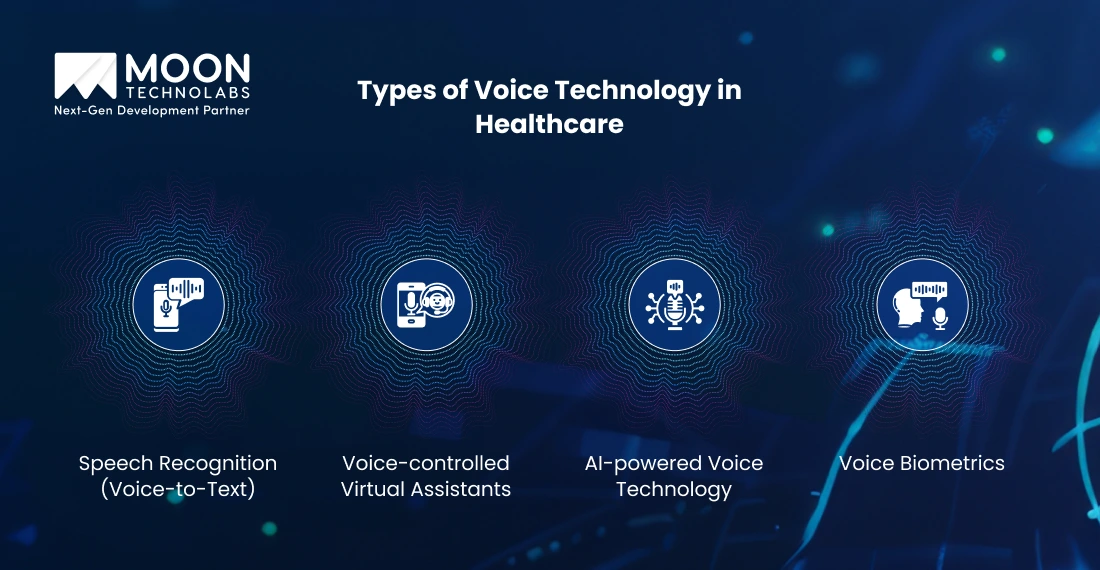
Healthcare organizations have recently adopted a vast array of solutions designed primarily to enhance patient care and clinical efficiency. We will discuss the most important types of voice technology that have redefined this sector:
Among the most widely adopted technologies, speech recognition allows physicians to dictate prescriptions, clinical notes, and patient records. These records are converted into electronic health systems. Popular tools like Nuance Dragon Medical One reduce documentation time while increasing accuracy.
Voice-controlled virtual assistants serve as an intermediary between patients and service providers, maximizing both accessibility and engagement. Whether it’s Google Assistant or Amazon Alexa, smart assistants are useful for a variety of purposes.
These purposes include scheduling appointments, reminding patients to take their medications, and providing care instructions after discharge. The system enables staff to order supplies, request information, and change room settings, among other tasks, even without requiring physical contact.
AI-driven voice technology serves more than just transcription by analyzing text, tone, patterns, and other aspects of speech. They have a higher potential to detect early signs of cognitive decline, depression, and various respiratory issues by using voice biomarkers.
The majority of hospitals explore these systems when it comes to predicting patients’ deterioration before any visible symptoms emerge. Once you integrate them with ML and predictive analytics, AI-powered voice platforms provide actionable insights that enable preventive care while minimizing costly readmissions.
Voice biometrics offer a secure method for authenticating both service providers and patients. They use voiceprints to authenticate a person, rather than relying on ID cards.
Voice biometrics have enormous capability of protecting sensitive health data while ensuring its secure access to electronic records and improving identity verification in telehealth platforms. With the surging cases of cyber threats, voice biometrics are set to play an indispensable role.
Voice recognition technology in healthcare redefines the way patient care is delivered and experienced. Apart from this, it matters for these sectors for various other reasons. Let’s find out some of them.
Healthcare organizations spend most of their valuable time on administrative tasks. It means they focus less on patient care. Meanwhile, they can overcome these burdens by utilizing voice-enabled tools that automate various related tasks, including appointment scheduling, charting, and subscription orders, among others.
Doctors can easily dictate their notes into electronic health records while offering consultations. With this change, healthcare professionals now focus more on patient care, resulting in a significant boost in productivity and improved patient outcomes.
It goes without saying that manual data entry is prone to errors, whether due to distraction or fatigue, or complex terminology. Meanwhile, speed recognition systems provide a higher precision while documenting treatment plans and symptoms.
These systems are trained on vast medical vocabularies. These systems provide high-quality patient records with improved clinical decision-making by reducing overall human error.
Time is highly important in healthcare – even a second has significant importance. Using voice technology enables the efficient utilization of time by recording test results, patient details, clinical observations, and other relevant information, all without interrupting the flow of care.
For any clinical care units and emergency departments, the real-time capture of information provides a sense of certainty that no important information is overlooked. Additionally, quick data availability offers fast coordination among multiple healthcare teams. It offers higher response times with improved continuity of care.
Another advantage of voice technology is its capability to humanize interactions. By leveraging this technology, physicians can maintain eye contact and thus listen more attentively. It gives patients satisfaction that they experienced more value, which thus boosts reliability and, of course, maximum satisfaction.
Apart from this, healthcare voice assistants can deliver health tips, reminders, medication schedules, and other relevant information in a highly intuitive manner. This technology is also beneficial for visually impaired patients, as it reduces barriers to accessing care while enhancing engagement with treatment plans.
When it comes to the accuracy and reliability of medical documentation, they are highly important for patient safety and compliance. Voice-based systems are necessary for consistency, as they record patient details in completely standardized formats.
It improves not only clinic records but also the capability of sharing information across different providers and healthcare systems. Since healthcare is a highly regulated industry, audits and trials are quite essential. Voice technology helps in this by providing a reliable framework for comprehensive, thorough, and transparent documentation.
From daily practices and assisting providers in minimizing inefficiencies to enhancing communication and creating a patient-centered experience, voice technology has numerous applications in the healthcare sector. We will discuss the following important use cases that illustrate how service providers utilize this technology.
Manual documentation requires a significant amount of time, which also impacts other tasks of healthcare professionals. To eliminate the need for manual transcription and save time, they can utilize voice-powered transcription tools to convert notes into electronic health records (EHRs) directly.
It thus prevents them from spending hours after appointments, allowing them to capture vital details quickly while speaking naturally. It minimizes overall documentation time up to 45%. It reduces errors from manual entry, allowing physicians to spend more time face-to-face with patients.
Digital voice assistants have become a reliable partner for patients. They can use either custom-built hospital voice apps or Amazon Alexa Health as a reminder for patients to track vital signs, take medications, answer basic health queries, and more.
For those patients who are elderly or have mobility challenges, these assistants provide fully accessible care support without the need for keyboards or screens. It provides a more inclusive approach to healthcare, ensuring that technology adapts to meet the needs of patients.
As telehealth continues to grow rapidly, voice technology plays a crucial role in enhancing the virtual care experience. While offering consultations, physicians can harness the advantages of speech-to-text tools to document the session in real-time. It minimizes the overall lag between record-keeping and consultation.
Voice commands have the capability of streamlining the overall navigation within telehealth platforms. It allows service providers to retrieve patient histories or lab results even without disrupting the conversation flow.
Apart from this, voice-powered features such as spoken symptoms or secure authentication add both reliability and convenience to the entire telemedicine journey for patients.
Voice technology boosts patients’ engagement by ensuring healthcare interactions are highly conversational. Patients who recover from surgery can receive daily check-ins with the help of voice-driven systems that ask about mobility, pain level, adherence to prescribed therapy, and more.
For timely intervention, the data is then shared with service providers. Apart from this, personalized health education and voice-powered reminders also enhance adherence rates, ensuring patients follow through with rehabilitation exercises, medication schedules, and lifestyle changes, as recommended by their care team.
Another popular usage of voice technology is that one can integrate it easily with EHRs. Physicians issue simple voice commands instead of engaging with complex interfaces.
It not only minimizes time saving but also minimizes the overall risk of ignoring important information. Integration of voice solutions ensures multidisciplinary teams can collaborate with higher efficiency.
Voice technology brings about a significant transformation in the way service providers and patients interact with each other, as we mentioned above. Clinicians nowadays use voice-powered devices to control access records, medical equipment, and request assistance even without leaving the bedside.
In smart hospital rooms, patients can easily adjust calls for nurses, lighting, and access to entertainment using voice commands, ensuring higher comfort and minimizing staff workload.
Several facilities are experimenting with voice-driven diagnostic tools that analyze vocal biomarkers to detect neurological and respiratory issues as early as possible.
Of course, the adoption of voice technology in healthcare presents numerous advantages. However, it also presents numerous challenges. We will describe some of the most common challenges in detail: .
Whether it’s scheduling tools, EHRs, telehealth platforms, or billing systems, healthcare environments depend on a range of platforms. The integration of voice solutions with multiple systems is indeed straightforward.
A large number of hospitals still use legacy infrastructure that can’t support voice-powered apps or modern APIs. It causes numerous issues, including compatibility problems, slows down deployment, and requires significant IT support.
Solutions: Always prioritize open API frameworks and standards, such as HL7 FHIR, to ensure seamless interoperability. To minimize complications, consider partnering with a service provider specializing in healthcare integration.
Since healthcare data is confidential, using voice systems often raises several questions about both compliance and security. Conversations captured through various tools often contain identifiable patient details that can be safeguarded under GDPR, HIPAA, FDA regulations, and other relevant laws.
Storing or transmitting different audio files increases the risk of data breaches, while maintaining patient consent and transparency remains an important ethical consideration. Maintaining a perfect balance between strict privacy requirements and accessibility remains a significant challenge.
Solution: You can safeguard your sensitive data in various ways, such as implementing anonymization protocols, end-to-end encryption, role-based control, and more. You also need to opt for staff training and regular compliance audits of voice data to maintain trust.
Due to a heavy workload, healthcare professionals often face a shortage of time for learning voice technology. Old-aged patients often feel unreliable or unfamiliar. On the other hand, a successful adoption requires an intuitive design, proper training, and evidence that technology minimizes effort compared to adding further complications.
Solution: It’s advisable to conduct adequate training programs, workshops, etc. You can also highlight many time-saving benefits, including minimized manual data entry, which maximizes adoption rates among clinicians.
Implementing voice technology in the healthcare sector needs much more than just software licenses. Hospitals often require secure integration services, cloud infrastructure, ongoing technical support, and more. Hardware costs play a significant role in voice-powered devices for at-home monitoring kits or facilities.
In addition, speed recognition models also require regular updates to boost accuracy, which adds recurring expenses. These costs are a major barrier to entry for underfunded health systems or smaller clinics.
Solution: You can minimize costs by using cloud-based voice solutions to limit infrastructure investments. It’s a good idea to opt for a pay-as-you-go model to ensure scalability even without any upfront spending.
Whether it’s staff communicating, machines beeping, or patients in distress, hospitals are a noisy place for many reasons. So, in this environment, it’s really tough for speech recognition systems to capture and process input with higher accuracy.
Any misinterpretation of a medical note or drug dosage can pose serious risks to patients. With higher improvements in AI-based noise filtering, ensuring a higher consistency in high-stakes settings is one of the challenges to resolve.
Solution: Utilize cutting-edge noise-cancellation technologies and AI models specifically trained for clinical environments to enhance accuracy. Systems should have the capability of contextual understanding and recognize medical accents and terminology.
The credit goes to the fast-paced innovation that ensures the emergence of voice recognition in the healthcare sector. Let’s explore some of the ongoing trends and advantages that have gained ground in this horizon: .
Ambient Clinic Intelligence (ACI) is one of the most emerging trends and advancements in voice recognition technology. ACI systems differ significantly from traditional dictation and operate in the background while patients are present. It captures and structures clinical notes automatically, even without interfering with the conversation.
Microsoft provides solutions that minimize documentation time, enabling healthcare professionals to focus entirely on patient care. The technology is designed to remove the “keyboard barrier” in the exam room and enhance the natural flow of care delivery.
The major attribute of advanced voice systems is that they are much more than just interpreting words. They, in fact, also interpret pitch, tone, sentiment, and more. These tools are capable of detecting fatigue, stress, emotional distress, and more in a patient’s voice.
Besides, they also alert clinicians to several conditions, such as depression, anxiety, cognitive decline, and more. With emotion-aware recognition, these systems enhance patient monitoring and provide in-depth insights for preventive care in the management of chronic diseases and mental health.
Voice technology has stepped in towards hyper-personalization. Any future assistants will not only remind patients to take medications. They can adapt based on medical histories, individual communication styles, preferences, and more.
You can consider a medical voice assistant that remembers a patient’s rehabilitation routine, coordinates with their care team, and adjusts reminders according to adherence patterns, among other features.
This standard of personalization boosts engagement, thereby enhancing long-term outcomes by making healthcare guidance feel more relevant and human.
The actual potential of voice recognition is enhanced when combined with other technologies. For example, when you integrate this technology with IoT devices, it ensures hands-free control of patient monitoring systems or medical equipment.
Additionally, utilizing voice technology with AI-powered predictive analytics enables it to identify health risks earlier, when integrated with various telehealth and wearable devices.
In the coming times, seamless interoperability will enable providers to access comprehensive patient data with the aid of a simple voice command. It also improves decision-making while minimizing the overall risk of fragmented care.
We help the healthcare sector to utilize the unmatched potential of voice technology by providing compliant, tailored, and scalable solutions. We provide high-grade voice-powered solutions to healthcare organizations, improving the efficiency of providers and patient care.
Whether you are looking for AI voicebot development to boost patient engagement or voice recognition software for healthcare, we offer a range of solutions to meet the diverse needs of healthcare service providers.
We specialize in integrating voice technology with EHR systems while ensuring a smooth data flow and compliance with HIPAA and GDPR.
We help clinics, hospitals, and telehealth providers minimize overhead and deliver personalized, accurate, and patient-centric healthcare experiences with our utmost expertise in AI-powered voice analytics.
It is undeniable that voice technology has revolutionized healthcare by enhancing accuracy, streamlining documentation, and strengthening patient engagement, among other benefits. Its impact is indeed undeniable, from a smooth EHR integration to smart assistants.
Meanwhile, increasing adoption challenges and higher costs encourage healthcare service providers to look for a reliable partner. Getting in touch with a company like Moon Technolabs helps you get secure and customized voice-powered solutions, align better with your clinical workflows, and also comply with your compliance requirements.
01
02
03
04
05

Jayanti Katariya is the CEO of Moon Technolabs, a fast-growing IT solutions provider, with 18+ years of experience in the industry. Passionate about developing creative apps from a young age, he pursued an engineering degree to further this interest. Under his leadership, Moon Technolabs has helped numerous brands establish their online presence and he has also launched an invoicing software that assists businesses to streamline their financial operations.


Submitting the form below will ensure a prompt response from us.
We refine our expertise to deliver innovative business solutions.





500 N Michigan Avenue, #600, Chicago IL 60611
13500 Long Is Dr, Pflugerville, TX 78660, USA

C-105, Ganesh Meridian, S.G. Highway, Ahmedabad, GJ 380060


 France
“ I highly recommend Moon Technolabs as the quality of service is wonderful. We have hired this company to develop the product based on some complex & technical issues. We get the best quality services as compared with others in the market. Huge Thanks to Moon Technolabs as the team is always ready to give the solution all time.”

 USA
USA“ Moon Technolabs is a pioneer in the WebRTC based project as they have fixed complicated segments of the module by fulfilling different product lines by providing 24X7 customer support. We really recommended Moon Technolabs as they are able to develop products as per the module deadline and project timeline.”

 Germany
“I am happy to recommend Moon Technolabs for their app development services. They successfully developed apps for me, and I am highly satisfied with the overall outcomes. The development team has swiftly addressed the issues with responsive and effective communication to understand the requirement quickly and actively resolve the back-and-forth problems that arose...”
 USA
USA“Moon Technolabs is the best company that provides advanced apps and websites development services in the USA and Europe. I am a newbie to develop my app with an external team. I am really happy to work with them as I am not that much mobile apps user. Here, the team and specially the CEO of Moon Technolabs helps me to let me know about the benefits of my app to generate revenue....”


