


Sitecore CMS vs DMS: Which Platform Is Right for You?

Marketing Team
Last Updated: Jul 29, 2026 Total Views: 84
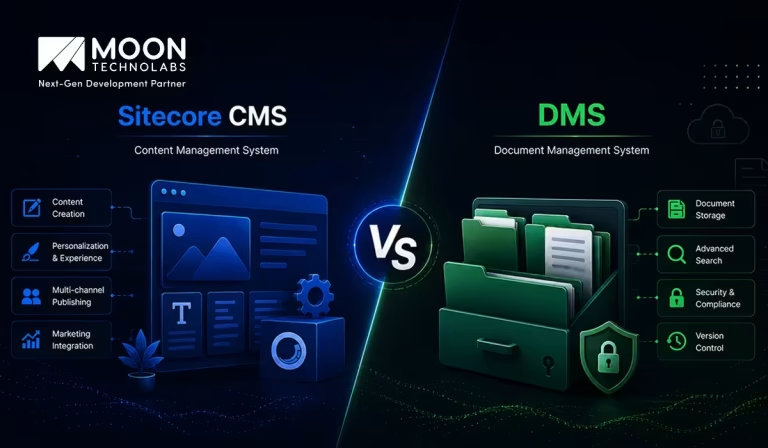
Table of Content


Blog Summary:
Selecting the right platform for managing digital content and business information can directly impact how effectively your organization engages customers and handles internal processes. The Sitecore CMS vs DMS comparison reveals how these two solutions serve different purposes, one focused on creating seamless digital experiences and the other on managing documents efficiently. In this blog, we’ll break down their key differences, benefits, and use cases to help you understand which solution is the right fit for your business needs.
Table of Content
Not all content is created for the same purpose, and choosing the right platform to manage it can significantly impact your digital strategy. Understanding the difference between Sitecore CMS vs DMS helps businesses determine which solution best meets their content and document management needs.
While Sitecore CMS focuses on creating personalized digital experiences across websites and channels, a document management system (DMS) helps securely store, organize, and manage business documents.
Understanding these differences is essential for selecting the right technology. In this blog, we’ll compare Sitecore CMS and DMS, explore their key differences and benefits, and help you choose the solution that best aligns with your business goals.
What is Sitecore CMS?
Sitecore CMS is an enterprise-level content management system (CMS) that helps businesses create, manage, and publish digital content across websites, mobile apps, and other channels.
Built on the Microsoft .NET platform, it offers features such as content authoring, workflow management, multilingual support, and easy integration with third-party systems. To meet specific business requirements, organizations often rely on CMS development services for customization, integration, and ongoing optimization.
In addition to content management, Sitecore provides personalization, analytics, and marketing automation tools that help businesses deliver relevant experiences to users. Its scalability, security, and flexibility make it a preferred choice for organizations managing large and complex digital platforms.
Core Features of Sitecore CMS
Discover the core capabilities of Sitecore CMS and understand how its features help businesses streamline operations, enhance efficiency, and achieve better results with a flexible platform:
Content Creation and Publishing
Sitecore CMS provides an intuitive platform for creating, editing, reviewing, and publishing digital content. It supports customizable workflows, content scheduling, version control, and collaboration, enabling teams to manage content efficiently while maintaining quality and consistency.
Personalization and Customer Experience
This web content management system delivers personalized experiences by analyzing visitor behavior and displaying relevant content based on user preferences and interactions. It also supports A/B testing, helping businesses optimize customer engagement and improve conversion rates.
Marketing Automation Capabilities
Sitecore offers built-in marketing automation tools for creating targeted campaigns, segmenting audiences, nurturing leads, and managing email marketing. Its analytics and reporting features help marketers measure campaign performance and improve marketing strategies.
Multi-site and Multi-language Management
Sitecore enables organizations to manage multiple websites from a single platform while maintaining consistent branding. It also supports multilingual web content management, allowing businesses to deliver localized experiences to global audiences efficiently.
Advantages of Sitecore CMS
Understand the benefits of Sitecore CMS and why businesses choose this platform to simplify content management, improve performance, and build a strong foundation for their digital initiatives:
Personalized Digital Experiences
Sitecore CMS delivers personalized digital experiences by analyzing visitor behavior, preferences, and demographics. It displays relevant content, targeted recommendations, and customized messaging, helping businesses improve customer engagement, strengthen relationships, increase conversions, and provide consistent experiences across websites and digital channels.
Centralized Content Management
The Sitecore platform provides a centralized solution for managing website content across multiple pages and channels. Teams can collaborate efficiently, reuse content, maintain brand consistency, simplify publishing workflows, and update information quickly, reducing administrative effort while improving overall content governance.
Scalability for Enterprise Websites
Sitecore CMS is built to support enterprise-level websites with high traffic, multiple brands, and expanding digital operations. Its scalable architecture ensures reliable performance, flexible deployment, and seamless growth, allowing organizations to meet evolving business requirements without compromising user experience.
Seamless Third-party Integrations
Sitecore implementation integrates smoothly with CRM, ERP, eCommerce, marketing automation, and analytics platforms. These integrations streamline business processes, synchronize customer data, automate workflows, and create a connected digital ecosystem that enhances operational efficiency and customer experience across multiple touchpoints.
Advanced Analytics and Marketing Tools
Sitecore Experience Platform includes advanced analytics and marketing tools that track visitor behavior, measure campaign performance, and generate actionable insights. Businesses can optimize customer journeys, conduct A/B testing, improve marketing strategies, and make informed decisions that drive better engagement and business growth.
Our CMS specialists help you compare solutions, simplify decisions, and implement the ideal platform for your unique business objectives.
Sitecore CMS Use Cases
Discover where Sitecore CMS fits best and how businesses across industries use it to support their unique requirements, improve efficiency, and drive meaningful outcomes:
Enterprise Websites
Sitecore CMS is built to support large-scale enterprise websites that require robust content management, high performance, and global scalability. It enables organizations to manage multiple websites, languages, and regions from a single platform while maintaining consistent branding and governance.
With advanced personalization and seamless integrations, enterprises can deliver engaging digital experiences across every touchpoint.
Corporate Portals
Organizations can use Sitecore Commerce to create secure, user-friendly corporate portals for employees, partners, and stakeholders. From sharing company updates and managing internal resources to enabling collaboration and self-service capabilities, Sitecore provides a centralized platform that improves communication, productivity, and information accessibility.
E-commerce Platforms
Sitecore CMS empowers businesses to build content-rich e-commerce experiences that drive customer engagement and conversions. By combining product content, personalized recommendations, and marketing automation, businesses can deliver tailored shopping journeys across web, mobile, and other digital channels.
Its integration capabilities also ensure smooth connectivity with commerce, CRM, and ERP systems.
Customer Experience Websites
Delivering exceptional customer experiences is at the core of the Sitecore digital marketing system. The platform leverages customer data, behavioral insights, and AI-powered personalization to present relevant content to every visitor. Whether it’s personalized landing pages, targeted campaigns, or omnichannel experiences, Sitecore solutions help businesses increase customer satisfaction, engagement, and long-term loyalty.
What is a DMS (Document Management System)?
A document management system (DMS) is software that helps organizations store, organize, manage, and securely retrieve digital documents. It centralizes files in one location, making it easy to search, share, and control access while reducing reliance on paper-based processes.
A DMS also includes features such as version control, document security, enterprise workflow automation, and collaboration tools, improving productivity and ensuring compliance. It enables businesses to streamline document handling, enhance team collaboration, and maintain accurate records efficiently.
Core Features of DMS
Learn about the fundamental capabilities of a document management system and how its features help businesses organize, access, secure, and manage important information more effectively:
Centralized Document Storage
A centralized document repository stores all business files in a single secure location, making them easy to organize, access, and manage while reducing duplication, improving consistency, and ensuring authorized users can retrieve information whenever needed.
Advanced Search and Retrieval
Advanced search features help users locate documents quickly using keywords, tags, metadata, categories, or filters. This reduces search time, increases productivity, and ensures employees can easily access the right information whenever required.
Version Control
Version control automatically tracks document changes, maintains revision history, and allows users to restore previous versions when needed. It prevents confusion caused by multiple copies of the file and ensures everyone works with the latest version.
Collaboration and File Sharing
Collaboration tools allow teams to securely share, review, edit, and approve documents in real time. Role-based permissions protect sensitive information while improving communication, teamwork, and overall efficiency across departments and remote work environments.
Audit Trails and Activity Tracking
Audit trails record every document activity, including viewing, editing, sharing, downloading, and deletion. This improves accountability, strengthens security, supports regulatory compliance, and helps organizations monitor user actions and investigate potential issues effectively.
You Might Want to Read:
Advantages of a Document Management System (DMS)
See how a DMS adds value to everyday business operations by improving document handling, supporting compliance needs, and enabling smoother information flow across teams:
Secure Document Storage
A DMS provides a centralized, secure repository for business documents. Advanced security features such as role-based access, password protection, encryption, and automated backups help safeguard sensitive information from unauthorized access, accidental deletion, and data loss.
Improved Document Collaboration
A DMS enables teams to collaborate efficiently by allowing multiple users to access, review, edit, and share documents in real time. Team members can work from different locations while maintaining a single source of truth, improving communication, reducing duplication, and increasing productivity.
Version Control and Audit Trails
Managing multiple versions of documents becomes effortless with a DMS. Every modification is automatically tracked, ensuring users always have access to the latest version while retaining previous versions for reference. Comprehensive audit trails record who viewed, edited, approved, or shared documents, promoting accountability and transparency.
Regulatory Compliance and Security
Organizations operating in regulated industries must comply with strict customer data management standards. A DMS helps meet compliance requirements by enforcing document retention policies, maintaining detailed audit logs, securing sensitive data through encryption, and controlling user permissions. This minimizes compliance risks and supports regulatory audits.
Faster Document Retrieval
Manually finding documents can be time-consuming and inefficient. A DMS offers powerful search capabilities using keywords, metadata, document categories, and filters, allowing users to locate files within seconds. Faster retrieval improves operational efficiency, enhances customer service, and saves valuable employee time.
DMS Use Cases
Explore the different scenarios where a DMS proves valuable and how organizations use it to streamline workflows, improve accessibility, and manage information more effectively:
Legal Document Management
Legal organizations manage contracts, case files, compliance records, and client documents that require secure handling and quick access. A DMS centralizes these files with version control, audit trails, and role-based permissions.
This improves collaboration, reduces the risk of lost documents, speeds up document retrieval, and helps legal teams maintain compliance with industry regulations while increasing overall operational efficiency.
Healthcare Records Management
Healthcare providers handle patient records, prescriptions, insurance forms, and medical reports daily. A DMS securely stores and organizes these documents, enabling authorized staff to access information quickly when needed.
With centralized storage, automated workflows, and strong security controls, healthcare organizations can improve patient care, reduce paperwork, protect sensitive health information, and maintain compliance with healthcare regulations.
Financial Document Processing
Finance teams process invoices, tax documents, audit reports, purchase orders, and financial statements, all of which require accuracy and security. A DMS automates document capture and approval workflows, reducing manual effort and processing errors.
It also provides secure access, faster document retrieval, and complete audit trails, helping businesses improve compliance, accelerate approvals, and manage financial records more efficiently.
Human Resource Document Management
HR departments manage employee records, recruitment documents, payroll files, performance reviews, and compliance paperwork throughout the employee lifecycle. A DMS centralizes these documents in a secure repository with role-based access and automated workflows.
This simplifies onboarding, improves document retrieval, reduces administrative workload, protects confidential employee information, and helps HR teams maintain compliance with organizational and legal requirements.
Sitecore CMS vs DMS: Key Differences
Compare Sitecore CMS and DMS to understand how their purpose, capabilities, and applications differ, helping businesses identify which solution aligns better with their content and information management needs:
| Aspect | Sitecore CMS | DMS |
|---|---|---|
| Primary Purpose | Designed to create, manage, personalize, and publish digital content across websites and digital channels. | Designed to store, organize, manage, and retrieve business documents and files securely. |
| Content vs Document Management | Focuses on web content, including pages, media, blogs, and digital experiences. | Focuses on documents like PDFs, Word files, contracts, invoices, and records. |
| User Experience and Accessibility | Delivers personalized, responsive, and omnichannel digital experiences for end users. | Provides secure document access, search, version history, and file sharing for internal users. |
| Workflow and Collaboration | Supports content authoring, editorial workflows, approvals, and scheduled publishing. | Supports document review, approvals, version control, check-in/check-out, and team collaboration. |
| Security and Compliance | Offers role-based permissions, authentication, and governance for digital content. | Emphasizes document security, audit trails, encryption, retention policies, and regulatory compliance. |
| Integration Capabilities | Integrates with CRM, marketing automation, analytics, e-commerce, and third-party digital platforms. | Integrates with ERP, CRM, email systems, office productivity tools, cloud storage, and business applications. |
| Scalability and Enterprise Support | Built for enterprise-scale digital experience management with support for multilingual and multisite deployments. | Built for enterprise document storage and governance with scalable repositories, backup, archival, and compliance management. |
Sitecore CMS vs DMS: Which One Should You Choose?
Both the Sitecore web application and a document management system (DMS) help organizations manage content, but they serve different purposes. Sitecore CMS focuses on creating and delivering customer-facing digital experiences, while a DMS is designed to store, organize, and manage business documents securely.
The right choice depends on your business goals.
Choose Sitecore CMS If:
Choose Sitecore CMS when your priority is managing digital content and delivering engaging online experiences.
It is ideal if you need to:
- Build and manage enterprise websites.
- Personalize content for different audiences.
- Publish content across multiple channels.
- Enable marketers to update content without developer support.
- Manage multilingual or multi-site content.
- Integrate with CRM, marketing, and commerce platforms.
Best for: Marketing teams, enterprise websites, and organizations focused on customer engagement.
Choose a DMS If:
A DMS is the better choice when your focus is secure document storage, compliance, and document workflows.
Choose a DMS if you need to:
- Store and organize business documents securely.
- Track document versions and changes.
- Automate approval workflows.
- Meet compliance and regulatory requirements.
- Control document access with user permissions.
- Manage contracts, invoices, HR files, and policies.
Best for: HR, finance, legal, healthcare, government, and other document-intensive industries.
When You Need Both Sitecore CMS and a DMS?
Many organizations use both systems because they address different needs. Sitecore CMS manages customer-facing content such as websites, blogs, and marketing campaigns, while a DMS handles internal documents like contracts, employee records, and compliance files.
Using both together helps organizations deliver engaging digital experiences while maintaining secure, organized, and compliant document management.
Partner with our experts to streamline your decision-making process and maximize the value of your content management investment.
How Can Moon Technolabs Help You Implement the Right Solution?
Choosing the right technology solution starts with understanding your business goals, challenges, and future growth plans. We work closely with businesses to analyze their requirements, identify opportunities, and recommend solutions that align with their objectives.
No matter the complexity of your project, we combine industry expertise, innovative technologies, and an agile development approach to build solutions that drive operational efficiency, accelerate digital transformation, and deliver lasting business value.
By combining technical expertise with industry best practices, we help businesses streamline operations, improve digital customer experiences, and accelerate innovation while ensuring the implemented solution continues to evolve with changing business needs.
Final Thoughts
Choosing between Sitecore CMS and a DMS ultimately depends on your organization’s goals, content strategy, and digital transformation needs. While Sitecore CMS excels at creating, managing, and personalizing digital experiences across multiple channels, a DMS focuses on securely storing, organizing, and managing business documents and records.
Evaluating your operational requirements, scalability needs, and user experience objectives will help you determine the right solution. If you’re looking to maximize the value of your digital ecosystem, partnering with an experienced Sitecore development team can ensure a seamless implementation tailored to your business goals.
FAQs
01
Is Sitecore PaaS or SaaS?
Sitecore offers both Platform as a Service (PaaS) and Software as a Service (SaaS) solutions. Traditional Sitecore XP can be deployed as PaaS on cloud platforms such as Azure. At the same time, Sitecore XM Cloud and Content Hub are SaaS offerings that provide fully managed, scalable, and cloud-native digital experience capabilities.02
Is SharePoint a CMS or DMS?
SharePoint functions as both a CMS and a DMS. It enables organizations to create, manage, store, and share digital content, while offering document versioning, collaboration, workflow automation, permissions management, and enterprise search to improve productivity.03
What are the three components of CMS?
The three primary components of a CMS are the Content Management Application (CMA), Content Delivery Application (CDA), and the content repository or database. Together, they enable content creation, storage, management, publishing, and seamless delivery across websites and digital platforms.04
What type of CMS is Sitecore?
Sitecore is an enterprise-level, headless-ready, and composable CMS designed for large organizations. It combines enterprise content management with digital experience capabilities, personalization, marketing automation, analytics, and omnichannel content delivery, making it suitable for complex business requirements and scalable digital experiences.05
What are the drawbacks of DMS?
A DMS can involve high implementation costs, ongoing maintenance, user training, and integration challenges with existing systems. Some organizations may also experience slower adoption, complex permission management, data migration challenges, and reliance on reliable infrastructure to ensure uninterrupted document access.




Jayanti Katariya is the CEO of Moon Technolabs, a fast-growing IT solutions provider, with 18+ years of experience in the industry. Passionate about developing creative apps from a young age, he pursued an engineering degree to further this interest. Under his leadership, Moon Technolabs has helped numerous brands establish their online presence and he has also launched an invoicing software that assists businesses to streamline their financial operations.
Submitting the form below will ensure a prompt response from us.
We refine our expertise to deliver innovative business solutions.


205 N Michigan Avenue, #810, Chicago, 60601, Illinois, United States
13500 Long Is Dr, Pflugerville, TX 78660, USA

C/105 Ganesh Meridian, S.G. Highway, Ahmedabad, GJ 380060


Ayse D.
Co-Founder France
“ I highly recommend Moon Technolabs as the quality of service is wonderful. We have hired this company to develop the product based on some complex & technical issues. We get the best quality services as compared with others in the market. Huge Thanks to Moon Technolabs as the team is always ready to give the solution all time.”

Justin G.
Founder & CEO USA
USA“ Moon Technolabs is a pioneer in the WebRTC based project as they have fixed complicated segments of the module by fulfilling different product lines by providing 24X7 customer support. We really recommended Moon Technolabs as they are able to develop products as per the module deadline and project timeline.”

Flavio S.
Founder & Managing Director Germany
“I am happy to recommend Moon Technolabs for their app development services. They successfully developed apps for me, and I am highly satisfied with the overall outcomes. The development team has swiftly addressed the issues with responsive and effective communication to understand the requirement quickly and actively resolve the back-and-forth problems that arose...”

Jay M.
Founder & CEOUSA“Moon Technolabs is the best company that provides advanced apps and websites development services in the USA and Europe. I am a newbie to develop my app with an external team. I am really happy to work with them as I am not that much mobile apps user. Here, the team and specially the CEO of Moon Technolabs helps me to let me know about the benefits of my app to generate revenue....”


Our Offices
India
C/105 Ganesh Meridian,S.G. Highway, Ahmedabad, GJ 380060USA
205 N Michigan Avenue, #810, Chicago, 60601, Illinois, United StatesContact Information


