
 Total Views: 394
Table of Content


Blog Summary:
This blog post dissects the Salesforce Business Model and how it created a scalable, revenue-generating CRM solution that leads the market. It will discuss Salesforce’s cloud-based technology, pricing models, licensing, and robust partner network that contribute to its predictable growth.
You will also learn more about its revenue models, market positioning, and SWOT analysis. This article will give you a better understanding of what makes Salesforce successful and how you can apply the same principles to your business.
Table of Content
Every successful SaaS company offers insights into how it scaled its revenue, locked in its customers, and built a maintainable platform. CRM market leadership isn’t about sales automation alone; it is also about design, extensibility, monetization, and an ecosystem that drives sustainable growth.
By understanding the different components of a successful technology product (design, monetization, and the ecosystem), you can evaluate the platforms, determine long-term costs, and identify a scalable business model that can be replicated. T Whether you are studying SaaS economics or planning an enterprise technology investment, you must interpret how leaders have defined their business models.
In this blog, we will take a look at the revenue engine and business model canvas for Salesforce, the CRM category leader. Using these insights, you can make smart and strategic decisions to deliver sustainable growth with your platform.
Salesforce is one of the top cloud-based software companies. It helps businesses manage their customers, sales, and service. Founded in 1999 by Marc Benioff along with a small team of co-founders, the company pioneered delivering enterprise software over the Internet. This occurred long before SaaS went mainstream.
Their “No Software” campaign challenged several traditional companies that offered on-premise systems, helping create the modern cloud-based services industry.
Today, Salesforce is a public company with a diverse shareholder base, including retail shareholders and institutional investors. Currently, Benioff is no longer the CEO; however, he remains Chair to the company and a key person in handling the company’s long-term strategy.
The mission statement of the company is “to empower companies to connect with their customers differently.” At the core, this company prioritizes creating a unified platform that can help organizations sell smarter, serve better, and build deeper relationships with their customers.
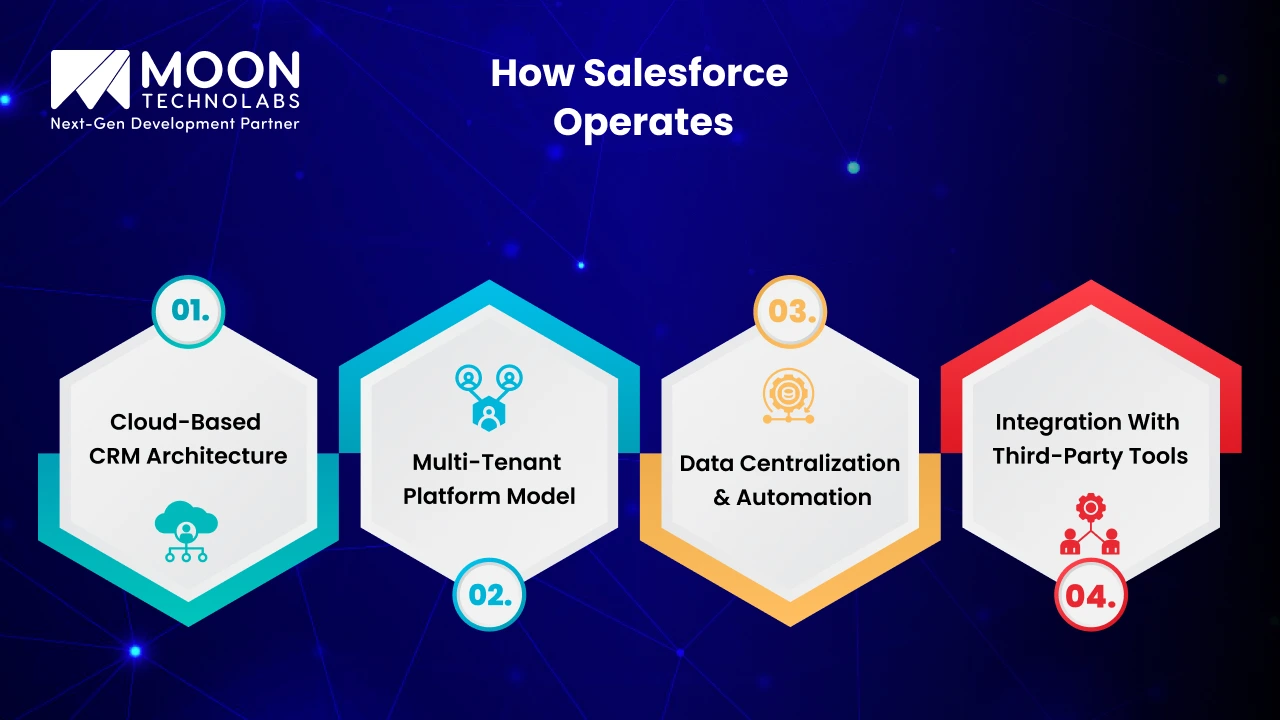
Salesforce is a cloud-first platform that’s designed to simplify how businesses can manage their customers, data, and workflows. Let’s look at how Salesforce operates using a cloud-first environment that helps them drive growth and returns.
Salesforce runs entirely in the cloud, allowing users to access their systems through a browser or mobile app, rather than installing the software locally. With this architecture, users can work from anywhere, receive updates automatically, and scale the storage/features as their business grows.
In the case of an IT organization, this can help reduce IT overheads while shifting the costs from capital expenses to predictable subscription spending.
With a multi-tenant model where multiple customers can share the same underlying infrastructure, the platform manages to keep data isolated and secure. This approach allows them to roll out new features to all their customers without compromising on performance.
It also helps them offer competitive pricing as the infrastructure cost is shared among millions of users.
Salesforce centralizes customer data from sales, marketing, service, and eCommerce verticals. As a result, silos are eliminated, and teams work using a single source of data. Subsequently, in-built automation tools, workflows, and AI features help with lead assignment, follow-ups, and service escalations.
Eventually, it reduces manual effort, driving consistency and helping organizations respond faster to customers.
Salesforce has been designed as a platform, not a closed system. Using APIs and AppExchange marketplace, businesses can easily connect their accounting software, ERP systems, and marketing tools with the platform.
Consequently, they can extend Salesforce into a diversified digital ecosystem, enabling end-to-end workflows across departments. This flexibility and extensibility have made Salesforce the core business platform in several organizations.
Together, these core components enable smooth operations and help businesses grow sustainably.
Salesforce’s business model is built around predictable and recurring revenue, layered pricing, and platform expansion. Let’s understand Salesforce revenue and monetization in detail to evaluate the long-term costs and returns effectively.
The major component of Salesforce revenue comes from subscriptions, charged either per user, month, or annually. Customers must pay to access Sales Cloud, Service Cloud, Marketing Cloud, and other industry solutions. For each service, the pricing is tied to features and usage.
With this recurring model, the platform can gain a stable cash flow, making forecasting efficient for vendors and customers. As subscriptions are billed in advance, Salesforce can enhance its working capital and invest more in R&D or acquisitions. The company was able to improve the product’s depth and market leadership over time using this flywheel
Salesforce has structured its products into tiers like Essentials, Professional, Enterprise, and Unlimited. With each tier, the users get advanced automation, analytics and even customizations. Using this tiered structure, they foster upselling in the case of mature organizations, enabling them to turn CRM into a long-term growth engine.
Tiered licensing helps shape their customer journeys. Most organizations start with basic plans to prove their ROI and justify upgrades before climbing the pricing ladder. Most organizations with operational maturity and complexity would go with higher plans.
Salesforce monetizes add-ons like analytics, data storage, industry-specific cloud services, and AI features. Using these incremental modules, they have been able to increase their average revenue per user, along with deepening the dependency on the platform.
That’s why expansion revenue is a significant growth driver for Salesforce. These add-ons are strategically priced by clubbing advanced capabilities like advanced security and compliance tools. With these premium features, they can target enterprise buyers who are willing to pay more.
With the Salesforce AppExchange marketplace, the partners are able to sell apps or integrations. In this case, Salesforce will take a share of its partner’s revenue. This lets them expand their platform’s capabilities without building any feature in-house.
The ecosystem approach also helps them accelerate innovation while building a powerful network effect. AppExchange revenue is indirect in nature. The partners are responsible for driving implementation, customization, and consulting services. All these efforts tend to improve Salesforce adoption and stickiness.
Large enterprises seek bundled pricing, negotiate the enterprise agreements, and even avail custom implementations. These contracts span multiple services and cloud, thus generating high value and multi-year commitments for Salesforce.
Buyers of Salesforce must understand these pricing mechanics to improve budgeting and negotiation while eliminating hidden costs. Custom contracts can also help gain volume discounts, support packages, and multi-cloud bundles.
By studying this revenue and monetization model, you can learn how SaaS leaders like Salesforce compound revenue across the business lifecycle and customer value expansion.
We help create SaaS products with recurring revenue, pricing tiers and architectures inspired by market leaders
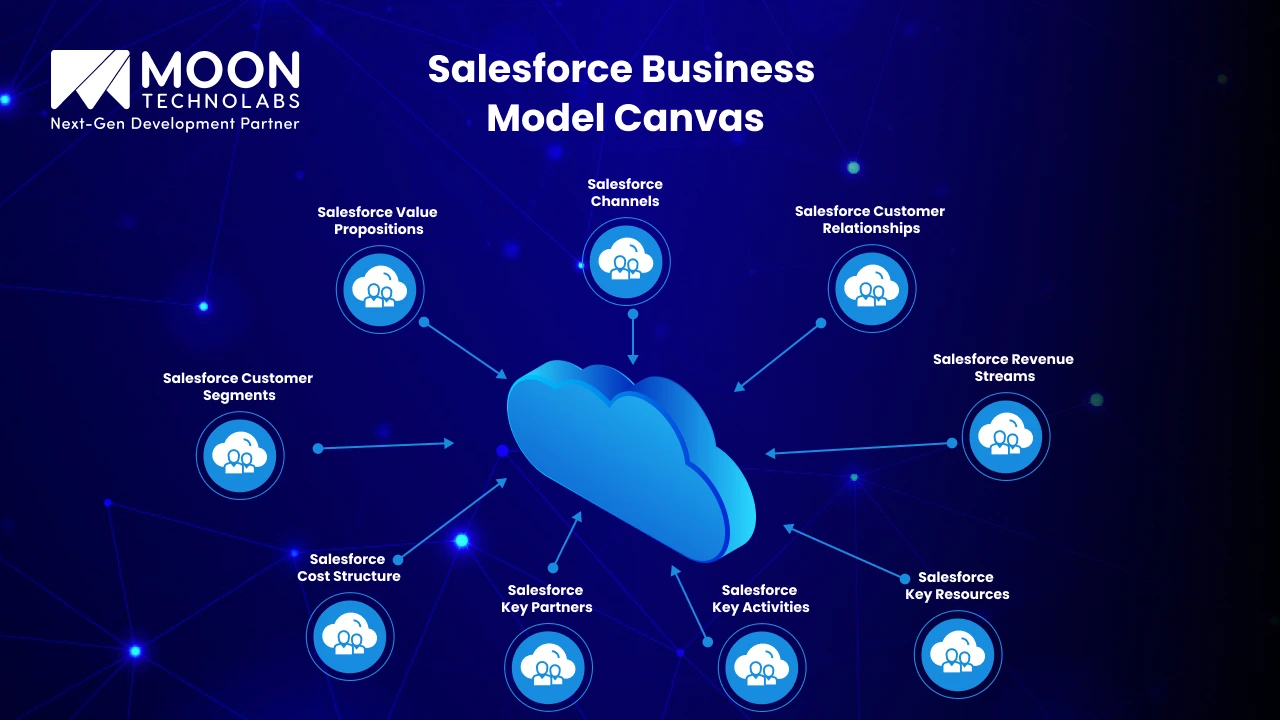
The Salesforce business model canvas breaks down how the platform creates, delivers, and captures value. It will help you see how products, customers, revenue, and operations align in a scalable system.
Salesforce has a diverse customer base, ranging from small teams to global enterprises across multiple industries, like finance, retail, manufacturing and healthcare. They also target developers, partners, and ISVs who build their platforms to create a second customer layer.
This helps them expand innovation and adoption. Using this segmentation approach, they offer tailored pricing and messaging for different maturity stages and industries globally.
The core value proposition of Salesforce is a unified customer platform, connecting sales, service, marketin,g and data. It lets businesses gain scalability, analytics, and automation without the hassle of managing infrastructure.
Simultaneously, the extensible platform lets businesses change the workflows and create custom applications. These value propositions assure faster deployment while lowering IT burden and delivering measurable productivity gains.
Salesforce uses a direct enterprise sales team, online self-service plans, consulting firms, and channel partners to sell the product. The platform’s website, AppExchange marketplace, and significant events are also pivotal as education and acquisition channels to drive the pipeline growth. They also nurture their mid-market and developer audiences through marketing and content.
Salesforce manages its customer relationships via account managers, community forums, success teams, and training platforms. They also invest in onboarding and certification to deepen their product usage and reduce churn over time. Customer communities also encourage peer learning while reducing support costs.
The major sources of revenue include subscriptions, add-ons, professional services, and partner marketplace fees. They offer multi-year contracts as well as expansion licenses to create predictable cash flows alongside usage-based features and premium clouds.
All these types of streams increase lifetime values as the platform’s customer base grows. Services revenue may be small, but it drives adoption and expansion.
The key resources utilized include cloud infrastructure, a wide customer dataset, a proprietary platform, and a developer ecosystem. The other critical asset that has helped the company innovate and execute large-scale deals is the human capital, such as engineers and enterprise sales talent. AI models also help the platform differentiate itself from their competitors.
The key activities include product development, platform maintenance, sales & marketing, customer success, and partner enablement. Continuous acquisition and integration with new technologies also enable them to expand their abilities and enter newer markets.
They have been able to keep the customers engaged and loyal through activities like events, certifications, and community programs.
Consulting firms, system integrators, hyperscalers, and technology vendors that integrate with the current platform all comprise the key partners for Salesforce. These partners have extended the reach of the platform, accelerated implementations, and created industry-specific solutions.
As a result, Salesforce never had to build everything internally while enabling revenue-sharing that aligns with its growth goals.
This is an important part of the business model. Most of their cost structure includes cloud infrastructure, sales, marketing, acquisitions, partner programs and R&D. With higher spend in sales, they can fuel growth. Additionally, they were able to invest in the platform to sustain competition while growing.
By understanding this cost mix, you will understand why Salesforce prioritizes recurring revenue and expansion. It also helps know that profitability depends on scaling the subscriptions rather than increasing the costs associated with acquiring/serving customers.
The CRM market is a crowded space with competitors ranging from SMB tools to enterprise platforms. HubSpot, Zoho, Microsoft Dynamics 365 and Oracle CX are competing on pricing, usability and industry depth, making them appealing to diverse buyer segments.
Open source and niche CRMs have also carved a space out for themselves by offering customization and cost advantages for companies that need more control over data and workflows.
Beyond direct CRM rivals, Salesforce is also competing with the broader SaaS and enterprise software solutions that tend to bundle CRM with the larger solutions. These include SAP, Adobe and ServiceNow. These platforms cater to their existing customer bases and data platforms, challenging the standalone CRM platforms.
It is crucial to understand the landscape as CRM choices are tied to your ERP, marketing automation, and AI roadmaps. This competitive pressure has also defined the pricing, bundling, and even innovation cycles for Salesforce, impacting total cost of ownership and long-term strategy.
You Might Also Like:
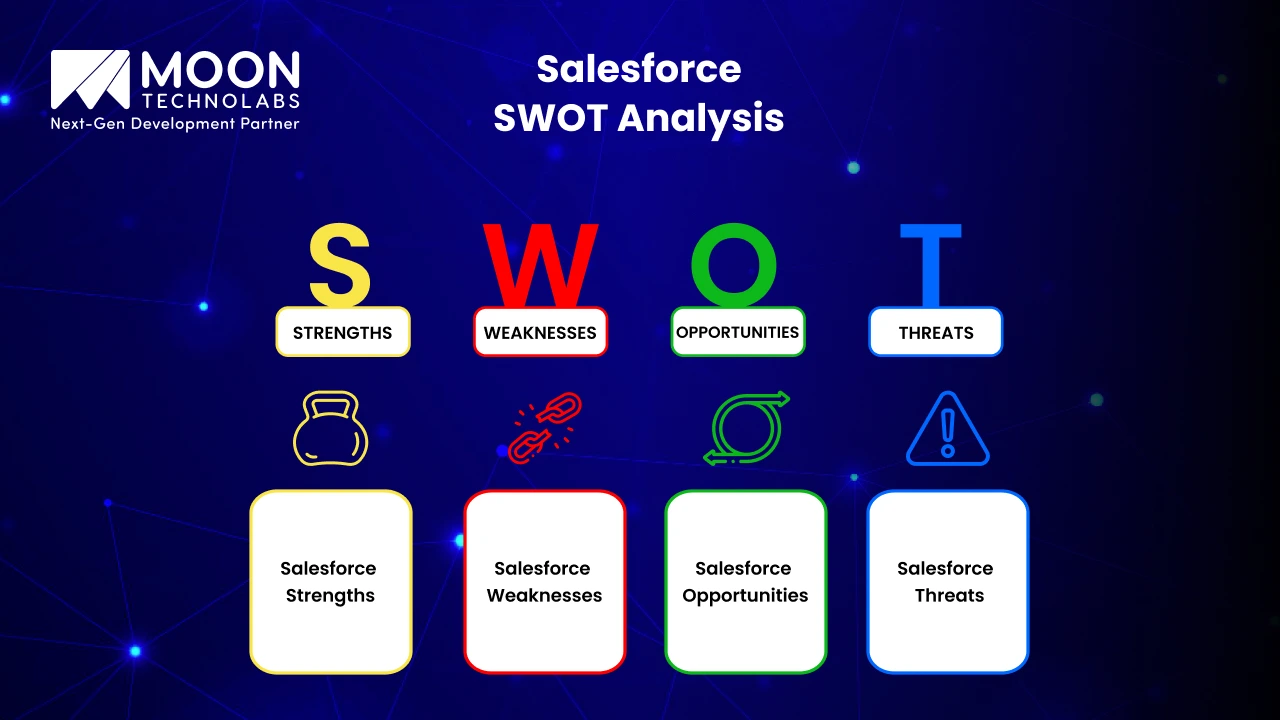
With this SWOT analysis, it is easier to understand what has enabled the platform’s sustained leadership and the risks it faces. Here is a detailed SWOT analysis that has helped Salesforce make strategy choices that provide a competitive advantage:
Salesforce’ biggest strength is the brand dominance, along with a scalable cloud platform and a massive ecosystem. Their subscription model helps them define a predictable model. Combined with AppExchange and a partner program, Salesforce can drive innovation without increasing the internal costs.
Deep enterprise relationships and higher switching costs have also helped the platform retain its customers and expand accounts with time. Lastly, their strong acquisitions and R&D have helped them deliver impeccable customer experience.
The biggest issues include complexity and cost. The licensing structure is difficult to predict, and companies need consultants to implement Salesforce. All of this increases the total cost of ownership.
For smaller organizations, it might reflect an overbuilt platform as compared to lighter CRM tools. Customizations can add technical debt, making upgrades difficult and adding to the long-term maintenance needs.
AI, data platforms, and industry clouds are creating expansion opportunities. By introducing analytics, automation, vertical solutions, and cross-selling opportunities, the platform has increased its revenue per customer. The global digital transformation trends have maintained the demand for Salesforce. Partnering with hyperscalers and ISVs have also helped them improve their reach.
Aggressive competitors, enterprise buyers choosing fewer and all-in-one platforms, as well as price pressure, act as threats for Salesforce. Data privacy regulations and AI governance will also increase the compliance costs. The platform may also face threats from open-source and low-cost platforms.
Under the pricing tiers, value from add-ons and contracts that help forecast costs and negotiate better to align your CRM strategy with business goals.
Salesforce’s rise wasn’t accidental; instead, it is a masterclass in how SaaS companies can build durable revenue engines and scale with ecosystems. The subscription-first model, along with tiered pricing, expansion add-ons, and a partner marketplace, shows monetization with product design and their go-to-market strategy, strengthening the product’s positioning.
The takeaway is clear: market leadership is built on a great combination of business architecture and technology. Whether you are evaluating a CRM platform or studying SaaS growth platforms, understanding these mechanics can help you choose the right technology after thorough consideration of long-term costs and opportunities.
If you are exploring CRM platforms, custom integrations or digital transformation for your business, Moon Technolabs, a Leading Salesforce Development Company, can translate these insights into scalable implementation roadmaps. Connect with our experts to align your technology needs with business goals and growth strategy.
01
02
03
04
05

Jayanti Katariya is the CEO of Moon Technolabs, a fast-growing IT solutions provider, with 18+ years of experience in the industry. Passionate about developing creative apps from a young age, he pursued an engineering degree to further this interest. Under his leadership, Moon Technolabs has helped numerous brands establish their online presence and he has also launched an invoicing software that assists businesses to streamline their financial operations.


Submitting the form below will ensure a prompt response from us.
We refine our expertise to deliver innovative business solutions.




500 N Michigan Avenue, #600, Chicago IL 60611
13500 Long Is Dr, Pflugerville, TX 78660, USA

C-105, Ganesh Meridian, S.G. Highway, Ahmedabad, GJ 380060


 France
“ I highly recommend Moon Technolabs as the quality of service is wonderful. We have hired this company to develop the product based on some complex & technical issues. We get the best quality services as compared with others in the market. Huge Thanks to Moon Technolabs as the team is always ready to give the solution all time.”

 USA
USA“ Moon Technolabs is a pioneer in the WebRTC based project as they have fixed complicated segments of the module by fulfilling different product lines by providing 24X7 customer support. We really recommended Moon Technolabs as they are able to develop products as per the module deadline and project timeline.”

 Germany
“I am happy to recommend Moon Technolabs for their app development services. They successfully developed apps for me, and I am highly satisfied with the overall outcomes. The development team has swiftly addressed the issues with responsive and effective communication to understand the requirement quickly and actively resolve the back-and-forth problems that arose...”
 USA
USA“Moon Technolabs is the best company that provides advanced apps and websites development services in the USA and Europe. I am a newbie to develop my app with an external team. I am really happy to work with them as I am not that much mobile apps user. Here, the team and specially the CEO of Moon Technolabs helps me to let me know about the benefits of my app to generate revenue....”


