
 Total Views: 8305
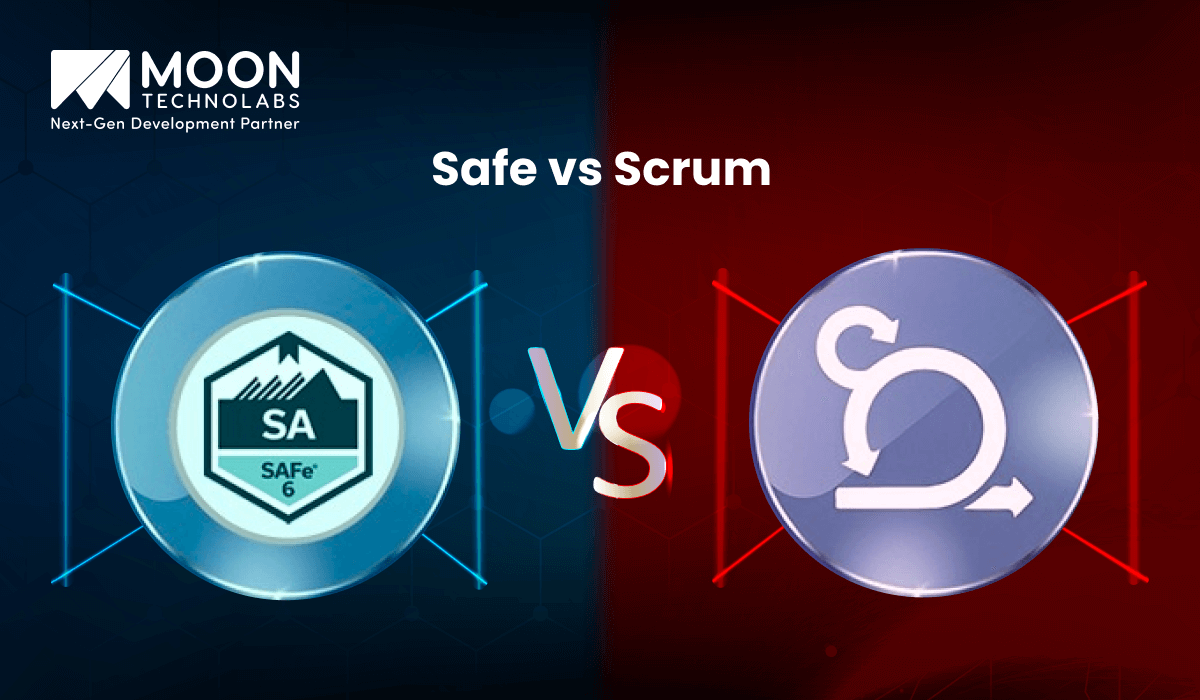
Table of Content


Blog Summary:
This blog compares SAFe and Scrum to help you make an informed decision and select the right option for your business. We compare both options based on various factors, while also discussing the benefits and key considerations to keep in mind when making a decision. Let’s explore all these by reading the entire blog.
Table of Content
Businesses have recently become increasingly inclined towards agile frameworks for several reasons, including improving workflow, delivery, and aligning teams more closely with their core objectives.
And they most frequently opt for SAFe and Scrum for these purposes. Meanwhile, most organizations often stick to a comparison of SAFe vs Scrum when it comes to choosing the right option between these frameworks.
Of course, both frameworks offer a unique set of advantages – SAFe primarily caters to larger enterprises for redefining their scalability. In contrast, Scrum has become pivotal for agile development, particularly when compared to SAFe, in small teams.
The demand for both frameworks is growing rapidly. Verified Market Reports claim that the Scrum and SAFe market size is likely to reach up to $3.5 billion by 2033, which was approximately $1.2 billion in 2024.
To decide between SAFe and Scrum, consider factors such as company size, goals, and complexity. In this blog, we discuss the major differences between these two to provide you with greater clarity. And you will end up eventually choosing the right option.
Being a fully structured methodology, SAFe works effectively to implement agile principles across large enterprises, managing complex projects and multiple teams. It includes multiple layers, such as program, team, portfolio, and large solution, which are essential to align strategy with proper execution. Organizations often rely on enterprise software examples to understand how SAFe can be applied in real-world projects.
SAFe works through synchronizing agile releases, where Kanban or Scrum teams collaborate effectively towards shared goals. Some common practices of SAFe include;
This framework enables enterprises to maintain complete agility while providing proper governance, alignment, and predictability across multiple teams. They work towards a shared strategic goal.
As a lightweight agile framework, Scrum is useful for cross-functional and small teams. It helps them adapt fast to any changes and deliver products iteratively. The framework divides the entire task into multiple time-boxed cycles, which are known as Sprints.
They generally last for two to four weeks, where the team takes responsibility for planning, creating, reviewing, and refining deliverables.
Whether it is accountability, collaboration, or continuous improvement, Scrum focuses on everything through defined roles, including Scrum Master, Product Owner, and Development Team. Some of its common practices are as follows;
The framework enables the team to respond actively by emphasizing constant feedback and incremental delivery. It also helps maintain transparency and increase customer value.
While both SAFe and Scrum aim to deliver customer value through iterative development, they differ significantly in key areas such as scope of implementation, roles and responsibilities, flexibility, structure, cost, and complexity. Understanding these differences will help you decide which framework aligns better with your organizational needs.
It’s a scaled agile framework that is apt for enterprise-level adoption. The framework allows businesses with different departments, teams, and portfolios to align under a unified agile model. SAFe provides a comprehensive roadmap for scaling practices across multiple practitioners, offering complete strategic governance and alignment.
Scrum functions properly at the team level, which generally includes 5 to 9 members. It flourishes in cross-functional and small units where fast feedback cycles boost innovation. Scrum can also be applied across multiple teams with the support of additional frameworks, such as LeSS.
You Might Also Like:
Accompanied by a layered structure, SAFe introduces multiple roles, including Product Manager, Solution Architect, Release Train Engineer, Business Owner, and others. These positions ensure proper coordination between different teams, maintain alignment, and manage dependencies in support of enterprise goals.
Scrum emphasizes limited roles such as Product Owners, Scrum Master, and Development Team. Limited roles bring simplicity, thereby fostering accountability, collaboration, and empowerment at the team level, while allowing you to avoid unnecessary hierarchy.
SAFe is a prescriptive and structured framework that outlines roles, ceremonies, and responsibilities in detail. It redefines predictability in larger organizations while minimizing flexibility for individual teams.
Scrum is a highly adaptive framework that enables teams to define workflows based on their actual needs. By offering agility, it becomes a perfect choice for a dynamic environment where requirements change over time.
When it comes to implementing SAFe, it requires a significant investment in various areas, including tools, training, and certifications. On the other hand, it also requires vast cultural transformation and organizational change, which makes adoption resource-intensive and complex.
Scrum is a cost-effective and easily implementable approach. It requires minimal overhead while allowing teams to start quickly. They can refine their practices and experiment, even without any significant structural or financial commitments.
We provide expert guidance to help you start your agile journey by assisting you in choosing the right framework, whether it’s Scrum or SAFe. Take your business to the next level.
Contact Our Agile Experts Now
Based on agile principles, both frameworks differ in their benefits, depending on factors such as organizational structure, size, and requirements. We discuss the benefits of each framework separately. Let’s find out:
One of the top advantages of SAFe is its capability to connect strategy with execution. In large companies, teams often operate within a hierarchical structure. There is a higher possibility that they will face issues in terms of duplication and misalignment of efforts.
The SAFe framework removes this through introducing Agile Release Trains (ARTs). It ensures every feature, sprint, or deliverable has an active contribution to business outcomes, which boosts both efficiency and revenue.
SAFe has the capability of scaling agile across enterprises. Although Scrum works well for small teams, it struggles to coordinate when it comes to multiple teams from different departments. SAFe features a multi-layered structure and addresses this issue more effectively.
This design enables businesses to manage multi-team and complex projects without losing control. This scalability is particularly beneficial for larger enterprises across diverse industries, including telecom, finance, healthcare, and others.
With synchronization ceremonies and program increment (PI) planning, SAFe offers great coordination among teams from multiple departments. It provides smooth coordination with a minimized risk of communication breakdown while properly scheduling shared planning sessions, reviewing dependencies, and setting clear goals.
This type of structured alignment is crucial for organizations that provide integrated solutions across operations, technology, and compliance functions.
SAFe is indispensable for governance and compliance for those organizations that work in industries such as aerospace, banking, finance, healthcare, and others. It introduces lean portfolio management practices that can balance agility with oversight.
SAFe offers a perfect mechanism for implementing compliance, tracking progress, and managing budgets. This balance between adaptability and governance makes SAFe a perfect choice for businesses with a stringent regulatory requirement.
Since Scrum is a lightweight framework, it is the easiest agile framework to adopt. Compared to SAFe, Scrum is easier and faster to introduce in small teams with less disruption.
Teams need to grasp a few important concepts, such as roles, sprints, and ceremonies, before they start delivering. That’s the reason why this framework is fully accessible to SMEs, startups, or even pilot projects, without the necessity of large-scale transformation.
You Might Also Like:
Scrum favors self-organizing and empowered teams. The minimal hierarchy allows team members to take complete ownership of their work, experiment with solutions, and make decisions quickly.
This autonomy is necessary to foster a culture of innovation, where teams can adapt according to changing requirements and customer feedback. The framework ensures collaboration and innovation within organizations, helping them thrive through adaptability and creativity.
Scrum offers the possibility of continuous delivery and presents great opportunities for improvement through time-boxed and short sprints. After the end of every sprint, teams conduct proper reviews and retrospectives to gather necessary feedback and adjust their processes accordingly.
This cycle helps businesses in identifying numerous issues early and delivering incremental value. They can also respond quickly based on customer demands. The framework helps businesses gain a competitive edge by providing products that evolve in sync with the changing market requirements.
Scrum requires fewer overhead costs, especially when compared to SAFe. As we already mentioned, it doesn’t need organization restructuring, expensive certifications, specialized tooling, and more.
To harness Scrum, a team requires a complete understanding of agile principles and to leverage basic collaboration platforms. This makes Scrum a great choice for small businesses and resource-conscious startups.
Apart from this, Scrum teams are autonomous and also need less managerial oversight. It helps organizations save costs in project management and also governance overhead.
With us, you can empower your team by using the right agile framework. Get in touch with us to know how SAFe or Scrum can restructure your workflow.
Schedule a Meeting with Us
The selection of the right framework between SAFe and Scrum requires a proper assessment. You need to choose between these two options based on factors such as the structure of your organization, projects, and objectives.
Let’s explore the following necessary factors in-depth:
The actual size of your organization matters significantly when choosing the right framework. As we mentioned, Scrum is a good choice for small to mid-sized teams that consist of generally 6 to 9 professionals. It’s good for organizations where teams work autonomously and communication is straightforward.
On the other hand, SAFe is a great choice for large enterprises with numerous departments, teams, and portfolios. Whether it’s an alignment mechanism or structured coordination, it’s a perfect choice for companies with multiple employees working on independent projects.
When you select the wrong framework for your business scale, it leads to misalignment, inefficiencies, wasted efforts, and more.
When it comes to project scope and complexity, they work effectively to guide better decisions. Scrum is a good choice for those projects with incremental deliverables, fast-changing requirements, smaller scopes, and more. An iterative approach enables teams to adapt fast based on feedback and emerging market requirements.
On the other hand, SAFe is a good choice for multi-team and complex projects. In these projects, risk management, dependencies, and long-term planning are crucial. The structured approach of SAFe is well-suited for projects with regulatory requirements, cross-departmental collaboration, and multi-product development.
Governance requirements are another factor you need to consider when selecting between SAFe and Scrum. Businesses from regulated industries require proper documentation, formalized oversight, and reporting.
SAFe is capable of matching these requirements with lean portfolio management, built-in governance layers, and program-level alignment. On the other hand, Scrum is most effective when teams work with autonomy and depend extensively on frequent feedback loops rather than formal reporting structures.
Scrum is the best choice due to its self-organizing structure, which empowers teams to make decisions. The framework is better when your priority is to innovate quickly.
Whether it’s adjusting priorities within sprints, managing their own workflows, or continually improving processes, teams can manage everything properly with the use of this framework.
SAFe comes with hierarchical coordination across multiple programs, which minimizes team autonomy while ensuring complete strategic alignment. Businesses need to determine whether coordinated alignment or flexibility and innovation is more vital for achieving their business objectives.
When it comes to budget and resource availability, these are the most important and practical considerations. As we mentioned earlier, implementing Scrum requires less investment, which is mainly spent on collaboration tools, team training, facilitation, and other related expenses.
But, SAFe requires a higher investment in these things. For any budget-conscious projects, Scrum is a good choice. Larger organizations can opt for SAFe to achieve the long-term benefits of alignment, scalability, and predictability.
Whether you opt for Scrum or SAFe, make your choice based on the project’s requirements, complexity, goals, and organizational size. For small teams with limited staff, choose Scrum.
Conversely, SAFe aligns organizations effectively and provides scalability. Partnering with Moon Technolabs ensures you select and implement the right framework for your needs, driving strong business outcomes.
01
02
03
04

Jayanti Katariya is the CEO of Moon Technolabs, a fast-growing IT solutions provider, with 18+ years of experience in the industry. Passionate about developing creative apps from a young age, he pursued an engineering degree to further this interest. Under his leadership, Moon Technolabs has helped numerous brands establish their online presence and he has also launched an invoicing software that assists businesses to streamline their financial operations.


Submitting the form below will ensure a prompt response from us.
We refine our expertise to deliver innovative business solutions.


500 N Michigan Avenue, #600, Chicago IL 60611
13500 Long Is Dr, Pflugerville, TX 78660, USA

C-105, Ganesh Meridian, S.G. Highway, Ahmedabad, GJ 380060


 France
“ I highly recommend Moon Technolabs as the quality of service is wonderful. We have hired this company to develop the product based on some complex & technical issues. We get the best quality services as compared with others in the market. Huge Thanks to Moon Technolabs as the team is always ready to give the solution all time.”

 USA
USA“ Moon Technolabs is a pioneer in the WebRTC based project as they have fixed complicated segments of the module by fulfilling different product lines by providing 24X7 customer support. We really recommended Moon Technolabs as they are able to develop products as per the module deadline and project timeline.”

 Germany
“I am happy to recommend Moon Technolabs for their app development services. They successfully developed apps for me, and I am highly satisfied with the overall outcomes. The development team has swiftly addressed the issues with responsive and effective communication to understand the requirement quickly and actively resolve the back-and-forth problems that arose...”
 USA
USA“Moon Technolabs is the best company that provides advanced apps and websites development services in the USA and Europe. I am a newbie to develop my app with an external team. I am really happy to work with them as I am not that much mobile apps user. Here, the team and specially the CEO of Moon Technolabs helps me to let me know about the benefits of my app to generate revenue....”


