
 Total Views: 156
Table of Content


Blog Summary:
This is a complete guide to Real Estate Mobile App Development, detailing the market overview, features, and various app types. Moreover, it covers the benefits of a mobile presence and outlines the development steps to build a successful online property solution.
Table of Content
Are you a real estate professional finding it challenging to consistently attract high-quality leads and manage your property portfolio with maximum efficiency? In a market that demands speed and precision, trying to keep up without modern tools can feel like an uphill battle.
The truth is, the real estate industry is undergoing a drastic digital transformation. The traditional methods of property discovery, like newspaper ads or “For Sale” signs, are no longer the primary way customers find properties. Today’s property buyers begin their search on mobile phones.
This shift means that developing a dedicated real estate mobile app has become essential for sustained growth. An effective application helps you stand out from the competition, boosting client engagement and strengthening your competitive edge. However, simply having an app isn’t enough. It must be innovative, feature-rich, and offer a truly unique user experience to ensure high adoption.
This blog will guide you through developing a successful real estate app, covering everything you need to know. But before that, let’s have a bird’s-eye view of the statistics of this booking market.
Building a successful real estate app starts with understanding the market’s explosive potential. The following statistics say that the real estate tech sector is growing rapidly and is ripe with opportunities for innovation and high returns.
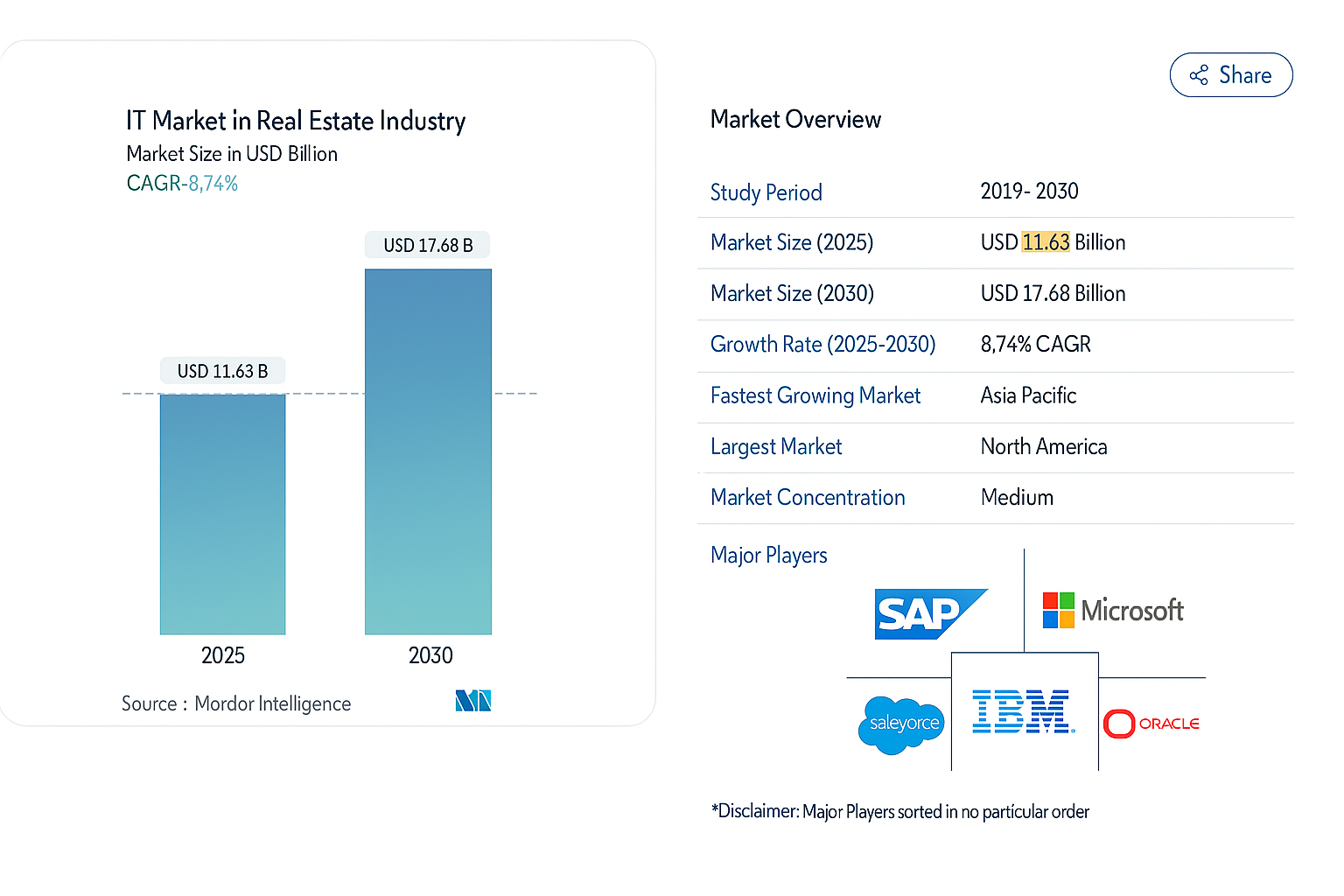
These numbers demonstrate that now is the time to invest in a real estate app that leverages digital technology to meet the demands of a rapidly digitizing market.
We bet you’re curious to know about real estate apps. The fundamental purpose of real estate mobile apps is to simplify and improve aspects such as searching, buying, selling, renting, managing, and transacting properties.
The real estate mobile apps help your property business gain exposure by providing an enhanced customer experience and driving substantial engagement. You can consequently amplify outreach and attract more sales & revenue. Wondering what makes a real estate app truly irresistible to users? Let’s uncover the must-have features that set successful apps apart.
To build a successful real estate mobile application, you need to blend essential functionality with modern technology for an optimal user experience.
Let’s check some of the foundational elements that users expect in any real estate app:
These features utilize modern tech to enhance convenience and personalization:
Explore Our Work
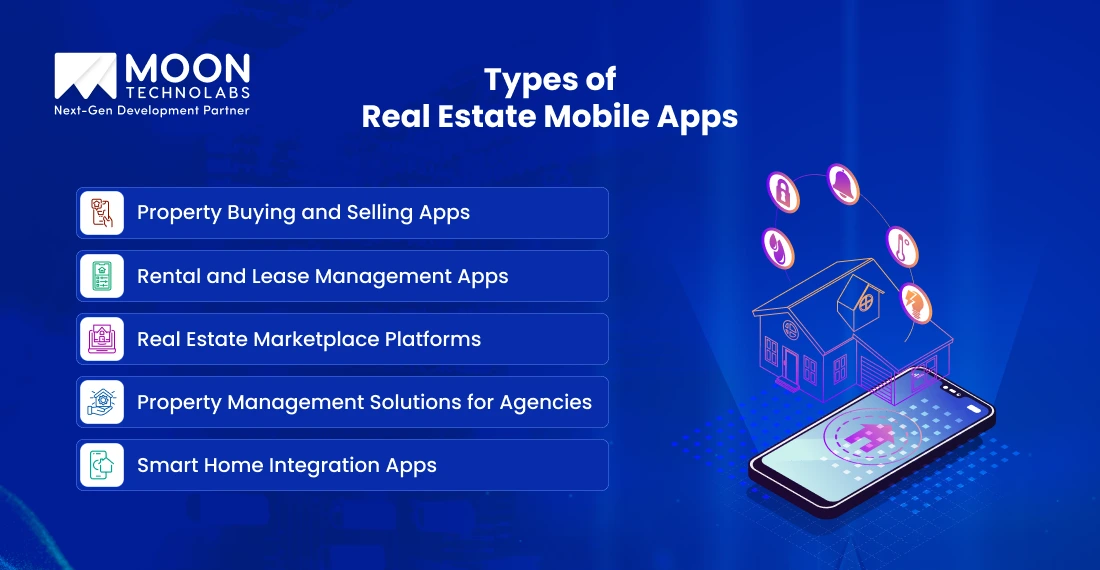
Now, let’s head on to check the different types of real estate mobile applications:
These are core property search and listing platforms. They connect buyers and sellers with available properties, offering advanced search filters, high-quality photos/videos, property valuation features, and agent contact features. They focus on the transaction process. Zillow, Realtor, and Redfin are some of the most common platforms.
This type of app is focused on the tenancy cycle. These solutions help tenants search for rentals, apply online, sign digital leases, and submit maintenance requests. For landlords, they automate rent collection, tenant communication, and lease tracking.
All-in-one hubs that bring buyers, sellers, agents, and even service providers together. They host a wide array of listings (for sale and rent) and facilitate the entire user journey on a single platform, often integrating features such as mortgage calculators and neighborhood insights.
These are professional tools for landlords and real estate companies. They streamline backend operations, including accounting, maintenance workflow, tenant screening, bulk communication, and portfolio performance tracking across multiple properties.
This emerging category focuses on the property experience after sale or lease. They connect listings to energy usage data, integrate with smart devices (such as locks and thermostats), and offer remote control and management of the home’s features for convenience and security.
From intuitive design to powerful backend integration, our development team ensures your real estate app stands out and delivers measurable results.
Get Your App Estimate
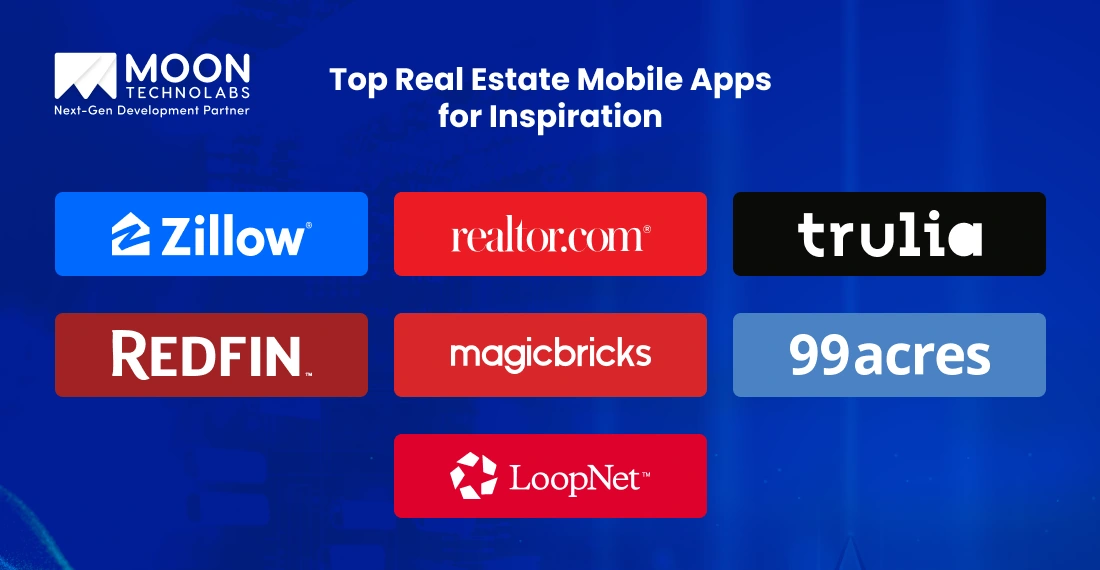
The apps below are widely used and can be incredibly inspiring, especially for their design, features, and overall user experience. Let’s have a breakdown of how each of these top 7 real estate mobile apps can inspire users looking to create a top-tier property app:
It’s one of the biggest in the U.S., covering buying, selling, renting, and home-value estimation. Key features include a large database of properties, strong filters, and estimated home values (“Zestimate”).
Reliable option for U.S. buyers/renters. It has good visuals and comprehensive data. The app is ideal for browsing with strong imagery and getting data on neighbourhoods.
This app focuses especially on neighbourhood info, rentals & purchases. It’s ideal for users who care about “area insight” (crime stats, schools, etc).
Redfin is a U.S.-based app, strong for buying & selling. The app emphasizes costs and commissions more. It’s ideal for more serious buyers/sellers who want up-to-date listings and agent integration.
It’s one of the prominent real estate apps in India for buying/renting. Ideal for property search in the Indian market (residential & rentals).
99acres is also India-focused and is strong for new projects, plots, and residential/commercial listings. It’s ideal for exploring upcoming projects and comparative searches in Indian cities.
Focused on commercial real estate like offices, industries, and retail spaces. It’s ideal for investors or businesses needing commercial property rather than purely residential.
Real estate mobile app development transforms how buyers, sellers, and agents connect. These apps bring convenience, transparency, and scalability to the real estate ecosystem. Let’s explore the benefits in detail.
Real estate mobile application development significantly enhances businesses’ presence and market penetration by establishing a direct, highly accessible channel to potential buyers and renters.
Unlike a website, which must compete for attention in search results, an app lives directly on the user’s device, ensuring your property listings are always just a tap away.
Push notifications play a key role in real estate apps. They allow businesses to instantly deliver real-time alerts about new listings, open houses, or price changes — bypassing crowded inboxes and capturing user attention to expand market reach.
Mobile apps offer a superior, more personalized, and highly interactive user experience compared to traditional websites, leading to deeper and more consistent customer engagement.
By leveraging features such as saved search criteria, custom property alerts, integrated mortgage calculators, and high-quality virtual tours, the app becomes an indispensable tool in users’ daily lives.
This level of personalization encourages users to return to the app frequently, turning a casual browser into an active, engaged prospect who feels their individual needs and preferences are being actively met and remembered by the platform.
For real estate firms managing rental properties, a dedicated mobile application serves as a powerful automation tool, vastly simplifying complex administrative and operational tasks.
The app centralizes processes such as maintenance request submission and tracking, secure digital rent payments, and streamlined sharing of lease documents and property notices.
This automation not only significantly reduces the administrative workload and potential for human error for property managers but also improves tenant satisfaction by providing a convenient, 24/7 service platform.
In a fast-moving market like real estate, the ability to communicate instantly is critical, and a mobile app makes this communication both efficient and direct. Instant push notifications deliver time-sensitive information, such as immediate price reductions or a notification that a property they favor is going under contract, ensuring the user never misses a vital opportunity.
Furthermore, integrating in-app chat or secure messaging capabilities provides a quick, traceable, and private channel for seamless conversations between agents and clients, fostering greater trust and leading to faster negotiations and decision-making.
A mobile application is a powerful engine for generating high-quality leads because it offers invaluable insights into user behavior and preferences that are often unavailable through other channels.
By tracking which properties users view, save to their favorites, or share with others, a business can segment its leads with high precision, identifying the most engaged prospects. This deep, data-driven understanding allows agents to personalize their follow-up.
When combined with the smooth, intuitive in-app experience, it significantly improves the efficiency of guiding users from initial browsing to crucial actions, such as booking a viewing, resulting in measurably higher conversion rates.
Building a real estate app involves a step-by-step process from concept to launch. Let’s break down the essential stages that make your app functional, user-centric, and market-ready.
Start by outlining your app’s core purpose — whether it’s for property listings, rentals, or agent services. Choose a revenue model such as subscriptions, ads, or premium listings.
Analyze competitors like Zillow, Realtor.com, and MagicBricks. Understand your users’ preferences, pain points, and location-based needs to design a solution that stands out.
Decide between a buyer-focused, seller-focused, or hybrid app. Include essential features like property search filters, virtual tours, maps, chat support, and mortgage calculators.
Pick reliable frameworks like React Native, Flutter, or Swift for scalability and performance. Create a clean, intuitive UI/UX that ensures smooth navigation and enhances user engagement.
Build a minimum viable product (MVP) to validate your concept. Conduct thorough testing to ensure your app runs seamlessly across different devices and platforms.
Enhance functionality with integrations such as the Google Maps API, MLS databases, payment gateways, and AI-driven recommendations for personalized experiences.
After deployment, track analytics, gather user feedback, and release regular updates to improve features, speed, and user retention.
We create scalable, high-performing real estate apps tailored to your business goals. Transform your property idea into a platform that seamlessly connects buyers, sellers, and agents.
Start Your Project
We’ve seen that success in real estate application development hinges on smart, user-focused decisions. Now comes the critical next step: execution.
Why navigate the complexities of building a real estate app alone? Consider partnering with a dedicated team. Moon Technolabs is equipped with innovation and deep industry expertise to bring your vision to life. Contact us to explore how we can deliver an app that redefines your business.
01
02
03
04
05

Jayanti Katariya is the CEO of Moon Technolabs, a fast-growing IT solutions provider, with 18+ years of experience in the industry. Passionate about developing creative apps from a young age, he pursued an engineering degree to further this interest. Under his leadership, Moon Technolabs has helped numerous brands establish their online presence and he has also launched an invoicing software that assists businesses to streamline their financial operations.


Submitting the form below will ensure a prompt response from us.
We refine our expertise to deliver innovative business solutions.





500 N Michigan Avenue, #600, Chicago IL 60611
13500 Long Is Dr, Pflugerville, TX 78660, USA

C-105, Ganesh Meridian, S.G. Highway, Ahmedabad, GJ 380060


 France
“ I highly recommend Moon Technolabs as the quality of service is wonderful. We have hired this company to develop the product based on some complex & technical issues. We get the best quality services as compared with others in the market. Huge Thanks to Moon Technolabs as the team is always ready to give the solution all time.”

 USA
USA“ Moon Technolabs is a pioneer in the WebRTC based project as they have fixed complicated segments of the module by fulfilling different product lines by providing 24X7 customer support. We really recommended Moon Technolabs as they are able to develop products as per the module deadline and project timeline.”

 Germany
“I am happy to recommend Moon Technolabs for their app development services. They successfully developed apps for me, and I am highly satisfied with the overall outcomes. The development team has swiftly addressed the issues with responsive and effective communication to understand the requirement quickly and actively resolve the back-and-forth problems that arose...”
 USA
USA“Moon Technolabs is the best company that provides advanced apps and websites development services in the USA and Europe. I am a newbie to develop my app with an external team. I am really happy to work with them as I am not that much mobile apps user. Here, the team and specially the CEO of Moon Technolabs helps me to let me know about the benefits of my app to generate revenue....”


