
 Total Views: 88
Table of Content


Blog Summary:
Metaverse as a Service is revolutionizing how businesses engage with immersive digital environments. By offering a cloud-based model for creating and managing virtual worlds, MaaS enables companies to bypass the complexities of infrastructure development. In this blog, we delve into the strategic advantages of MaaS, including cost efficiency, scalability, and enhanced collaboration. We also cover its diverse applications across industries and how its integration with advanced technologies such as AI and blockchain is shaping the future of the metaverse.
Table of Content
The way we work, socialize, shop, and experience entertainment is rapidly evolving. What once sounded futuristic is now becoming mainstream: the metaverse. Powered by immersive technologies like AR, VR, blockchain, and AI, the metaverse is reshaping how businesses interact with users in digital spaces.
Companies are no longer just building websites or mobile apps; they are creating a virtual environment where people can connect, collaborate, and transact in real time.
To meet this growing demand, Metaverse as a Service has emerged as a practical solution. It enables organizations to build and manage metaverse platforms without developing complex infrastructure from scratch, making immersive experiences more accessible and scalable.
According to Statista, the global Metaverse market is projected to reach US$150.1 billion in 2026. The market is expected to grow at a CAGR of 35.63% between 2026 and 2030, leading to an estimated market volume of US$507.8 billion by 2030. This rapid expansion reflects increasing investments in virtual platforms, digital assets, immersive technologies, and enterprise applications across industries.
Metaverse as a Service (MaaS) is a cloud-based service model that enables businesses to build, deploy, and manage immersive virtual spaces without having to develop the entire metaverse infrastructure from scratch.
Instead of investing heavily in hardware, 3D engines, blockchain integration, security systems, and real-time networking architecture, companies can leverage ready-made Metaverse development tools and platforms provided by MaaS vendors.
These MaaS services typically include:
In simple terms, MaaS works much like Software as a Service, but for immersive digital ecosystems. It allows businesses to focus on user experience, branding, and engagement while the service provider manages the technical foundation.
Organizations across industries, including retail, healthcare, education, sports, real estate, and entertainment, use MaaS platforms to create virtual stores, training simulations, collaborative workspaces, and interactive events. As the metaverse economy grows, MaaS is becoming a practical and cost-efficient way to enter this evolving digital landscape without building everything from the ground up.
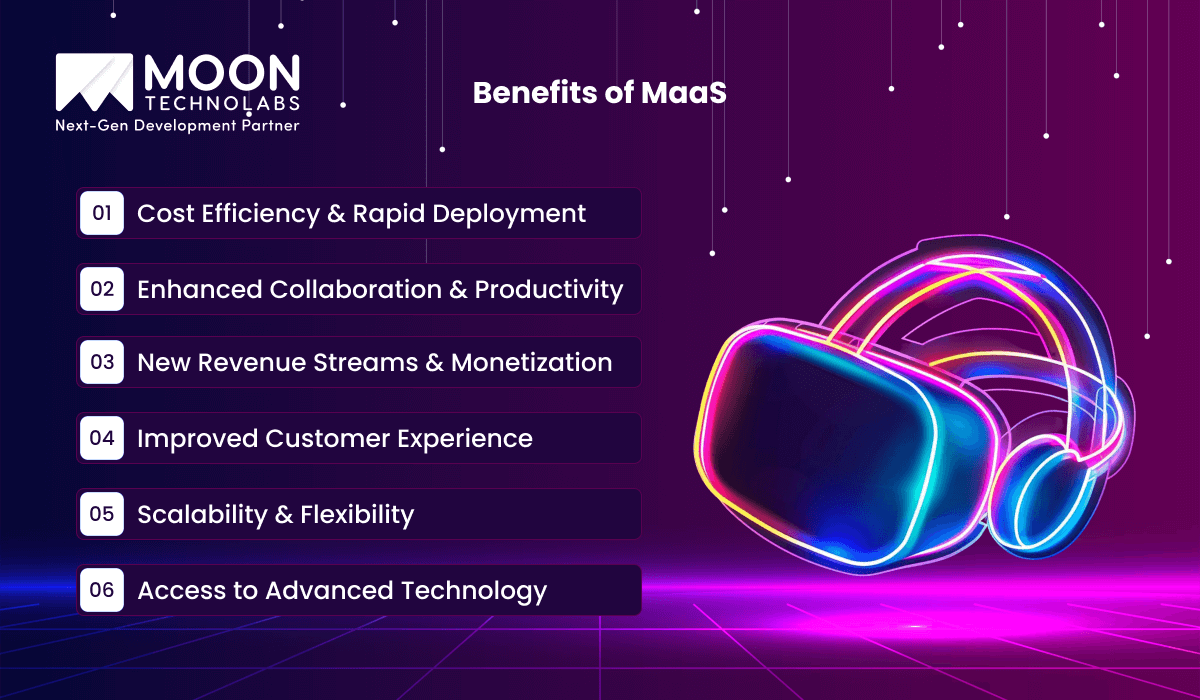
Metaverse as a service has emerged as a transformative platform that enables individuals and businesses to create, interact with, and monetize their own virtual worlds. With the rise of immersive experiences and the blending of physical and digital spaces, MaaS is shaping the future of technology and business. Here are some of the key benefits, have a look:
MaaS provides cost-effective solutions for businesses to create virtual environments, significantly reducing metaverse costs by eliminating the need to build infrastructure from scratch. This enables rapid deployment, accelerating time-to-market while cutting overhead expenses.
Through virtual environments, teams can meet and collaborate in real time, boosting productivity and engagement. Physical and digital spaces become more connected, making remote work more interactive and efficient.
Businesses gain access to new revenue opportunities, including virtual assets, digital storefronts, subscription models, and virtual events. These solutions allow enterprises to monetize digital experiences and tap into the expanding virtual economy.
Immersive virtual interactions, personalized avatars, and interactive events create richer customer experiences. Brands can engage audiences in more innovative and meaningful ways, strengthening relationships and loyalty.
Built for growth, the platform enables organizations to scale and adapt their virtual environments easily. Whether hosting large-scale events or expanding digital services, capabilities evolve seamlessly with demand.
Cutting-edge technologies such as AI, VR/AR, and blockchain enable interactive, secure virtual worlds that seamlessly connect digital experiences with real-world applications.
MaaS solutions are enabling businesses across sectors to create tailored, interactive environments that drive efficiency, enhance learning, and foster collaboration in ways previously difficult or costly to achieve.
MaaS enables businesses to create virtual environments for onboarding, employee training, leadership development, and safety simulations. Companies can conduct realistic scenario-based training for global teams without physical presence. This improves engagement, reduces training costs, and ensures consistent learning experiences across locations.
MaaS supports virtual consultation rooms, medical simulations, and remote therapy sessions. Healthcare providers can use engaging environments to support surge training, patient education, and rehabilitation programs. It enhances accessibility, improves collaboration among specialists, and allows safe, hands-on practice in controlled virtual settings.
Educational institutions can build virtual classrooms, interactive labs, and experiential learning spaces using MaaS platforms. Students can participate in simulations, explore complex subjects in 3D environments, and collaborate globally. This approach increases engagement and supports flexible remote or hybrid learning models.
Gaming companies use MaaS to develop scalable, persistent virtual worlds with real-time interaction. It supports multiplayer environments, digital assets, and user-generated content. By handling backend infrastructure and scalability, MaaS allows developers to focus more on gameplay innovation and user experience.
Industries leverage MaaS to create digital twins of factories, equipment, and supply chains. These virtual replicas allow real-time monitoring, predictive maintenance, and scenario testing without disrupting operations. This improves operational efficiency, reduces downtime, and supports data-driven decision-making.
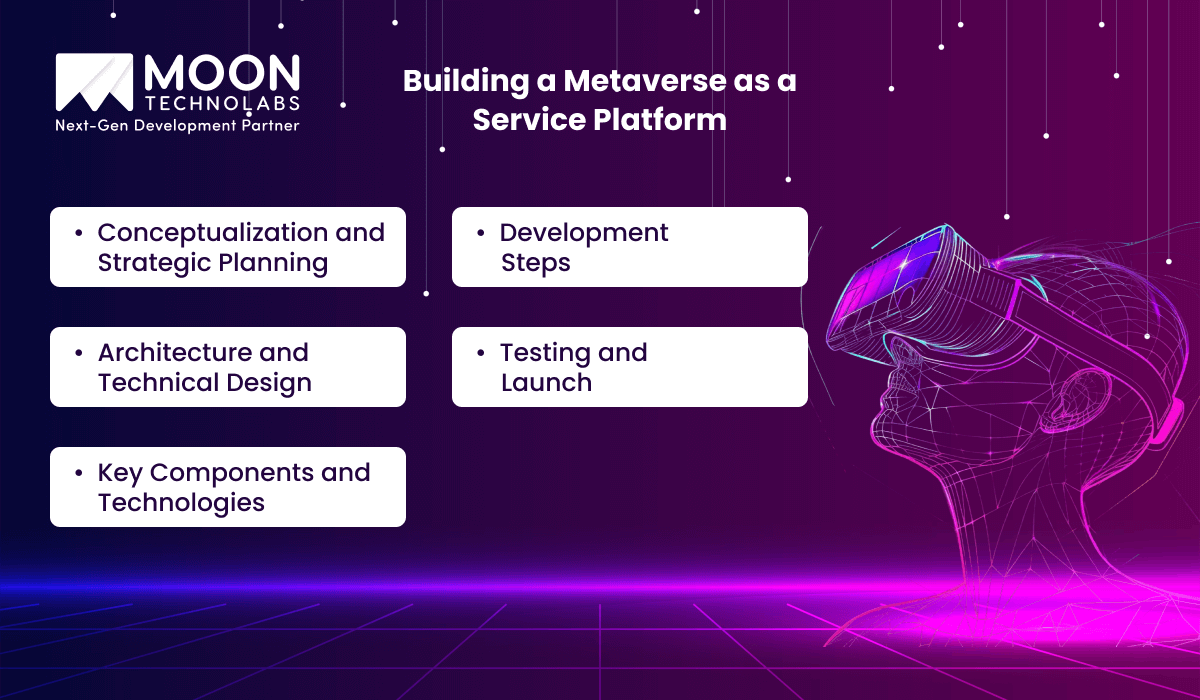
A Metaverse-as-a-Service platform enables businesses, creators, and organizations to build immersive virtual worlds without building the entire infrastructure from scratch. It combines cloud computing, 3D environments, blockchain, AI, and other technologies into a scalable service model.
Building a Metaverse as a Service (MaaS) platform starts with defining a clear vision, target audience, and primary use cases such as virtual collaboration, gaming, digital commerce, or learning. A sustainable revenue model, such as subscriptions, marketplace commissions, token economies, or enterprise licensing, must be established early.
Competitive analysis of platforms such as Meta Platforms, Roblox, Decentraland, and The Sandbox helps identify market gaps and opportunities for differentiation. A phased roadmap ensures scalable growth and long-term viability.
A MaaS platform requires a scalable, cloud-native architecture that supports real-time interactions. Typically built using microservices, the infrastructure layer handles cloud hosting and edge computing, while the platform layer integrates rendering engines, networking, blockchain, and AI services.
The experience layer delivers access through VR, web, and mobile applications. Secure identity management, interoperability standards, and high-availability deployment are critical to ensure performance, security, and seamless cross-platform experiences.
Core technologies include 3D engines such as Unity and Unreal Engine for rendering and simulation, as well as blockchain platforms for digital assets and smart contracts.
Artificial intelligence enhances personalization and analytics, while XR devices enable engaging user experiences. Together, these technologies create a scalable and interactive virtual ecosystem.
Development begins with requirement analysis and MVP creation, focusing on essential features like avatars, communication, and virtual environments. Backend services, authentication systems, asset management, and payment integrations are then implemented.
Frontend applications are developed for VR, web, and mobile platforms, followed by the release of creator tools, SDKs, and APIs to support third-party development. Agile deployment practices ensure continuous updates and scalability.
Thorough testing covers functionality, performance under high user loads, and security audits, including smart contract validation. A beta launch gathers user feedback and performance data before full-scale deployment.
The official launch is supported by partnerships, marketing initiatives, and enterprise onboarding, while continuous monitoring and updates drive long-term platform growth and innovation.
Integration is a core driver of MaaS development, transforming immersive digital spaces into fully interconnected, enterprise-grade ecosystems. Instead of functioning as isolated environments, modern platforms depend on seamless connectivity with CRM, ERP, cloud infrastructure, IoT systems, and analytics tools.
This integration enables real-time data synchronization between physical and digital domains, supporting digital twins, remote operations, intelligent simulations, and collaborative work.
Through this connected framework, organizations can create virtual workspaces and training environments that integrate with existing enterprise systems. Unified identity management, synchronized access controls, and integrated workflows ensure secure, frictionless user movement across platforms while maintaining governance and compliance standards.
Integration also strengthens scalability and innovation. By leveraging APIs, cloud-native services, AI engines, and third-party applications, an ideal MaaS platform can expand capabilities without rebuilding its foundational architecture.
These metaverse bridges enable the integration of advanced technologies, such as artificial intelligence, blockchain-based identity solutions, and real-time analytics, directly into digital ecosystems.
Ultimately, integration positions MaaS platforms not as standalone virtual destinations but as strategic layers of digital infrastructure embedded within broader enterprise ecosystems, enabling long-term sustainability, operational agility, and measurable business impact.
Step into the next digital frontier with a trusted MaaS partner. We help you create scalable, secure, and immersive experiences that drive engagement and revenue.
Talk to Our MaaS Experts
Metaverse as a Service platform development enables businesses to build and manage virtual environments, NFT ecosystems, and experiences without building the underlying infrastructure themselves. Below are leading companies that adopt the MaaS model by offering scalable platforms, cloud infrastructure, and development tools to build and monetize experiences.
Propell provides blockchain-based MaaS solutions, including smart contract deployment, NFT integration, and DeFi capabilities. Its platform supports multiple blockchain networks, helping businesses quickly launch secure metaverse applications.
Touchcast delivers virtual campuses and branded metaverse environments. Its platform, MCity, allows organizations to host events, training sessions, and collaborative experiences in secure, cloud-powered virtual office spaces.
Lovelace World offers tools for creating and monetizing VR online experiences, NFTs, and blockchain-based applications. It focuses on simplifying the adoption of the metaverse for brands and developers.
The next phase of MaaS innovation is moving beyond hype-driven virtual worlds toward practical, scalable, and revenue-focused applications. Instead of consumer novelty, the focus is shifting to enterprise value, AI integration, interoperability, immersive commerce, and subscription-based platform ecosystems. Here’s what that evolution looks like:
Enterprise adoption is now the primary growth engine for MaaS. Organizations are deploying platforms for digital twins, predictive simulations, workforce training, and remote maintenance. Industrial leaders like Siemens and NVIDIA are advancing real-time simulation and AI-powered modeling to improve operational efficiency and reduce downtime.
This shift signals a transition from experimental environments to mission-critical infrastructure. MaaS is increasingly embedded into manufacturing, healthcare, energy, and logistics systems where measurable ROI, not entertainment, is the priority.
Artificial intelligence is becoming the intelligence layer of the metaverse. Instead of manually built static environments, AI now enables automated 3D world creation, intelligent virtual assistants, real-time translation, and predictive analytics.
Technology leaders such as Microsoft and Meta are integrating AI directly into collaboration tools and virtual ecosystems. The result is “invisible technology”, where users interact naturally while AI manages personalization, content generation, and workflow automation behind the scenes.
AI is transforming MaaS from a visual experience into a dynamic, adaptive system.
Early metaverse platforms operated in silos, with limited compatibility between platforms and ecosystems. The next phase emphasizes interoperability and open standards, enabling digital identities, avatars, and 3D assets to move seamlessly across virtual environments. For enterprises, this shift reduces vendor lock-in, improves system integration, and safeguards long-term digital investments.
As a result, MaaS is gradually evolving into a connected infrastructure layer, much like the web matured through standardized protocols that enabled global scalability and collaboration.
Commerce is becoming immersive and interactive. Brands are merging physical and digital touchpoints to create “phygital” experiences that enhance customer engagement.
Retail innovators are leveraging AR try-ons, virtual showrooms, and 3D configurators to help customers visualize products before purchase. These experiences increase confidence, reduce return rates, and generate actionable data insights.
In this phase, MaaS becomes a revenue driver rather than just a branding tool.
Early metaverse platforms operated in silos, with limited compatibility between ecosystems. The next phase emphasizes interoperability and open standards, allowing digital identities, avatars, and 3D assets to move seamlessly across virtual environments.
Emerging technical standards are enabling cross-platform compatibility by creating shared frameworks for engaging experiences. For enterprises, this reduces vendor lock-in, simplifies integration with existing systems, and protects long-term digital investments.
As a result, MaaS is evolving into a connected infrastructure layer, much like the web matured through standardized protocols that enabled scalability, accessibility, and global collaboration.
Moon Technolabs takes a future-focused approach to MaaS platform solutions, helping businesses accelerate metaverse adoption through scalable, secure, and engaging digital ecosystems.
We design and develop customized platforms that seamlessly integrate advanced technologies to create interactive virtual worlds tailored to specific industry needs. From strategy through consulting, development, and deployment, we ensure every solution is built to enhance user engagement, brand presence, and digital innovation.
With a strong emphasis on performance and usability, we help enterprises unlock new dimensions of collaboration through engaging workspaces and real-time interaction tools. Our MaaS solutions are designed to improve communication, training, customer experiences, and operational efficiency within dynamic digital environments.
By combining technical expertise with creative vision, we deliver powerful metaverse experiences that drive measurable business growth and long-term competitive advantage.
Our expertise in the metaverse can help you craft immersive, impactful experiences. Want to learn how we can enhance your brand’s presence?
Chat with Our Experts
Metaverse as a Service (MaaS) is reshaping how businesses create engaging digital experiences, offering a streamlined path to the metaverse without the complexity of building everything from scratch. As a leading metaverse development company, we provide scalable infrastructure, intuitive tools, and seamless integrations to help businesses quickly and cost-effectively enter the metaverse.
MaaS enables brands to focus on innovation and meaningful virtual connections, allowing them to stand out in an evolving digital landscape. The future of digital experiences is immersive, interactive, and powered by the metaverse, and we’re here to help you unlock its full potential.
01
02
03
04

Jayanti Katariya is the CEO of Moon Technolabs, a fast-growing IT solutions provider, with 18+ years of experience in the industry. Passionate about developing creative apps from a young age, he pursued an engineering degree to further this interest. Under his leadership, Moon Technolabs has helped numerous brands establish their online presence and he has also launched an invoicing software that assists businesses to streamline their financial operations.


Submitting the form below will ensure a prompt response from us.
We refine our expertise to deliver innovative business solutions.





500 N Michigan Avenue, #600, Chicago IL 60611
13500 Long Is Dr, Pflugerville, TX 78660, USA

C-105, Ganesh Meridian, S.G. Highway, Ahmedabad, GJ 380060


Ayse D.
Co-Founder France
“ I highly recommend Moon Technolabs as the quality of service is wonderful. We have hired this company to develop the product based on some complex & technical issues. We get the best quality services as compared with others in the market. Huge Thanks to Moon Technolabs as the team is always ready to give the solution all time.”

Justin G.
Founder & CEO USA
USA“ Moon Technolabs is a pioneer in the WebRTC based project as they have fixed complicated segments of the module by fulfilling different product lines by providing 24X7 customer support. We really recommended Moon Technolabs as they are able to develop products as per the module deadline and project timeline.”

Flavio S.
Founder & Managing Director Germany
“I am happy to recommend Moon Technolabs for their app development services. They successfully developed apps for me, and I am highly satisfied with the overall outcomes. The development team has swiftly addressed the issues with responsive and effective communication to understand the requirement quickly and actively resolve the back-and-forth problems that arose...”

Jay M.
Founder & CEOUSA“Moon Technolabs is the best company that provides advanced apps and websites development services in the USA and Europe. I am a newbie to develop my app with an external team. I am really happy to work with them as I am not that much mobile apps user. Here, the team and specially the CEO of Moon Technolabs helps me to let me know about the benefits of my app to generate revenue....”


Our Offices
India
C-105, Ganesh Meridian, S.G. Highway, Ahmedabad, GJ 380060USA
500 N Michigan Avenue, #600, Chicago IL 60611Contact Information


