
 Total Views: 168
Table of Content


Blog Summary:
This blog on Managed vs Co-Managed IT Services looks into the differences and similarities between the two. We’ve defined both service models, provided an in-depth comparison, and weighed their respective pros and cons. Read on to find the ideal IT support solution for your business.
Table of Content
In the world of business technology, a simple truth often gets ignored: one-size-fits-all IT solutions rarely fit anyone well. The choice between Co-Managed IT and traditional managed IT services (MSP) isn’t just about outsourcing. It’s about defining the exact support your unique business needs. We understand that your existing IT team, budget, and strategic goals demand a custom approach.
Are you ready to stop settling for cookie-cutter solutions? Let’s dive into the clear pros and cons of both models to help you tailor your perfect IT partnership.
Managed IT Services involve a business outsourcing its information technology (IT) management and maintenance to an external company, known as a managed services provider (MSP). This strategic decision enables businesses to delegate oversight and operation of their IT infrastructure, applications, and processes to specialized external experts.
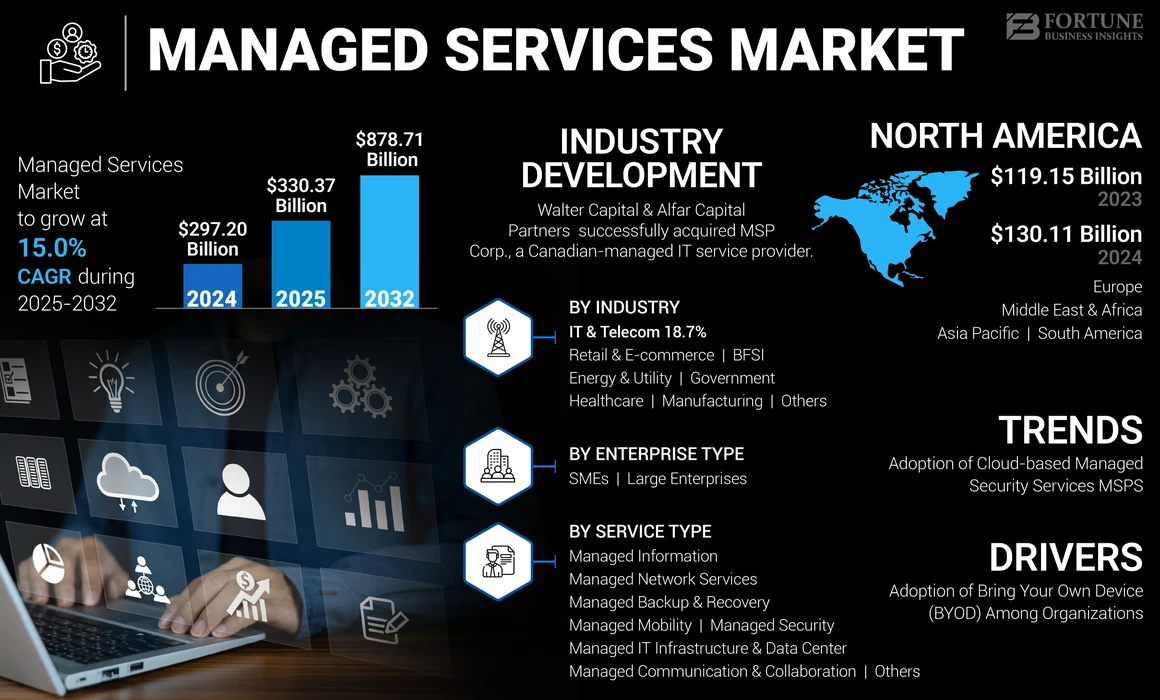
Research by Fortune Business Insights suggests that the global market for managed IT services was valued at $297.20 billion in 2024 and is projected to grow significantly, reaching $878.71 billion by 2032. These figures underscore the essential role managed services play in supporting organizations across various industries.
Co-Managed IT Services is a collaborative partnership that joins an external IT provider with a business’s internal IT department. Instead of completely replacing or outsourcing your IT operations, co-management strengthens your existing team by adding expertise, resources, or specific technical services.
We have compiled a brief comparison of Managed IT Services and Co-Managed IT Services. Check out the table below:
| Feature | Managed IT Services | Co-Managed IT Services |
|---|---|---|
| Ownership and Control | Low. The external provider assumes full control and accountability for all outsourced IT operations and strategy. | High. The organization’s internal IT team retains control over key strategic decisions and daily operations, with the MSP acting as an extension. |
| Cost Structure | A fixed, predictable monthly or annual fee that covers a comprehensive set of services. | Generally, it is more flexible and potentially lower overall, as it covers only the specific outsourced services, projects, or staff augmentation. |
| Scalability and Flexibility | Highly scalable to meet business growth, but the services are standardized and offer less flexibility outside the defined package. | Highly flexible and customizable, the organization can easily scale external support up or down to fill specific resource or skill gaps as needed. |
| Customization Options | Lower. Services adhere to the provider’s standardized processes and toolsets for optimal efficiency. | Higher. The partnership is tailored to complement the internal team’s strengths and fill specific weaknesses or resource needs. |
| Level of In-House IT Involvement | Minimal to None. Ideal for organizations with no or very small in-house IT staff, seeking a fully outsourced solution. | High. Requires a well-established internal IT team that collaborates actively with the MSP on tasks, strategy, and decision-making. |
Whether you’re considering managed or co-managed IT services, our specialists will help you design the perfect strategy for your unique business needs.
Get in Touch
We will now highlight the distinct differences between managed and co-managed IT services, including partnership, responsibility, control, and cost structure. The ideal choice depends heavily on a business’s existing internal IT capabilities and strategic goals.
Managed IT Services: This is a fully outsourced service model. The managed service provider (MSP) assumes full control of the client’s IT infrastructure, serving as the de facto external IT department. The client has minimal involvement in day-to-day operations.
Co-Managed IT Services: A hybrid model that combines the best of both worlds. The MSP acts as an extension of the internal IT team. Responsibilities are clearly delineated, with the internal team often handling daily tasks, line-of-business applications, and on-site presence.
At the same time, the MSP fills specific needs, such as 24/7 monitoring, specialized security, or project-based work.
Managed IT Services: Operates on a fixed, all-inclusive monthly fee. It offers predictable costs for comprehensive coverage, making budgeting straightforward. It eliminates the overhead of hiring, training, and retaining a full internal IT staff.
Co-Managed IT Services: Pricing is generally more variable and modular, based on the specific services the internal team requires. It is less expensive than fully managed IT, but the total IT budget must still account for the salaries and overhead of the internal IT staff, as well as the MSP fees.
Managed IT Services: The MSP holds primary responsibility and accountability for ensuring robust security measures and meeting regulatory compliance requirements, including HIPAA, GDPR, SOC2, and others. They proactively manage firewalls, patch management, threat detection, and audits.
Co-Managed Services: In this model, responsibilities are shared between the parties. The MSP typically brings advanced tools and niche expertise that the internal team may lack.
It enables the business to stay ahead of complex threats and evolving compliance requirements. The in-house team is responsible for enforcing day-to-day user-level security policies.
Managed IT Services: The MSP utilizes its own comprehensive suite of proprietary and licensed tools for remote monitoring and management (RMM), professional services automation (PSA), ticketing, and security. The client gains access to cutting-edge technology without capital expenditure.
Co-Managed Services: The MSP shares its toolsets, such as advanced network monitoring and ticketing systems, with internal teams, empowering them to work more efficiently. This service model provides access to enterprise-grade tools that a business might not be able to afford on its own.
Managed IT Services: Provide complete, often 24/7/365 coverage for all IT issues. The service level agreement (SLA) is defined and fully executed by the MSP, ensuring consistent, reliable support around the clock.
Co-Managed IT Services: Support is a strategic augmentation. The MSP is engaged to cover specific resource gaps, such as providing a 24/7 help desk to take over after the in-house team leaves for the day, handling third-tier escalations for complex problems, or providing staff coverage during holidays and absences.
Managed IT Services: Ideal for SMBs that lack the budget or complexity to justify a full internal IT department. It’s also suitable for businesses that want to completely offload all IT burden to focus solely on core business functions.
Co-Managed IT Services: Best for medium to large enterprises that already have a functioning in-house IT team. It’s the right fit when internal staff are overstretched, lack specific expertise, or need reliable assistance with routine maintenance.
Managed and co-managed services share several key similarities. Both leverage the expertise of an external provider to enhance a business’s IT operations. Let’s have a look at it in detail:
Both models typically include 24/7 monitoring of the network, servers, and systems, along with routine maintenance like patching and updates, to prevent issues before they cause downtime.
Both models place strong emphasis on cybersecurity, often involving robust security software, threat detection, compliance monitoring, and disaster recovery solutions.
Both managed and co-managed services provide access to a broader, more specialized pool of IT professionals and advanced tools than a single organization can afford or retain in-house.
A central goal for both service types is to ensure high system availability, efficiency, and rapid problem resolution, minimizing business disruption and its associated costs.
Both typically offer some level of IT consulting or strategy to help align the technology infrastructure with the business’s overall goals.
The managed IT services model is a strategic decision for businesses seeking to improve their technology infrastructure and operational efficiency. This approach offers a range of advantages, from enhanced security to cost savings.
However, there are also potential downsides, such as a loss of direct control over IT functions. Let’s explore the key benefits and drawbacks of managed IT services:
| Pros and Cons |
|---|
|
Co-managed services present a unique balancing act, and organizations need to weigh the potential benefits against the significant limitations.
| Pros and Cons |
|---|
|
When choosing between fully managed and co-managed IT services, the right fit depends on your business’s existing resources and needs. In managed IT services, you have to completely outsource your entire technology function to a third-party managed services provider.
In a fully managed model, the MSP acts as your full IT department, taking on 100% of the responsibility for maintenance, security, help desk, and strategic planning for a predictable monthly fee. The fully managed services model is best for small businesses or those with no in-house IT staff who want a completely hands-off approach.
In contrast, co-managed services establish a joint venture where an MSP works alongside your existing internal IT team. Your team maintains control and handles daily tasks, while the MSP fills specific skill gaps, provides specialized tools, offers 24/7 desk support, and assists with large projects.
The co-managed arrangement is ideal for mid-sized or growing businesses with an already capable in-house team that is overworked or needs niche-based external expertise to scale effectively. Ultimately, the decision is whether you need to replace your IT function (Managed IT) or augment it (Co-Managed IT).
Let our specialists assess your current setup and help you choose the most efficient and cost-effective service model for your business.
Get Expert Guidance
It can be challenging to choose an IT service model (fully managed or co-managed), especially when the IT services firm aims to optimize infrastructure. With fully managed services, you gain a worry-free outsourcing solution that ensures maximum convenience and access to deep domain expertise.
Conversely, co-managed services offer a flexible partnership that is perfectly suited for businesses with an existing internal IT department.
The choice between full outsourcing and a supportive partnership should be meticulously aligned with your organization’s specific operational needs, strategic goals, and current technological assets. Striking the right equilibrium between control, specialized skill, and budgetary efficiency is paramount when securing the services of a top-tier IT consulting partner.
Partner with Moon Technolabs to receive expert consultation services and customized IT strategies. Our versatile proficiency spans a range of service frameworks, enabling us to deliver a precise, tailored approach that meets your unique IT requirements, whether you need complete external management or a seamless co-managed collaboration.
01
02
03
04
05

Jayanti Katariya is the CEO of Moon Technolabs, a fast-growing IT solutions provider, with 18+ years of experience in the industry. Passionate about developing creative apps from a young age, he pursued an engineering degree to further this interest. Under his leadership, Moon Technolabs has helped numerous brands establish their online presence and he has also launched an invoicing software that assists businesses to streamline their financial operations.


Submitting the form below will ensure a prompt response from us.
We refine our expertise to deliver innovative business solutions.





500 N Michigan Avenue, #600, Chicago IL 60611
13500 Long Is Dr, Pflugerville, TX 78660, USA

C-105, Ganesh Meridian, S.G. Highway, Ahmedabad, GJ 380060


 France
“ I highly recommend Moon Technolabs as the quality of service is wonderful. We have hired this company to develop the product based on some complex & technical issues. We get the best quality services as compared with others in the market. Huge Thanks to Moon Technolabs as the team is always ready to give the solution all time.”

 USA
USA“ Moon Technolabs is a pioneer in the WebRTC based project as they have fixed complicated segments of the module by fulfilling different product lines by providing 24X7 customer support. We really recommended Moon Technolabs as they are able to develop products as per the module deadline and project timeline.”

 Germany
“I am happy to recommend Moon Technolabs for their app development services. They successfully developed apps for me, and I am highly satisfied with the overall outcomes. The development team has swiftly addressed the issues with responsive and effective communication to understand the requirement quickly and actively resolve the back-and-forth problems that arose...”
 USA
USA“Moon Technolabs is the best company that provides advanced apps and websites development services in the USA and Europe. I am a newbie to develop my app with an external team. I am really happy to work with them as I am not that much mobile apps user. Here, the team and specially the CEO of Moon Technolabs helps me to let me know about the benefits of my app to generate revenue....”


