
 Total Views: 4644
Table of Content


Blog Summary:
This blog explores the comprehensive process of hiring offshore AI engineers in New York, covering market size, costs, timelines, and hiring models. It highlights key roles, essential skills, advantages, and the hiring framework, providing actionable insights to optimize budgets and maximize ROI. Discover how to establish effective offshore AI teams for accelerated innovation and a competitive edge.
Table of Content
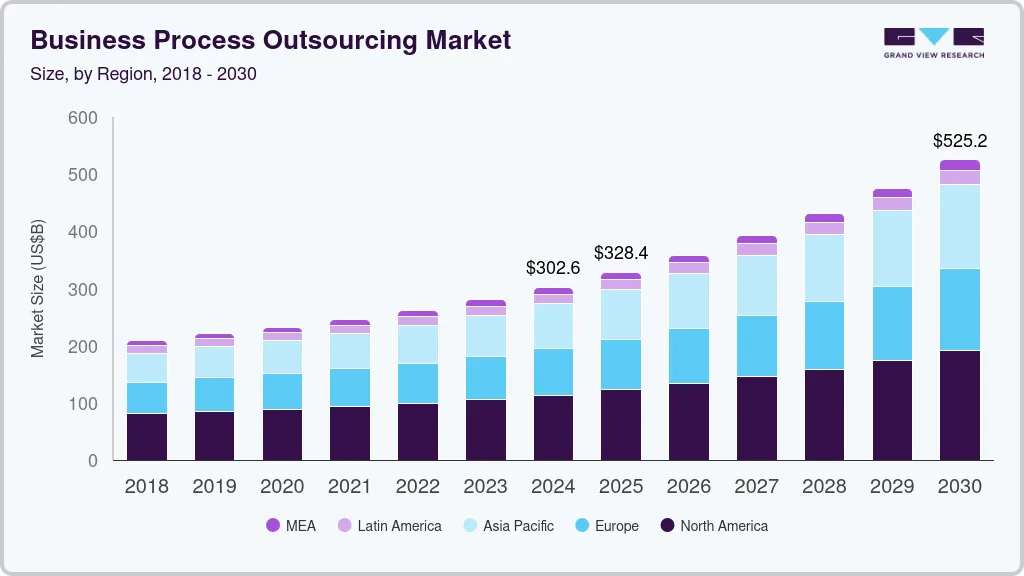
The demand for AI engineers in New York is experiencing a critical talent shortage, which is the primary reason driving companies to seek offshore outsourcing. Grand View Research predicts that the offshore development segment will account for over 45% of the global outsourcing market. In fact, North America alone contributes USD 46 billion to the offshore development market, underscoring the growing demand for offshore hiring models in the US.
With 4.2 million AI positions currently vacant worldwide, there are only 320,000 qualified developers available to fill them. By 2027, these numbers are expected to increase, reaching at least one in two unfilled AI positions, with demand potentially rising to 1.3 million positions.
Furthermore, the supply of professionals will also be significantly less than required, standing at only 645,000 professionals. Compared to local hiring, offshore hiring enables companies to save up to 80% on costs, helping to bridge the talent gap.
In this blog, we’ll dive deeper into how companies can hire offshore AI engineers in New York.
The AI talent gap will continue to grow if companies lack in-house AI talent expertise, which is a key barrier to the effective implementation of generative AI. According to Verified Market Research, the offshore software development sector is projected to evolve into a USD 283 billion market by 2031. The level of growth is an indication of an increasing share of global software projects in the years to come.
In New York, the daily job postings have reached 4000, exhibiting a very high demand for AI talent. New York is second only to California, which has a 6.4% AI talent demand, compared to New York’s 5.16%. New York has become one of the most competitive markets alongside San Francisco and California.
In the last 16 months, AI has become the topmost scarce technology skill, jumping from 6th place. More than half of IT leaders are currently facing an undersupply of in-house AI talent, particularly in the following areas:
For New York businesses, hiring offshore AI engineers is a highly cost-effective option, given that the salaries paid for local AI talent are significantly higher. On a surface level, the compensation for local New York AI engineers is premium, making the market highly competitive.
In contrast, hiring offshore AI engineers offers considerable cost advantages across multiple global regions. In Eastern Europe, the offshore hiring rates range from USD 40 to USD 80 per hour. Similarly, in Latin America, hourly rates range from USD 25 to USD 55.
Hence, when comparing annual costs, New York costs around USD 2,00,000 to USD 4,00,000. However, Eastern Europe is 50-60% cheaper, costing around USD 80,000 to USD 160,000.
The hiring timeline for offshore AI engineers is also significantly shorter than that for local hiring. Considering that in-house hiring for AI engineers typically takes 12-24 weeks, and hiring from a local recruitment agency takes up to 16 weeks, offshore hiring has almost half of these timelines.
Direct offshore hiring can take up to 12 weeks, whereas hiring from a platform typically takes between 6 and 8 weeks. However, choosing an offshore partner can cut the hiring timeline by up to 4 weeks. Offshore hiring also features an accelerated onboarding process, as teams follow a structured approach to ensure a seamless integration.
From the initial setup of 2 weeks and team integration of 4 weeks, the teams are able to deliver full productivity within 3 months.
Don’t let AI hiring delays stall your projects. Our offshore model delivers expert AI engineers quickly, optimizing your development cycle, reducing costs by up to 80%.
However, it’s essential to understand that the key roles and responsibilities of offshore AI engineers are crucial for building an effective team. For a higher project success, here are the core technical, data analysis, and business integration roles and responsibilities for offshore AI engineers:
Apart from the roles and responsibilities discussed above, there are specialized AI engineering roles that require essential technical and soft skill expertise. First, let’s explore the specialized roles:
Let’s take a look at essential soft skills and technical skills:
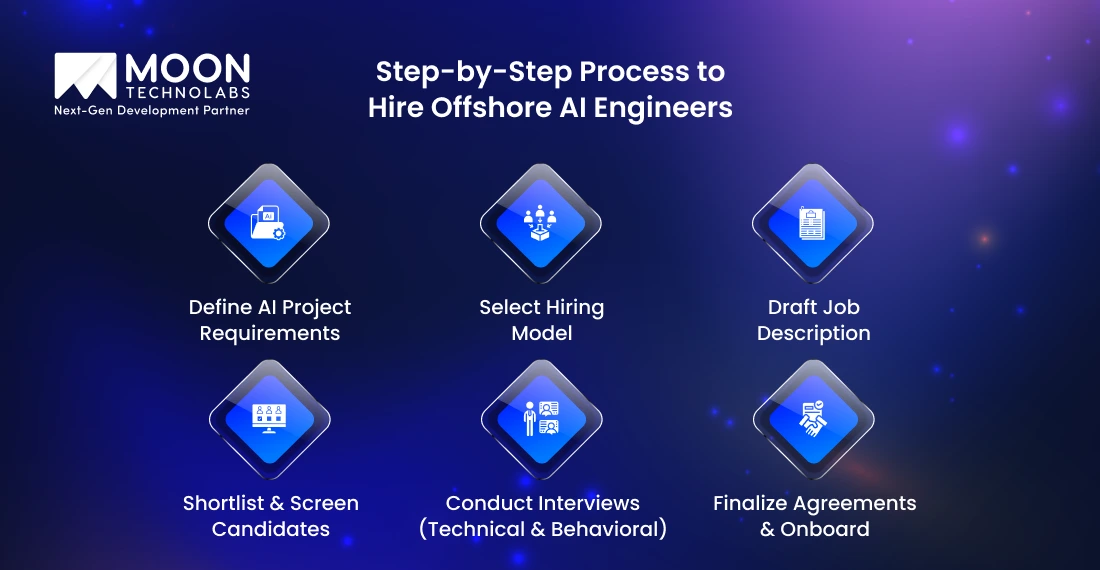
The hiring process of offshore AI engineers for custom software development is a systematic approach that ensures successful outcomes and effective team integration. Here’s how the process works:
The first step is to define project requirements and plan the strategic assessment. It involves conducting an audit of current AI capabilities and skill gaps. It helps build the project scope and establish parameters to save costs. You can then set a realistic deployment schedule and timeline.
The next step is to select the right hiring model. For this, it’s essential to evaluate offshore destinations based on multiple criteria. The most important criteria that companies must check are the availability of technical expertise in AI domains, alignment with time zones, cultural compatibility, and cost-effectiveness.
Based on that, you can choose from three hiring models: a dedicated long-term development team, staff augmentation to build existing teams, or outsourcing complete project management.
The third step is to create a comprehensive job description that includes technical must-haves and non-negotiables. These include expertise in programming languages, AI frameworks, and soft skills, as well as details on project scope, duration, and cultural expectations. Well-articulated roles attract stronger candidates and streamline the screening process.
The next step in the hiring process is to leverage vetted offshore platforms, agencies, or networks to source potential candidates. Hence, this step requires proper screening of resumes for skills and relevant project experience, with an emphasis on portfolios that match your requirements. Pre-screening assessments or coding tests can validate technical capabilities early in the process.
Arrange in-depth interviews that not only assess technical problem-solving with real-world scenarios or code reviews but also evaluate communication skills and cultural fit. Include both technical leads and key stakeholders to ensure alignment with your team’s working style and business values.
Negotiate terms that cover deliverables, intellectual property rights, confidentiality, and service-level expectations. It is essential to implement a robust onboarding program that encompasses project orientation, tool access, and other protocols to ensure a smooth integration and productivity.
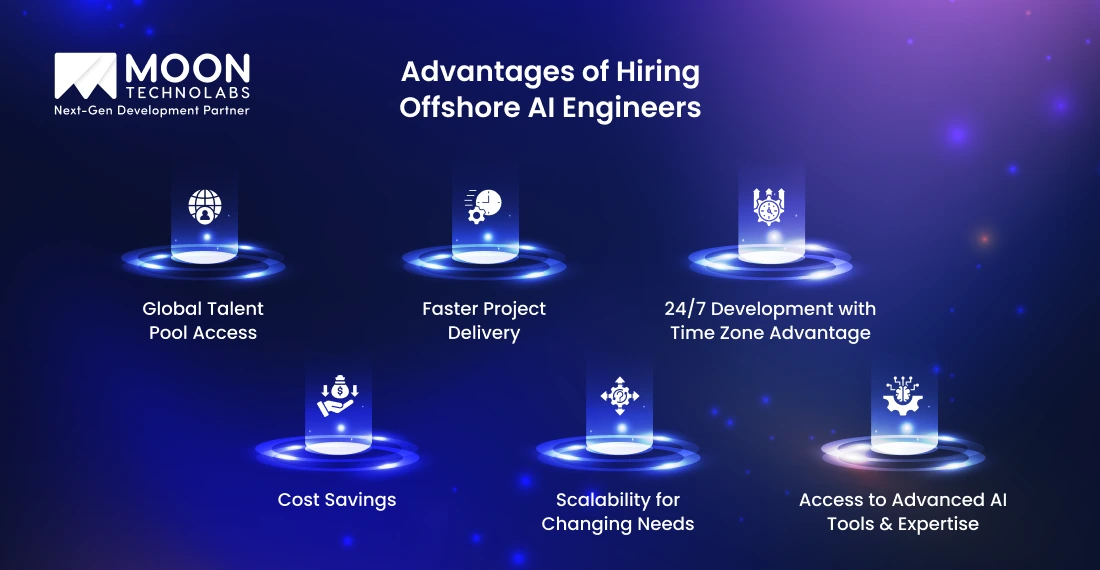
Beyond high cost savings compared to local hiring, offshore outsourcing of AI engineers provides a lot of strategic advantages that transform business operations:
Offshore hiring offers access to a diverse pool of expertise, comprising tens of millions of skilled developers worldwide. This global reach is particularly valuable for AI development, where specialized skills in emerging technologies are often concentrated in specific regions.
There are ample opportunities with flexible engagement models to gain significant cost savings based on your project. You can choose from dedicated teams, staff augmentation, or project-based models. For example, in India, there is significant large-scale AI development, particularly in machine learning and data science, with cheaper hiring models.
Hiring offshore AI engineers enables faster project delivery and shorter time-to-market through accelerated development cycles. Companies can mitigate risks by diversifying their development across different locations.
Offshore AI teams offer unprecedented scalability advantages. They can be scaled rapidly by adjusting team size quickly without long-term commitments. For example, in Eastern Europe, they can utilize advanced technical skills, computer vision, and NLP.
Offshore hiring leverages global time zones for continuous development. For example, in Latin America, aligning time zones with those of the US facilitates excellent communication.
Offshore hiring provides enhanced capacity for innovation. Companies can get access to fresh perspectives and specialized expertise in various AI technologies.
Here’s a strategic breakdown of the major hiring models for offshore AI engineers, plus a side-by-side comparison with in-house teams, freelancers, dedicated remote teams, and agency partnerships:
| Feature | In-House Team (NY/US) | Offshore Team (Global) |
|---|---|---|
| Cost | USD 1,76,000 – USD 3,00,000 /engineer/year | USD 40,000 – USD 1,20,000 /engineer/year |
| Control | Direct management, cultural alignment | Medium-high (with the right partner) |
| Scalability | Slower hiring, high overhead | Scale quickly, lower costs |
| Expertise | Local, but a talent shortage | Huge global talent pool |
| Time to Hire | 3–6 months typical | 1–4 weeks with agencies/platforms |
| Infrastructure | Employer-funded | Included in vendor costs |
Best for: Firms prioritizing high control, security, and on-site collaboration.
Hire independent AI engineers for specific, smaller tasks or rapid prototyping. Rates can vary from USD 30 to USD 150/hr depending on region and expertise.
Pros:
Cons:
Best for: Startups, rapid PoCs, or one-off features.
Assemble a consistent offshore team, often via an agency, acting as an extension of your internal staff. Rates can vary from USD 40 to USD 80/hr in Eastern Europe and USD 25 to USD 60/hr in India.
Pros:
Cons:
Best suited for Mid-to-large businesses requiring scalable, long-term AI development.
Engage with offshore agencies to deliver full-cycle AI projects using either a project-based or hybrid model. Rates can vary from project-based to retainer; typically 40–60% lower than those of US agencies.
Pros:
Cons:
Best suited for Enterprises requiring full-lifecycle solutions, those in regulated industries, or when internal management bandwidth is limited.
Our offshore AI teams offer premium skills at a fraction of local costs, enabling you to build cutting-edge solutions while optimizing budget and resources.
A thorough analysis of cost considerations reveals that hiring offshore AI engineers offers compelling advantages for New York-based companies. Whether they are looking for immediate expenditure or long-term value creation, their greatest advantage is a significant reduction in labor costs.
Let’s look at their average salary comparisons, factors that affect the labor costs, and some tips to optimize them:
In New York, the average salary of an AI engineer reaches approximately USD 225,000. The total compensation can often exceed USD 250,000 when factoring in bonuses and benefits.
In stark contrast, the average annual salary for an offshore AI engineer ranges from USD 40,000 to USD 80,000 in Eastern Europe, and USD 25,000 to USD 60,000 in India.
Here’s a tabular overview:
| Region/Nature | Average Salary | Salary Range |
|---|---|---|
| New York (In-House) | USD 225,000 | USD 180,000–USD 200,000+ |
| Eastern Europe (Offshore) | USD 60,000 | USD 60,000–USD 1,80,000 |
| India (Offshore) | USD 42,500 | USD 25,000–USD 60,000 |
| Latin America (Offshore) | USD 40,000 | USD 25,000–USD 55,000 |
| Philippines (Offshore) | USD 35,000 | USD 20,000–USD 50,000 |
The cost gap is even more pronounced when factoring in secondary expenses such as benefits, office infrastructure, and recruitment fees, all of which are generally absorbed by offshore vendors.
Let’s understand how these factors affect the costs:
| Cost Factor | Description & Impact |
|---|---|
| Base Salary | Driven by location (local wage, demand, scarcity) |
| Experience & Skill Level | Senior/rare AI skills increase rates |
| Hiring Model | Freelance, dedicated team, or agency partnership |
| Project Complexity | Advanced AI (e.g., NLP, vision) costs more |
| Team Size & Composition | Larger, specialized teams cost more but enable scaling |
| Engagement Duration | Long-term vs. short-term; longer contracts may get discounts |
| Time Zone/Communication Needs | Overlap or 24/7 support may affect pricing |
| Service Provider/Ecosystem | Top-tier agencies/platforms may charge a premium |
| Support & Maintenance | Ongoing operations, model updates, and infrastructure costs |
| Compliance & Security | Regulatory and IP protection requirements can add costs |
Effective cost management is essential to maximize the ROI of offshore AI engineering. The following tips address common budget challenges with practical solutions to help ensure lasting value and project success:
Clarify payment terms and cover onboarding and compliance in the agreement to avoid unexpected expenses.
Select engineers whose expertise aligns closely with your actual use case rather than always hiring senior-level talent.
Break projects into clear phases, requiring signoff and cost review before advancing.
Frequent check-ins and defined sprints help identify bottlenecks, keeping spending on track.
Allocate budget for updates, ongoing monitoring, and potential scaling, not just for initial development.
At Moon Technolabs, our expert AI engineers specialize in connecting New York businesses with top-tier offshore AI engineers, delivering cost-effective, scalable, and expertly managed AI development teams.
Leveraging a rigorous vetting process, we are a leading AI development services partner for offshore talent, ensuring access to skilled professionals with expertise in machine learning, NLP, computer vision, and MLOps. Our tailored hiring models range from dedicated remote teams to project-based agency partnerships, offering flexibility to suit diverse project needs and budgets.
With streamlined onboarding, transparent communication, and ongoing support, we can help your business accelerate its time-to-market while maintaining high-quality standards and compliance, enabling rapid innovation and confidence in today’s competitive AI landscape.
Beyond upfront savings, building an offshore AI engineering team enables organizations to realize substantial time and cost advantages. When companies partner with specialized agencies or platforms, offshore hiring models enable businesses to onboard qualified AI engineers within one to four weeks.
Compared to in-house recruitment, this is a significant improvement, which typically takes between three and six months to complete. This accelerated hiring translates into much faster project launches, considering the critical nature of time-to-market edge in the competitive AI sector.
01
02
03
04

Jayanti Katariya is the CEO of Moon Technolabs, a fast-growing IT solutions provider, with 18+ years of experience in the industry. Passionate about developing creative apps from a young age, he pursued an engineering degree to further this interest. Under his leadership, Moon Technolabs has helped numerous brands establish their online presence and he has also launched an invoicing software that assists businesses to streamline their financial operations.


Submitting the form below will ensure a prompt response from us.
We refine our expertise to deliver innovative business solutions.





500 N Michigan Avenue, #600, Chicago IL 60611
13500 Long Is Dr, Pflugerville, TX 78660, USA

C-105, Ganesh Meridian, S.G. Highway, Ahmedabad, GJ 380060


 France
“ I highly recommend Moon Technolabs as the quality of service is wonderful. We have hired this company to develop the product based on some complex & technical issues. We get the best quality services as compared with others in the market. Huge Thanks to Moon Technolabs as the team is always ready to give the solution all time.”

 USA
USA“ Moon Technolabs is a pioneer in the WebRTC based project as they have fixed complicated segments of the module by fulfilling different product lines by providing 24X7 customer support. We really recommended Moon Technolabs as they are able to develop products as per the module deadline and project timeline.”

 Germany
“I am happy to recommend Moon Technolabs for their app development services. They successfully developed apps for me, and I am highly satisfied with the overall outcomes. The development team has swiftly addressed the issues with responsive and effective communication to understand the requirement quickly and actively resolve the back-and-forth problems that arose...”
 USA
USA“Moon Technolabs is the best company that provides advanced apps and websites development services in the USA and Europe. I am a newbie to develop my app with an external team. I am really happy to work with them as I am not that much mobile apps user. Here, the team and specially the CEO of Moon Technolabs helps me to let me know about the benefits of my app to generate revenue....”


