
 Total Views: 5392
Table of Content


Blog Summary:
This blog provides comprehensive details on hiring the best DevOps Consultant tailored to your business’s needs and goals. We explain every important factor you need to consider when hiring them, including responsibilities, needs, skills, benefits, and scenarios. Start reading the entire blog now.
Table of Content
Businesses have been continually seeking the optimal approach to innovate, maintain reliability, and deliver speed across their IT operations. A DevOps consultant plays a leading role in this.
They enhance workflow and ensure that product delivery is more closely aligned with your business objectives. They help your business stay competitive with higher scalability, long-term operational success, security, and more.
Due to these advantages for business, the role of DevOps consultant has surged unprecedentedly. Fortune Business Insights predicts that the global DevOps market size will reach USD 14,969.9 million by 2026. This statistic reflects the growing need for these consultants in the business sector.

So, the question is, how to hire them? We will address the question in this blog by explaining various factors to consider.
DevOps consultants, known as technology specialists, help organizations transform IT operations and software development. They apply diverse DevOps tools, practices, and strategies to bridge the gap between software development and IT operations. Their focus is on delivering reliable, rapid, and automated pipelines.
They foster a team culture, enhance collaboration, and align DevOps initiatives with business goals, handling a wide range of responsibilities. Their deep expertise with Infrastructure as Code (IaC), CI/CD, and cloud platforms streamlines workflows.
Companies hire DevOps consultants to redefine their software development and IT operations, while promoting innovation and business growth. Let’s find out some other reasons as well.
Earlier, software development and IT operations teams often worked in silos, resulting in several issues, including delays and inefficiencies. However, the scenario is now completely different – DevOps consultants ensure that both teams are aligned to work together. They also improve collaboration between teams by improving communication, refining workflows, and more.
By implementing automation, CI/CD pipelines, and agile workflows, DevOps consultants accelerate software delivery. They help you release updates and features, thus matching customer expectations.
Manual processes often require vast resources, thereby increasing expenses, whether for testing, deployment, or monitoring. However, DevOps consultants help you save both resources and costs by implementing automation at every stage of the software development lifecycle. It minimizes operational costs while allowing you to optimize resource allocation.
DevOps enables your system to scale and manage complex workloads and higher traffic as your business grows. A DevOps consultant crafts a highly scalable DevOps architecture. To ensure reliability, they utilize a range of tools, including Terraform and Kubernetes, among others. This helps you be ready for future expansion even without any disruption.
Apart from their technical expertise, these professionals promote a DevOps mindset by focusing on accountability, collaboration, and continuous improvement. They create a culture that ensures teams stay motivated, innovation thrives, and projects succeed by aligning process, people, and technology.
A DevOps consultant is responsible for performing various roles and responsibilities to help the organization achieve faster product delivery and match the satisfaction level of clients. Let’s understand some of their major responsibilities;
A DevOps consultant starts their tasks by analyzing the existing infrastructure, which helps them discover any inefficiencies, bottlenecks, and gaps. Once they identify any of these issues, they address them promptly to ensure a smooth operation.
Another major responsibility of DevOps consultants is to create highly efficient CI/CD pipelines. These consultants offer more reliable and faster software releases by automating testing, integration, and deployment. It ensures more reliable and faster software releases while minimizing both downtime and human errors.
As a growing number of businesses transition to the cloud from their existing infrastructure, DevOps consultants help them make the transition seamlessly. They specialize in designing and implementing migrations while ensuring the entire process is smooth. To improve scalability, performance, and cost efficiency, they optimize cloud resources better.
Whether it’s Ansible, Terraform, or AWS CloudFormation, DevOps consultants utilize various tools to define infrastructure through code. It ensures deployment consistency, repeatability, and scalability, while minimizing manual configuration errors.
These consultants understand the importance of security and compliance and integrate the same into every stage of software development. To achieve success, they employ DevSecOps practices. They also ensure proper compliance with regulations, including HIPAA, GDPR, and PCI-DSS, with vulnerability scanning, automated checks, and secure configurations.
DevOps consultants also automate repetitive tasks and monitor systems to ensure optimal performance. They utilize various monitoring tools, automation frameworks, and other technologies to detect issues early, maintain uptime, and thereby enhance the overall reliability of apps and systems.
A DevOps consultant must possess a range of skills to perform their core tasks more effectively and add value to their clients, whether it involves implementing security practices, problem-solving, or effective communication. Let’s explore the top skills that every consultant must have.
A DevOps consultant must have a powerful technical proficiency in advanced tools and platforms. They should have enormous expertise in IaC, CI/CD pipelines, cloud environments, containerization, and more. With these skills, they automate, design, and scale infrastructure in the most effective way.
Apart from technical knowledge, analytical thinking and problem-solving are quite necessary. DevOps consultants must address deployment failures, system bottlenecks, scalability challenges, and other issues. They should have the ability to identify issues and implement the most effective solutions to provide continuous improvement and operational stability.
DevOps consultants must possess a thorough understanding of security and compliance. They need to embed DevSecOps principles into workflow, integrate security checks into CI/CD pipelines, and adhere to compliance frameworks.
You need to take into account that DevOps is much about culture than about technology. A consultant needs to minimize the gap between the operations and development teams by using clear communication, collaboration, documentation, and other effective methods.
A powerful set of interpersonal skills aligns the team perfectly towards common goals, minimizes conflict, and offers smooth project implementation.
DevOps consultants must possess essential skills to balance technical strategies with business goals effectively. Their recommendation should be useful in boosting IT efficiency while also aligning with fast time-to-market, cost optimization, long-term scalability, and other key objectives.
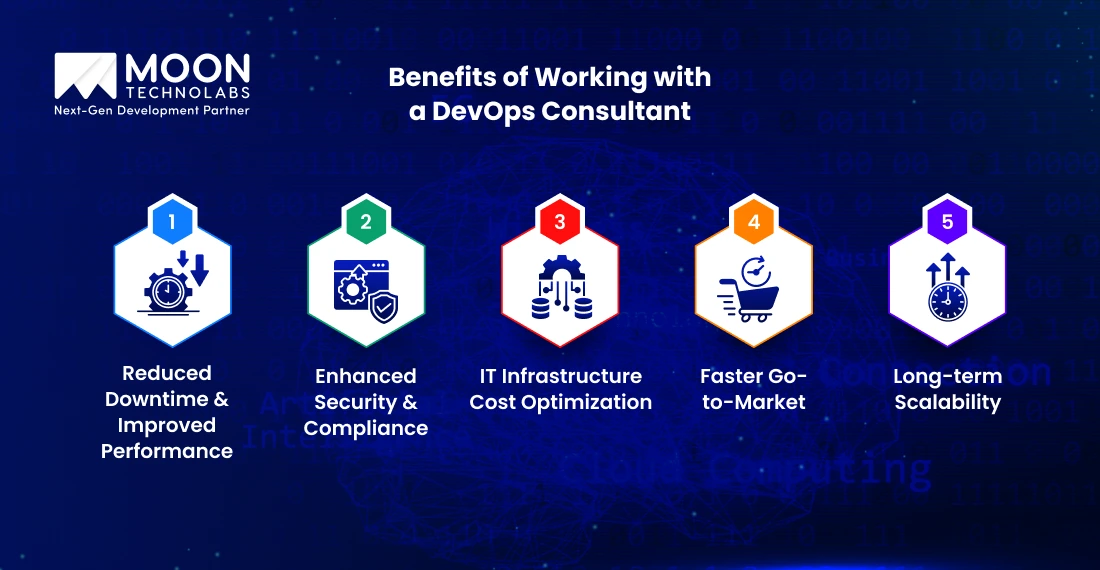
Working with a DevOps consultant provides numerous benefits, including minimizing downtime, optimizing costs, and achieving long-term scalability. Let’s understand some other benefits in-depth.
A DevOps consultant helps reduce downtime and improve system performance. They should be capable of implementing automated recovery, proactive monitoring, optimized workflows, and more to ensure fast response times and uninterrupted services. It leads to improved user experience and a trusted digital infrastructure.
A DevOps consultant can implement DevSecOps practices more effectively. They ensure the implementation of security in multiple stages of software development and deployment. Additionally, they also ensure compliance with regulations such as GDPR and HIPAA, among others. It minimizes the overall risk of costly penalties and breaches.
DevOps consultants first review your existing infrastructure to assess the current situation. Based on this, they offer recommendations like IaC, cloud cost optimization, automated scaling, and more. These strategies minimize unnecessary expenses while increasing resource efficiency, which offers businesses a powerful return on investment.
When it comes to speed, it’s highly important, especially in today’s competitive markets. They ensure the rapid delivery of updates and features by implementing test automation, CI/CD pipelines, and streamlined release cycles, among other measures. It enables businesses to respond quickly to customer demands, maintain a competitive edge, and capitalize on new opportunities, among other benefits.
DevOps consultants also serve organizations by creating scalable systems that can manage traffic spikes, increased workloads, future expansion, and other demands. They possess extensive expertise in container orchestration and cloud-native solutions, enabling businesses to remain future-ready and agile, even in the face of major disruptions.
You can hire a DevOps consultant in various situations, such as inefficient deployments, frequent downtime, a lack of automation, struggles with cloud migration, compliance gaps, and more. Let’s explore these in detail.
If you encounter situations such as frequent system crashes, sudden downtime, or outages, consider hiring a DevOps consultant. You need to understand that frequent failures disrupt operation, but also eliminate both customer trust and revenue.
Error-prone or slow deployment cycles tend to delay product releases, which indeed makes it tough to stay competitive. If your operation and development teams struggle to push updates flawlessly, DevOps consultants make the entire process smooth by utilizing CI/CD pipelines.
Since migration to a cloud platform often poses significant risks, including data loss, downtime, and cost overruns, cloud adoption remains of great importance for agility and scalability. DevOps consultants ensure cloud migration through optimizing resources, designing scalable architectures, leveraging IaC for higher consistency, etc.
With manual workflows, you will encounter numerous issues, including inefficiencies, limited scalability, and an increased risk of errors. DevOps consultants rely on automation tools for various tasks, including testing, infrastructure management, and deployment, as well as continuous monitoring solutions. It improves both performance and operational visibility.
Any security gaps or misconfigurations can lead to significant repercussions, including penalties, data breaches, and damage to reputation. DevOps has an enormous capability of integrating top-notch security practices into your entire workflow, which implements compliance checks while ensuring data integrity across different environments.
Choosing the right DevOps consultant requires considering several factors, including experience, portfolio, and more. Let’s understand these in detail:
First, review the portfolio and assess the consultant’s experience. Ensure they have a professional portfolio and a suitable background. They should possess adequate experience in cloud migration, CI/CD pipelines, automation projects, and other relevant skills. These reflect their capability of delivering real outcomes.
A well-deserving DevOps consultant should be aware of advanced platforms and tools. It includes various tools that are as follows:
Apart from leveraging the above tools, they must possess the ability to recommend the right stack tailored to match your business requirements.
The next important factor to consider is client feedback, which provides valuable information about the reliability and performance of consultants. When you read their detailed case studies and positive testimonials, they will help you know how the consultant can resolve challenges.
You need to know that every industry has unique security, compliance, and scalability requirements. Ensure the consultant has sufficient experience relevant to your industry, such as finance, healthcare, SaaS, or retail. They need to align perfectly with your business objectives and regulatory requirements.
Before hiring a DevOps consultant, it is essential to have a clear understanding of the pricing and associated charges. They generally charge based on hourly, daily, and project-based rates.
Once you are familiar with these pricing models, you can match your budget with the expected results as well. Ensure you clarify deliverables, scope, and support options to avoid any unexpected costs.
Be it part-time, full-time, or project-based, flexible engagement models are highly important. You need to select a consultant who adapts to your resources, timelines, and evolving requirements, ensuring a smooth long-term success and collaboration.
DevOps consultants generally charge by the hour, with rates starting from USD 50 per hour and increasing to or even beyond USD 250. The exact cost of hiring any consultant depends on various factors that are as follows;
We are an end-to-end DevOps development company that provides DevOps development and consulting services. We help you optimize your IT infrastructure to streamline your software delivery. Our experts specialize in cloud migration, CI/CD pipelines, security best practices, and automation.
We possess the necessary expertise to deliver tailored solutions that meet your specific needs. With a business-centric approach, we let organizations achieve reliability, efficiency, and long-term growth.
Hiring a professional DevOps consultant is a decisive step in transforming your business by accelerating delivery cycles, streamlining operations, and ensuring long-term scalability. These consultants help you minimize costs while ensuring compliance and improving performance.
Therefore, you need to proceed in the right way with proper planning to hire the right consultant. Collaborating with a reputable DevOps solutions provider, such as Moon Technolabs, enables you to access the right expertise, ensuring sustainable business success.
01
02
03
04

Jayanti Katariya is the CEO of Moon Technolabs, a fast-growing IT solutions provider, with 18+ years of experience in the industry. Passionate about developing creative apps from a young age, he pursued an engineering degree to further this interest. Under his leadership, Moon Technolabs has helped numerous brands establish their online presence and he has also launched an invoicing software that assists businesses to streamline their financial operations.


Submitting the form below will ensure a prompt response from us.
We refine our expertise to deliver innovative business solutions.





500 N Michigan Avenue, #600, Chicago IL 60611
13500 Long Is Dr, Pflugerville, TX 78660, USA

C-105, Ganesh Meridian, S.G. Highway, Ahmedabad, GJ 380060


 France
“ I highly recommend Moon Technolabs as the quality of service is wonderful. We have hired this company to develop the product based on some complex & technical issues. We get the best quality services as compared with others in the market. Huge Thanks to Moon Technolabs as the team is always ready to give the solution all time.”

 USA
USA“ Moon Technolabs is a pioneer in the WebRTC based project as they have fixed complicated segments of the module by fulfilling different product lines by providing 24X7 customer support. We really recommended Moon Technolabs as they are able to develop products as per the module deadline and project timeline.”

 Germany
“I am happy to recommend Moon Technolabs for their app development services. They successfully developed apps for me, and I am highly satisfied with the overall outcomes. The development team has swiftly addressed the issues with responsive and effective communication to understand the requirement quickly and actively resolve the back-and-forth problems that arose...”
 USA
USA“Moon Technolabs is the best company that provides advanced apps and websites development services in the USA and Europe. I am a newbie to develop my app with an external team. I am really happy to work with them as I am not that much mobile apps user. Here, the team and specially the CEO of Moon Technolabs helps me to let me know about the benefits of my app to generate revenue....”


