
Jayanti Katariya
Last Updated: September 18, 2025 Total Views: 4305
Table of Content


Blog Summary:
Gamification in apps can help you deliver engaging user journeys by using mechanics like purpose-backed goals, badges, leaderboards, and progress bars. This guide will explore the core principles like feedback, autonomy, challenge,s and player archetypes to help your team design seamless and rewarding user experiences for long-term growth and loyalty.
Table of Content
Ever thought why many of your users download the app, only to open it once or twice before moving away? Most design teams struggle to improve their retention levels. If you are also experiencing a similar issue, consider incorporating gamification into your user experience design.
Gamification in apps involves applying game mechanics, such as points, challenges, and leaderboards, to non-gaming contexts to enhance users’ motivation and engagement. Users are encouraged to interact and achieve within the application, making them more likely to return and engage further.
With gamification, you can transform ordinary user interactions into memorable moments. It can significantly uplift your app’s user engagement. Moreover, gamification integrates with your broader UX ecosystem, offering better usability, accessibility, and aesthetics.
If you want to create a more natural, purposeful, and aligned user experience design, implementing gamification is a good idea. This guide will help you with the tools and strategies needed for successful implementation.
Why do some apps become addictive while others end up fading after a single use? The answer lies in using gamification as a strategic design strategy. Gamification in apps can turn normal interactions into motivating and rewarding experiences for your users.
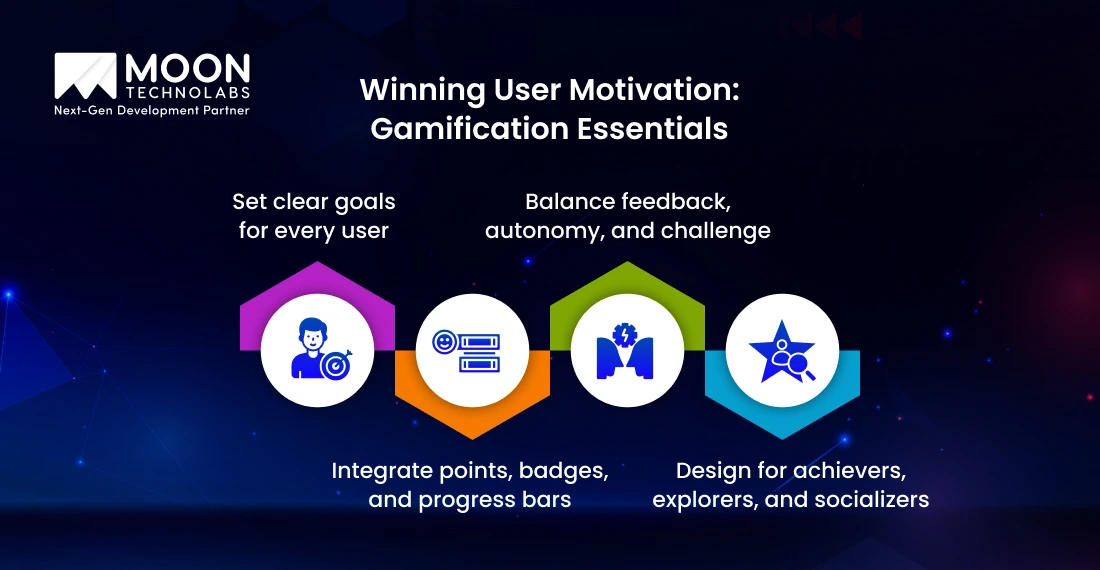
When you add meaningful goals for every gamification element, it will make sense to the users. Instead of adding random tasks, every goal of the application should be directly connected to the app’s actual purpose.
For example, Duolingo is an app that aims to help people practice their language skills daily. The user receives a motivational badge upon achieving a milestone, celebrating their progress. Badges have been translated into a nudge to motivate the users.
The diverse gamification mechanics include points, badges, leaderboards, levels, progress bars, and rewards. Points let your users track their efforts, badges appreciate milestones achieved, leaderboards instill competition and levels mark advancement.
Challenges keep the entire app development process exciting, and progress bars help visualize progress. Headspace has made headway with these mechanics. They used progress bars to make the progress of meditation feel tangible.
Instant feedback is an excellent way to get your users excited and keep them motivated. For instance, when Duolingo gives that ding sound on getting an answer correct, it builds momentum. The balanced risk/reward system is equally crucial. If the rewards seem easy to achieve, they can be hollow.
For example, Candy Crush mixes achievable with advanced levels to help the user stay on the app longer.
No two players are motivated in the same way. Some are happy with leaderboards, while others prefer personal growth. Your design team must recognize these archetypes before creating personalized experiences.
Strava has created a gamification model that appeals to athletes with the leaderboards. However, they also have progress tracking and badges that can encourage casual users.
When gamification in apps feels invisible while blending naturally into your users’ journey, you can call it a success. Trello uses progress checklists, while Spotify has a year-wrapped mechanic that is integrated into the core gamified design.
By now, your design team is aware that a great user experience goes beyond making the application usable. Your app must capture the user’s attention by incorporating the right gamification mechanics. A clear process would help your team integrate gamification into the product seamlessly while engaging the users for a longer period.
Your first phase is to define the actions and the goals behind them. What kind of actions are you planning for your users? Do you want them to log in daily to your application against specific rewards or share content frequently?
Your engagement objectives will help with UX design. In case you don’t have clarity on the objectives, you might create gamification that feels like fluff. That’s why you should ensure that every mechanic added to the application supports the bigger goals of your app.
Every user is motivated differently. Some are motivated by competitive elements, while others seek exploration, mastery of skills, or social connection.
You can utilize the defined research methods, such as surveys, interviews, and behavioral analytics, to gain a deeper understanding of your audience. This will help you plan mobile apps gamification better while removing the guesswork and assumptions from the process.
With clear motivations, you can align the game mechanics with the user’s journey. Including points can improve consistency, while progress bars help accomplish task completion. Adding challenges can lead to short-term activity, while leaderboards help encourage competition.
You should always look for elements that fit into the flow naturally, creating a seamless experience. If you reinforce the elements, you might create friction in the user experience.
Creating prototypes is an essential element of designing an app architecture to deliver great UI/UX designs that help you visualize the game mechanics. This will help you determine whether progress bars are effective in motivating users to take action. Similarly, it will help recognize if the challenges overwhelm users.
Based on the feedback you have gathered, you can refine the mechanics to ensure the entire design is seamless, fun, and motivating.
Monitor the session length, task completion, and return frequency after the application launch to assess the success of gamification elements. It will help you determine if you need to adjust rewards, add new gamification layers to encourage usage, or enhance challenges. It will help continuously improve the experience.
When you combine all these phases, you get a structured roadmap for gamified UX.
Every app is unique, and with the right game mechanics, you can delight your users. Our team will align the gamification strategy with your app’s purpose to deliver business outcomes.
By now, you should be aware that gamification is most effective when implemented through a thoughtful design process. Despite the right phases and strategy, it is the execution that defines your success. When implemented properly, a few best practices can ensure that your gamified app is enjoyable rather than forced.
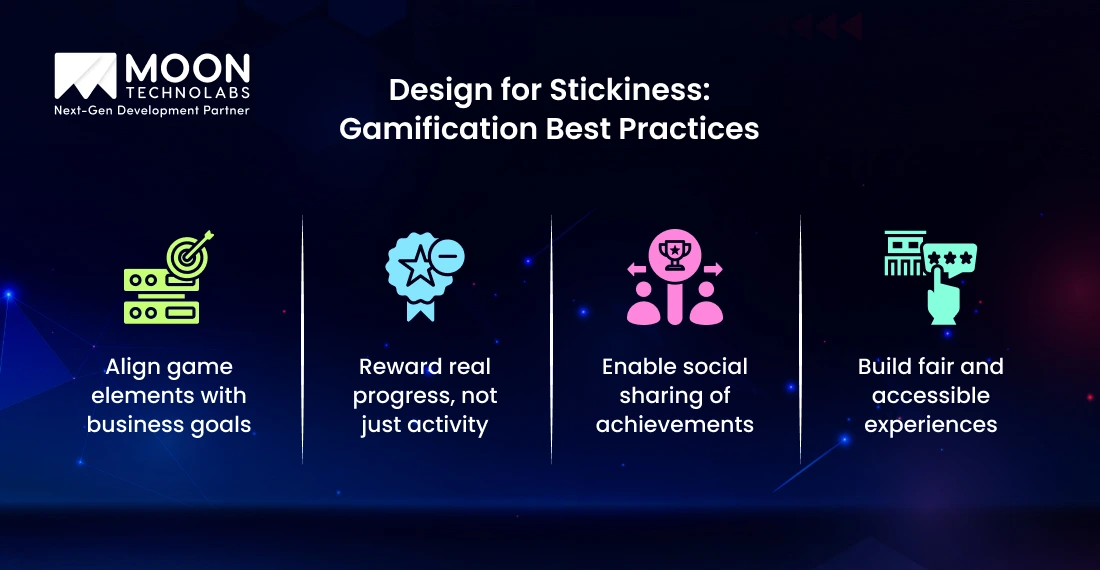
Gamification shouldn’t feel like you have added an extra feature or its extension. Whether you are planning levels, points, or rewards, it should be aligned with the app’s purpose and the business outcomes. The elements can risk becoming a distraction if they are not aligned.
If you include points or badges without purpose or meaning, you may face a failure in gamification. The users will not engage with such apps. You must ideate your gamification elements in a way that enhances the experience without overwhelming them.
Progress within the app should feel like growth to the users. Ensure that levels, tiers, and unlockable features are tied to real-world advancement. It would give your users a sense of accomplishment.
Immediate feedback helps the user stay engaged and motivated. For example, when you add a progress bar that moves or offer instant rewards for positive actions, it encourages the user to stay on the app longer.
Users love to share a win with the community. If you make achievements easy to showcase through leaderboards or challenges, you encourage competitiveness and foster a sense of community. When you allow users to share their badges, milestones, and challenges easily, they feel recognized and continue to engage.
Public achievements help create friendly competitions, build a sense of community, and foster a sense of belonging.
As a business, a shared win is equivalent to an organic promotion that allows you to attract new users. This also helps you reinforce loyalty among existing customers, thus increasing the retention rate.
You should make your gamification app inclusive. For this purpose, add rewards that are achievable by all user types. You should not put new or casual players at a disadvantage. When you have a fair system, it reduces frustration.
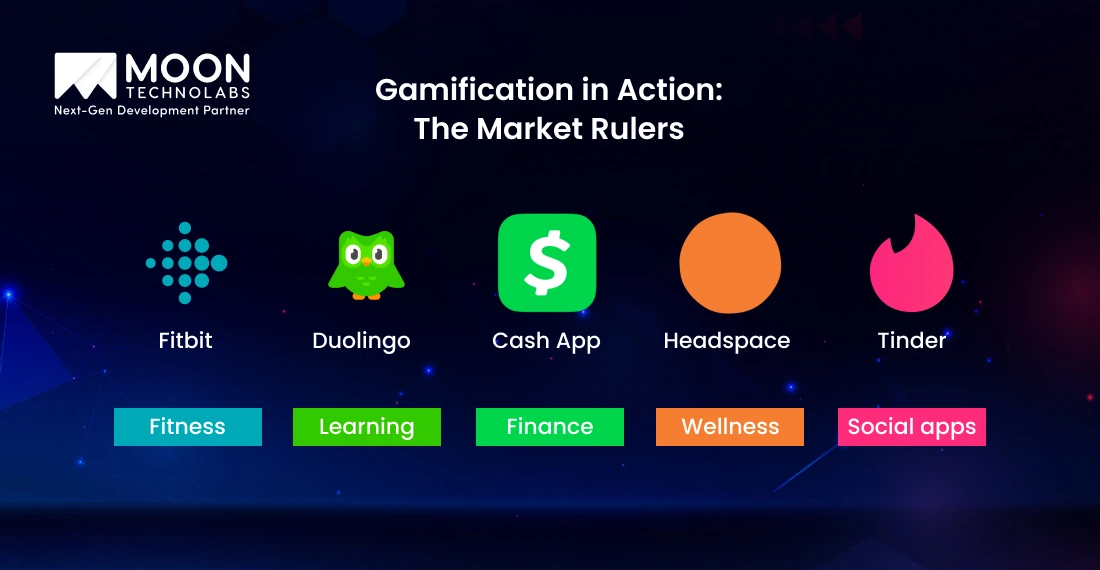
Let’s examine how some of the world’s most successful apps have effectively utilized gamification and incorporated these best practices into their strategies. They have made gamification a core driver of engagement and growth.
Motivation is the basis of a good fitness app. That’s why both these apps, MyFitnessPal and Fitbit, use streaks, progress bars, and achievement badges that help users stay consistent.
MyFitnessPal rewards its users for logging in daily to convert tasks into a habit. Fitbit utilizes step challenges and leaderboards to foster a community and make fitness a competitive endeavour.
The results are evident in the millions of active users on Fitbit, largely due to the community challenges they offer.
Cash App uses elements like referral challenges and small rewards to make money management engaging. They incentivize specific purchases and reward for consistent app use.
This playful approach motivates Cash App users and has resulted in a significant increase in their daily active users. The app ensures that financial tasks do not feel dull.
You Might Also Like:
Duolingo has mastered gamification. They have streak counters, levelling systems, and badges that motivate their users to come every day. They have combined immediate feedback with long-term progression to create an engaging learning platform. Duolingo has reported 40.5 million DAUs (51% YoY) and 116.7 million MAUs (32% YoY growth) in the last quarter of 2024.
Explore More Insights:
Headspace has demonstrated how meditation can naturally integrate with gamification elements. They have incorporated streaks, progress milestones, and gentle encouragement to make mindfulness a habit. The app has achieved a minimum churn rate through gamification.
Waze can convert your routine driving experience into a community-powered game. When users share real-time reports on police sightings, hazards, and traffic, they receive rewards. The interesting challenges and playful badges encourage more contributions. The leaderboards also establish a sense of collective achievement.
Tinder gamifies social discovery by converting the user’s dating into a swipe-based addictive experience. The app offers powerful and intuitive mechanics, including left- and right-swipes, instant feedback when matched, and streak momentum to enhance consistency. These elements facilitate habit formation among users, enhancing engagement and resulting in sustained daily usage.
These apps have successfully converted tasks into habits by incorporating common gamification elements, including streaks, challenges, competition, badges, and rewards. When you combine all these elements and align them with the broader purpose of the application, you enhance retention and increase DAU for the app.
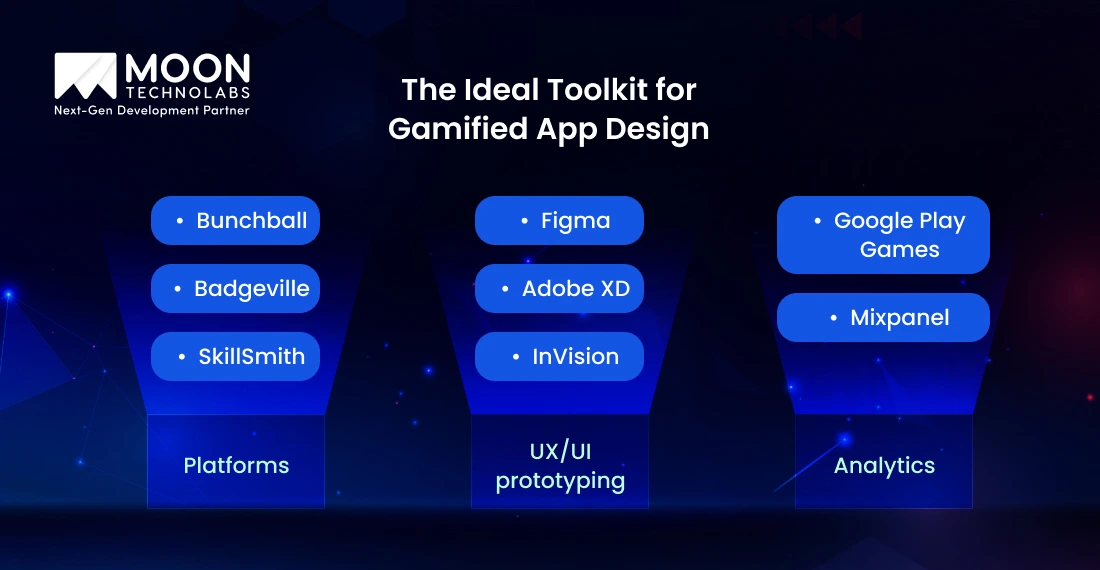
Great ideas require the perfect design tools and technologies for successful execution. You must use a blend of specialized platforms, prototyping tools, and SDKs in your tech stack to build engaging experiences.
The top platforms for gamification include Bunchball, Badgeville, and Skillsmith. They come with ready systems to include points, badges, leaderboards, and rewards. These platforms allow you to plug these elements into your app and customize them for goal alignment. You can quickly scale your apps while ensuring flexibility.
It is crucial to visualize and test your gamified elements within the app to understand the gamification user experience.. Figma, Adobe XD, and Invision allow design teams to create prototypes of progress bars, streak counters, and achievement flows in the app. These tools can simulate the user’s journey and help validate if the game mechanics feel natural.
You will note that SDKs and APIs are invaluable in enhancing the app’s functionality. The Google Play Games Services enrich your app with leaderboards, cloud saves, and achievements. You can integrate Mixpanel to track user interactions with gamified elements for immediate feedback. It can help you prioritize design and engagement without having to reinvent the wheel.
Gamification is a success when it delivers the desired results. That’s why you should include analytics tools that track metrics such as daily active users, session length, and retention rate. These metrics help analyze the impact of the gamified app. You can use these insights to adjust rewards or introduce new challenges that enhance motivation.
The entire stack, comprising these tools and technologies, can help your team move from concept to execution. It lets gamification be a measurable and scalable part of app development.
Let gamification transform your ordinary apps into habit-forming experiences, driving increased engagement and fostering a loyal user base for your business.
The gamification landscape is fast evolving. With increasing user expectations and technological advancements, you must stay vigilant for the latest trends poised to redefine gamified experiences.
The need for personalized experiences is replacing the one-size-fits-all approach to game mechanics. The future apps will include challenges, rewards, and progress paths that match the user’s preferences and behaviour. For instance, the fitness application of the future will be able to adjust the difficulty level based on the user’s individual performance.
The emerging technologies pave the way for newer and highly motivated applications. AI can predict what actually motivates your users and help with adaptive gamification in real-time. AR and VR lead to immersive app solutions.
It can convert your fitness app into an interactive quest, making it more engaging. Lastly, when you integrate with social platforms, your achievements are shareable, and this fuels community-backed engagement.
Gamified UX is becoming inclusive. As a result, design teams are including features that work for all user types, irrespective of their abilities. This step will ensure that progress, rewards, and challenges are fair and accessible to all. It will also help shift gamification beyond niche users.
Ethics and regulation will define the future of gamification. You must maintain transparency around rewards and ensure limits for manipulative mechanics. It is equally important to use safeguards when including a younger audience.
With all these trends, gamification will become inclusive, immersive, intelligent, and ethical.
Gamification is a powerful way to enhance engagement, retention, and loyalty for your mobile app or digital platform. Using streaks, rewards, leaderboards, and personalized challenges, you can convert the user interactions into meaningful experiences that delight users.
The real success of gamification lies in establishing a user-first design. You should confirm your decisions with genuine motivation, excellent integration, and accessibility to reduce distractions and improve the quality of engagement.
Moon Technolabs is a top UI/UX design services company that provides gamification services to help design teams and businesses incorporate these elements for optimal outcomes. Whether you want to create a gamified UX or refine your existing features, our team can guide you from strategy to implementation. To enhance app engagement, connect with our team to create gamified experiences that captivate your users.
01
02
03
04

Jayanti Katariya is the CEO of Moon Technolabs, a fast-growing IT solutions provider, with 18+ years of experience in the industry. Passionate about developing creative apps from a young age, he pursued an engineering degree to further this interest. Under his leadership, Moon Technolabs has helped numerous brands establish their online presence and he has also launched an invoicing software that assists businesses to streamline their financial operations.


Submitting the form below will ensure a prompt response from us.
We refine our expertise to deliver innovative business solutions.





205 N Michigan Avenue, #810, Chicago, 60601, Illinois, United States
13500 Long Is Dr, Pflugerville, TX 78660, USA

C/105 Ganesh Meridian, S.G. Highway, Ahmedabad, GJ 380060


Ayse D.
Co-Founder France
“ I highly recommend Moon Technolabs as the quality of service is wonderful. We have hired this company to develop the product based on some complex & technical issues. We get the best quality services as compared with others in the market. Huge Thanks to Moon Technolabs as the team is always ready to give the solution all time.”

Justin G.
Founder & CEO USA
USA“ Moon Technolabs is a pioneer in the WebRTC based project as they have fixed complicated segments of the module by fulfilling different product lines by providing 24X7 customer support. We really recommended Moon Technolabs as they are able to develop products as per the module deadline and project timeline.”

Flavio S.
Founder & Managing Director Germany
“I am happy to recommend Moon Technolabs for their app development services. They successfully developed apps for me, and I am highly satisfied with the overall outcomes. The development team has swiftly addressed the issues with responsive and effective communication to understand the requirement quickly and actively resolve the back-and-forth problems that arose...”

Jay M.
Founder & CEOUSA“Moon Technolabs is the best company that provides advanced apps and websites development services in the USA and Europe. I am a newbie to develop my app with an external team. I am really happy to work with them as I am not that much mobile apps user. Here, the team and specially the CEO of Moon Technolabs helps me to let me know about the benefits of my app to generate revenue....”


Our Offices
India
C/105 Ganesh Meridian,S.G. Highway, Ahmedabad, GJ 380060USA
205 N Michigan Avenue, #810, Chicago, 60601, Illinois, United StatesContact Information


