
 Total Views: 183
Table of Content


Blog Summary:
This blog examines how fintech app user experience (UX) serves as a critical business driver, transforming complex financial services into clear, intuitive digital products. It emphasizes the importance of striking a balance between usability, security, and regulatory compliance. The blog provides actionable insights on designing fintech apps with a user-centric approach, helping to build trust, improve engagement, and enhance customer retention in a competitive market.
Table of Content
The financial industry, which spans investments, insurance, compliance-heavy onboarding, and credit scoring, is complex and layered. Your users expect the Fintech systems to feel as simple as ordering food online.
They don’t see the backend integrations, risk models, or even regulatory hurdles. All that matters to them is whether the application is clear, fast, and trustworthy. That’s why, while developing financial or fintech apps, fintech user experience isn’t just another design solution; it is a business driver.
Your product and design teams must collaborate to simplify technical and financial language, strike a balance between usability and security, and implement smooth workflows to ensure compliance with regulations. All this while maintaining app speed and performance. Even a minor friction during onboarding and payments can frustrate users. According to TrustCloud, about 68% of the customers have abandoned their Fintech apps due to trust issues and technical barriers.
Effective UX can drive trust, customer retention, and compliance, giving your fintech product an edge in the market. This blog will explore how Fintech teams can convert the financial complexities into clear and scalable applications.
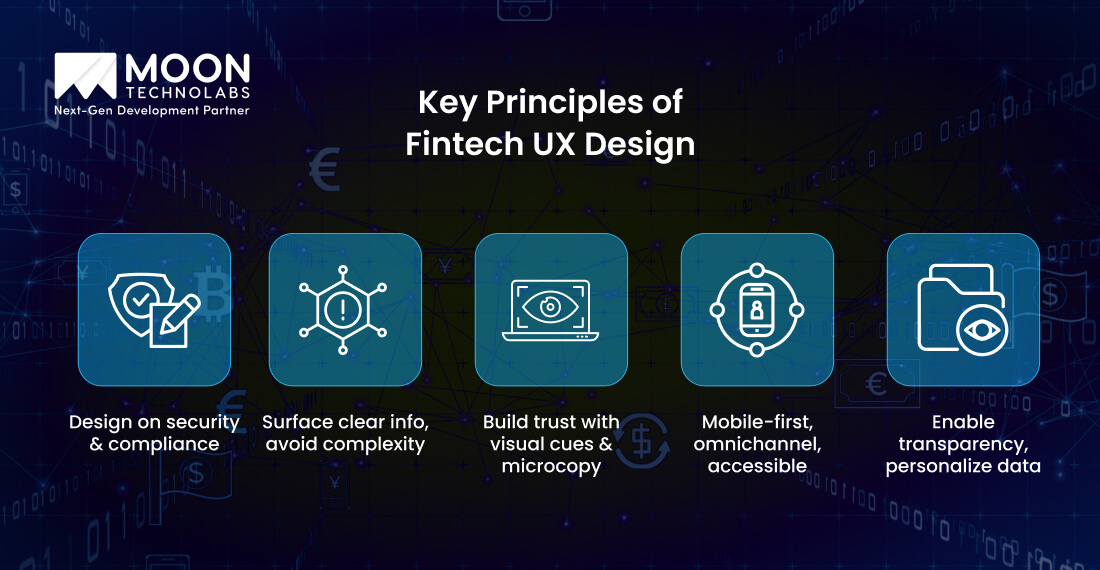
Great UX is at the core of your product’s success. You can create a secure, clear, and fully compliant solution that guides your users through complex financial processes. By prioritizing the design principles, your team can build apps that engage users to foster long-term loyalty.
When users feel their data and transactions are safe, they will use your app more often. However, you must also ensure that the rigid and confusing workflows do not slow down your users.
By integrating compliance into every step of the application, from KYC forms to multi-factor authentication, you can offer better security with minimal frustration. With thoughtful designs, you can prevent fraud and create a secure environment for your users, fostering loyalty and trust in complex financial activities.
Security designs that are visible and unobtrusive can turn compliance into a unified aspect of your user experience design.
Your users can get overwhelmed using your fintech application if you present all financial solutions, such as loans, investments, or payments at once. You can improve user focus on what truly matters to them by showing relevant information at the right time.
Use clear labels alongside step-by-step guidance and visible cues to help users make informed decisions quickly. Designing a custom mobile app with a well-structured and personalized UX is costly, but it improves user onboarding and simplifies navigating complex features.
Incorporating clarity allows your app to deliver immediate value, thus translating intimidating financial services into approachable experiences for your users.
Using visuals, language, and micro-interactions, you can communicate trust to your users. Add consistent branding elements, familiar icons and reassuring microcopy that allow your users to recognize the app flow better. It will help them understand why their actions matter and what to expect next in the flow.
Implement contextual tips, transparent explanations, and confirmation messages to prevent frustration and attrition. In every interaction, your user should feel in control and completely secure. If they can trust your application, they will stay longer. This will improve retention and help them engage with advanced features, while consuming financial information responsibly.
While your user may be using their mobile to access the application, they require a seamless experience across devices. By prioritizing mobile-first designs with responsive layouts, you can enable accessibility, compliance, and consistent branding throughout user interactions.
Whether you have designed the user experience of a fintech solution for desktop, tablet, or web, it should mirror the functionalities available on mobile. With omnichannel consistency, you can make your app feel familiar to your user across devices, building credibility. It will also help support diverse user behaviours, such as casual browsing, financial planning, and even task execution.
Users need actionable insights that they can use to improve their decisions. You must offer personalized recommendations, display their account or transaction data, and explain aspects such as credit scoring. This will help improve transparency in financial processes.
Personalization can enhance user engagement and increase the frequency of application use. Your users will trust you more when they are in control of the decisions.
Adding transparency and personalization to your fintech design can make your fintech product a reliable companion for your users, helping you differentiate from the crowded market.

Designing the user experience for a fintech app isn’t just about adding aesthetics; it’s about creating a seamless and intuitive interface. It involves a structured process where you blend users’ needs with business goals, compliance, and technical feasibility. Having a clear design process allows you to build a secure, usable, and scalable app that delivers value to your organization and its users.
Begin your UX design for a fintech application by consulting with the right stakeholders. Interview business leaders, compliance officers, and your tech teams to understand their priorities, regulatory requirements, and challenges.
These discussions help identify the must-include features, strategic app goals, and even roadblocks for the development. By capturing these insights in the early stages, you can align user needs with the product and reduce costly reworks during development.
Understand the people who will be using your fintech app to create a better user experience design. Build a detailed user and buyer persona to get insights into their behaviours, pain points, and even goals. You should map the task flows to key actions, such as onboarding, payments, and investments.
Using this information, you can create a user-centric fintech app design that simplifies complex tasks and provides an intuitive user experience.
Align your content and user flows with the business objectives. Map the information architecture to identify the most crucial user journeys. You should focus on the user paths, such as account creation, loan application, and transaction tracking, that may feel intimidating. With a structured information architecture, you can help users navigate efficiently while achieving your business goals.
Convert your ideas or concepts into tangible designs with wireframes and interactive prototype designs. All stakeholders, including product, UX, tech, and compliance teams, should collaborate to validate the concept and refine user flows.
When you visualize your designs in the early stages, you can identify the usability issues, address regulatory concerns and technical constraints. It helps save time and resources before development commences.
You must test your prototypes of the UX designs for fintech apps with the real users and internal stakeholders. Gather feedback from users, observe their behaviours while using the app, and measure task completion rate. Implement iterative cycles of testing and refinement to identify usability issues, validate the design decisions, and optimize the design.
Plan for your app’s launch with clear onboarding flows, feature rollouts, and a scalable design system. The onboarding should be smooth, while highlighting critical functionality without overwhelming your users. Incorporate a consistent design system for all devices and systems to create cross-platform coherence. This would also help reduce your maintenance efforts.
The fintech app UX design process continues even after the application has been launched. In the post-launch process, you must monitor analytics, incorporate user feedback, and identify behaviour patterns to determine improvement opportunities.
Conduct A/B tests that help optimize flows, refine the messaging, and even adjust features. Using continuous iteration can help ensure your app is relevant, efficient, and competitive.
With this structured UI/UX design process, you can deliver secure, intuitive, and fully aligned fintech apps that support usability and compliance.
Trust is crucial in designing the UX for a fintech app. While your users are concerned about protecting their money and data, they also need an app that is fast and intuitive. Your biggest challenge, therefore, is to incorporate security and compliance while delivering a user-friendly design.
Having robust KYC processes, such as multi-factor authentication and strict data privacy protocols, is crucial in UX design for fintech apps. However, that doesn’t mean you overload your users with steps and technical jargon that eventually lead to abandonment.
You must always streamline identity verification with login flows and transaction approvals for robust security that adheres to regulatory requirements. Ultimately, you must be able to create a sense of safety without slowing down your users or confusing them.
To create a great UX design for a fintech app, you require coordination between the product, tech, and legal teams. For example, compliance handoffs that occur without coordination can delay the process. Additionally, conflicting requirements can also cause issues in UX design.
That’s why you must prioritize transparent communication and early collaboration. Involving the different teams in the early stages can help you meet the regulatory requirements without causing friction for users.
Clear and visual indicators of security will build trust among your users. Adding verified badges, confirmation messages, and contextual microcopy can reduce their anxiety while using your app for financial transactions.
You should provide transparent explanations for why you need certain information from them. Help them know why these authentication steps are important. It will make them feel secure, and they will use your app with confidence.
You can balance friction and protection using a thoughtful UX design for fintech applications. This means simplifying the steps, offering guidance, and using intelligent defaults that reduce users’ efforts while protecting them.
For example, adding progressive disclosure allows users to consume complex information in a step-by-step manner. This would help them understand their actions and make better decisions. You must enable security in a natural and trustworthy fashion to improve engagement and retention.
A better UX enhances trust, engagement, and retention for your application. Fix friction in onboarding, dashboards, and transactions for faster actions, reduced churn, and tangible ROI.
Let’s Talk
Developing an incredible fintech software product is more than adding a few great features. It is about creating an approach that embeds the user’s experience throughout the product lifecycle. Enterprises that have prioritized UX have observed measurable improvements in user adoption, retention, and customer satisfaction levels.
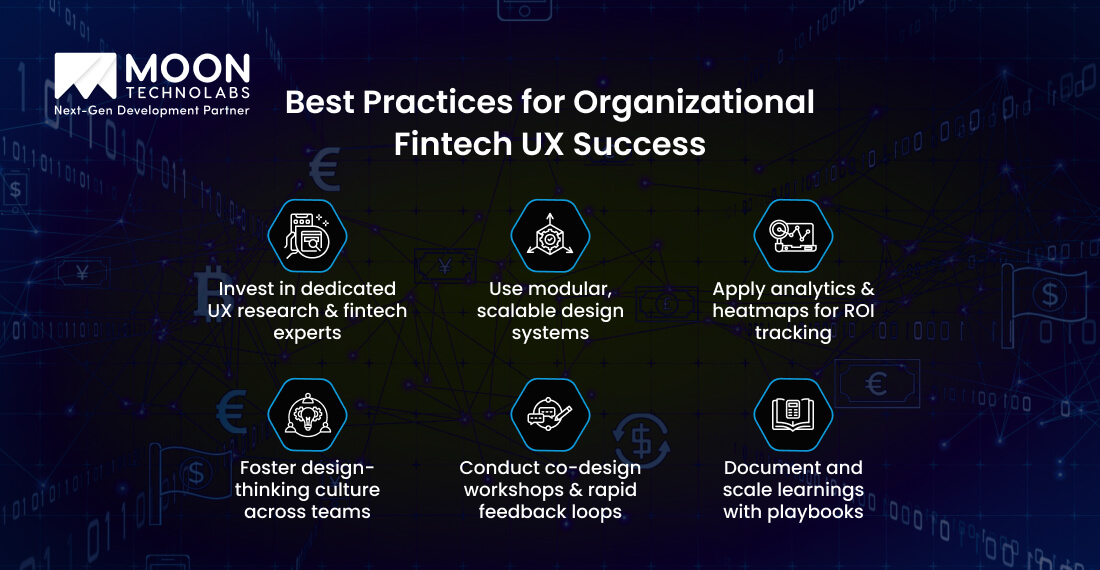
To design fintech apps, you must navigate the security needs, regulatory requirements, and complex user flows. Invest in UI/UX design and consulting services for your fintech app’s user experience to understand your users’ behavior and industry constraints.
With continuous research, you can identify pain points, prioritize features, and validate the design decisions. This will lay a strong foundation for your app, improving adoption and trust.
A modular design enables your team to reuse components across multiple products while maintaining consistency. Adding scalable design frameworks can enable faster iterations while supporting web and mobile channels. With this approach, you can reduce duplication, align with compliance frameworks and deliver a cohesive brand experience, even when you add products to your portfolio.
Having a data-backed design for your fintech application is crucial. Tools like heatmaps, session recordings, and funnel analytics help determine where users encounter friction and when they drop off. Tracking these metrics can help your team drive business outcomes, such as feature adoption, onboarding completion, and transaction success. The insights from these analytics help make decisions tied to ROI.
Cross-team collaboration is crucial for a successful fintech app design. You must encourage all stakeholders, like compliance officers, designers, engineers, and others, to adopt a design-thinking mindset. This involves having empathy for users, prototyping ideas, and validating them quickly. A culture where being user-centric thrives on experimentation and quick feedback loops ensures that UX is embedded into their design practices.
Involve your stakeholders and users early in the design stage to reduce rework. With co-design sessions, you can iterate on the prototypes, gather input from users, and validate the ideas in real-time. The rapid feedback loops also help determine pain points, clarify requirements, and ensure solutions meet the user’s needs and business goals.
With every UX project, you gain lessons for future financial product design and development. By maintaining a centralized repository of these design patterns, workflows, and playbooks, you can scale knowledge across products. The documentation can offer consistency, help onboarding new team members, and provide a reference to maintain UX quality even as your offerings expand.
Fintech is rapidly evolving, and your user experience design must keep pace with this movement. You must go beyond usability to deliver hyper-personalized and transparent experiences while building next-gen products. Here are a few trends that can help you build a deeper trust with your users.
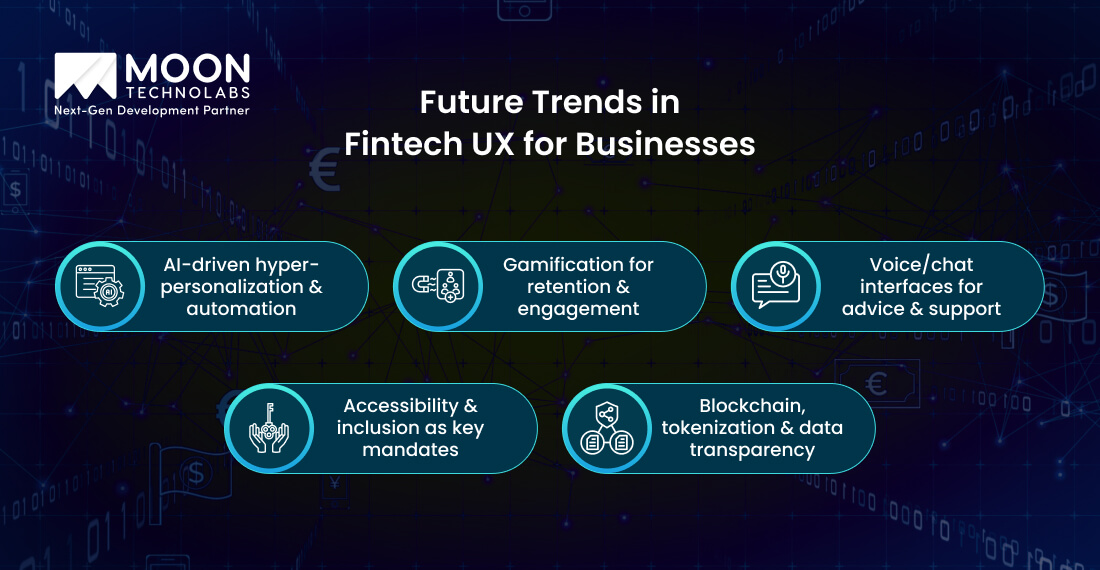
Artificial Intelligence can help customize products for users, thereby enhancing their experiences. From personalizing investment recommendations to automating budget-related insights, AI can provide personalized financial services, enabling users to access the right information at the right time.
Intelligent automation can streamline repetitive tasks, such as payments and account monitoring, to deliver actionable insights with minimal friction. Hyperpersonalization helps users with their unique financial needs, thus enhancing trust and boosting engagement.
Gamification trends help fintech apps encourage healthy financial habits and improve retention. From progress trackers to milestone notifications, they make tasks related to saving, investment, and loan repayment engaging for the users. Behavioural design strategies, such as nudges and feedback loops, can improve users’ decision-making and ensure they interact with the app regularly.
Conversational interfaces are transforming financial advisory. For example, voice commands and chatbots can provide real-time guidance to users, assist them with making payments, and checking balances. All this occurs without them having to navigate the complex menus. These interfaces can also enhance accessibility while reducing cognitive load on users to create a human-centered digital experience.
Accessibility is a regulatory requirement and business mandate. You must design your fintech application to be accessible to people with diverse abilities, making it usable for everyone. Inclusive design practices can also help you expand your user base while demonstrating your social responsibility. It will help you future-proof your product for emerging accessibility standards.
Blockchain and tokenization help you deliver transparent and trustworthy applications in multiple ways. Your users can securely track their transactions and verify data authenticity. It is particularly valuable in cases involving cross-border payments and digital assets. When you integrate these technologies into your UX design, you can enhance the app’s credibility while simplifying complex processes. You can even deliver clear insights to your users.
Collaborate with the experienced fintech design teams to get specialized design, compliance guidance, and iterative testing to improve onboarding and engagement, driving product success.
Schedule a Free Consultation
When you see UX principles in action, they become tangible. Let’s take a look at some of the leading applications and their approaches to UX redesign.
This application simplified international money transfers. With a redesign, they were able to streamline onboarding using progressive KYC, minimal form fields, and inline guidance for first-time users.
The transaction flows were optimized using clear fee breakdowns and real-time status updates. After the redesign was completed, the app saw an increase in engagement, and more users were able to complete their transfers. The churn rate automatically reduced. This app redesign taught how iterative testing with feedback loops between product, UX, and compliance teams can improve usability without compromising regulatory requirements.
This is a digital banking platform that revamped its dashboard to make financial insights immediately visible. This helped them provide the users with a unified view into their key balances and upcoming bills, along with actionable recommendations.
The onboarding time was shortened using pre-filled forms and contextual microcopy. User retention also improved, as customers could access information immediately. The collaboration across design, development ,and data analytics teams helped them align business goals with user-centric visuals to offer measurable ROI.
This app managed to improve its transaction flows and personalization features. Users can categorize their spending, receive budget alerts, and access financial insights tailored to their behavior. The gamified elements, along with interactive onboarding, encouraged users to complete their profiles and explore advanced features.
The engagement metrics increased substantially, resulting in higher app usage and increased feature adoption. This fintech app design is a lesson in how continuous iteration, combined with heatmaps and user behavior analytics, helps improve features while maintaining compliance with financial regulations.
They prioritized mobile-first and a clear UX redesign. They also introduced a step-by-step onboarding with guidance and verification checkpoints that combined security with speed. The dashboard provided a clear visual representation of the user’s savings, loans, and investments.
They introduced a simplified navigation with transparent alerts to improve users’ confidence in using the application and reduce the support queries.
Fintech design teams rely on design, compliance, and analytical tools to deliver a secure and intuitive application that can be scaled. With prototyping and collaboration tools like Figma, Sketch, and Invision, your designers, product managers, and developers work in real-time.
These tools support wireframing, interactive prototype development, and version control, thus offering fast iteration and cross-team alignment.
Your UX design team needs to understand the user’s behaviour and gather feedback, which is why they are investing in analytics and testing platforms. Hotjar, Maze, and Fullstory are among the most popular tools. Your team receives heatmaps, session recordings, and task-based tests that reveal friction points and offer design improvements.
To improve security and compliance, your team will focus on templates, guidelines, and design frameworks. This will ensure that authentication processes, KYC flows, and even sensitive transactions meet the regulatory needs.
Lastly, there are the playbooks for accessibility and financial regulations that offer practical guidance to enable inclusive design and adherence to industry standards. With these resources, your team can scale their efforts while maintaining consistency to deliver safe and user-friendly experiences to your users.
User experience isn’t just a design consideration; it is a strategic element that should be embedded into all stages of the fintech product lifecycle. You should enable a thoughtful fintech user experience design across onboarding, transaction flows, and post-launch optimization to get engagement and measurable business outcomes.
You can build an internal UX team by investing in the right researchers, designers, and cross-functional collaboration practices. Alternatively, you can partner with experienced fintech design teams to accelerate the adoption of best practices and ensure alignment with compliance.
Moon Technolabs is a leading fintech app design and development company with a proficient team of fintech research specialists, designers, and developers. Our team helps deliver scalable and user-friendly solutions that improve retention and strengthen your market position.
If you want to develop a fintech app that prioritizes UX to differentiate your business in the competitive landscape, schedule a free consultation with us.
01
02
03
04

Jayanti Katariya is the CEO of Moon Technolabs, a fast-growing IT solutions provider, with 18+ years of experience in the industry. Passionate about developing creative apps from a young age, he pursued an engineering degree to further this interest. Under his leadership, Moon Technolabs has helped numerous brands establish their online presence and he has also launched an invoicing software that assists businesses to streamline their financial operations.


Submitting the form below will ensure a prompt response from us.
We refine our expertise to deliver innovative business solutions.





500 N Michigan Avenue, #600, Chicago IL 60611
13500 Long Is Dr, Pflugerville, TX 78660, USA

C-105, Ganesh Meridian, S.G. Highway, Ahmedabad, GJ 380060


 France
“ I highly recommend Moon Technolabs as the quality of service is wonderful. We have hired this company to develop the product based on some complex & technical issues. We get the best quality services as compared with others in the market. Huge Thanks to Moon Technolabs as the team is always ready to give the solution all time.”

 USA
USA“ Moon Technolabs is a pioneer in the WebRTC based project as they have fixed complicated segments of the module by fulfilling different product lines by providing 24X7 customer support. We really recommended Moon Technolabs as they are able to develop products as per the module deadline and project timeline.”

 Germany
“I am happy to recommend Moon Technolabs for their app development services. They successfully developed apps for me, and I am highly satisfied with the overall outcomes. The development team has swiftly addressed the issues with responsive and effective communication to understand the requirement quickly and actively resolve the back-and-forth problems that arose...”
 USA
USA“Moon Technolabs is the best company that provides advanced apps and websites development services in the USA and Europe. I am a newbie to develop my app with an external team. I am really happy to work with them as I am not that much mobile apps user. Here, the team and specially the CEO of Moon Technolabs helps me to let me know about the benefits of my app to generate revenue....”


