
 Total Views: 89
Table of Content


Blog Summary:
This blog provides comprehensive information on ERP Software Development Costs. It discusses various details, including ERP implementation and maintenance costs, factors directly affecting ERP development costs, and more. Read the entire blog to prepare the budget easily for your next project.
Table of Content
The majority of growing businesses have recently encountered common pain points, such as manual workflows, disconnected systems, and scattered data. These keep them under constant pressure and push them to find the best way to improve their workflow, productivity, and ROI. ERP software development comes as the top solution and helps them overcome these scenarios.
The major advantage of implementing ERP systems for businesses is that they help automate their processes, centralize data, and improve efficiency. And they help businesses optimize resources across various industries such as HR, finance, operations, and supply chain.
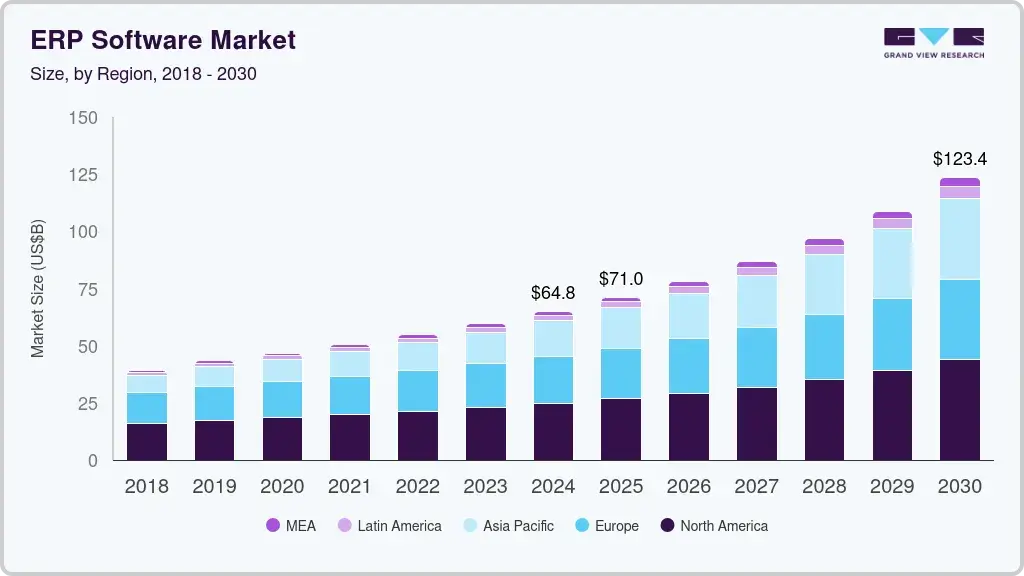
As a result, the adoption of ERP systems surged. Grand View Research reports that the ERP software market size is projected to reach $ 123.41 billion by 2030. It’s expected to grow at a CAGR of 11.7% from 2025 to 2030. The stat reflects the importance of developing ERP solutions.
So, you may be thinking about ERP software development costs, right? Well, it depends on many factors. We will discuss them and the related information in this post. So, keep reading.
While exploring the cost of ERP software development, you also need complete information on the overall expenses involved in its implementation. Let’s explore some of the most important types of ERP implementation costs:
The cost of software licensing depends on your choice of on-premises solutions, a cloud-based ERP, or a custom-built ERP. Licensing costs are charged on a per-module, per-user, or subscription basis.
In addition, integrating cutting-edge features such as CRM, analytics, and supply chain management incurs additional costs. In the case of custom ERP development, development cost replaces licensing cost. Though it offers greater flexibility, it also requires a higher upfront cost.
Infrastructure costs depend mainly on the ERP deployment model. On-premise ERP systems require vast investments in networking equipment, servers, security systems, databases, and more.
Besides, cloud ERP solutions minimize upfront infrastructure costs but also incur storage fees and recurring hosting costs. Organizations often need to boost network bandwidth, upgrade existing hardware, implement disaster recovery systems, or invest in data backup to improve performance and compliance.
When you integrate an ERP solution into your existing system, you need professionals with diverse skills to ensure the integration is successful. The following are some of them:
So, personnel costs generally include external consultant fees, internal team salaries, training, etc. The fact is that training your internal team is necessary to help them use the ERP system and boost your business’s productivity.
Even after successful deployment, ERP cost doesn’t end. Ongoing cost is a combination of expenses related to a variety of post deployment activities that are as follows:
Not to mention that regular updates are crucial for keeping ERP systems aligned with emerging and regulatory requirements.
Hidden costs are those expenses that are indirectly involved in ERP implementation. Some of these costs are as follows:
In cases of improper planning, user resistance, compliance requirements, process re-engineering, and more, costs are maximized. All you need to do is keep an eye on these expenses as soon as possible to create a realistic budget for ERP implementation and avoid any unexpected costs that could drain your budget later.
So, when you build your own ERP, you need complete cost details for each phase. Let’s have a complete breakdown of the ERP software development cost.
| Factors | Estimated Cost Range |
|---|---|
| Requirements Gathering | $3000 to $15000 |
| ERP Designing | $5,000 to $20,000 |
| ERP Development | $25000 to $100,000+ |
| Customization and integration | $15,000 to $40000+ |
| Data Migration | $10,000 to $25000+ |
| Quality Assurance (QA) | $4000 to $10000 |
| Deployment | $3,000 to $5000 |
| Training | $3000 to $10,000 |
| Maintenance and Support | $10,000 to $25000+ |
Let’s build a custom ERP solution that aligns better with your business workflow and performs seamlessly. We deliver high-end solutions to businesses.
Discuss Your Project with Experts
Though businesses often focus on ERP software development costs, they should also understand its maintenance expenses. Needless to mention, ERP maintenance costs account for approximately 10-25% of the overall ERP implementation cost per year. Let’s understand different types of ERP maintenance costs:
When it comes to infrastructure and hosting costs, these rely mainly on the ERP deployment model. Cloud-based systems include various costs, primarily recurring fees. These include storage, hosting, bandwidth usage, data backups, and more.
These costs tend to scale with the number of users and the volume of data. On the other hand, on-premises ERP systems require ongoing investment in hardware upgrades, servers, cooling, power, disaster recovery infrastructure, and more. Hybrid models combine both.
As the largest ERP maintenance cost component, ongoing support is crucial to flawless performance. It includes the following activities:
Support costs tend to increase with the number of modules, system complexity, integrations, and more. Be it user support or help desk services, they are important for reducing overall downtime and maintaining operational efficiency.
Security maintenance must not be compromised under any circumstances. The reason is that ERP systems can handle sensitive data. One needs to implement the following security practices to make the ERP system fully protected against any cyber threats:
In addition, many industries, such as finance, healthcare, and manufacturing, often handle confidential data. So, they require solutions that comply with HIPAA, GDPR, and others. Negotiating security or compliance can have serious repercussions. It not only exposes you to heavy legal penalties but also damages your brand reputation.
One thing you need to keep in mind is that ERP software is designed to support business growth. So, it’s necessary to perform the following upgrades:
These upgrades require additional effort in ERP system development, training, and testing. While they incur additional maintenance costs, they also boost system efficiency, long-term scalability, user adoption, and more. These make them a strategic rather than an optional investment.
One thing you need to know is that ERP development costs are not fixed; they vary based on several factors, such as technical complexity and business requirements. We will discuss these factors in more detail as follows:
The more ERP modules your ERP system includes, the higher its development costs will be. Some of the important modules are as follows:
Implementing these modules in your ERP system will definitely increase its overall development costs. It’s a fact that every additional module needs a unique design, coding, integration, and testing.
ERP Customization is crucial for aligning systems with your core business requirements, objectives, and processes. On the other hand, a tailored ERP solution requires more technical expertise and development time.
Be it automation rules, custom dashboards, role-based access controls, or approval hierarchies, many factors contribute to complexity. This clearly indicates that customization maximizes upfront costs and thus also boosts efficiency. Besides, it minimizes overall reliance on manual processes in the long run.
Third-party system integration is an essential activity that developers perform when creating an ERP software solution. They integrate it with payment gateways, CRM platforms, accounting tools, HR systems, IoT devices, legacy software, and more.
So, this integration indeed has a direct impact on its development cost. Make sure you design, test, and secure APIs while ensuring real-time data flow and system stability.
The technologies that you select to leverage in developing your ERP software also have a direct impact on the development cost of this solution. Using open-source frameworks helps you minimizeERP software costs to some extent. These frameworks don’t come with licensing fees. Meanwhile, they also need experienced developers. Using enterprise-grade technologies is decisive as it offers both security and stability while ensuring higher support and setup costs.
Well, the type of ERP developed is another factor that has a stronger influence on cost structure. You need to know that cloud-based ERP solutions generally have lower upfront infrastructure costs and faster deployment.
Besides, on-premise ERP systems also need a higher initial investment in security, hardware, IT resources, etc. Apart from that, hybrid ERP models combine both approaches, offering greater flexibility but also increasing architectural complexity and costs.
The actual size of your development team and the total time they spend on development also have a greater impact on development costs. When you form a larger team with professionals such as designers, developers, QA specialists, DevOps engineers, project managers, and more, it maximizes hourly expenses.
While working with a tight deadline, you may need parallel development, additional resources, or overtime. These further increase the ERP system’s cost. When you work with a properly defined scope and a realistic timeline, you can better control budget overruns.
We have discussed below the development and implementation costs for some of the most sought-after ERP systems that have seen widespread adoption. Let’s explore them one-by-one:
Being cloud-native, NetSuite is basically an enterprise-grade solution designed exclusively for businesses that grow fast and expand globally. As for its cost structure, it mainly includes per-user pricing, annual licensing fees, module-based charges, etc.
Several factors can increase its development cost, including workflow automation, customization, third-party integrations, and more. Meanwhile, NetSuite reduces the overall infrastructure expenses, multi-subsidiary support, advanced reporting, custom scripts, and more. These indeed maximize the overall implementation costs. It’s the right fit for mid- to large-sized enterprises with scalable budgets.
The ERP development cost for Epicor Kinetic primarily depends on factors such as the number of users, deployment type, industry-specific modules, and more. Apart from this, its customization for production planning, manufacturing workflows, shop-floor integrations, and more maximizes development effort and thus cost.
Epicor Kinetric, which is widely used in manufacturing organizations, also requires consultation, especially in supply-chain or complex manufacturing environments. It further increases the cost.
Infor CloudSuite Industrial is apt mainly for process and discrete manufacturing businesses. It provides industry-ready templates that minimize overall development time, data migration, and customization. These indeed contribute to the entire ERP development cost.
Besides, its integration with analytics tools, IoT platforms, legacy systems, and more further increases overall development expenses. Even though CloudSuite minimizes infrastructure costs with cloud deployment, configuration and licensing fees are among its key cost factors.
As a cloud-based ERP solution, Cetec ERP is a great choice for businesses of all sizes, including small and mid-sized manufacturing organizations. It includes a more transparent model with less upfront costs, especially when compared to an enterprise ERP platform.
Its development costs are mainly based on light customization, configuration, system integration, and more. Organizations seeking fast implementation and an ERP solution with simple functionality often select Cetec ERP.
It comes in between mid-market and enterprise ERP solutions. The development cost of Sage X3 ERP depends mainly on factors such as the number of users, deployment type, customization level, and more. Be it inventory control, complex financial management, or multi-country operations, it supports everything.
These indeed need additional integration and configuration work. Though Sage X3 ERP offers greater flexibility, its advanced localization and customization increase implementation and maintenance costs over time.
We assist you in developing a future-ready ERP solution that can adapt to your business needs. Automate your workflow with the world–class solutions.
Get Your Project Started Now
Well, the answer is yes. It’s indeed profitable, especially for organizations seeking scalable, custom, and industry-specific ERP solutions. Businesses nowadays most frequently invest in ERP systems, especially with the increasing trend of digital transformation. It helps them improve visibility, efficiency, and decision-making capability.
ERP projects generally include long-term maintenance agreements, high-value contracts, and recurring revenue through integrations, upgrades, support services, and more. Apart from this, SaaS models and cloud-based ERP systems offer higher margins and more predictable income streams over time.
ERP software development offers a lucrative and sustainable opportunity for both development firms and technology providers, as businesses frequently replace their existing systems to automate workflow.
Since our inception, we have been serving businesses by delivering high-grade and powerful ERP solutions. We possess vast expertise in creating scalable, secure, and cost-effective ERP software solutions. Be it ERP development, third-party integrations, or cloud deployment, our team performs everything with a proven strategy and ensures its success.
With 16+ years of experience, we have served clients worldwide by delivering world-class ERP solutions without compromising performance or quality. We work with a transparent development approach that minimizes unnecessary costs and accelerates time-to-market.
We create a variety of ERP solutions, whether you need a full-scale or a light-weight enterprise solution. We deliver solutions while committing to efficiency, long-term value, and growth.
So, you have enough information regarding ERP software development cost, right? It’s highly important to decide whether your budget is sufficient to proceed with building ERP solutions.
You can definitely keep the ERP development cost under control by focusing on the right features, planning carefully, selecting experienced development companies, and more. Partner with us to get expert advice on controlling costs or developing a next-generation ERP solution.
01
02
03
04

Jayanti Katariya is the CEO of Moon Technolabs, a fast-growing IT solutions provider, with 18+ years of experience in the industry. Passionate about developing creative apps from a young age, he pursued an engineering degree to further this interest. Under his leadership, Moon Technolabs has helped numerous brands establish their online presence and he has also launched an invoicing software that assists businesses to streamline their financial operations.


Submitting the form below will ensure a prompt response from us.
We refine our expertise to deliver innovative business solutions.





500 N Michigan Avenue, #600, Chicago IL 60611
13500 Long Is Dr, Pflugerville, TX 78660, USA

C-105, Ganesh Meridian, S.G. Highway, Ahmedabad, GJ 380060


 France
“ I highly recommend Moon Technolabs as the quality of service is wonderful. We have hired this company to develop the product based on some complex & technical issues. We get the best quality services as compared with others in the market. Huge Thanks to Moon Technolabs as the team is always ready to give the solution all time.”

 USA
USA“ Moon Technolabs is a pioneer in the WebRTC based project as they have fixed complicated segments of the module by fulfilling different product lines by providing 24X7 customer support. We really recommended Moon Technolabs as they are able to develop products as per the module deadline and project timeline.”

 Germany
“I am happy to recommend Moon Technolabs for their app development services. They successfully developed apps for me, and I am highly satisfied with the overall outcomes. The development team has swiftly addressed the issues with responsive and effective communication to understand the requirement quickly and actively resolve the back-and-forth problems that arose...”
 USA
USA“Moon Technolabs is the best company that provides advanced apps and websites development services in the USA and Europe. I am a newbie to develop my app with an external team. I am really happy to work with them as I am not that much mobile apps user. Here, the team and specially the CEO of Moon Technolabs helps me to let me know about the benefits of my app to generate revenue....”


