


Enterprise AI Roadmap: A Complete Guide

Artificial Intelligence Team
Last Updated: Aug 25, 2026 Total Views: 92
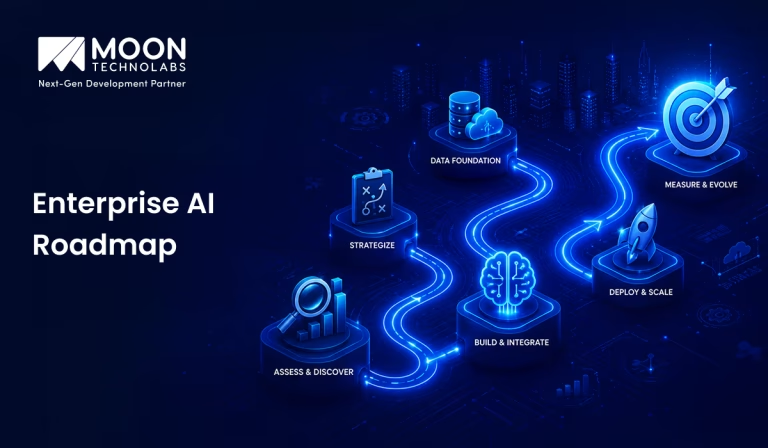
Table of Content


Blog Summary:
AI adoption without a clear direction can lead to scattered pilots, rising costs, and solutions that never make it into everyday operations. A well-defined enterprise AI roadmap helps businesses prioritize the right opportunities, connect AI initiatives to real business outcomes, and create a practical path from experimentation to scale. In this blog, we cover AI use-case prioritization, technical requirements, data and infrastructure, governance, adoption, and ROI measurement.
Table of Content
Enterprise AI is moving from experimentation to execution. The real challenge is no longer deciding whether to use AI, but knowing where it can create the most value, how to scale it responsibly, and what needs to change across the organization to make it work. An effective enterprise AI roadmap provides a clear path from initial use cases to scalable, measurable AI adoption.
A strong AI strategy goes beyond adopting new tools. It connects AI initiatives to business goals, prioritizes high-impact use cases, integrates data and existing systems, and addresses security, governance, and adoption. This guide covers the key steps to turn AI from isolated experiments into a scalable business capability.
What is an Enterprise AI Roadmap?
An enterprise AI roadmap is a strategic plan that outlines how an organization will adopt and integrate artificial intelligence into its business operations. It connects AI initiatives with business goals, helping companies identify where AI can create measurable business value.
A well-designed, strategic roadmap covers key areas such as AI use cases, technology, data readiness, talent, governance, and investment. It also prioritizes initiatives based on their potential impact, feasibility, and business requirements.
The goal of an enterprise AI roadmap is to move from experimentation to scalable AI adoption. It provides a clear, structured path for implementing AI responsibly while improving efficiency, decision-making, customer experiences, and long-term business growth.
Why Do Enterprises Need a Structured AI Roadmap?
A structured AI roadmap helps enterprises prioritize the right opportunities, align investments with business goals, reduce risks, and create a clear path from experimentation to scalable adoption. Here are the key areas to consider:
Aligning AI Initiatives With Business Goals
Structured enterprise AI roadmap development ensures that AI investments are aligned with the organization’s strategic business priorities. It helps most enterprises identify high-value use cases and focus resources on initiatives that can improve efficiency, revenue, customer experience, and decision-making.
Reducing AI Implementation Risks
AI adoption can introduce challenges related to data quality, privacy, regulatory compliance, and model performance. Following a well-defined AI adoption framework enables organizations to identify potential risks early, strengthen governance, and implement responsible AI practices before scaling their solutions.
Creating a Path From Pilot Projects to Production
Many AI initiatives begin as successful pilots but struggle to reach production. An AI enterprise roadmap creates a clear path from experimentation to deployment by defining the technology, data infrastructure, skills, and processes required to scale AI solutions effectively across the enterprise.
Measuring AI Investments and Business Outcomes
A structured roadmap also establishes clear metrics for measuring AI success. Enterprises can track outcomes such as cost savings, productivity, revenue growth, customer satisfaction, adoption, and ROI. These insights help leaders determine which initiatives are delivering value and where future investments should be focused.
Build Your Enterprise AI Strategy With Our Experts
Get expert guidance to identify high-impact AI opportunities, overcome implementation challenges, and create a roadmap designed to deliver measurable results for your organization.
Key Elements of an Enterprise AI Roadmap
Here are the key elements to include when building a practical enterprise AI roadmap that aligns technology investments with business priorities and supports successful AI implementation at scale:
Business Goals and AI Use Case Prioritization
Start with business problems rather than AI technology. Identify where AI can create measurable value, such as reducing service costs, improving forecasting, accelerating decision-making, or increasing sales. Rank use cases by expected business impact, implementation effort, data readiness, and risk, then build a phased portfolio of quick wins, strategic initiatives, and longer-term bets.
Data Readiness and Data Infrastructure
AI initiatives depend on trusted, accessible, and well-governed data. Assess existing data sources, quality, ownership, and gaps for each priority use case. Strengthen data platform, pipelines, and access controls so teams can reliably use enterprise data while maintaining privacy and regulatory requirements.
AI Technology and Architecture
Build a scalable technology foundation that enables AI solutions to move beyond individual pilots. Establish clear guidelines for choosing commercial, open-source, or internally developed models, along with standards for model selection, APIs, cloud infrastructure, and system integration. A flexible generative AI architecture supports both traditional ML and generative AI while minimizing unnecessary complexity and reducing the risk of vendor lock-in.
Talent, Skills, and Organizational Structure
Move from isolated AI specialists to operating models that connect AI expertise with business ownership. Determine which capabilities should be built internally and which can be sourced through partners or platforms. Establish product-oriented, cross-functional teams where business leaders, data scientists, engineers, domain experts, and risk teams jointly own AI outcomes.
AI Governance, Security, and Compliance
Effective AI governance requires organizations to manage risks throughout the AI lifecycle. Governance should be embedded into AI development, with risk-based controls for privacy, security, explainability, and human oversight. The EU AI Act reinforces this approach by requiring stronger safeguards, transparency, accountability, and compliance for higher-risk AI systems.
MLOps and AI Lifecycle Management
Create a repeatable path from AI experiment to production. Standardize development, testing, deployment, monitoring, and model updates, with additional controls for generative AI, including prompt management, evaluation, hallucination monitoring, and usage-cost tracking. Continuously measure both technical performance and business outcomes to determine whether an AI solution should be scaled, improved, or retired.
How to Assess Enterprise AI Readiness?
Assessing enterprise AI readiness helps organizations determine whether they have the business strategy, data, technology, skills, and governance needed to adopt and scale AI successfully.
Business and Strategic Readiness
A well-defined AI strategy ensures that AI investments support broader business priorities and long-term objectives, such as:
- Enterprise AI strategy: Assess whether AI initiatives align with overall business goals.
- Use cases: Identify AI opportunities that can improve revenue, efficiency, customer experience, or decision-making.
- Leadership support: Evaluate executive commitment, funding, and the clarity of success metrics.
- Change readiness: Determine whether the organization can adapt its processes and operating models.
Data and Analytics Maturity
High-quality, accessible data is essential for building reliable AI solutions. Organizations should evaluate how effectively they manage, integrate, and use data across the enterprise.
- Data quality: Ensure information is accurate, complete, consistent, and up to date.
- Data accessibility: Check whether relevant data is easily available to authorized AI systems and users.
- Data governance: Assess policies for data ownership and usage.
- Data integration: Evaluate how well data is connected across departments and systems.
- Analytics maturity: Determine how effectively the organization uses information for decision-making.
Technology and Infrastructure Readiness
The right technology foundation allows organizations to deploy AI efficiently and scale solutions as demand grows. Evaluate whether current infrastructure, platforms, and systems can support AI workloads.
- IT infrastructure: Assess whether existing cloud or on-premises systems can support AI workloads.
- AI platforms: Evaluate the availability of suitable AI, data, and development tools.
- Integration: Determine whether AI can integrate with existing business applications.
- Scalability and security: Ensure infrastructure can support growing AI usage while protecting data and systems.
Workforce and Skills Assessment
Successful AI adoption depends not only on technology but also on people with the right skills and understanding. Assess both technical capabilities and employee readiness to work with AI.
- AI talent: Assess the availability of data scientists, AI engineers, and technical specialists.
- AI literacy: Ensure employees understand AI capabilities, limitations, and responsible use.
- Training: Identify skill gaps and provide appropriate upskilling programs.
- Change management: Evaluate employee readiness to adopt AI-enabled business processes.
Governance and Risk Readiness
Effective governance helps organizations scale AI responsibly while managing operational, ethical, privacy, and regulatory risks. Establish clear accountability and processes before AI solutions are deployed widely.
- AI governance: Establish clear policies, roles, and responsibilities for AI use.
- Responsible AI: Address fairness, transparency, accountability, and human oversight.
- Privacy and compliance: Ensure AI systems meet applicable legal and regulatory requirements.
- Risk management: Monitor risks such as bias, inaccurate outputs, and model failures.
- Model governance: Establish processes for testing, monitoring, documentation, and ongoing evaluation.
You Might Want to Read:
AI Adoption Framework: A Complete Guide for Enterprise AI Success
Enterprise AI Roadmap: Step-by-Step Process
A step-by-step process helps enterprises move from identifying AI opportunities to deploying and scaling solutions with clear priorities, measurable outcomes, and effective governance. Here’s how to approach each stage:
Phase 1: Define Business Objectives and AI Vision
Start by identifying the business challenges AI should address and defining measurable goals such as cost reduction, revenue growth, better customer experience, or improved efficiency. Establish an AI vision aligned with the organization’s overall strategy and secure leadership support.
Key activities:
- Define business objectives and KPIs.
- Identify areas where AI can create value.
- Establish an enterprise AI vision.
- Assign leadership and governance responsibilities.
Phase 2: Identify and Prioritize AI Use Cases
Identify AI opportunities across business functions and evaluate them based on business value, feasibility, data availability, cost, complexity, and risk. Prioritize high-value use cases that can deliver measurable results.
Key activities:
- Create an AI use-case inventory.
- Assess potential ROI and feasibility.
- Evaluate risks and data requirements.
- Prioritize short, medium, and long-term initiatives.
Phase 3: Evaluate Data and Technology Gaps
Assess whether the organization has the data, infrastructure, tools, and security capabilities needed to support AI. Identify gaps in data quality, governance, technology, integration, and compliance.
Key activities:
- Assess data quality and availability.
- Review technology and infrastructure.
- Identify security and compliance gaps.
- Develop a plan to address critical gaps.
Phase 4: Build the AI Foundation
Build the foundational capabilities required for enterprise AI, including data platforms, AI infrastructure, governance, and skilled teams. Establish responsible AI principles covering privacy, transparency, and human oversight.
Key activities:
- Establish AI and data infrastructure.
- Implement governance and security controls.
- Define responsible AI standards.
- Build AI skills and teams.
Phase 5: Develop and Test AI Solutions
Develop prototypes and pilots for prioritized use cases. Test solutions for accuracy, reliability, scalability, and business impact before moving them into production.
Key activities:
- Develop AI prototypes and pilots.
- Integrate AI with business systems.
- Test performance and security.
- Validate results with business users.
Phase 6: Deploy AI into Business Operations
Move successful AI solutions into production and integrate them into existing workflows. Train employees, establish human oversight where needed, and create processes for monitoring and support.
Key activities:
- Integrate AI into business processes.
- Deploy solutions into production.
- Train employees and users.
- Establish monitoring and escalation processes.
Phase 7: Scale, Monitor, and Optimize AI Systems
Continuously monitor AI performance, costs, adoption, and business outcomes. Improve models as conditions change and scale successful solutions across the organization.
Key activities:
- Monitor AI performance and KPIs.
- Detect model drift and performance issues.
- Continuously improve AI solutions.
- Scale successful use cases across the enterprise.
- Regularly review governance and compliance.
Enterprise AI Use Cases to Include in Your Roadmap
Enterprise AI use cases should be selected based on business impact, feasibility, and scalability rather than simply following technology trends. Here are the key use cases worth considering for your roadmap:
Predictive Analytics and Forecasting
AI can analyze historical and real-time data to forecast demand, revenue, customer behavior, and market trends. This helps organizations plan, optimize resources, and make proactive business decisions.
Intelligent Process Automation
Artificial Intelligence can automate repetitive tasks such as document processing, data entry, invoice management, and routine workflows. AI workflow automation can help organizations streamline complex processes, reduce manual effort, improve accuracy, and make business operations more scalable.
AI-powered Customer Experience
AI-powered chatbots, virtual assistants, recommendation engines, and sentiment analysis can deliver faster and more personalized customer interactions. These solutions can improve satisfaction, engagement, and customer loyalty.
Fraud Detection and Risk Management
Artificial Intelligence can identify unusual transaction patterns and potential risks by analyzing large volumes of data. Organizations can use these capabilities to detect fraud, strengthen compliance, identify security threats, and reduce financial losses.
Predictive Maintenance
Successful AI implementation can monitor equipment data and identify early signs of potential failures. This enables organizations to schedule maintenance proactively, reduce unexpected downtime, lower costs, and extend the life of critical assets.
AI-Powered Decision Support
AI can provide managers and executives with data-driven insights, predictions, and recommendations. By highlighting trends, risks, and measurable outcomes, AI helps teams make faster and more informed decisions.
Generative AI and Enterprise Copilots
Generative AI can support employees with tasks such as drafting content, summarizing documents, analyzing information, answering questions, generating code, and creating reports. Enterprise copilots can improve productivity while making organizational knowledge easier to access.
Looking for the Right AI Roadmap for Your Business?
Turn your AI goals into a focused action plan with expert support across use-case discovery, solution planning, development, and enterprise-wide implementation.
How to Measure the Success of an Enterprise AI Roadmap?
An enterprise AI roadmap is successful when AI moves beyond experimentation and delivers measurable business outcomes. Organizations should track adoption, efficiency, financial impact, model performance, user experience, and overall ROI.
AI Adoption and Usage Metrics
Adoption shows whether AI is becoming part of everyday workflows.
Key metrics include:
- Percentage of active AI users
- Frequency of AI usage
- AI-assisted tasks and workflows
- Employee training and adoption rates
- User retention and repeat usage
Meaningful adoption matters more than simply providing access to AI tools.
Operational Efficiency Gains
AI should make processes faster, more productive, and less dependent on manual effort.
Track:
- Reduction in processing time
- Hours of work saved
- Productivity improvements
- Reduction in errors and rework
- Automation rates
- Faster response and decision-making
Comparing performance before and after AI implementation helps demonstrate its operational impact.
Cost Reduction and Revenue Impact
AI initiatives should contribute to financial performance through cost savings or new revenue opportunities.
Measure:
- Reduction in operational and labor costs
- Savings from automation
- Improved conversion and retention rates
- Increased sales productivity
- Revenue from AI-enabled products and services
Always compare financial benefits against the total cost of implementing and maintaining AI.
Model Performance and Accuracy
Reliable AI is essential for real business value.
Organizations should monitor:
- Accuracy and error rates
- Response quality
- Hallucination rates for generative AI
- Model latency and uptime
- Data quality
- Model drift
- Bias, security, and compliance risks
The metrics should reflect the specific AI use case and be monitored continuously.
User and Customer Experience
AI should make employee and customer interactions easier and more effective.
Useful metrics include:
- User and customer satisfaction
- Task completion rates
- Response and resolution times
- AI acceptance rates
- Human escalation rates
- Customer feedback and complaints
Combining quantitative metrics with user feedback provides a more complete picture of AI’s impact.
AI ROI and Business Value
The ultimate measure of an AI roadmap is the value created compared with the investment.
AI ROI = (Financial Benefits − AI Investment) ÷ AI Investment × 100
Beyond direct financial return, organizations should consider strategic benefits such as improved decision-making, innovation, customer experience, employee capabilities, and competitive advantage.
A strong AI measurement framework looks beyond the number of models deployed. By tracking adoption, efficiency, financial impact, model performance, user experience, and measurable ROI, organizations can identify successful initiatives, improve underperforming AI projects, and prioritize investments that deliver the greatest business value.
Final Thoughts
An enterprise AI roadmap gives organizations a clear way to decide what to build, where to invest, and how to scale without wasting resources on disconnected AI initiatives.
By aligning AI with specific business needs, companies can improve processes, make faster decisions, and uncover new opportunities. With the right AI development services, the roadmap can move from strategy to real-world implementation and measurable outcomes.
FAQs
01
How is AI being used in enterprise?
AI helps enterprises automate tasks, improve decision-making, personalize customer experiences, optimize operations, detect fraud, enhance customer support, and accelerate software development. It is increasingly embedded across departments to improve productivity, reduce costs, and create new business opportunities.02
What is the difference between generative AI and enterprise AI?
Generative AI creates new content such as text, images, code, and audio. Enterprise AI is broader, covering generative AI, machine learning, predictive analytics, and automation. Enterprise AI focuses on applying these technologies securely and strategically to solve business challenges.03
What are some popular AI tools for enterprises?
Popular enterprise AI tools include Microsoft Azure AI, Google Cloud AI, AWS AI, OpenAI, Salesforce Einstein, and NVIDIA AI platforms. The best choice depends on business needs, data, integrations, scalability, and budget.04
How do you measure success on an AI roadmap?
Success can be measured through business and technical metrics, including cost savings, revenue growth, productivity, customer satisfaction, adoption, accuracy, and ROI. Organizations should establish clear baselines, KPIs, and targets to evaluate each AI initiative and its overall measurable business impact.05
How long does it take to build a scalable AI roadmap?
A scalable AI roadmap typically takes a few weeks to several months, depending on business size, data maturity, and objectives. The process usually includes identifying use cases, assessing readiness, prioritizing initiatives, defining governance, and creating a phased implementation plan for sustainable AI adoption.



Explore the latest insights on Artificial Intelligence, including Generative AI, Agentic AI, natural language processing, computer vision, automation, and enterprise AI solutions. This category covers industry trends, practical applications, implementation strategies, and innovations that help businesses leverage AI for smarter decision-making and digital transformation. Stay updated with evolving AI technologies that are reshaping industries worldwide.
Submitting the form below will ensure a prompt response from us.
We refine our expertise to deliver innovative business solutions.





205 N Michigan Avenue, #810, Chicago, 60601, Illinois, United States
13500 Long Is Dr, Pflugerville, TX 78660, USA

C/105 Ganesh Meridian, S.G. Highway, Ahmedabad, GJ 380060


Ayse D.
Co-Founder France
“ I highly recommend Moon Technolabs as the quality of service is wonderful. We have hired this company to develop the product based on some complex & technical issues. We get the best quality services as compared with others in the market. Huge Thanks to Moon Technolabs as the team is always ready to give the solution all time.”

Justin G.
Founder & CEO USA
USA“ Moon Technolabs is a pioneer in the WebRTC based project as they have fixed complicated segments of the module by fulfilling different product lines by providing 24X7 customer support. We really recommended Moon Technolabs as they are able to develop products as per the module deadline and project timeline.”

Flavio S.
Founder & Managing Director Germany
“I am happy to recommend Moon Technolabs for their app development services. They successfully developed apps for me, and I am highly satisfied with the overall outcomes. The development team has swiftly addressed the issues with responsive and effective communication to understand the requirement quickly and actively resolve the back-and-forth problems that arose...”

Jay M.
Founder & CEOUSA“Moon Technolabs is the best company that provides advanced apps and websites development services in the USA and Europe. I am a newbie to develop my app with an external team. I am really happy to work with them as I am not that much mobile apps user. Here, the team and specially the CEO of Moon Technolabs helps me to let me know about the benefits of my app to generate revenue....”


Our Offices
India
C/105 Ganesh Meridian,S.G. Highway, Ahmedabad, GJ 380060USA
205 N Michigan Avenue, #810, Chicago, 60601, Illinois, United StatesContact Information


