
 Total Views: 165
Table of Content


Blog Summary:
This guide provides a comprehensive overview of energy software development and its increasing significance within the sector. We discuss benefits, necessities, primary applications, innovations, and emerging trends. Each topic is discussed in detail to support effective project planning.
Table of Content
CO2 emissions worldwide increased at an unprecedented rate. And it’s set to increase even in the near future.
Obviously, increasing CO2 emissions is a major concern for organizations, especially energy providers, who are constantly seeking the right way to limit their carbon footprints. And this is where Energy Software Development plays a vital role.
Apart from enabling energy companies to fulfil their core responsibilities towards the ecosystem, the software is also useful for other reasons. These include real-time monitoring, performance analysis, predictive maintenance, and energy consumption monitoring. These reflect that developing energy software is a profitable deal for energy suppliers.
Energy software development requires a well-planned, proven strategy and a holistic approach. This guide explores the entire process of developing energy software. Let’s begin.
Energy software development is a process of creating software solutions for energy service providers. It involves multiple steps that are as follows:
Software developed using the above steps can optimize energy generation, consumption, distribution, etc. They serve a variety of purposes, such as renewable energy management, smart grids, data analytics, and predictive maintenance.
An energy software caters to energy providers, enterprises, utilities, etc. They use it to perform a range of tasks, such as checking real-time performance, improving operational efficiency, reducing waste, and more. Developed with AI, cloud computing, and the Internet of Things (IoT), the software helps make smart decisions while improving sustainability.
Energy software development is necessary for businesses to achieve a competitive advantage through sustainability. Let’s explore some of the important purposes as follows:
With custom energy software solutions, businesses can monitor energy usage, identify inefficiencies, implement optimization strategies, and more. Energy management systems (EMS) tend to adjust automatically for light adjustment. It also automatically adjusts production equipment, HVAC systems, and more.
Energy expenses are a significant concern for commercial facilities, data centers, and various manufacturing plants. An energy software automates forecasting and cost tracking, helping businesses identify what requires higher costs and optimize resource allocation.
Businesses find it quite convenient to prevent overconsumption, reduce energy waste, and also negotiate better rates with suppliers by integrating automation tools and smart analytics. It helps businesses minimize operational expenses, thereby enhancing profit margins.
Real-time visibility is increasingly important as data complexity across distributed energy systems grows. An energy software system can consolidate data from many sources, such as grid meters, solar panels, storage systems, and more, into a unified dashboard.
This transparency enables energy managers to make well-informed, quick decisions. Businesses get a complete view of their actual energy performance through data reporting, visualization, cloud-based analytics, and more. It ensures complete strategic planning and continuous improvement.
Any unexpected equipment issues can lead to several repercussions, including safety risks, downtime, and financial losses. The software, developed with IoT and ML, offers predictive maintenance. It analyzes sensor data to detect potential failures before they occur.
The system can notify maintenance teams if any generator or wind turbine reflects early signs of issues. It boosts asset reliability, minimizes unplanned maintenance costs, and extends equipment lifespan.
In energy software development, organizations can easily automate compliance tracking, documentation, and reporting. It ensures data accuracy and on-time submissions, whether you adhere to local emission norms, ISO standards, or sustainability reporting requirements.
It thus helps businesses to minimize regulatory risks while enhancing their overall brand reputation as eco-conscious and responsible entities by maintaining overall compliance.
We restructure your operation by developing custom energy software. Transform your efficiency and processes, and harness smart management solutions now.
Get Started Today
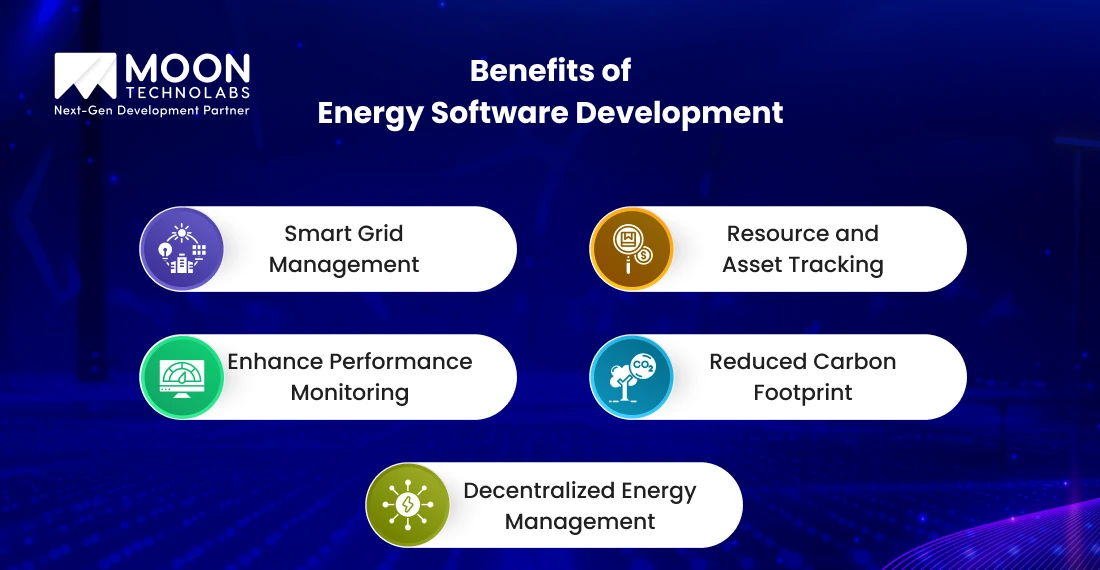
An energy software solution enables data-driven decision-making and real-time control, from enhancing grid stability to minimizing emissions. The following are some of the top benefits that improve digital transformation in the energy industry:
Smart grids are common in modern power plant systems. They can balance the emerging generation, demand, and distribution in real time. Energy software enables smart grid management by integrating data from sensors, renewable energy sources, energy storage units, and more.
Using AI and automation, the software can manage energy flow, analyze consumption patterns, and minimize outages. It ensures both the resilience and reliability of the grid, especially as renewable energy sources such as solar and wind become more prevalent.
Centralized visibility is essential for managing emerging assets, including transformers, turbines, and solar panels. Otherwise, it can be a complex process. Energy software makes it easy through lifecycle management and precise asset tracking, enabled by IoT integration.
Businesses can analyze energy output, equipment performance, maintenance schedules, etc., in real time. It not only reduces downtime but also allows organizations to optimize resource allocation and extend asset longevity. It finally maximizes return on investment.
When it comes to data-driven performance monitoring, it’s essential to optimize energy operations properly. Energy software makes it easy for organizations to gather and analyze data across multiple distributed systems, identify inefficiencies, and identify opportunities for improvement.
Operators can easily assess overall performance against KPIs such as conversion efficiency, energy yield, and power losses using dashboards and advanced analytics. It offers several advantages, such as faster issue resolution, continuous optimization, and improved productivity across different energy assets.
Energy software plays a leading role in minimizing and tracking carbon emissions. It allows organizations to analyze emerging usage patterns, inspect high-emission areas, switch to cleaner sources, and more.
Whether it’s sustainability dashboards or automated reporting, they make it easy to assess overall progress towards net-zero goals. Businesses can minimize their carbon footprint and enhance their environmental credibility by optimizing energy consumption and integrating renewable sources.
Decentralized management has become necessary as distributed energy resources such as EV chargers, rooftop solar, microgrids, and more proliferate.
Energy software provides smooth coordination among these important systems, enabling optimized use and balanced energy distribution.
This level of decentralization improves energy independence. This minimizes its dependence on central grids and supports more community-driven, sustainable energy ecosystems.
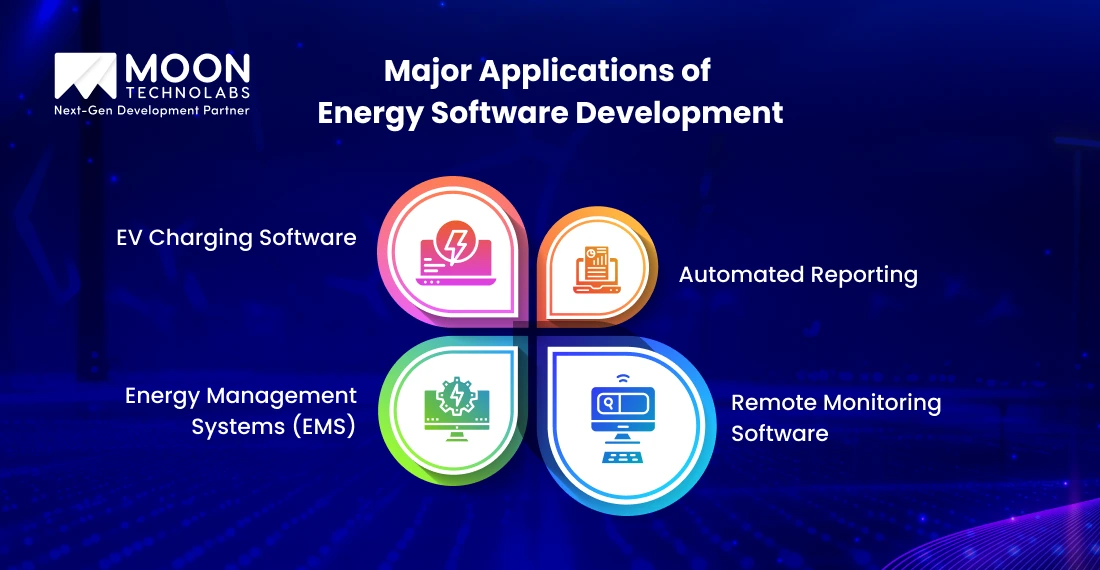
Whether for businesses or consumers, energy software development is useful for everyone. Let’s explore some of its most popular use cases:
The fast-growing popularity of electric vehicles (EVs) has increased the demand for smart infrastructure. EV charging software allows efficiency management of dynamic pricing, charging stations, grid load balancing, and more. It enables users to locate many available stations, analyze charging status, and ensure secure payment in real time.
Operators can leverage software to obtain critical analytics to prevent grid overload, optimize energy distribution, integrate renewable sources, and more. These support a clean and scalable mobility ecosystem.
Check Out the Portfolio
Whether it’s sustainability or regulatory compliance, it requires proper, timely reporting. Energy software automates data collection across multiple systems and generates accurate reports on energy efficiency, consumption, emissions, and more.
It thus effectively minimizes errors, reduces manual effort, and ensures adherence to standards such as ESG or ISO. Automated reporting improves transparency and supports progress toward sustainable goals.
EMS is essential for energy optimization. It ensures fully centralized control over energy generation, consumption, and distribution through AI and predictive analytics.
With EMS solutions, organizations can forecast demand, track performance, and implement efficient strategies across multiple facilities. It works effectively in several ways, such as improving energy reliability, minimizing operational costs, and supporting long-term sustainability initiatives.
Remote monitoring offers real-time monitoring and is therefore highly important for distributed assets and renewable energy power plants. With the software, energy operators can easily track equipment performance, identify issues, and initiate maintenance activities accordingly from any location.
It not only reduces downtime but also delivers higher energy output while ensuring complete operational safety. This software boosts scalability, visibility, and decision-making across various multi-site energy networks.
Energy software development is redefined by technological innovations such as Blockchain, Artificial Intelligence (AI), the Internet of Things (IoT), and Cloud computing. Let’s have a detailed look at each of these technologies:
AI and ML have a major impact on energy software development. These technologies offer numerous benefits, such as demand forecasting, predictive analytics, intelligent automation, and more.
AI-driven software can analyze large amounts of data to predict equipment failures, optimize grid performance, improve energy distribution efficiency, and more.
For instance, ML algorithms can predict the high demand and, based on this, adjust energy production schedules. It thus saves energy.
Apart from this, AI in energy mangement also assists operators of renewable energy plants in detecting anomalies, helping them avoid costly downtime and improve the longevity of their assets.
Blockchain is another technology that has also revolutionized energy software development. It improves both trust and transparency in this sector.
Blockchain, by leveraging decentralized ledgers, enables secure peer-to-peer (P2P) energy trading, tamper-proof transaction records, and smart contracts. It allows consumers to sell excess energy or buy energy whenever they need it.
The technology also enhances supply chain traceability and enables stakeholders to verify the actual origins of synergy sources. It ensures both sustainability and compliance with energy regulations. With its immutable data structure, Blockchain improves cybersecurity and reduces fraud in digital energy transactions.
Cloud computing is essential for a flexible and scalable renewable energy software solution. Be it real-time analytics, centralized data storage, or remote access to energy systems, it allows everything.
Cloud platforms offer advanced analytics that can easily recognize energy consumption patterns, recommend optimization strategies, and detect energy inefficiencies. Businesses can gain greater agility and better decision-making power by integrating AI-based insights into the cloud.
Apart from this, cloud-based energy management systems minimize the overall infrastructure costs and also improve collaboration among distributed teams.
IoT operates on the principle of connecting multiple physical assets, such as turbines, meters, and sensors, into a digital network. This connectivity plays a leading role in enabling operators to gain control, monitor energy systems in real time, and automate energy systems.
IoT energy software can manage distributed resources, track performance metrics, detect faults remotely, and more.
You Might Also Like:
IoT devices provide rapid feedback on environmental conditions and equipment efficiency in wind plants and solar farms. By combining cloud and AI, IoT transforms raw data into actionable intelligence, boosting reliability through optimized resource utilization.
Boost operations by minimizing costs and leveraging smart energy management. Get our customized software solutions for your organization.
Start Your Project Now
Future trends in energy software development are moving towards technologies that emphasize security, agility, and intelligent automation. Let’s get a detailed insight into these technologies:
With low-code/no-code, even non-technical users can quickly build and customize energy management solutions using pre-built modules and visual interfaces.
It offers various advantages for energy providers, including reduced development costs, faster prototyping, greater adaptability to market demands, and more.
Low-code solutions enable businesses to innovate quickly, even without complex programming, whether it’s analyzing energy grid consumption or managing grid assets.
Cyber threats have increased in recent years, driven by increased digitization. In the future, the energy software is set to focus more on cybersecurity, leveraging AI-based threat detection, real-time vulnerability monitoring, and related capabilities.
So, for the protection of distributed energy networks, cloud platforms, and IoT-based assets will be the top priority. Whether it’s secure APIs, advanced encryption, or zero-trust architectures, these will become the new standard for ensuring data integrity and operational continuity.
Digital twin technology revolutionizes the way energy infrastructure is analyzed and optimized. This technology predicts equipment behavior, simulates grid performance, and tests new configurations even without any physical interventions.
It minimizes overall maintenance costs, improves innovation, and boosts efficiency. Digital twins can model how environmental changes affect wind or solar output. It enables real-time performance optimization and data-based planning.
Quantum computing is at the forefront of modernizing energy software development. It’s popular for its unmatched processing power, which enables it to analyze complex datasets, accelerate renewable energy simulations, optimize grid distribution, and more.
In the near future, quantum algorithms will enable ultra-accurate predictions of energy demand, power system behavior, and weather patterns. These ensure an efficient and resilient energy system.
This technology has transformative potential to address various energy challenges that traditional computing cannot.
A large number of companies adopted energy software to transform how they operate, improving sustainability, efficiency, and intelligence across multiple operations.
The following are some of these companies:
As a comprehensive energy data management system worldwide, the energy IP Platform can integrate data from multiple smart meters and IoT devices. It allows energy providers and utilities to optimize grid performance.
It leverages advanced analytics to analyze energy consumption patterns, forecast demands, and check potential issues.
EnergyIP offers real-time insights and efficient load balancing, improving outage management. It also supports integrating a range of renewable energy sources into the existing power grid, making the energy system future-ready and more reliable.
Enel X’s demand response software is another example that has transformed energy optimization. It allows businesses to adjust energy consumption according to real-time grid conditions.
This platform leverages automation and AI to track energy usage, incentivize customers, predict demand, and more to minimize or shift loads even during peak hours.
It effectively stabilizes grid operations and enables participants to earn financial rewards for full energy flexibility. Demand response software supports decarbonization by reducing the need for additional fossil-fuel-based power generation.
An energy management suite harnesses the potential of machine learning and artificial intelligence to provide detailed insights into energy consumption. It combines data from equipment, sensors, and enterprise systems to identify inefficiencies, recommend optimization strategies, and predict energy requirements, among other tasks.
Industrial operators and utilities use it to improve energy efficiency, minimize overall costs, and more. It includes features such as emissions tracking and predictive maintenance to help organizations effectively pursue these goals.
We, as an energy management software development company, provide custom energy software solutions to help businesses lead the energy revolution.
We assist organizations in achieving sustainability, efficiency, and innovation through our extensive expertise in developing solutions for smart grid management, predictive analytics, and renewable energy monitoring.
Our developers can leverage IoT, AI, Blockchain, and Cloud computing to deliver secure, scalable energy software tailored to your organization’s specific needs.
We work as your trusted development partner, whether you seek to build energy management systems or revolutionize your existing infrastructure.
So, you have already recognized the importance of renewable energy software and are seeking to develop it. You need to plan well before making your final step in the development process.
It’s important to look for technologies, features, and functionalities to integrate into your app. Partnering with an energy power plant software development company like us helps you plan well for your renewable energy app development to drive the growth and sustainability of your business.
01
02
03
04

Jayanti Katariya is the CEO of Moon Technolabs, a fast-growing IT solutions provider, with 18+ years of experience in the industry. Passionate about developing creative apps from a young age, he pursued an engineering degree to further this interest. Under his leadership, Moon Technolabs has helped numerous brands establish their online presence and he has also launched an invoicing software that assists businesses to streamline their financial operations.


Submitting the form below will ensure a prompt response from us.
We refine our expertise to deliver innovative business solutions.





500 N Michigan Avenue, #600, Chicago IL 60611
13500 Long Is Dr, Pflugerville, TX 78660, USA

C-105, Ganesh Meridian, S.G. Highway, Ahmedabad, GJ 380060


 France
“ I highly recommend Moon Technolabs as the quality of service is wonderful. We have hired this company to develop the product based on some complex & technical issues. We get the best quality services as compared with others in the market. Huge Thanks to Moon Technolabs as the team is always ready to give the solution all time.”

 USA
USA“ Moon Technolabs is a pioneer in the WebRTC based project as they have fixed complicated segments of the module by fulfilling different product lines by providing 24X7 customer support. We really recommended Moon Technolabs as they are able to develop products as per the module deadline and project timeline.”

 Germany
“I am happy to recommend Moon Technolabs for their app development services. They successfully developed apps for me, and I am highly satisfied with the overall outcomes. The development team has swiftly addressed the issues with responsive and effective communication to understand the requirement quickly and actively resolve the back-and-forth problems that arose...”
 USA
USA“Moon Technolabs is the best company that provides advanced apps and websites development services in the USA and Europe. I am a newbie to develop my app with an external team. I am really happy to work with them as I am not that much mobile apps user. Here, the team and specially the CEO of Moon Technolabs helps me to let me know about the benefits of my app to generate revenue....”


