
 Total Views: 384
Table of Content


Blog Summary:
This blog provides a concise yet insightful overview of Duolingo Business Model, explaining how it uses a freemium approach to attract millions of users while generating revenue from subscriptions, ads, in-app purchases, and its English proficiency test. It highlights the platform’s value proposition, use of gamification and AI for engagement, key revenue streams, and competitive advantages, giving readers a clear understanding of how the Duolingo business successfully balances accessibility, scalability, and profitability.
Table of Content
Duolingo has transformed the way people learn languages by making education engaging, accessible, and scalable for a global audience. With its gamified lessons and user-friendly design, this leading language learning platform attracts millions of learners every day, but behind this simplicity lies a well-structured and data-driven strategy.
This blog explores the Duolingo business model, examining how the company combines a freemium approach with innovative technology, personalization, and strong brand positioning. It also explains how Duolingo generates revenue through multiple streams while staying true to its mission of providing free and effective language education worldwide.
The idea for Duolingo emerged in 2009, when Carnegie Mellon University professor Luis von Ahn teamed up with his Swiss-born graduate student, Severin Hacker. Two years later, in 2011, they founded the company with a clear and ambitious mission: to make language learning free and accessible to people everywhere.
The idea grew out of von Ahn’s work on crowdsourcing and the belief that expensive language learning tools created unnecessary barriers. Duolingo launched publicly in 2012 and quickly stood out for its playful, game-like lessons, streaks, and bite-sized exercises that made daily practice feel less like homework and more like a habit.
In its early years, Duolingo experimented with a model that used learners’ translations to help translate parts of the web, helping fund the platform while keeping it free. Over time, the company shifted to a freemium approach, often cited as the Duolingo business model. This model is supported by ads, subscriptions (Duolingo Plus/Super), and certification tools. One of the key innovations was the Duolingo English Test, which gained acceptance by universities worldwide as a remote language proficiency exam.
By the late 2010s and early 2020s, Duolingo had grown into one of the most popular education apps globally, expanding beyond languages into subjects like math and music. The company went public in 2021, cementing its place as a major player in ed-tech, known not just for teaching languages but also for reshaping how people think about online learning.
Duolingo follows a freemium business model, offering free language-learning content to attract a large global user base and monetizing a small portion through paid features. The platform emphasizes gamification and daily engagement (streaks, XP, leagues) to build learning habits and long-term retention, allowing it to scale efficiently with low marginal costs.
Most of Duolingo’s revenue comes from subscriptions (Super Duolingo and Duolingo Max), which contribute over 80% of total revenue. These plans remove ads and offer premium, AI-powered features. Additional revenue is generated from advertising, in-app purchases, and the Duolingo English Test, an online English proficiency exam accepted by many universities.
The platform has a massive user base, with 100M+ monthly active users, 35–45M daily active users, and 900M+ total app downloads. Paid subscribers account for only 6–8% of users, or about 11M subscribers, which is typical for freemium language learning apps. User growth is strongest in emerging markets, while paid conversions are higher in developed regions.
According to Duolingo statistics, over 103 million people access the platform at least once a month, with 32% of monthly active users engaging with the app daily. The app has achieved an impressive milestone, surpassing 950 million downloads worldwide. This growth highlights Duolingo’s widespread popularity and the strong, consistent engagement of its user base, making it one of the most widely used language-learning platforms globally.
Duolingo’s business model works by providing users with interactive, bite-sized lessons designed to teach language skills such as vocabulary, grammar, speaking, listening, and writing. Each language course is divided into various “skills” that build progressively, allowing users to advance at their own pace.
The Duolingo app uses an adaptive algorithm to tailor lessons to the learner’s proficiency, adjusting the difficulty based on performance and providing instant feedback on errors.
The platform integrates gamification to keep users engaged, offering XP points, streaks, and virtual rewards like gems. These elements encourage consistent practice and learning. Duolingo also uses speech recognition for pronunciation practice and provides listening exercises to improve comprehension.
While it is free to use, Duolingo’s business model includes premium options such as Duolingo Plus, which removes ads, offers offline access, and provides unlimited hearts for mistakes. The Duolingo English Test (DET), a paid language proficiency exam, is also available and accepted by universities and institutions as an alternative to traditional exams.
Duolingo’s operating strategy focuses on making language learning accessible, engaging, and scalable through technology. The company combines behavioral science, data analytics, and mobile-first design to attract a large global user base while maintaining low marginal costs.
Here are the most important elements of this strategy, which cannot be neglected:
Gamification is at the core of Duolingo’s product design. Features such as streaks, points (XP), levels, leaderboards, and rewards turn learning into a game-like experience. These features appeal to people’s desire to improve and succeed, and they also offer external rewards or recognition to keep them motivated.
By reducing the psychological friction of learning a new language, Duolingo increases user engagement and makes education feel fun rather than burdensome.
Duolingo operates on a freemium model, offering most core features for free while monetizing through premium subscriptions (Super Duolingo), advertising, and language proficiency testing.
This model lowers the barrier to entry and allows the platform to attract hundreds of millions of users globally. A small percentage of paying users subsidizes the free experience, enabling scale without sacrificing accessibility.
Artificial intelligence and data analytics play a critical role in Duolingo’s operations. The company continuously collects data on user behaviour to personalize learning paths, optimize lesson difficulty, and improve retention.
AI-driven features such as adaptive exercises and automated feedback enhance learning efficiency while reducing reliance on human instructors, keeping operating costs low.
Duolingo’s business model maintains high product quality through constant experimentation and iteration. Beyond language learning, the company has expanded into adjacent areas, such as math and music education, using the same gamified, mobile-first approach.
This expansion strengthens the platform ecosystem and allows Duolingo to use its existing technology, brand, and user base across new learning domains.
Rathan than prioritizing short-term monetization, Duolingo’s business model places strong emphasis on long-term user retention. Daily reminders, streak protection, personalized goals, and timely notifications are designed to build habits and keep users returning. High retention increases lifetime value per user and improves conversion rates from free to paid subscriptions over time.
Duolingo’s brand is a powerful competitive advantage. The company is widely recognized for its friendly tone, humorous marketing, and iconic owl mascot. This strong brand identity creates emotional connection and trust, making Duolingo the default choice for many new language learners.
As competitors struggle to replicate this combination of personality, scale, and engagement, Duolingo’s brand acts as a durable moat.
We help founders and businesses turn learning ideas into real products—covering technology, product structure, and long-term sustainability from the start.
Duolingo’s cost structure is divided into several key areas. The company allocates around $80 million annually to research and development (R&D), which supports the development of new features, AI improvements, and platform enhancements. This also includes the salaries of engineers, linguists, and other members of product teams working on language-learning courses and learning algorithms.
In terms of sales and marketing, Duolingo spends approximately $130 million per year. This budget is used for digital advertising, user acquisition campaigns, influencer partnerships, and global brand promotions to attract and retain a growing user base.
Server hosting and infrastructure costs about $20 million annually. These expenses cover cloud hosting, data storage, content delivery networks (CDNs), and cybersecurity to maintain platform performance and user security.
Duolingo’s business model also invests $10-15 million annually in content generation and maintenance, which includes creating, updating, and localizing language courses. This covers the work of linguists, curriculum designers, and editors to ensure the content stays fresh and accurate across all languages.
Finally, compliance and legal costs are estimated at $5-10 million annually. This includes expenses for legal services, data privacy protection (such as GDPR compliance), and ensuring the company adheres to regulations in various global markets.
These costs are critical to Duolingo’s continued growth, ensuring it remains a competitive and reliable platform in the global edtech space.
Duolingo earns revenue from its Super Duolingo subscription, which offers premium features such as an ad-free experience, offline access, unlimited hearts, and personalized learning plans for a monthly or yearly fee.
The Duolingo English Test (DET) is an affordable language certification used by universities and immigration authorities. Duolingo charges a fee for each test taken, creating a revenue stream.
Free users see ads in the app, which generate revenue through advertising partnerships with third-party networks. These ads are shown between lessons or as banners.
Duolingo offers language training for businesses, providing tailored courses and progress tracking to help companies improve employee language skills through subscription-based corporate packages.
Duolingo also makes money from in-app purchases, such as virtual currency (Lingots/Gems), to unlock extras or boost progress, thereby enhancing the user experience.
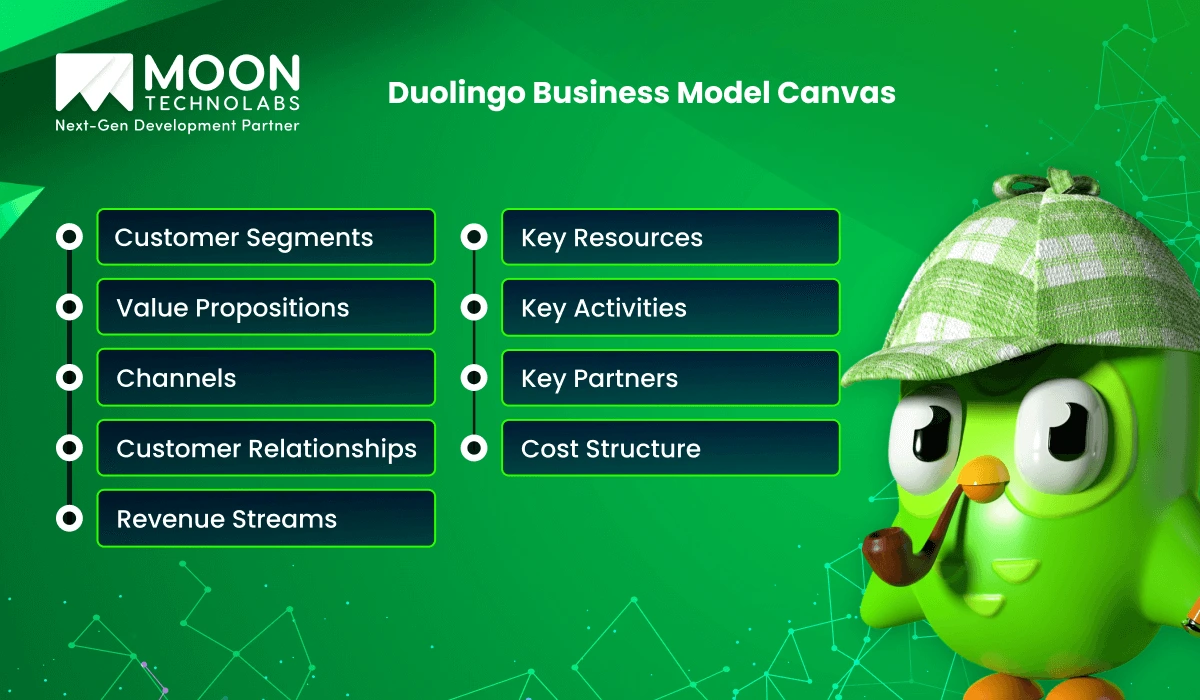
Duolingo serves a wide range of users who are interested in learning languages or proving their language proficiency. Its platform is designed to be accessible to language learners of different ages, goals, and economic backgrounds. Its platform caters to:
The platform’s value proposition is to make language learning fun, affordable, and accessible to everyone. By combining technology, gamification, and data-driven personalization, Duolingo keeps learners engaged while delivering effective education. This is achieved through:
Duolingo reaches its users primarily through digital platforms, ensuring easy access and continuous engagement. Its strong online presence and mobile-first strategy help it connect with a global audience. These include:
This business model canvas builds long-term relationships with users by focusing on engagement, motivation, and continuous improvement. It also emphasizes self-service learning while using technology to personalize and support the user journey. It achieves this through:
The Duolingo platform uses a freemium business model, allowing users to access basic functionalities for free while generating revenue from premium offerings and services. These include:
Duolingo relies on a combination of technological, human, and intellectual key resources to deliver its value proposition effectively. These include:
Duolingo’s key activities focus on developing, maintaining, and improving its language-learning ecosystem while ensuring high user engagement and learning effectiveness. These activities involve:
Duolingo collaborates with a range of partners to expand its reach, enhance its offerings, and ensure platform scalability. Key partners include:
Duolingo’s cost structure reflects its focus on technology development, content creation, and global platform operations while keeping the service affordable. The key costs are associated with:
Moon Technolabs provides end-to-end development for language and education platforms, combining technology, design, and engagement strategy.
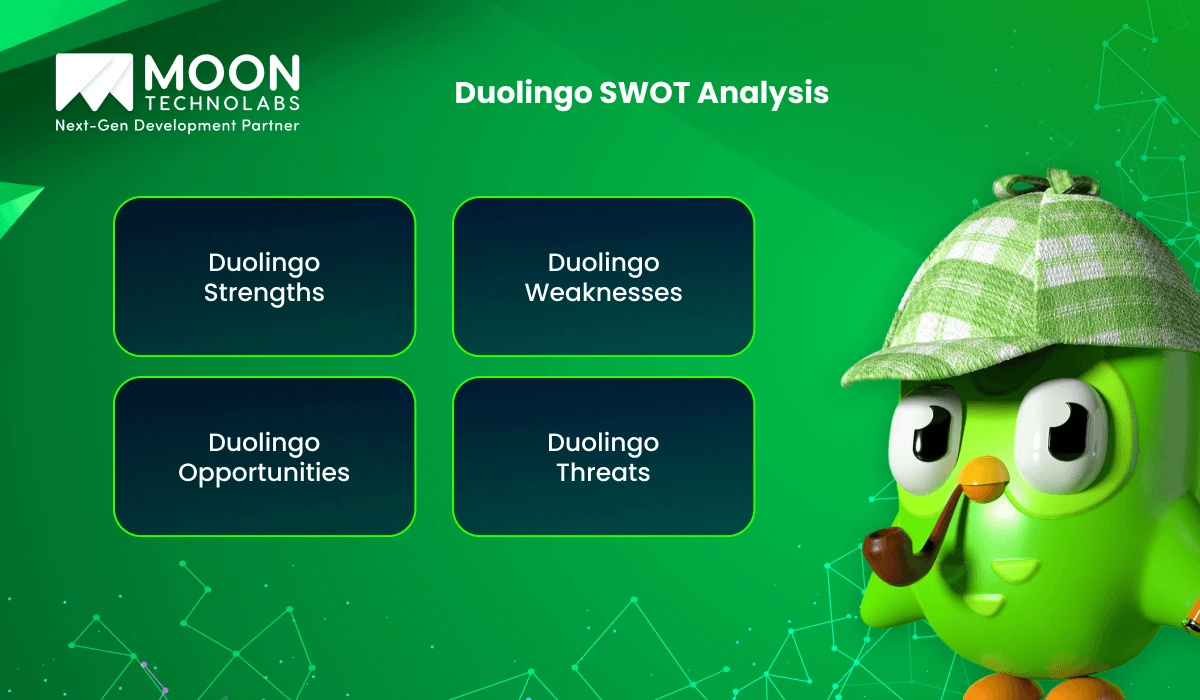
Duolingo’s strengths include free accessibility, making it widely available to business users, and gamification, which keeps language learners motivated through points, streaks, and leaderboards.
The platform’s user-friendly interface appeals to users of all ages and offers a wide variety of languages, including less common ones. Its mobile-first design allows learning on the go, and a strong community boosts retention and engagement.
Duolingo’s weaknesses include its limited depth for intermediate or advanced learners and its oversimplified content, which may lack cultural context and advanced grammar. The repetitive lessons can become monotonous, and speech recognition is not always accurate. Additionally, Duolingo requires an internet connection, which can limit access in areas with poor connectivity.
Duolingo can grow by expanding its premium services, offering more advanced courses, and forming educational partnerships with schools and universities. Enhancing the app with AI improvements for better speech recognition and personalized learning, as well as adding cultural experiences, could set it apart from competitors. Expanding into non-English markets could also drive growth in underserved regions.
Duolingo faces intense competition from apps like Babbel and Rosetta Stone, which offer more in-depth courses. Market saturation in existing regions could slow growth, and new trends like VR/AR learning might challenge its current model. The company’s reliance on ads and premium subscriptions for revenue poses risks, as do potential privacy concerns or regulatory challenges across different countries.
Moon Technolabs can help you build an e-learning platform like Duolingo by combining deep technical expertise with a strong understanding of user engagement. By blending intuitive UI/UX design with interactive lessons, smart gamification, and instant feedback, our team builds learning experiences that keep users engaged and motivated daily. Every feature is designed to make learning effortless, fun, and results-driven.
With expertise in mobile and web app development, we deliver scalable, high-performance eLearning software solutions using modern technologies. We do integrate AI-driven personalization, adaptive learning paths, speech recognition, progress tracking, and multilingual support to provide a smart, customized language learning experience. A secure backend architecture ensures smooth performance as your user base grows.
Beyond development, we act as a long-term technology partner, refining your product vision, optimizing features based on user behavior, and supporting continuous improvements post-launch. This end-to-end approach ensures your learning platform not only launches successfully but also evolves into a competitive, engaging, and revenue-ready product in the edtech market.
Duolingo’s success comes from a well-balanced business model that combines free, accessible learning with smart monetization. Through subscriptions, language tests, and limited advertising, Duolingo has scaled globally while keeping the user experience at the center of its strategy. Gamification, personalization, and a mobile-first approach continue to drive strong engagement across its platform.
Most importantly, the Duolingo mission statement, to make education free, fun, and accessible to everyone, shapes every aspect of the business. By aligning purpose with profit, Duolingo proves that a mission-driven education platform can be both impactful and sustainable.
01
02
03
04
05

Jayanti Katariya is the CEO of Moon Technolabs, a fast-growing IT solutions provider, with 18+ years of experience in the industry. Passionate about developing creative apps from a young age, he pursued an engineering degree to further this interest. Under his leadership, Moon Technolabs has helped numerous brands establish their online presence and he has also launched an invoicing software that assists businesses to streamline their financial operations.


Submitting the form below will ensure a prompt response from us.
We refine our expertise to deliver innovative business solutions.




500 N Michigan Avenue, #600, Chicago IL 60611
13500 Long Is Dr, Pflugerville, TX 78660, USA

C-105, Ganesh Meridian, S.G. Highway, Ahmedabad, GJ 380060


 France
“ I highly recommend Moon Technolabs as the quality of service is wonderful. We have hired this company to develop the product based on some complex & technical issues. We get the best quality services as compared with others in the market. Huge Thanks to Moon Technolabs as the team is always ready to give the solution all time.”

 USA
USA“ Moon Technolabs is a pioneer in the WebRTC based project as they have fixed complicated segments of the module by fulfilling different product lines by providing 24X7 customer support. We really recommended Moon Technolabs as they are able to develop products as per the module deadline and project timeline.”

 Germany
“I am happy to recommend Moon Technolabs for their app development services. They successfully developed apps for me, and I am highly satisfied with the overall outcomes. The development team has swiftly addressed the issues with responsive and effective communication to understand the requirement quickly and actively resolve the back-and-forth problems that arose...”
 USA
USA“Moon Technolabs is the best company that provides advanced apps and websites development services in the USA and Europe. I am a newbie to develop my app with an external team. I am really happy to work with them as I am not that much mobile apps user. Here, the team and specially the CEO of Moon Technolabs helps me to let me know about the benefits of my app to generate revenue....”


