
 Total Views: 202
Table of Content


Blog Summary:
To define the cost of machine learning app development, you must consider multiple factors like data, algorithm, infrastructure, and design. This guide breaks down all these expenses, compares custom vs ready-made solutions, and offers cost-saving strategies. You will also get a clear roadmap and an overview of current market trends to develop a smarter, risk-free ML plan.
Table of Content
Imagine launching a machine learning application only to realize you have overrun your defined budget by 3 times. Most business owners and ML app developers underestimate the true cost of building a Machine Learning app.
The cost of developing an ML app ranges from $10,000 to $1,000,000, especially for enterprise systems. That’s why understanding the true cost of ML app development is crucial. It will not only help you financially but also improve your strategic decision-making.
You will be able to prioritize the features, make better deployment decisions, and even choose the right model/approach. Without a clear breakdown, you may notice scope creep, delays, and increased risks.
This guide will act as your compass and help determine the cost to build a machine learning application. We will take you through all the cost categories, benchmarks, and cost-saving strategies so that you don’t fly blind.
The machine learning landscape is booming. Let’s take note of where things stand at the moment and how they are progressing.
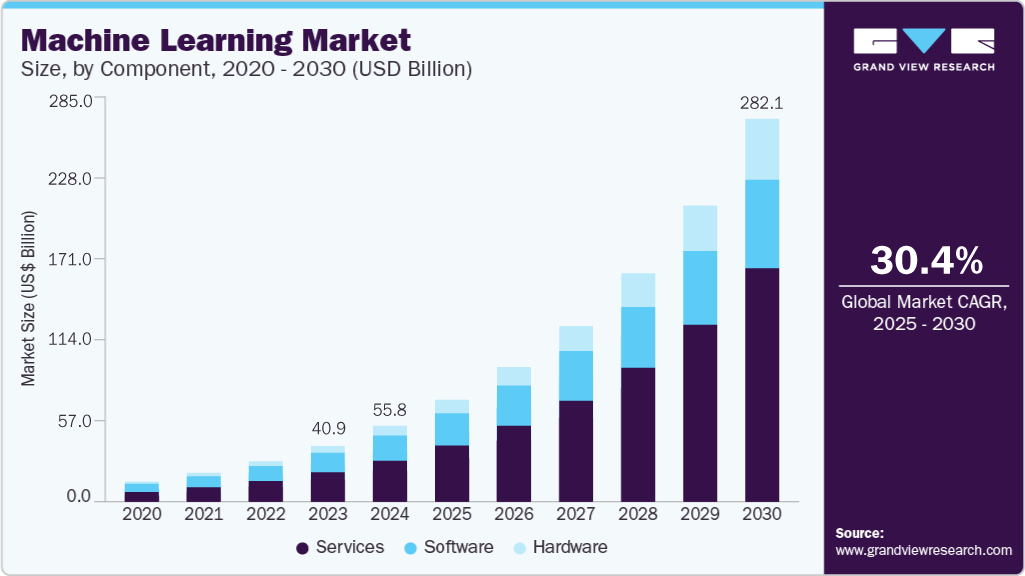
According to Grand View Research, the global Machine Learning market was valued at $55.8 billion in 2024. The segment is expected to reach $282.13 billion by 2030 with a CAGR of about 30.4%. With mobile app consumer spending across all operating systems valued at $150.1 billion in 2024, there would be greater demand for data-backed, insightful apps.
As more apps are embracing subscription models and in-app purchases for their monetization, you will notice better revenue opportunities for your product.
Now that we have seen how ML is progressing and what will help you generate more ROI, let’s look at the key trends:
When you plan a machine learning application, there is no “one-size-fits-all” price tag. Several factors impact the final development cost. From the application’s complexity to infrastructure and other factors, everything must be considered when planning the budget.
Here is a detailed look at all the factors that impact the budget:
Adding advanced, complex features to your application increases development costs. Basic ML features, such as predictions or recommendations, are easier and faster to build.
However, when you add real-time personalization, computer vision, or voice recognition, you need more complex data models. It can also increase API requirements and testing time, thereby increasing costs.
A good ML app results from good data fed into the algorithm. To add large datasets for app development, you must spend time and money collecting, cleaning, and labelling the data. With high-quality, diverse data, you can improve the accuracy of the outcomes.
However, the high-quality data costs more, as you need additional storage space, resources for preprocessing, and annotation.
To manage the different algorithms, you must invest in diverse expertise and computing power. The basic regression model costs less than deep neural networks or ensemble learning solutions.
As algorithms grow more complex, you need to invest more in experimentation and tuning. This will increase the development time and resource costs.
Developing the application for a single platform, either Android or iOS, is affordable than creating a cross-platform solution. For each additional platform, you need to optimize, test, and maintain the application separately. Additionally, you must ensure the app’s performance is consistent across all devices without increasing the workload.
Your ML apps depend on AWS, Azure, Google Cloud, and other cloud platforms to train, deploy, and scale the models. The cost will depend on the compute usage, data storage, and API calls. Cloud hosting is definitely convenient, but in case of heavy workloads or real-time processing, it can increase the monthly expenses.
The framework you choose—TensorFlow, PyTorch, Scikit-learn, or a custom one — influences the cost of development. With open-source tools, you don’t incur the licensing fee or cost of hiring specialized developers.
However, with proprietary AI development tools and frameworks, you may need to pay subscription or usage costs that increase with time.
Compliance is critical when you build apps that handle sensitive user data. You must comply with the GDPR, HIPAA, and other applicable data protection laws. This would require adding encryption layers, securing the data pipelines, and ensuring periodic audits. Adding these layers increases trust and reliability, but also increases the setup and maintenance costs for your application.
Integrating your ML app with existing systems, such as CRM, ERP, and third-party solutions, can be tedious. Moreover, configuration, testing, and custom connections are important for each integration. Adding more systems to the ML application will increase maintenance and integration costs.
The app development hiring costs depend on the team setup. For instance, choosing an in-house team increases costs but offers better control. On the contrary, offshore or hybrid teams help save time and money without compromising quality.
Check out our detailed blog post comparing outsourcing vs. offshore software development services.
The industry you plan to develop the app for will also influence app development costs. For an ML app in healthcare or finance, you need to include additional compliance and security measures. This increases the cost. Moreover, you will need niche expertise, which can increase expenses.
Knowing how you will spend the allocated budget is the first step to managing it. The typical cost of machine learning app development ranges from $40,000 to $300,000. Here’s a look at all the areas where you will spend the total allocated budget:
Data preparation for app development accounts for about 20-40% of the total budget. In this stage, you will be responsible for collecting, cleaning, labelling, and structuring the data, making it ready for model training.
If the data is unstructured and low-quality, it can slow development and lead to costly manual work. That’s why you must invest in good data that saves time and enhances the accuracy of app outcomes. You will also need to proceed with anonymization, versioning, and validation if your app involves sensitive datasets.
Most of your app development budget is spent in this segment, as this is crucial for ML applications. You can expect to spend between $15,000 and $100,000 in this stage, depending on the complexity.
This stage involves selecting the algorithm, training the data, validating the model, and optimizing it. Developing simpler models, such as regression or classification, is cheaper than developing advanced NLP or computer vision models.
The reason is that the former need less computing power or expertise. You will also need to invest in iterations and experimentation cycles to enhance the accuracy and reliability of the models.
The ML app requires dedicated infrastructure to function smoothly. This will include storage, servers, and computing power. AWS, Google Cloud, and Azure use a pay-for-what-you-use model, where compute time, data storage, and usage are factored into final expenses.
The infrastructure cost may be around $5,000 for the startup. However, as enterprise workloads are higher, the infrastructure costs them $50,000. The costs are higher if real-time data processing, GPUs, and large-scale APIs are needed for the app development.
You should always select a scalable architecture that can reduce the cost spikes later.
You must invest in a good UI/UX design if you want a smart app that engages. The design cost ranges from $5,000 to $25,000. This will depend on the complexity of dashboards, visualizations, and interactive elements.
Use visual cues, recommendations, and analytics views to explain the model outputs intuitively through design. This would increase trust in your application and help them better understand the data.
Testing is crucial as it helps validate whether the app works accurately and consistently for all use cases. Unit testing, performance testing, and model-prediction validation are important tests.
This step will cost approximately $5,000 to $20,000, depending on the model’s size and complexity. It is crucial to retrain and monitor algorithms to maintain accuracy continuously.
To deploy the ML application to your production environment, you must integrate the APIs, configure the environment, and ensure scalability. The typical cost of deployment is around $5,000 to $15,000.
Add CI/CD pipelines that have model versioning tools to manage future releases effortlessly. Invest in a deployment plan that reduces downtime while improving user experience.
The ML model might change, the data may change, and the usage may differ from when you started. That’s why you cannot just build it once and use it forever. You should invest in continuous maintenance, bug fixes, and updates.
That will take up 15-20% of the total development cost. By focusing on maintenance, you can ensure the app remains secure and accurate.
The API usage fees, third-party integrations, data storage, and even monitoring tools add to the cost of development. They are hidden expenses and can become significant with time. You must plan for all these recurring expenses right from the start to maintain the performance and profitability of your ML application.
Partner with ML experts to stay ahead of the curve with AI-driven automation, intelligent personalization, and predictive analytics while having full control of your data and compliance needs.
Selecting between a custom-built ML app and a ready-made solution is about balancing flexibility, cost, and control. Off-the-shelf solutions are faster to launch compared to custom-built applications. However, the custom-built solutions offer better control, scalability, and personalization.
Here’s an at-a-glance comparison between these models:
| Factor | Custom-built ML Application | Ready-Made Solution |
|---|---|---|
| Initial Development Cost | The upfront cost is high, ranging from $50,000 to $300,000. This includes data preparation, design, and coding. | Lower cost, usually between $5,000 and $50,000. Most of the core features are already present. |
| Time to Market | Longer, between 3 and 9 months. It is built from scratch | Faster, available in a few weeks, as it comes with pre-built features. |
| Scalability | Fully scalable, as it is built to grow with your business. | Limited scalability, as it depends on the vendor’s roadmap |
| Maintenance Costs | Continuous and customized to your needs | Lower, as it depends on the vendor’s support cycle |
| Data Security | Complete control over data and compliance | Restricted access as data is stored on third-party servers |
| Long-term ROI | Higher ROI that comes with ownership and flexibility | Lower ROI. It is good for short-term use |
| Upgrades and Future Proofing | Easily integrates with new tech and models | Upgrades are dependent on the vendor’s availability. |
You don’t need to break your bank to develop a machine learning application. Using the right approach and strategies, you can smartly reduce your costs. All this without compromising on the app’s performance, scalability, or user experience.
Here are all the cost-saving strategies for ML app development:
Start building the application in a lean fashion. Instead of building all the features at once, you should prioritize the core functionality that aligns with the app’s purpose. After launching the MVP that defines the application’s value, you can proceed to add advanced features.
With a modular architecture, you can develop and deploy the features independently. This will help with updating and scaling the application. As a result, you won’t need to rebuild the entire system every time there is a change; you can tweak the solution or replace the specific modules.
Using open-source frameworks, such as TensorFlow and PyTorch, will make app development cost-effective. They are backed with robust communities, regular updates, and extensive libraries.
This will save time and reduce licensing costs. Moreover, cloud providers can easily integrate with these tools, enabling faster setups.
Manual testing is both time-consuming and expensive. That’s why you must automate the tests for data validation, model accuracy and performance. This would enable faster release cycles and minimize bugs. You can accelerate bug resolution with CI/CD pipelines while reducing rework costs.
We have published a detailed blog post on the cost differences between manual and automated testing.
It is impossible to run countless live experiments, so you must simulate real-world conditions using synthetic and pre-collected data. These simulations help accelerate model training and testing. It can also minimize resource consumption, making it useful in situations involving rare or sensitive data.
You can use pre-trained models instead of building them from scratch. This allows you to adapt the existing model to your dataset while reducing training time and computational costs. It can also help you achieve higher accuracy with minimal data preparation.
You can avoid missteps that lead to higher expenses by collecting user feedback early. Test the smaller updates, measure your users’ response, and then iterate accordingly. With this agile approach, you will invest in features that enhance the app’s performance and the user’s experience.
Use pre-trained models from providers like OpenAI, Google Cloud AI, and Hugging Face to get started. They help with vision- and pattern-recognition tasks, making customization easier. You will pay only for what you use, saving a lot on computing costs.
For a smart and cost-efficient ML development, you must select the right tools, plan smart, and implement iterative designs.
Build powerful and scalable Machine Learning applications within budget. We use smart designs and scalable architectures to deliver maximum value without overspending.
To build a machine learning app, you need a structured process that effectively combines strategy, design, and data-backed engineering. Here’s a simple roadmap that will guide you from concept to application launch:
Get clarity on the problem you aim to solve with your application. Then, determine how ML can make the app smarter and efficient. You should also identify the success metrics, target audience, and desired outcomes. With a clear scope, you can avoid scope creep and budget overruns that impact your project.
The data that you feed your app is important for building a useful solution. You must plan how you aim to collect, clean, and store the data for training. Additionally, you should also consider privacy, compliance, and scalability from the beginning. Good data planning can help you deliver reliable applications.
Next, select the development tools and frameworks that support your application. Use popular ML stacks like Python and TensorFlow. Align your technology choices with the goals while focusing on flexibility, integration, and long-term support needs.
A good interface will bridge the gap between complex ML logic and simple interactions. You must focus on clarity, trust, and responsiveness. At the same time, visualise the outputs so the user can understand the insights without confusion.
This is the stage where all your designs come to life. You must build models and train the algorithms for the ML application. Establish smooth communication between the different ML components and the application’s core functionalities. Use the agile development method for iterative progress.
Test everything, from accuracy, performance, to usability and scalability. You must have real data that helps validate the model’s predictions. Using continuous testing, you can ensure the app adapts to the evolving data.
Once you have tested, deploy the app securely while continuously monitoring its performance. You must retrain the models as the data changes, while proactively fixing issues. With regular maintenance, you can provide accurate, reliable models.
Scale the features and infrastructure to support the model handling more users and data once the solution is stable. Optimize the models regularly and improve performance to stand out.
The cost of developing ML apps evolves with the advancements in technology. Generative AI, low-code platforms, and automated model development have made AI accessible while reducing upfront costs and development time.
With edge computing and privacy-first architectures, you may notice increased costs for security and hardware. An increase in synthetic data has lowered data collection costs. You may incur additional costs related to AI regulations and ethical compliance, which will add to overheads.
Overall, the future is about smart cost optimization, balancing automation and scalability to deliver innovative, reliable solutions.
At Moon Technolabs, we combine our deep technical expertise with a results-driven approach to build scalable machine learning solutions. With a team of certified data scientists and developers who specialize in custom ML app development, we help further your goals.
From preparing the data to deploying the solution, we manage the entire development lifecycle with transparency and precision at the forefront. We use modern frameworks such as TensorFlow, PyTorch, and AWS to deliver high-speed, secure, and performant solutions.
Whether you want predictive analytics or intelligent insights, we blend innovation with experience to launch cost-effective solutions.
Building a machine learning application is an exciting and complex journey. Several factors, such as features, algorithms, infrastructure, and data, influence the total cost of building an ML application.
You must understand these factors, implement cost-saving strategies, and select the right partner for your development journey. All this will help you optimize your investment while building a high-performing application.
By embracing future trends and scalability, you can deliver long-term value to your clients. Carefully planning and executing can help you deliver experiential applications that drive business outcomes.
01
02
03
04
05

Jayanti Katariya is the CEO of Moon Technolabs, a fast-growing IT solutions provider, with 18+ years of experience in the industry. Passionate about developing creative apps from a young age, he pursued an engineering degree to further this interest. Under his leadership, Moon Technolabs has helped numerous brands establish their online presence and he has also launched an invoicing software that assists businesses to streamline their financial operations.


Submitting the form below will ensure a prompt response from us.
We refine our expertise to deliver innovative business solutions.





500 N Michigan Avenue, #600, Chicago IL 60611
13500 Long Is Dr, Pflugerville, TX 78660, USA

C-105, Ganesh Meridian, S.G. Highway, Ahmedabad, GJ 380060


 France
“ I highly recommend Moon Technolabs as the quality of service is wonderful. We have hired this company to develop the product based on some complex & technical issues. We get the best quality services as compared with others in the market. Huge Thanks to Moon Technolabs as the team is always ready to give the solution all time.”

 USA
USA“ Moon Technolabs is a pioneer in the WebRTC based project as they have fixed complicated segments of the module by fulfilling different product lines by providing 24X7 customer support. We really recommended Moon Technolabs as they are able to develop products as per the module deadline and project timeline.”

 Germany
“I am happy to recommend Moon Technolabs for their app development services. They successfully developed apps for me, and I am highly satisfied with the overall outcomes. The development team has swiftly addressed the issues with responsive and effective communication to understand the requirement quickly and actively resolve the back-and-forth problems that arose...”
 USA
USA“Moon Technolabs is the best company that provides advanced apps and websites development services in the USA and Europe. I am a newbie to develop my app with an external team. I am really happy to work with them as I am not that much mobile apps user. Here, the team and specially the CEO of Moon Technolabs helps me to let me know about the benefits of my app to generate revenue....”


