
 Total Views: 368
Table of Content


Blog Summary:
This blog examines how Concierge Services enhance modern businesses by saving time, enhancing convenience, and improving customer satisfaction. It highlights industry examples from hotels, corporations, and luxury brands, and explains the role of technology in delivering personalized service. It also outlines challenges, essential steps for launching a concierge business, and the ways partners like Moon Technolabs enable scalable concierge app development.
Table of Content
For business owners, situations like productivity drains are common. They possess exceptional talent and streamlined processes, yet they continue to experience delays in project timelines. Soon, they find themselves in a disconnect where employees are losing nearly a third of their workday.
These silent productivity killers are the routine tasks, such as scheduling appointments and managing family needs, that need strategic delegation. By developing a corporate concierge app, business owners can reclaim lost time and convert personal chaos into professional focus.
Whether you’re running a hotel chain or a healthcare facility, guest communications can be interrupted and delayed with inadequate concierge services. It can result in declining client, patient, and customer satisfaction, and in lost bookings worth millions. These situations highlight a significant gap between rising customer expectations for personalized services and the limitations of traditional concierge service models.
This is where concierge services emerge as a transformative solution by developing a concierge app to help businesses address these challenges. In this blog, we will delve deeper into the technical aspects of starting a similar business.
Concierge services are highly personalized assistance services to individuals or businesses. They are focused on handling tasks, errands, and logistical needs, making life and work easier and more efficient. These are traditionally found in luxury hotels. However, concierge services now span sectors such as corporate, hospitality, healthcare, and real estate.
Concierge services first emerged in medieval Europe. It originated from the French term “comte des cierges,” which translates to “keeper of the candles.” Initially, the cierges took care of the castles by providing security and ensuring the comfort of the guests.
It was in the 17th century that it started to hold significant positions in grand events and estates for high-ranking guests. In the 19th century, the modern concept of luxurious hotels and leisure tourism was passed down, and the Swiss became the first hotel concierges.
In 1952, the global organization Les Clefs d’Or was established, also known as The Golden Keys. Today, it comprises 44 member countries that set professional standards for concierge services. In 1973, it entered the US market with the first formal concierge service in San Francisco, initiated by a European-trained professional, Tom Wolfe.
The global concierge services market has experienced remarkable growth, with current valuations and projections varying across different market research firms.
According to Intel Market Research, the market size of lifestyle concierge services was valued at USD 647.30 million in 2023. However, it is projected to grow at a 5.80% CAGR and reach USD 1075.17 million by 2032.
Similarly, the global concierge services market was valued at USD 0.94 billion in 2025, as reported by Business Research Insights. This market is projected to reach USD 1 billion by 2035.

App-based concierge platforms, younger luxury consumers, rapid wealth creation, and corporate adoption are driving the growth of the luxury market in China and India.
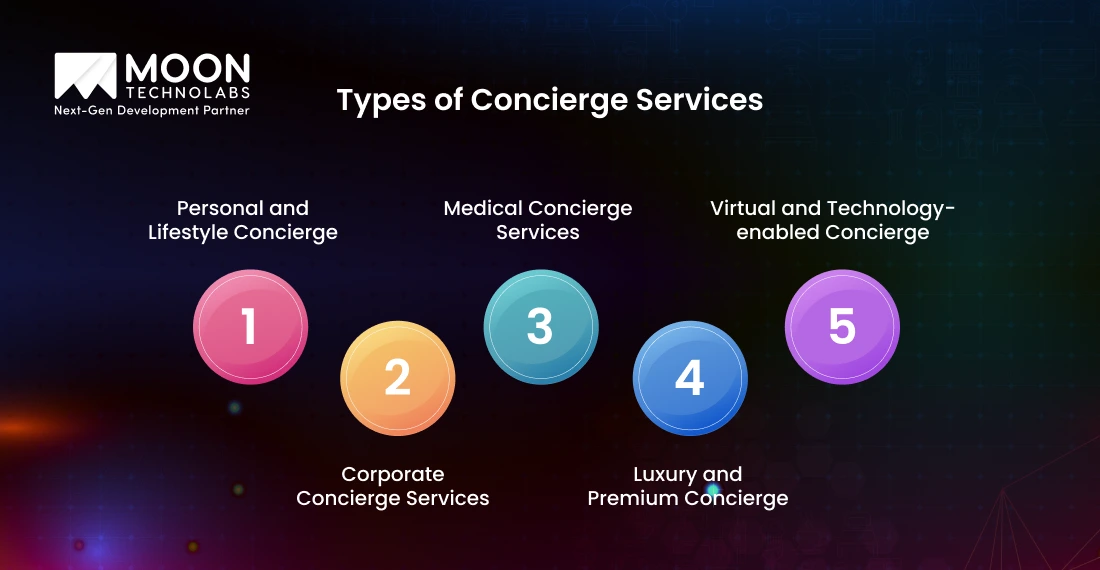
Concierge services are designed to simplify, personalize, and elevate experiences. Whether you’re an individual, business, or guest, you can access these services and get help by handling specialized tasks, streamlining daily routines, and meeting unique needs across multiple industries.
Personal and lifestyle concierge services are designed to handle comprehensive life management. These solutions encompass a range of tasks, including grocery shopping, dry cleaning, travel arrangements, and event planning. They help individuals and businesses achieve a better work-life balance by providing support across all aspects.
Key Services:
Corporate concierge services are designed to enhance employee satisfaction and workplace efficiency. They help businesses by handling personal tasks that would otherwise consume employees’ time and resources. These services also directly help companies attract and retain talent while boosting productivity.
Key Services:
Medical concierge services cater to elderly patients, individuals with injuries, and those requiring ongoing healthcare support. Operating on flat-fee or retainer models, these services offer enhanced, personalized care and improved access to doctors.
Key Services:
Luxury concierge services are for affluent clients seeking privileged experiences and lifestyle enhancement. These services offer access to experiences that would otherwise be unattainable, including VIP event access, private dining with celebrities, and exclusive travel arrangements.
Key Services:
Virtual concierge services leverage technology to provide remote assistance without face-to-face interactions. These services offer flexibility and accessibility through digital platforms, mobile apps, and AI-powered systems.
Key Services:
Don’t let your core team waste valuable hours on repetitive tasks. Empower them with an intelligent concierge platform and watch productivity soar.
Build Your Concierge App
As explained above, concierge services operate as on-demand personal or corporate support systems. Hence, they have a structured workflow that streamlines requests and delivers tailored solutions.
They provide support services for busy professionals, employees, and clients, including travel planning, event coordination, and appointment scheduling. Usually, these services can be accessed through individuals, dedicated teams, or specialized companies. They often offer 24/7 availability, either in person or via digital platforms.
Businesses can offload time-consuming functions, such as administrative support and client management, to experts, allowing them to focus on their core priorities.
Here’s the entire process of how these services work:
The process usually begins when a client submits a request via dedicated phone lines, apps, websites, or directly to the concierge staff. The concierge then listens to and clarifies the client’s needs.
Once the concierge clarifies the needs, it assesses tasks, whether it’s booking travel, arranging events, handling personal errands, or resolving specific operational challenges.
Once the request is clear, the concierge uses their network, expertise, and technology to fulfill the request. It builds a customized plan by coordinating with vendors, service providers, or internal resources as necessary.
The concierge ensures services are executed promptly and provides real-time updates to the client throughout the process. After notifying the client, it may also follow up to ensure satisfaction and collect feedback for service improvement.
Modern concierge services allow clients to track their service requests by leveraging digital platforms and workflow management tools, receive notifications, and rate service quality seamlessly.
Concierge services follow a structured process to ensure multi-channel accessibility, rapid response, and high service personalization for time savings. Such tailored experiences, achieved through continuous follow-up, elevate experiences for both businesses and individual users alike.
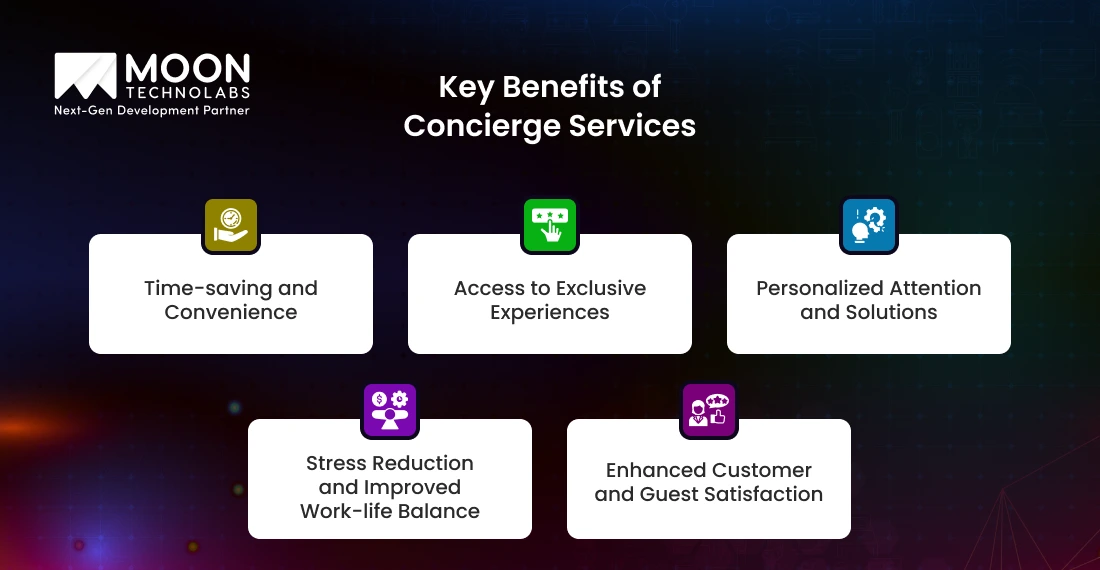
Successful concierge services across industries prioritize understanding and anticipating customer needs. This requires investment in customer relationship management and personalized service delivery. Let’s look at the key benefits across industries:
Concierge services are highly beneficial in saving time by streamlining time-consuming tasks and errands. They help free employees and business leaders to concentrate on their core work and priorities.
Example: Many global technology companies utilize corporate concierge programs to manage travel bookings and personal errands for employees. It helps them with a 2.7-hour return on each request and a significant boost in workplace productivity.
Businesses can gain access to many bookings and reservations that are typically difficult to obtain. They can also attend many privileged events and insider experiences that ordinary channels can’t offer.
Example: In the hospitality industry, luxury hotels leverage concierge teams to secure VIP access to sold-out concerts or exclusive restaurant tables.
Concierge professionals tailor each service to the unique needs and preferences of their clients. Everything from arranging custom travel itineraries to recommending wellness services can be personalized.
Example: Tailored employee support programs offer fully personalized services, ranging from private spa appointments to custom fitness classes tailored to the diverse needs of the workforce.
Concierge services help reduce stress and prevent burnout among employees. By offloading personal and professional logistical burdens, they also result in greater job satisfaction.
Example: Corporate firms that offer concierge services for home management and running errands report that their teams experience less stress and improved engagement.
Concierge services enhance user and guest experiences by providing thoughtful, prompt support. By responding proactively to their needs, they enhance satisfaction and repeat business.
Example: Hotels with robust concierge programs consistently rank higher in guest loyalty and online reviews thanks to their white-glove assistance.
Launching a successful concierge business begins by defining your niche and services. This would help build your brand and leverage technology for streamlined operations.
Here are the essential steps to help anyone looking to open a similar business and avoid common pitfalls that can hinder lasting growth:
The first step in launching a successful concierge business is conducting thorough market analysis and developing a strategic plan. It’s essential to understand your target market, local competition, and service differentiation opportunities for a strong foundation.
These include analyzing local competitors, pricing models, market trends, and demand patterns. These components will help identify market gaps, target segments, and assess licensing requirements.
The second step is to establish a proper legal framework to ensure compliance with business operations. The choice of business structure affects taxes, liability, and operational flexibility.
The legal considerations you should pay attention to include choosing an appropriate business structure, registering a business name, obtaining the necessary license, and securing insurance coverage. These will help understand local compliance regulations and set up financial systems.
In the third step, businesses require robust technology platforms to manage operations. Essential technology infrastructure tools include communication systems, task management and CRM software, accounting systems, payment processing systems, and interaction platforms.
The fourth step starts with clearly defining service offerings and pricing models. This helps establish market position and customer expectations for service portfolio development.
These include personal assistance services like errands and appointments, specialized services, event planning, exclusive experiences, and corporate support.
The fifth step takes your business on a journey to find a qualified team with the appropriate skills and training. Key factors to consider when hiring include effective communication skills and exceptional customer service.
Apart from that, the team should also possess local market knowledge, service discretion, multicultural and multilingual capabilities, as well as technology proficiency.
The sixth step helps you develop marketing strategies to enhance brand recognition and attract your target customers. The marketing channels you should focus on include a website with clear descriptions, referral programs, testimonials, social media, content marketing, luxury brands, hotels, and B2B relationships.
The final step is crucial to the successful launch of a business and requires careful coordination of operations, marketing, and customer service. Key considerations include building pilot programs, optimizing platforms, expanding services, developing partnerships, and implementing continuous improvement.
For businesses considering entry into the concierge services market, it is essential to understand the challenges so they can address them promptly. Whether they enter through traditional service models or digital app-based solutions, the key lies in understanding local market dynamics.
Here are some challenges they should be aware of before investing in appropriate technology infrastructure to keep delivering best-in-class customer experience:
Challenge: Consistent, exceptional service across all client interactions. Variability in staff performance, training gaps, and a lack of standardized protocols can lead to inconsistent experiences.
Solution: To address this, companies must invest in training and implement quality assurance programs with regular performance evaluations and feedback systems.
Challenge: Unique, last-minute, or highly specific requests require creative problem-solving and extensive networks.
Solution: Managing such complexity demands deep local knowledge, strong vendor relationships, and adaptability with proper tools and experienced staff.
Challenge: Handling sensitive personal information such as travel itineraries, health details, or financial data requires strict data protection measures.
Solution: Concierge services must implement secure systems, train staff on confidentiality, and comply with data privacy regulations like GDPR or HIPAA.
Challenge: Over-reliance on technology can erode the personalized, empathetic service that defines concierge excellence.
Solution: Utilize technology efficiently to streamline operations —such as request tracking or automated updates —without compromising human connection, discretion, or emotional intelligence.
Deliver hyper-personalized experiences with an AI-powered concierge app that anticipates needs and streamlines services with intuitive designs.
Talk to an Expert
The concierge services industry boasts a highly innovative approach that combines traditional hospitality values with modern technology. With global market valuations ranging from nearly USD 1 billion to over USD 16 billion, the industry demonstrates robust growth potential.
Here’s how technology can play a crucial role, driven by rising affluent populations, digital transformation, and changing lifestyle preferences with concierge app development:
Modern concierge apps require comprehensive feature sets to deliver seamless user experiences and ensure broad user adoption. Some of these include profiles, AI recommendations, booking, payments, voice integration, geolocation, and third-party integrations.
Selecting the right technology stack ensures optimal app performance, scalability, and efficient maintenance. While integrating it, some platform considerations are necessary:
Emerging technologies continue to reshape the capabilities of concierge apps and user expectations. With personalization of digital experiences, you can invest in:
Is your concierge business struggling to keep up with evolving expectations and the fast-paced demands of personalized service?
Many companies find themselves limited by outdated systems, overwhelmed by manual processes, and unable to scale the one-on-one attention users now expect.
We are a custom software development company specializing in building software products for concierge businesses across healthcare, real estate, corporate services, and luxury markets.
At Moon Technolabs, we tackle your pain points head-on by integrating cutting-edge AI, secure cloud technology, and intuitive mobile experiences that automate tasks, personalize service, and keep your operations seamless.
Don’t let legacy systems or operational bottlenecks hold you back. Partner with Moon Technolabs to reimagine modern customer experiences with concierge apps.
Connect with us today to start building your next-generation concierge app.
The industry’s evolution from medieval castle keepers to AI-powered digital assistants illustrates its fundamental resilience and adaptability.
Companies like Magic have shown how simplifying user interfaces can drive adoption. On the other hand, Quintessentially’s experience demonstrates both the potential for global expansion and the importance of sustainable operational models.
Hence, success in this market requires a balanced approach that combines technological sophistication with genuine human service excellence.
01
02
03
04
05

Jayanti Katariya is the CEO of Moon Technolabs, a fast-growing IT solutions provider, with 18+ years of experience in the industry. Passionate about developing creative apps from a young age, he pursued an engineering degree to further this interest. Under his leadership, Moon Technolabs has helped numerous brands establish their online presence and he has also launched an invoicing software that assists businesses to streamline their financial operations.


Submitting the form below will ensure a prompt response from us.
We refine our expertise to deliver innovative business solutions.





500 N Michigan Avenue, #600, Chicago IL 60611
13500 Long Is Dr, Pflugerville, TX 78660, USA

C-105, Ganesh Meridian, S.G. Highway, Ahmedabad, GJ 380060


 France
“ I highly recommend Moon Technolabs as the quality of service is wonderful. We have hired this company to develop the product based on some complex & technical issues. We get the best quality services as compared with others in the market. Huge Thanks to Moon Technolabs as the team is always ready to give the solution all time.”

 USA
USA“ Moon Technolabs is a pioneer in the WebRTC based project as they have fixed complicated segments of the module by fulfilling different product lines by providing 24X7 customer support. We really recommended Moon Technolabs as they are able to develop products as per the module deadline and project timeline.”

 Germany
“I am happy to recommend Moon Technolabs for their app development services. They successfully developed apps for me, and I am highly satisfied with the overall outcomes. The development team has swiftly addressed the issues with responsive and effective communication to understand the requirement quickly and actively resolve the back-and-forth problems that arose...”
 USA
USA“Moon Technolabs is the best company that provides advanced apps and websites development services in the USA and Europe. I am a newbie to develop my app with an external team. I am really happy to work with them as I am not that much mobile apps user. Here, the team and specially the CEO of Moon Technolabs helps me to let me know about the benefits of my app to generate revenue....”


