
 Total Views: 2244
Table of Content


Blog Summary:
This blog explains the importance of cloud computing adoption in the insurance industry. It highlights key advantages and real-world use cases. The blog also covers deployment strategies, challenges in cloud adoption, and its future in the insurance industry, with insights from Moon Technolabs.
Table of Content
The insurance industry is currently undergoing a significant shift, driven by the unshakable adoption of cloud-based solutions. The technology has drastically improved the way operational processes of insurance companies are conducted. Hence, they are now rethinking their procedures to enhance customer experiences and accelerate business growth.
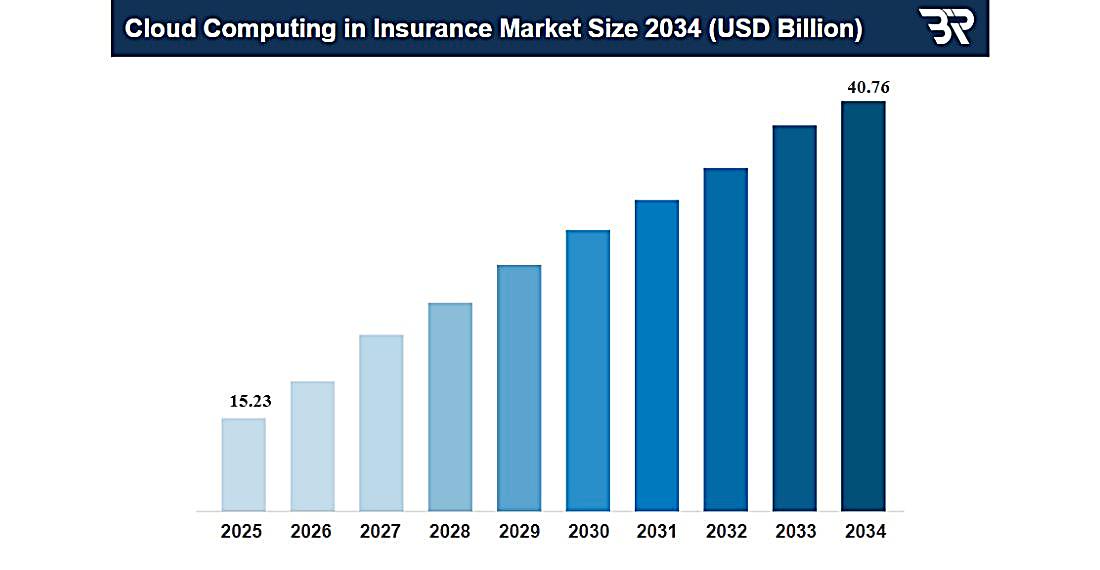
The cloud computing market is reaching sky-high levels, and a recent report suggests that it is set to surpass $40.76 billion by 2034. This presents a safe opportunity in the insurance market.
Through cloud-based insurance solutions, insurers can now rationalize their operations, enhance efficiency, and access real-time data to make informed decisions. The insurance industry is increasingly adopting cloud technology because of its scalability, cost-effectiveness, and advanced data security.
This article examines how cloud computing is transforming the insurance industry. We’ll also cover the benefits as well as the challenges that insurers may encounter during cloud adoption. Additionally, we will discuss best practices to help them navigate this journey successfully.
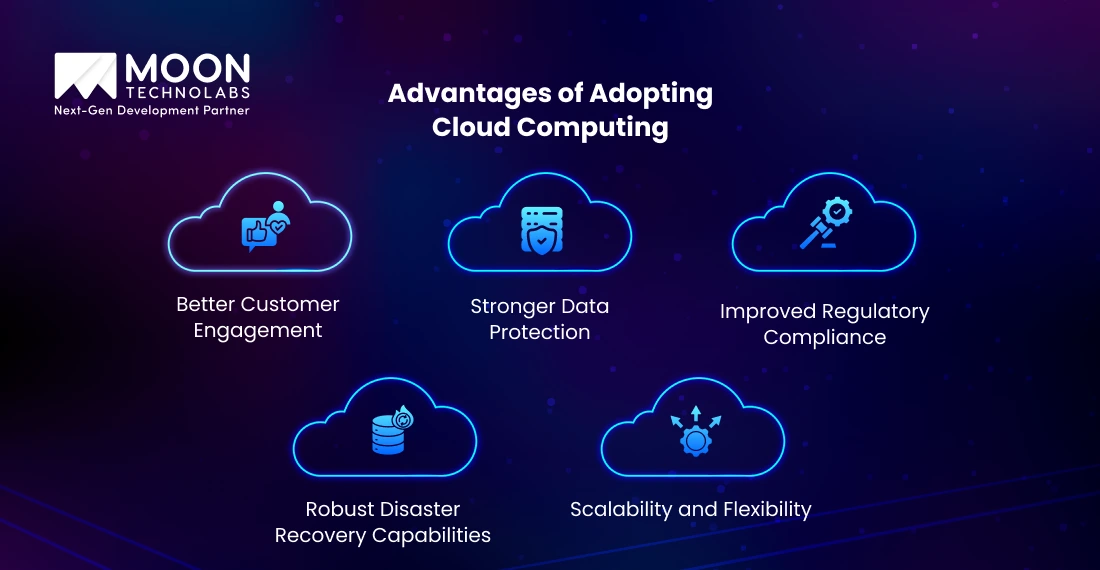
Cloud solutions have numerous benefits for insurance companies. It fundamentally changes how companies operate, serve customers, and manage risk. Let’s dissect each advantage in detail:
With cloud solutions, insurers can provide a more personalized, efficient, and seamless customer experience. Cloud platforms accelerate the policy issuance process, renewals, and claims processing. Moreover, it allows customers to access services 24/7 through self-service portals, mobile apps, and chatbots.
By leveraging cloud-based advanced analytics and AI, insurers can analyze vast amounts of customer data to create tailored policies, customized pricing, and targeted recommendations, leading to higher customer satisfaction and loyalty.
Moreover, cloud-based platforms offer a 360-degree view of the customer. This enables consistent and personalized communication across channels.
Data security is the most significant concern for the insurance industry. Cloud providers offer robust security features that are more advanced than those found in on-premises systems.
They invest heavily in cutting-edge security measures, including encryption, multi-factor authentication, and continuous monitoring, to protect sensitive customer information.
Moreover, they have expert security teams who continuously monitor for threats and update security measures. Cloud solutions providers also offer a secure, centralized repository for data, simplifying data management and protecting against unauthorized access or breaches.
The insurance industry is highly regulated. Cloud solutions help companies meet complex compliance requirements. Many cloud providers offer built-in tools and services designed to meet specific industry regulations and legal standards, such as GDPR and HIPAA.
Additionally, cloud platforms can automate reporting and provide detailed audit trails. Hence, this makes it easier for insurers to demonstrate compliance with regulatory bodies. Cloud-based systems allow insurers to adapt more quickly to new regulations without the need for costly and time-consuming system overhauls.
Cloud Computing in Insurance industry enhances an insurer’s ability to recover from natural calamities, cyberattacks, and system failures. For this, the cloud service providers store data across multiple, geographically diverse data centers, eliminating a single point of failure and ensuring that data remains accessible even if one location is compromised.
Cloud-based disaster recovery (DR) restores critical data and applications in minutes or hours, compared to the days or weeks it might take with traditional on-premises systems. Moreover, cloud DR eliminates the need for insurers to invest in and maintain a secondary, physical data center.
Cloud solutions offer the scalability and flexibility that traditional IT infrastructures often lack. The insurance industry experiences fluctuating workloads, such as a surge in claims following a major natural disaster.
Therefore, cloud platforms enable insurers to scale their resources up or down as needed automatically. It ensures they have the necessary capacity without over-provisioning and incurring unnecessary costs.
The flexibility of the cloud enables insurers to quickly test and deploy new applications and services. Therefore, it accelerates product development and reduces time-to-market.
Moreover, the pay-as-you-go pricing model of the cloud enables insurers to pay only for the resources they use. It results in significant cost savings compared to maintaining and upgrading expensive on-premises hardware.
Cloud solutions are transforming the insurance industry by providing a flexible and scalable infrastructure that enables companies to modernize their operations and improve efficiency. Let’s check out some of the key application areas.
Cloud computing and advanced data analytics work together to enable insurers to create policies tailored to individual needs and preferences. Cloud-based analytics platforms create highly customized insurance products through data analysis from various sources, including lifestyle information, personal data, and risk profiles.
Insurers can use data from IoT devices, telematics, and other sensors to monitor policyholders’ behavior in real-time and offer dynamic policies. They can also integrate external data sources, like credit scores and IoT-generated risk data, to make more data-driven and personalized underwriting decisions. Moreover, cloud platforms enable insurers to offer more competitive premiums based on accurate risk assessments, thereby attracting a larger customer base.
Cloud-based solutions reduce the time and cost associated with claims processing, which is a time-consuming and manual process. Cloud-based claims management systems enable real-time tracking and automated approvals. With AI-driven analytics, insurers can process claims and assess damage in minutes, not weeks.
Check out Our Portfolio:
Moreover, predictive analytics and machine learning algorithms on the cloud can analyze claims data to detect anomalies and identify potential fraud cases in real-time, reducing financial losses.
The cloud provides a centralized repository for claims data, making it easier for adjusters, underwriters, and other stakeholders to collaborate and make faster, more informed decisions.
Risk assessment is the core part of the insurance sector. Cloud-based platforms provide real-time access to massive datasets, enabling insurers to evaluate risks with greater accuracy. They achieve this through big data analytics, predictive modeling, or catastrophe modeling.
Cloud platforms can process large volumes of structured and unstructured data from various sources, including social media, IoT devices, and public records, to identify patterns and predict potential risks.
Furthermore, advanced machine learning algorithms can analyze historical data to predict the likelihood of future claims. It enables more accurate underwriting decisions and pricing models.
Cloud solutions empower insurers to assess catastrophe risks and manage liability with science-driven insights and a comprehensive view of emerging risks, including cyberattacks and pandemics.
Cloud computing offers a foundation for more effective and data-driven marketing strategies in the insurance industry. First is hyper-personalized campaigns, where cloud-based analytics enable insurers to understand customer behavior and create highly personalized marketing campaigns. It directly targets the right audience with the right products.
Then comes data-driven engagement, where insurers anticipate customer needs and provide tailored recommendations through AI-driven insights. It enhances engagement and creates opportunities for cross-selling.
Cloud solution providers empower insurers to provide a seamless, personalized, and convenient customer experience. They offer 24/7 access. Cloud-based portals and mobile apps enable policyholders to manage their accounts, view policy details, file claims, and receive updates at any time and from anywhere.
Additionally, cloud-based CRM solutions enable omnichannel communication, providing a unified view that allows insurers to offer consistent and personalized service across all touchpoints.
The speed and agility of cloud platforms enable insurers to launch new products, services, and features faster, ensuring they meet evolving customer demands and stay ahead of the competition.
We help you adopt custom cloud strategies through modernized legacy systems and enhanced scalability to outperform competitors ultimately.
Schedule a Call With An Expert
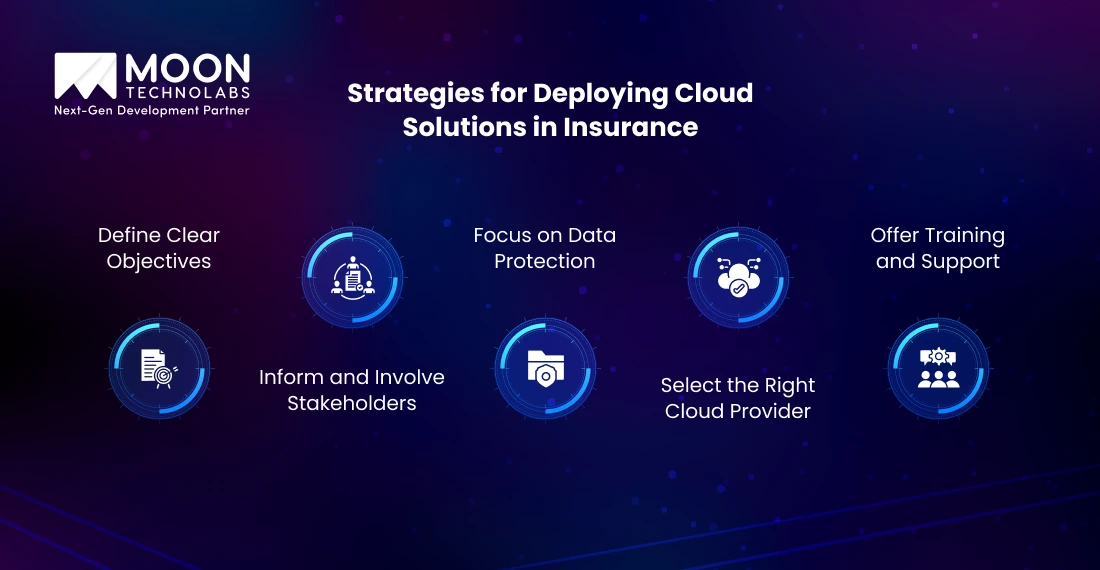
Deploying cloud solutions in the insurance industry requires thoughtful planning and effective execution. Some effective strategies enable insurers to streamline operations, scale efficiently, and deliver improved customer experiences.
Let’s check them out:
When deploying a cloud solution, the first step is to understand the reasons behind it. Insurance companies need to reduce operational costs, improve customer service with faster claims processing, and launch new products more quickly.
Moreover, when you define objectives, it helps you choose the right cloud service partner. Without a clear goal, you risk wasting time and money on a solution that doesn’t meet your business needs.
Cloud migration is a significant change that affects everyone, from IT staff to underwriters and claims adjusters. It’s crucial to involve key stakeholders from all departments early in the process.
This ensures that the new system meets the needs of its future users and helps to build buy-in. When people feel like they’re part of the process, they’re more likely to embrace the change and help make it a success.
Insurance companies handle a lot of sensitive data, including personal information, health records, and financial details. Hence, data security becomes a top priority.
When moving to the cloud, ensure your data is protected from breaches and complies with regulations such as GDPR or HIPAA. You can use strong encryption, implement strict access controls, and collaborate with a cloud provider that has robust security measures in place.
Then comes selecting the right cloud services provider, which is quite a critical decision because not all providers are ethical. To make an informed decision, consider factors such as their security track record, compliance certifications, pricing models, and the specific services they offer.
A provider with a deep understanding of the financial services industry and its unique regulatory requirements is a great advantage.
Lastly, a new system is only as good as the people using it. To ensure a smooth transition, provide comprehensive training and ongoing support for all employees. This includes training on the new software, security protocols, and troubleshooting common issues. 4
It’s also beneficial to have a dedicated support team to answer questions and assist with any issues that may arise. It ensures that employees can utilize the new system effectively, thereby maximizing its benefits.
Undoubtedly, there are numerous benefits of cloud adoption in the insurance sector. However, it also presents significant cloud implementation challenges, particularly in terms of security, data management, and compliance.
The fundamental issues revolve around the shared responsibility model and the complexities of data migration. The problems are also related to dependence on network infrastructure and navigating a labyrinth of regulatory compliance requirements.
The shared responsibility creates confusion and security gaps. In this model, the cloud provider is responsible for the security of the physical infrastructure, network, and hardware. At the same time, the insurance company is responsible for security in the cloud. It involves protecting its own data, applications, operating systems, and configurations.
Misconfiguration is one of the biggest risks in cloud services. Simple errors, like leaving a storage bucket publicly accessible or improperly setting user permissions, can expose massive amounts of sensitive policyholder data, leading to a serious data breach.
Lack of clarity is also one of the risks where the exact division of responsibility varies between cloud providers and service models. If an insurance company’s IT team doesn’t fully understand its obligations, it can leave critical vulnerabilities unaddressed.
Identity and Access Management (IAM) is about properly managing who has access to what data and resources, as it’s a major customer responsibility. Poorly implemented IAM controls lead to unauthorized access, both from internal employees and external threats.
You may encounter challenges with cloud data migration. It’s mainly because of the sheer volume, sensitivity, and historical nature of their data. Insurers often have decades of data stored in various legacy systems. Hence, this makes the transfer a major undertaking.
Moving massive datasets from on-premise systems to the cloud carries the risk of data loss or corruption during the transfer process. This is particularly problematic for critical policy and claims data.
Many insurance companies rely on older, mainframe-based systems that don’t easily integrate with modern cloud platforms. Migrating this data requires careful planning, specialized cloud computing tools, and a phased approach to minimize disruptions to business operations.
A poorly planned migration can result in significant downtime, affecting everything from customer service and claims processing to billing and underwriting. The financial and reputational costs of a prolonged outage can be severe. So, it’s crucial to have a strong cloud migration strategy.
Cloud services rely on a stable, high-performance network connection to operate effectively. For insurance companies, network issues can severely impact their business.
Performance suffers if there’s high latency or low bandwidth between the insurance company’s internal network and the cloud provider. This can slow down critical applications and processes, such as real-time risk analysis or customer portal interactions.
Cloud services are also susceptible to outages, which can be caused by the provider’s technical issues or external factors, such as natural disasters. A widespread outage can bring all cloud-based operations to a halt, making it impossible to serve customers or access vital data.
The network itself is a potential vulnerability to attack. A strong network connection is essential, but it must be properly secured to prevent cyberattacks, such as denial-of-service (DoS) attacks or man-in-the-middle attacks, that could compromise data in transit.
The insurance industry is one of the most heavily regulated sectors, and adopting the cloud introduces new layers of complexity for compliance. Insurers must adhere to a patchwork of data privacy, security, and financial regulations.
Many regulations, such as the EU’s GDPR or local state laws in the U.S., dictate where sensitive data can be stored and processed. Insurers must ensure their cloud provider has data centers in the correct geographic regions to meet these requirements.
Moreover, regulators require insurers to maintain detailed audit trails and provide reports on how customer data is handled. While cloud providers offer tools for this, the insurance company is ultimately responsible for ensuring the data is auditable and that it can produce the necessary documentation.
Compliance requirements also change constantly. Hence, insurers must stay updated on new and evolving regulations and ensure their cloud strategy can adapt to these changes without incurring major penalties.
Our tailored cloud solutions for the insurance sector empower insurers to remain agile, innovative, and adaptive.
Get Started with Cloud Today
Cloud computing commits a radical transformation for the insurance industry. Cloud technology is expected to transform the insurance industry by leveraging AI and machine learning to refine data analytics and drive more informed decision-making.
Hence, it leads to more precise risk assessments and personalized product offerings. This will improve customer engagement through seamless interactions and customized services.
Additionally, integrating blockchain with cloud platforms will revolutionize insurance processes by increasing transparency and accelerating claim settlements. Collaborative cloud ecosystems will also encourage innovation between insurers and startups. Stronger security features will be crucial for protecting data as regulations change.
Innovation, a customer-centric focus, and increased efficiency will characterize the future of cloud computing in the insurance sector. It will address current challenges while creating a more secure digital environment for significant growth.
Digital insurance solutions change the insurance industry by enhancing efficiency, reducing costs, and fostering collaboration. However, this shift comes with challenges.
To fully leverage the potential of cloud computing, you must navigate risks such as security threats, data privacy issues, and regulatory compliance requirements. By implementing robust protocols and leveraging expertise, insurance companies can overcome these hurdles to stay competitive.
Need Help with cloud-based insurance software development? Moon Technolabs can help. With over 300 talented and experienced professionals, we are confident in our ability to deliver optimized solutions tailored to your business needs. Contact us for a free consultation.
01
02
03
04

Jayanti Katariya is the CEO of Moon Technolabs, a fast-growing IT solutions provider, with 18+ years of experience in the industry. Passionate about developing creative apps from a young age, he pursued an engineering degree to further this interest. Under his leadership, Moon Technolabs has helped numerous brands establish their online presence and he has also launched an invoicing software that assists businesses to streamline their financial operations.


Submitting the form below will ensure a prompt response from us.
We refine our expertise to deliver innovative business solutions.





500 N Michigan Avenue, #600, Chicago IL 60611
13500 Long Is Dr, Pflugerville, TX 78660, USA

C-105, Ganesh Meridian, S.G. Highway, Ahmedabad, GJ 380060


 France
“ I highly recommend Moon Technolabs as the quality of service is wonderful. We have hired this company to develop the product based on some complex & technical issues. We get the best quality services as compared with others in the market. Huge Thanks to Moon Technolabs as the team is always ready to give the solution all time.”

 USA
USA“ Moon Technolabs is a pioneer in the WebRTC based project as they have fixed complicated segments of the module by fulfilling different product lines by providing 24X7 customer support. We really recommended Moon Technolabs as they are able to develop products as per the module deadline and project timeline.”

 Germany
“I am happy to recommend Moon Technolabs for their app development services. They successfully developed apps for me, and I am highly satisfied with the overall outcomes. The development team has swiftly addressed the issues with responsive and effective communication to understand the requirement quickly and actively resolve the back-and-forth problems that arose...”
 USA
USA“Moon Technolabs is the best company that provides advanced apps and websites development services in the USA and Europe. I am a newbie to develop my app with an external team. I am really happy to work with them as I am not that much mobile apps user. Here, the team and specially the CEO of Moon Technolabs helps me to let me know about the benefits of my app to generate revenue....”


