
 Total Views: 5525
Table of Content


Blog Summary:
This blog offers a detailed, practical guide to the top 8 automation frameworks specifically designed for software testing in healthcare applications. It breaks down each framework’s strengths, suitability for healthcare QA requirements, compliance features, scalability, and real-world use cases. Readers will learn how to choose, implement, and scale the ideal testing frameworks for their healthcare web, mobile, EHR, and API-based applications—all while ensuring regulatory compliance and robust risk reduction.
Table of Content
Envision this: a hospital admin uses your application to update a patient’s medical plan. However, the update failed silently, and the information wasn’t saved. Consequently, the team continues to treat the patient using the outdated plan.
The scenario we just played out isn’t just another bug in the system; it is a compliance violation that poses life-threatening consequences to the patient. As healthcare apps manage everything from EHR integration to real-time patient vitals, it is crucial to invest in flawless QA.
With continuous FDA audits, extensive HIPAA requirements, and frequent feature rollouts, you cannot rely on guesswork to deliver a bug-free application. Automation frameworks can help you with fast, repeatable, and regulation-ready testing. It helps ensure reliable and scalable testing strategies.
In this guide, you will learn about the top 10 automated testing frameworks that meet the unique demands of the healthcare industry.
What if you pushed an update to your healthcare app, only to find a critical bug once the app has reached thousands of users? In the healthcare domain, every click impacts the patient’s safety and the accuracy of information shared. That’s why testing is no longer non-negotiable for the segment.
The automated testing framework provides you with tools, libraries, and practices that help your QA teams test faster with accuracy and consistency. Rapid regression with these tools allow you to catch bugs before they can harm your application.
For on-demand healthcare solutions like medicine delivery app and software development, it saves time, allowing your resources to focus on complex and edge-case scenarios.
When you consider the HIPAA, GDPR, and FDA regulations for healthcare, you must invest in QA that makes your app audit-ready. With the high-coverage, detailed logs and repeatable results that automated frameworks offer, you can check for critical compliance as well.
These frameworks also help tackle scalability challenges and provide support for cross-platform testing. Eventually, every release guarantees the app meets the quality benchmark, irrespective of the device where it is used.
These frameworks help you deliver safer, faster, and future-proof healthcare QA.
Healthcare app development poses different risks. Hence, your testing framework should meet the unique needs of the application. By choosing the right automation testing framework, you can reduce the testing hours, minimize errors and maintain app compliance.
Here are the main testing framework types and their benefits in healthcare QA:
These frameworks prioritize validating the individual code components, making them perfect for catching logic errors in the early stages. You can prevent these issues from snowballing into compliance with safety issues for your app.
You can use these frameworks to run the same test for diverse datasets. They will help you validate patient record imports from the different EHR systems accurately.
These frameworks incorporate pre-defined keywords to represent actions, helping non-technical members create and maintain the tests. It is great for cross-functional healthcare teams to ensure proper verification.
With these frameworks, you can describe the tests using plain language to improve collaboration between development, testers and compliance officers. This makes it easier for you to align software behaviour with regulatory expectations.
It combines various approaches to give you flexibility. For example, you can use the hybrid frameworks to blend data-driven testing with BDD to validate the complex and multi-step workflows.
Our healthcare app testing and QA specialize in automation testing strategies to deliver reliable software that meets HIPAA, FDA and HL7 standards.
Schedule Free Consultation
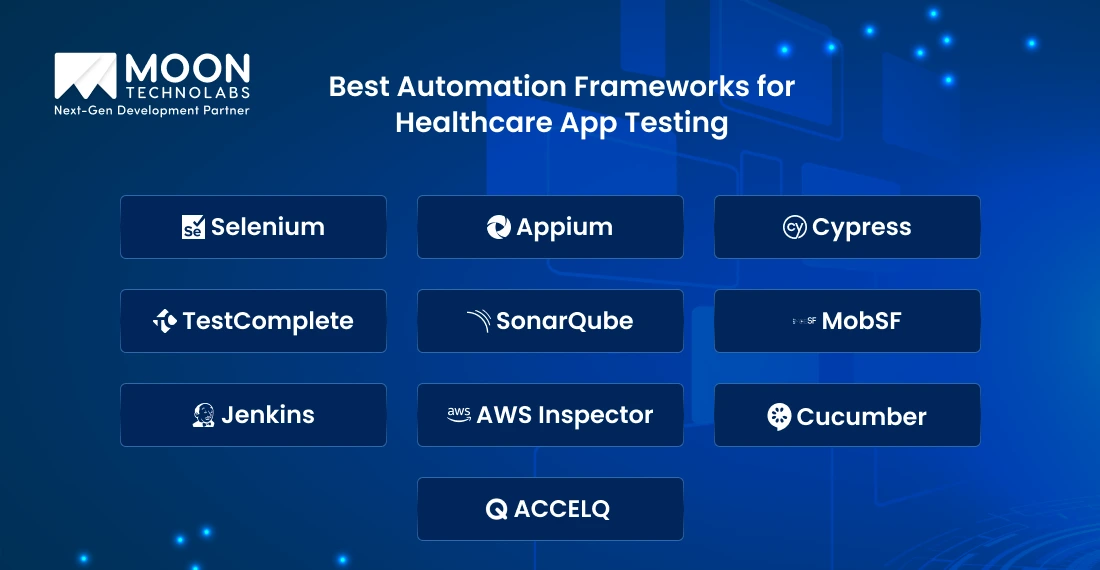
With diverse healthcare app testing automation frameworks available, finding the right one can seem like searching for a needle in a haystack. Here are the top 10 frameworks that offer scalability and healthcare-specific features:
If you have built a web-based healthcare app, then Selenium comprises all the essential testing tools. With this open-source framework, you can automate browser-based tests to validate your EHR dashboards and patient portals.
This framework helps with mobile web validation, API-driven workflow assessment and web UI testing. For example, you can use this tool for developing smart wearable devices and verify if the data flows flawlessly between the systems.
As it provides cross-browser coverage, audit-ready logging and flexible scripting for multiple languages, you can test for HIPAA and FDA compliance.
Moreover, Selenium integrates with your CI/CD pipelines, DevOps workflows and third-party tools to automate the regression cycles. It is the best fit for web automation, especially for native mobile applications.
Using this open-source framework, you can automate native, hybrid and mobile web apps. Subsequently, this tool is perfect for testing your telehealth platforms, patient monitoring solutions and medical device companion software.
While developing one of our clients’ app, DocTalk AI-powered healthcare app, Appium was utilized for robust mobile test automation across iOS and Android, ensuring HIPAA-compliant workflows and stable patient-facing features.
The true strength of this tool lies in its ability to conduct cross-platform automation. It can write tests that are then conducted on both iOS and Android devices. Moreover, it supports multiple programming languages and works with real devices to handle complex workflows, combining mobile and API testing.
The entire setup can take a lot of time and the execution speed is slower than native frameworks.
Cypress is a great tool if you want to build a modern healthcare app with lightning-fast feedback. It is designed for end-to-end testing and is a good fit for dynamic, JavaScript-backed apps. You can use it to test patient dashboards, telemedicine portals and lab result systems.
This framework provides features like fast execution, real-time reloading and intuitive syntax for quick test creation plus debugging. You can use it to manage API testing, and data exchanges between EHRs and the portal work seamlessly.
This tool integrates with CI/CD pipelines, DevOps workflows and tools like GitHub. Cypress supports only modern browsers, which can limit cross-browser coverage.
TestComplete is the ultimate tool for testing applications across mobile, web and desktop. It is an enterprise-grade automation tool that can help with GUI testing, making it a great fit for assessing the patient management systems, cross-platform healthcare workflows and EHR interfaces.
You can use this tool for defined object recognition, compliance-ready reporting and record-playback scripting. This platform can support multiple languages and handle all types of tests, including functional tests & regression cycles.
You can use the tool to integrate CI/CD pipelines, DevOps tools and platforms like Jenkins to offer continuous delivery. The flip side is that it is a licensed product, which increases the cost of testing.
SonarQube checks the health of your code before you go live with your app. It helps with static code analysis, helping healthcare development teams identify bugs, vulnerabilities and code issues early.
You can verify the backend services, APIs, EHR integrations and code handling sensitive data with this tool. SonarQube is a great addition to your list of automation frameworks for software testing, especially for developing medicine delivery apps that need to be highly compliant with HIPAA and GDPR, multi-language support and detailed quality reports.
The flip side is that it doesn’t execute functional tests, which is why you need other tools for mobile automation. However, it is best suited if you want to ensure clean, secure and compliant healthcare app codebases.
For healthcare apps, a security flaw isn’t a bug; it is a compliance issue. This open-source framework is specifically designed for mobile app security testing. It helps verify the telehealth platforms, patient monitoring applications and medical device companion software.
Using this tool, you can handle both static and dynamic analysis along with API security checks and vulnerability detection for Android & iOS. You can determine insecure storage, weak encryption and data leaks before risking the patient data.
As it integrates with CI/CD pipelines and DevSecOps workflows, you can enable automated scans. This platform focuses on security tests alone; you will need other tools for full test coverage.
If you want to ensure perfect healthcare app testing and deployment, Jenkins is your go-to tool. It helps with orchestrating the mobile, web, API and EHR testing within a continuous integration and continuous delivery (CI/CD) environment.
You can use it to automate the build, test and deployment pipelines. It can easily integrate with Selenium, Appium, SonarQube and other tools with the diverse plugins. With its flexibility, you can release the apps faster without compromising quality or compliance.
The disadvantage of using this tool could be a complex setup and maintenance. It is a must-include to your tool collection because of its scalable and compliance-friendly nature.
AWS Inspector helps with cloud security, which is critical for healthcare apps. It automates vulnerability management services. It can scan the AWS-hosted healthcare app to check for security risks, compliance issues and misconfigurations.
You can use the tool to assess web platforms, EHR systems and APIs that run on AWS to verify they meet the GDPR and HIPAA guidelines. The core strengths of the tool include risk scoring and integrations with other AWS services. This tool fits into the CI/CD and DevSecOps workflows seamlessly. The only limitation is that this tool is AWS-specific.
Cucumber is a behaviour-driven development framework that lets you write the tests using plain language. This way, it ensures the developers, testers and compliance teams are aligned.
If you have transparent and traceable web, mobile, API and EHR workflows, you should use this tool for QA. It offers complete documentation, ensures easy stakeholder collaboration and clear compliance trails. Eventually, it is best suited for HIPAA and FDA audits.
You can easily integrate it with CI/CD pipelines, DevOps tools and frameworks like Selenium. It may be slower for complex scripts, which could be its limitation.
If you want to automate your QA team without heavy coding, go for ACCELQ. It is a no-code and AI-backed test platform that is built for enterprise-grade applications. You can use the tool to test web apps, mobile solutions, APIs and complex EHR workflows.
The advantages include natural language test creation, end-to-end automation and self-healing scripts. It supports HIPAA and FDA compliance requirements and ensures traceability. The high licensing cost and customization that come with this tool could become its limitation.
If you need speed and scalability, you should use ACCELQ for QA.
Selecting the right automation framework is no longer a technical decision; it is a compliance-driven choice. When looking for the right framework, you should ensure it matches your app’s platform, regulatory requirements and team capabilities.
Determine if your app is a mobile, web, API-backed or EHR-integrated system. Based on this, you can identify the frameworks that specialize in these environments.
If you are working within the guidelines provided by HIPAA, GDPR and FDA, you need frameworks that are completely aligned. Look for platforms that provide secure data handling, long-term data retention and audit trails.
Some frameworks require advanced coding, while others come with no-code and low-code needs. This will be critical, especially when business users are involved in testing.
Look for a framework that will connect seamlessly with CI/CD pipelines and DevOps tools. It should also align with the test management systems.
Look for solutions that are documented and actively supported. It should adapt to the evolving regulations or workflows.
| Criteria | What to look for |
|---|---|
| Compliance readiness | Audit logs, security checks, HIPAA/GDPR support |
| Supported platforms | Web, mobile, EHR, API |
| Ease of integration | CI/CD, Jira, DevOps |
| Maintenance & scalability | Community support, extensibility, docs |
| Security and privacy testing | Encryption checks, vulnerability scans |
| Adaptability | Updates on workflows and new regulations |
You should look for a framework that helps you release a bug-free, fully compliant and scalable healthcare application.
Partner with our testing specialists to release healthcare applications that meet the highest safety, compliance and performance standards.
Talk to Our Experts
Your automation framework is the QA backbone for your healthcare application. As patients and compliance auditors cannot handle bugs or risks, you need a framework that supports speed, safety and stability of your application.
Your automation framework will meet the HIPAA/GDPR demands and will test your app on all platforms/devices to minimize risks. It will provide compliance, coverage and scalability needed to release a bug-free application.
Moon Technolabs is an excellent HIPAA-compliant QA and healthcare app testing services provider. If you need help releasing a stable and reliable healthcare application with confidence, schedule a one-on-one strategy meeting with our team. meeting with our team.
01
02
03
04

Jayanti Katariya is the CEO of Moon Technolabs, a fast-growing IT solutions provider, with 18+ years of experience in the industry. Passionate about developing creative apps from a young age, he pursued an engineering degree to further this interest. Under his leadership, Moon Technolabs has helped numerous brands establish their online presence and he has also launched an invoicing software that assists businesses to streamline their financial operations.


Submitting the form below will ensure a prompt response from us.
We refine our expertise to deliver innovative business solutions.



500 N Michigan Avenue, #600, Chicago IL 60611
13500 Long Is Dr, Pflugerville, TX 78660, USA

C-105, Ganesh Meridian, S.G. Highway, Ahmedabad, GJ 380060


 France
“ I highly recommend Moon Technolabs as the quality of service is wonderful. We have hired this company to develop the product based on some complex & technical issues. We get the best quality services as compared with others in the market. Huge Thanks to Moon Technolabs as the team is always ready to give the solution all time.”

 USA
USA“ Moon Technolabs is a pioneer in the WebRTC based project as they have fixed complicated segments of the module by fulfilling different product lines by providing 24X7 customer support. We really recommended Moon Technolabs as they are able to develop products as per the module deadline and project timeline.”

 Germany
“I am happy to recommend Moon Technolabs for their app development services. They successfully developed apps for me, and I am highly satisfied with the overall outcomes. The development team has swiftly addressed the issues with responsive and effective communication to understand the requirement quickly and actively resolve the back-and-forth problems that arose...”
 USA
USA“Moon Technolabs is the best company that provides advanced apps and websites development services in the USA and Europe. I am a newbie to develop my app with an external team. I am really happy to work with them as I am not that much mobile apps user. Here, the team and specially the CEO of Moon Technolabs helps me to let me know about the benefits of my app to generate revenue....”


