
 Total Views: 562
Table of Content


Blog Summary:
This blog explains how you can simplify and speed up your company’s purchasing processes with the automated purchasing system. It covers the key features, benefits, and steps to follow to implement the automation successfully. You will also learn about new technologies that pave the way for smarter procurement and automation that save you time.
Table of Content
Did you know that procurement inefficiencies like delayed approvals or inaccurate vendor data can cost your business millions each year? As your business grows, managing purchases manually becomes time-consuming and risky.
Automating your purchase processes is no longer an option; It gives you a strategic edge while establishing control, consistency, and compliance. To ensure a smooth automation, you must invest in the right tools, workflows, and structure. That’s when you get complete visibility into your spending.
This blog will take you through Automated Purchasing Systems, helping you understand what they are and how they function. Whether you plan to modernize your procurement processes or reduce human errors, this guide will serve you with the right components and best practices.
Automated purchasing systems are a smarter, faster way to manage your buying processes. As everything is stored in a single place digitally, you don’t need to juggle between spreadsheets or chase approvals.
Let’s understand how this procurement automation process works. When someone wants to purchase, they will raise a request using the automated system. This system will send it to the appropriate manager for approval and create the purchase request. Simultaneously, it will notify the supplier, track the order, and even update the payment details.
All these functions run seamlessly without manual intervention, so you can’t miss deadlines or approvals. APS is valuable to our business because it offers better visibility and control.
Additionally, you can see the purchases, the money spent on them, and track them in real time. Eventually, you can reduce errors while ensuring everyone stays on the same page.
In short, with APS in your business, you can eliminate chaos from the entire procurement process. It will save time, reduce costs, and help you stay organized.
With an automated purchasing system, you can redefine how you manage approvals or buying. It digitizes and streamlines the procurement process from raising requests to managing payments, eliminating errors, delays, and unnecessary paperwork.
This system guarantees faster approvals, accurate tracking, and better visibility into spending. As a result, your team can make smarter and data-backed decisions that improve business outcomes.
Automation also allows you to control budgets better, ensuring purchases comply with business policies. They aim to reduce overspending and unauthorized buying. When all your data is stored in a single place, you can easily monitor your vendor’s performance and determine money-saving opportunities.
So, whether you are a small business or a large enterprise, you can automate purchase processes to boost efficiency, improve compliance, and gain a clearer financial understanding. This will help you run your business smoothly while saving costs.
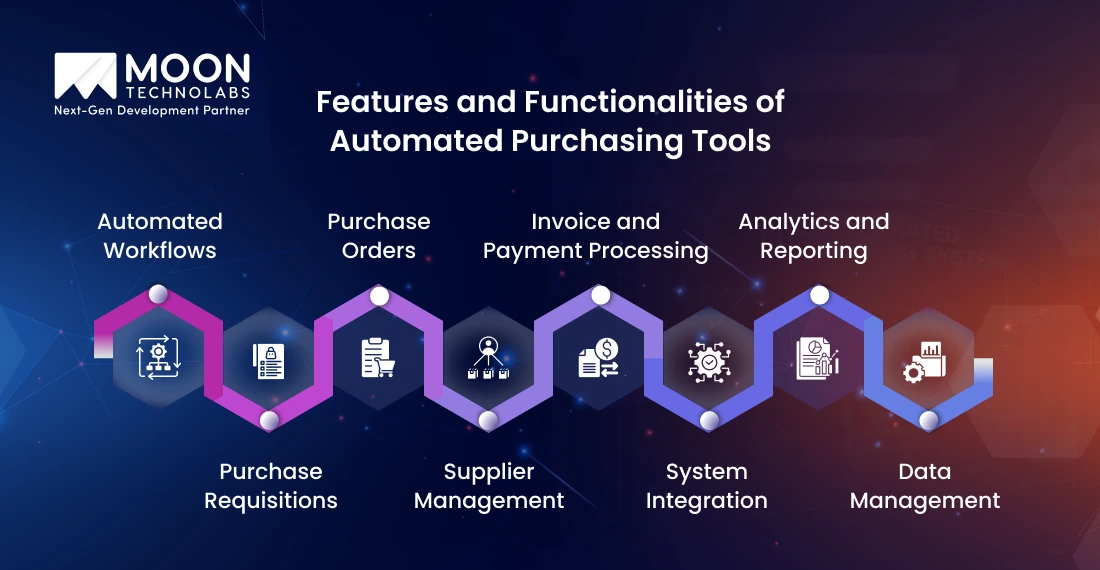
The automated purchasing tools are packed with features that make procurement faster, easier, and more accurate. Each functionality ensures that the entire process — from request to payment—runs smoothly.
Let’s look at the key features that make this system powerful:
You can create customized workflows with automated purchasing tools. Using these workflows, you can route purchase requests and approvals to the right people according to the company rules.
Consequently, they reduce delays and bottlenecks, allowing every request to follow a consistent process. Add automated notifications and reminders, and you will notice that nothing slips through the cracks.
With this feature, your employees can request goods and services without filling out manual forms or sending emails. They need to fill in the details into the system, and requests are automatically raised. These requests are then reviewed, approved, and modified as needed. Overall, they help maintain clarity and speed up decision-making for your business.
When the system approves the requisition, it will generate a purchase order and send it to the supplier. You will notice greater accuracy in pricing, delivery timelines, and quantities as a result. These systems allow you to track all your purchase orders from a single place, improving accountability and enabling real-time status monitoring.
It is very common for most businesses to have multiple vendors. Managing them can be challenging and complex. However, automated systems have simplified this process by storing all supplier details—contact information, contracts, and performance history — in a single place.
You can easily assess these factors to determine their reliability, pricing, and compliance, which helps negotiate deals and close them faster.
You can extend automation to invoice matching and payment approvals as well. Using this system, you can verify the invoices against their purchase orders and delivery receipts to determine discrepancies before completing payment. It will also minimize human error, ensuring timely and accurate payments.
The modern automated purchasing system can integrate with your accounting, ERP, and inventory systems to give you better control over data. It also helps you manage data effortlessly, removing duplication.
Moreover, integration helps finance teams access procurement data in real time for better financial planning.
The built-in analytics feature provides insights into spending patterns, supplier performance, and cost-saving strategies. You can customize the reports to track KPIs such as approval times and budget utilization, enabling smart, data-driven insights.
Data management lets you keep all your purchase-related information in a single, organized, searchable place. Everything from historical transactions to audit trails is stored digitally to simplify compliance and record-keeping.
When you combine all these features, you get a streamlined, transparent, and efficient purchasing system.
Automate your manual processes to gain visibility, control and efficiency using an automated purchase system tailored to your business needs.
An automated purchasing system simplifies purchasing and helps manage end-to-end procurement processes. It automates your procurement, increases visibility, and provides data-driven insights to help save time and reduce costs.
Let’s look at the benefits of having procurement automation software:
With automation at the core of your procurement, you get real-time visibility into the purchasing process. Your users can track the purchase requests, order status approvals, and payments from a single place, eliminating confusion and miscommunication.
Managers within the organization can see what is pending, approved, or to be delivered. This transparency can help the teams make informed decisions easily while improving accountability within the enterprise, as all actions are easy to trace.
Moreover, the single dashboard and instant reports enable the finance and procurement teams to monitor budgets, track spending patterns, and ensure compliance in real time.
Manual purchasing processes incur hidden expenses, such as time spent on paperwork, approvals, and error correction. Automation can reduce these costs by drastically reducing manual work and accelerating workflows.
Your employees will spend less time on administrative tasks, freeing up time for more strategic work such as supplier negotiation or cost analysis.
Moreover, automation can also help identify duplicate orders, eliminate over-purchasing, and capitalize on early payment discounts. With time, you will notice that these savings can help you improve your bottom line.
Human errors such as incorrect quantities, mismatched invoices, and even incorrect vendor details are common in manual procurement processes. Automation can reduce the chances of these mistakes. Because the systems use predefined rules and validation checks, they can provide accurate data at every stage.
For example, the system will match the purchase orders to the approved requisitions and supplier details before sending them out. This will improve accuracy and build a solid relationship with the vendors, as they will receive consistent, error-free documentation. As a result, you will notice a smoother operations cycle with fewer disruptions.
Automated workflows enable well-structured, high-speed, and consistent workflows. Your purchase requests flow through a predefined approval chain instead of going through paper approvals and emails.
With real-time notifications, reminders, and escalations, your team can maintain the timelines. Using smart workflows eliminates bottlenecks, shortens purchase cycles, and standardizes the purchase processes across departments.
Consequently, you get a more organized, efficient process that fosters better decision-making and stronger compliance with internal policies.
Automation can help strengthen supplier relationships. By using centralized communication, timely payments, and accurate orders, they can deliver a smooth process that prioritizes your business.
With automated systems, you can evaluate vendor performance, track delivery timelines, and address concerns immediately. This transparency builds mutual trust and collaboration with your vendors, leading to better pricing and improved service quality.
Enhancing visibility and reducing costs can help improve relationships and make procurement a strategic advantage for your business.
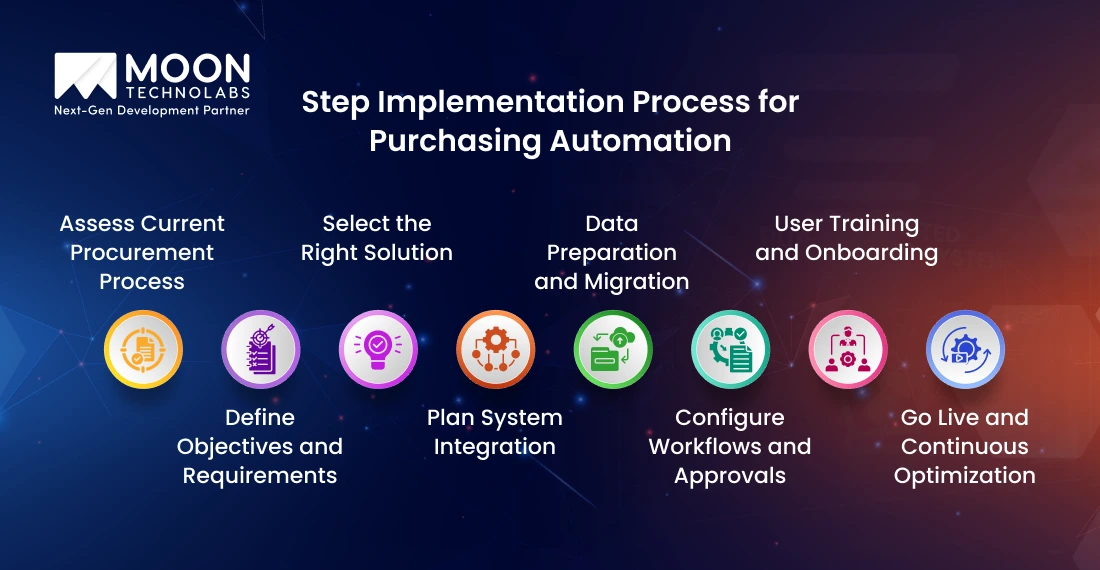
Implementing the Purchasing Automation System is a smart move for your business. However, its success depends on how well you have planned and executed it.
Here’s an easy eight-step process that will help you get it right:
Take a look at how your current purchasing process works before you begin automating the system. Understand what aspects slow you down. For example, approvals might be taking a bit longer than usual. It could also be invoice mismatches that delay the purchase orders.
Once you have identified the issues, connect with your procurement and finance teams to better understand the pain points. By leveraging these inefficiencies, you can create an automation system that solves real issues rather than becoming another layer of technology.
Once you have gained an understanding of what truly works, begin defining the automation goals. Do you want to speed up approvals or gain better visibility into the spending? Are you looking to strengthen vendor compliance with automation?
You must outline the must-have features for the system, such as automated approvals and supplier tracking. At the same time, include a list of nice-to-have features. Setting these clear objectives can help you stay focused and measure success later.
After defining the goals, you must select the purchasing automation software that fits your needs. Look for a tool that matches your company size, industry, and budget. It must also integrate with the existing accounting & ERP systems and support customizations.
Along with comparing prices, consider the tool’s customer support, scalability, security, and usability. Use a trial run or demo to determine whether the platform is intuitive, flexible, and aligned with your needs.
Integration helps your automation work seamlessly. Connect with your IT and finance teams to plan how the new system will connect with your existing ERP, CRM, and inventory software systems.
The data must flow seamlessly between different systems without duplication. Having a solid integration plan can reduce manual data entry, minimize error,s and offer a single source of truth for procurement activities.
Clean up the existing data before you launch the new system. Remove outdated records, standardize item descriptions, and verify your pricing.
When you have clean and accurate data, you can deliver smooth automation. After cleaning up the data, migrate it into the new system. Test the system for consistency and errors to prevent issues after deployment.
At this point, you will be customizing the system to suit your company’s unique process. Set up the automated workflows to manage purchase requisitions, approvals, and payments.
You should also define approval hierarchies, routing rules, and spending limits to ensure that every request follows the correct path. With automation, you can adjust workflows to align with policy changes.
Even with the best system in place, you can still fail if your employees don’t know how to use it. That’s why you must plan training sessions for the procurement, finance, and other department heads.
Take them through the key features, such as submitting requests and tracking purchase orders. Make hands-on training available and offer quick guides with FAQs to provide continuous support. Once the user feels confident, you will notice increased adoption.
You can go live once you have tested the system and trained the team. Conduct a soft launch or pilot phase to identify issues early. Collect user and supplier feedback to improve the process.
Review performance metrics, approval times, and cost savings to improve the system continuously. Incorporate data from analytics to identify new opportunities.
Use automated workflows to eliminate repetitive tasks and approval delays in your procurement processes, empowering teams with faster, error-free purchasing.
The future belongs to smarter, faster, and connected automation systems. Automation Purchasing Systems will sync with intelligent and adaptive tools to predict needs, identify savings, and make procurement strategic.
Artificial Intelligence with Machine Learning is set to take procurement automation to the next big level. Instead of following rules, your systems can learn from the available data to spot trends, predict purchasing needs, and determine the best time to buy.
AI will analyze supplier performance, flag risks, and suggest alternative vendors using quality and delivery history data. You can even use the system to forecast demand, automate approvals, and detect invoice anomalies. Over time, these systems can help the procurement team make data-backed decisions with less manual effort, leading to more proactive decision-making.
RPA will help manage the repetitive procurement tasks. You can think of them as your team’s digital assistants, handling time-consuming tasks such as copying data between systems and verifying purchase orders.
As these bots work 24/7, they offer accuracy and speed. Moreover, they can automate the routine work, freeing up the procurement team to prioritize strategy, relationship building, and cost optimization.
When you combine AI with RPA, you build a more powerful process that enables touchless workflows and integrates purchase orders, invoices, and payments for seamless outcomes.
Blockchain is an innovative technology that provides procurement teams with unmatched transparency and security. You can maintain a record of every transaction with the tamper-proof digital ledger.
With this technology, you can ensure that the data is neither altered nor lost, thus reducing fraud and fostering trust in suppliers.
Blockchain-backed smart contracts execute the pre-defined conditions automatically, releasing goods only after payments are made. It will speed up transactions and eliminate disputes. In the case of global supply chains, this technology offers end-to-end visibility, allowing you to verify compliance and delivery timelines.
With Cloud-based procurement, you can make procurement automation accessible. Cloud-based systems allow your teams to collaborate from anywhere, offering real-time access to data and approvals.
Using these platforms, you can scale for business growth while reducing the need for expensive hardware and IT maintenance. Moreover, it provides automatic updates while keeping security and functionality up to date.
Cloud-based procurements can also create a connected ecosystem by integrating with other enterprise platforms.
Moon Technolabs can help your business automate the purchasing process with powerful, customized solutions. We help streamline the procurement process for speed, control, and accuracy. By leveraging automated workflows and supplier management, our experts design systems that reduce costs, improve transparency, and eliminate manual work.
We help startups, small businesses, and enterprises transition to a smart, data-backed procurement process seamlessly. With us as your partners, you gain more than an automated process; you get efficiency, compliance, and a strategic advantage that helps you stand out.
Manual purchasing processes cannot keep up with the fast pace of enterprises and the digital world. That’s why you need an automated purchasing system that can bring order, speed, and accuracy to your procurement process. It will also help convert time-consuming tasks into a strategic advantage for your business.
Automation can help you gain real-time visibility, improve cost control, and strengthen supplier relationships while enabling you to track and manage spending. With new-age technologies like AI, RPA, and cloud-based solutions, you will see that the future of procurement will be intelligent and connected.
If you are planning to modernize your systems, now is the perfect time. By partnering with Moon Technolabs, you can build a custom automation solution that seamlessly integrates with your business.
01
02
03
04
05

Jayanti Katariya is the CEO of Moon Technolabs, a fast-growing IT solutions provider, with 18+ years of experience in the industry. Passionate about developing creative apps from a young age, he pursued an engineering degree to further this interest. Under his leadership, Moon Technolabs has helped numerous brands establish their online presence and he has also launched an invoicing software that assists businesses to streamline their financial operations.


Submitting the form below will ensure a prompt response from us.
We refine our expertise to deliver innovative business solutions.





500 N Michigan Avenue, #600, Chicago IL 60611
13500 Long Is Dr, Pflugerville, TX 78660, USA

C-105, Ganesh Meridian, S.G. Highway, Ahmedabad, GJ 380060


 France
“ I highly recommend Moon Technolabs as the quality of service is wonderful. We have hired this company to develop the product based on some complex & technical issues. We get the best quality services as compared with others in the market. Huge Thanks to Moon Technolabs as the team is always ready to give the solution all time.”

 USA
USA“ Moon Technolabs is a pioneer in the WebRTC based project as they have fixed complicated segments of the module by fulfilling different product lines by providing 24X7 customer support. We really recommended Moon Technolabs as they are able to develop products as per the module deadline and project timeline.”

 Germany
“I am happy to recommend Moon Technolabs for their app development services. They successfully developed apps for me, and I am highly satisfied with the overall outcomes. The development team has swiftly addressed the issues with responsive and effective communication to understand the requirement quickly and actively resolve the back-and-forth problems that arose...”
 USA
USA“Moon Technolabs is the best company that provides advanced apps and websites development services in the USA and Europe. I am a newbie to develop my app with an external team. I am really happy to work with them as I am not that much mobile apps user. Here, the team and specially the CEO of Moon Technolabs helps me to let me know about the benefits of my app to generate revenue....”


