UX Product Development: A Complete Guide to Building User-Centered Digital Products

Marketing Team
Last Updated: Jun 23, 2026 Total View: 158
UX Issues Slowing Down Product Adoption?
If users are dropping off, struggling to navigate, or not engaging with your product, your UX strategy may need refinement. Create experiences that drive satisfaction, retention, and growth.
- User journey optimization
- Wireframing & prototyping
- Usability testing insights
- Conversion-focused design


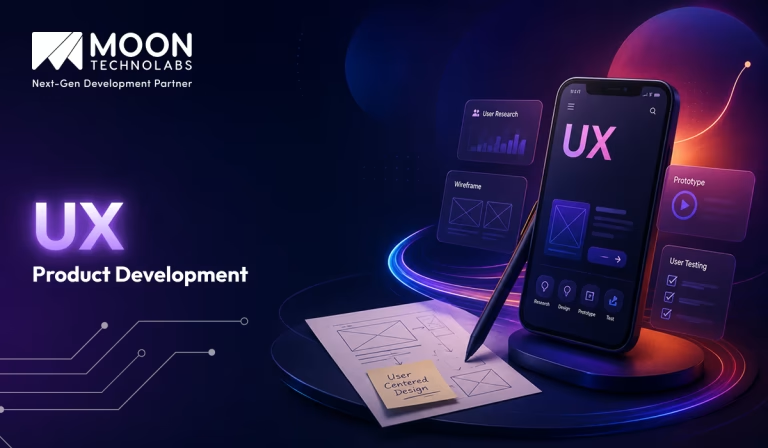
In today’s competitive digital landscape, building a functional product is no longer enough. Users expect products that are intuitive, efficient, visually appealing, and capable of solving real problems with minimal friction. This is where UX Product Development becomes essential.
UX Product Development combines user experience (UX) design principles with the product development lifecycle to create solutions that align business goals with user needs. Instead of treating design as a final step, UX becomes an integral part of planning, designing, building, testing, and improving the product throughout its lifecycle.
What is UX Product Development?
UX Product Development is the process of designing and developing digital products with a strong focus on user experience. It involves understanding users, identifying their needs, and continuously improving the product based on research and feedback.
The goal is not simply to create features but to create experiences that help users accomplish their goals efficiently and enjoyably. A successful UX-driven product balances usability, functionality, accessibility, and business objectives.
You Might Also Like:
Why is UX Important in Product Development?
Many products fail not because of poor technology but because they fail to meet user expectations. Even a feature-rich application can struggle if users find it confusing or difficult to use.
Integrating UX into product development helps teams create solutions that users actually want. It reduces usability issues, improves adoption rates, and increases customer satisfaction while reducing costly redesigns later in the project.
Improves User Satisfaction
When products are easy to navigate and understand, users can accomplish tasks with less effort. This creates a positive experience and increases customer satisfaction.
Satisfied users are more likely to continue using the product, recommend it to others, and become loyal customers.
Reduces Development Risks
UX research helps teams validate ideas before significant development resources are invested.
By identifying user needs early, businesses can avoid building unnecessary features and reduce the risk of product failure.
Increases Product Adoption
A well-designed user experience lowers the learning curve and encourages users to engage with the product.
This often results in higher onboarding completion rates, increased retention, and stronger long-term adoption.
How UX Fits Into the Product Development Lifecycle?
UX should not be viewed as a separate activity that happens before development. Instead, it should be integrated into every stage of the product lifecycle.
This ensures that user feedback continuously influences decisions and that the final product remains aligned with user expectations.
Research Phase
The first step is understanding users, their goals, challenges, and behaviors.
UX researchers conduct:
- User interviews
- Surveys
- Competitor analysis
- Market research
- Stakeholder workshops
The insights gathered during this phase help define product direction and priorities.
Planning Phase
Research findings are translated into product requirements and user stories.
Teams define:
- Business objectives
- User goals
- Functional requirements
- Success metrics
This alignment ensures that both business and user needs are considered from the beginning.
Design Phase
During the design phase, UX designers create wireframes, user flows, prototypes, and visual interfaces.
The objective is to validate ideas before development begins and identify potential usability issues early.
Popular design tools include:
- Figma
- Adobe XD
- Sketch
- Axure RP
Development Phase
Developers work closely with designers to transform approved designs into functional products.
Collaboration between design and engineering teams ensures that the intended user experience is preserved during implementation.
Example React component:
function Button() {
  return (
    <button className="primary-btn">
      Get Started
    </button>
  );
}
This simple component demonstrates how design elements become functional user interface components.
Testing Phase
Before launch, usability testing helps identify friction points and areas for improvement.
Common testing methods include:
- Usability testing
- A/B testing
- Accessibility testing
- User acceptance testing
Testing ensures the product performs well from a user perspective.
Continuous Improvement
UX product development does not end after launch.
Teams continuously monitor:
- User feedback
- Analytics
- Heatmaps
- Session recordings
- Customer support tickets
These insights guide future enhancements and feature development.
Key Components of UX Product Development
Several UX disciplines work together to create successful products.
Each component contributes to a different aspect of the overall user experience.
User Research
User research provides evidence-based insights about target audiences.
Researchers seek answers to questions such as:
- Who are the users?
- What problems do they face?
- What motivates their behavior?
- What expectations do they have?
Research ensures product decisions are based on real user needs rather than assumptions.
Information Architecture
Information architecture focuses on organizing content and functionality logically.
A well-structured product helps users:
- Find information quickly
- Navigate efficiently
- Complete tasks successfully
Poor information architecture often leads to confusion and frustration.
Wireframing
Wireframes are low-fidelity representations of product layouts and interactions.
They help teams:
- Visualize concepts
- Validate workflows
- Align stakeholders
Wireframing reduces costly design changes later in development.
Prototyping
Prototypes simulate user interactions before development begins.
Designers use prototypes to test workflows, gather feedback, and refine experiences without writing production code.
This accelerates learning and reduces development waste.
Usability Testing
Usability testing evaluates how easily users can complete tasks within the product.
Observing real users often reveals issues that internal teams may overlook.
Regular testing helps improve product effectiveness and user satisfaction.
Step-by-Step UX Product Development Process
Successful UX product development follows a structured framework that balances research, design, validation, and execution.
The following process is commonly used by product teams.
Step 1: Define the Problem
Clearly identify the problem the product aims to solve.
Questions to answer:
- What user need exists?
- Why does this problem matter?
- What business value does solving it create?
A well-defined problem statement guides the entire development effort.
Step 2: Conduct User Research
Gather insights through interviews, surveys, analytics, and observation.
The objective is to understand user behavior and validate assumptions before building solutions.
Step 3: Create User Personas
User personas represent key audience segments.
Example:
Name: Sarah
Role: Marketing Manager
Goal: Generate more qualified leads
Challenge: Limited reporting visibility
Personas help teams design with specific users in mind.
Step 4: Design User Flows
User flows map how users interact with the product.
Example:
Landing Page
↓
Sign Up
↓
Dashboard
↓
Feature Usage
These flows help identify friction points and improve navigation.
Step 5: Build Prototypes
Interactive prototypes allow teams to test ideas before development.
Feedback gathered during this stage often prevents costly redesigns later.
Step 6: Develop the Product
Once designs are validated, development begins.
Close collaboration between designers and developers ensures consistency between design intent and implementation.
Step 7: Test and Optimize
After launch, collect user feedback and analyze behavioral data.
Continuous optimization ensures the product evolves alongside user needs.
Common UX Product Development Challenges
Despite its benefits, UX-driven development presents several challenges.
Organizations must address these obstacles to maximize success.
Limited User Research
Teams sometimes skip research due to time or budget constraints.
This increases the risk of building solutions based on assumptions rather than actual user needs.
Misalignment Between Teams
Design, development, and business stakeholders may have conflicting priorities.
Effective collaboration and communication are essential for maintaining alignment.
Feature Overload
Adding too many features can complicate the user experience.
Successful products focus on solving core problems before expanding functionality.
Best Practices for UX Product Development
Adopting proven practices helps teams create better products while reducing risks.
These principles support long-term product success.
Design for Users, Not Assumptions
Always validate ideas through research and testing.
User behavior often differs from stakeholder expectations.
Involve Users Early
Gather feedback throughout the product lifecycle rather than waiting until launch.
Early validation reduces costly changes later.
Prioritize Accessibility
Accessible products serve a wider audience and improve overall usability.
Consider:
- Keyboard navigation
- Screen readers
- Color contrast
- Responsive design
Measure UX Performance
Track metrics such as:
- Task completion rate
- User retention
- Net Promoter Score (NPS)
- Customer Satisfaction (CSAT)
These indicators help evaluate UX effectiveness.
Emerging Trends in UX Product Development
Technology continues to reshape how products are designed and experienced.
Several trends are influencing modern UX development.
AI-Powered Personalization
AI helps deliver personalized experiences based on user behavior and preferences.
This improves engagement and increases user satisfaction.
Voice and Conversational Interfaces
Voice assistants and conversational AI are creating new interaction models beyond traditional screens.
Products increasingly incorporate natural language interactions.
Data-Driven UX Decisions
Analytics tools provide deeper visibility into user behavior.
Teams use this data to guide design improvements and optimize user journeys continuously.
How Moon Technolabs Helps with UX Product Development?
Moon Technolabs helps businesses design and develop user-centered digital products through a combination of UX research, product strategy, UI/UX design, and agile development. The team focuses on creating experiences that balance business objectives with user needs.
From product discovery and prototyping to development and optimization, Moon Technolabs supports organizations throughout the entire product lifecycle to ensure products are intuitive, scalable, and market-ready.
Our UX experts help you design and develop user-centered products that improve satisfaction, retention, and long-term business success.
Conclusion
UX Product Development is more than creating attractive interfaces—it is a strategic approach to building products that solve real user problems effectively. By integrating user research, design thinking, validation, and continuous improvement into the development process, organizations can create products that drive engagement, satisfaction, and business growth.
When UX becomes a core part of product strategy rather than an afterthought, businesses are better positioned to deliver meaningful experiences that stand out in competitive markets.


Jayanti Katariya is the CEO of Moon Technolabs, a fast-growing IT solutions provider, with 18+ years of experience in the industry. Passionate about developing creative apps from a young age, he pursued an engineering degree to further this interest. Under his leadership, Moon Technolabs has helped numerous brands establish their online presence and he has also launched an invoicing software that assists businesses to streamline their financial operations.
Get in Touch With Us
Submitting the form below will ensure a prompt response from us.