Payment Gateway Architecture: Components, Transaction Flow, Security, and Best Practices

Trending Technologies
Last Updated: Aug 05, 2026 Total View: 94
Building a Secure Payment Gateway?
If you’re designing a payment gateway and unsure how to handle security, scalability, or transaction flow, the right architecture can ensure fast, reliable, and compliant payment processing.
- Secure transaction flow
- PCI DSS–ready architecture
- Fraud prevention strategies
- Scalable payment integration


A payment gateway is the foundation of modern digital transactions. Whenever a customer pays through a website, mobile app, subscription platform, marketplace, or point-of-sale system, the gateway securely transfers payment information between the customer, merchant, acquiring bank, card network, and issuing bank.
While the payment process may appear instant to users, several systems work together behind the scenes to validate credentials, detect fraud, authorize funds, and record the transaction. A poorly designed payment infrastructure can create security vulnerabilities, failed payments, duplicate charges, slow checkout experiences, and reconciliation problems.
Understanding payment gateway architecture is therefore essential for businesses planning to build e-commerce platforms, fintech applications, SaaS billing systems, marketplaces, booking platforms, or custom payment solutions.
This guide explains how payment gateway architecture works, its major components, transaction lifecycle, security controls, integration patterns, scalability requirements, and best practices for building a reliable payment system.
What is Payment Gateway Architecture?
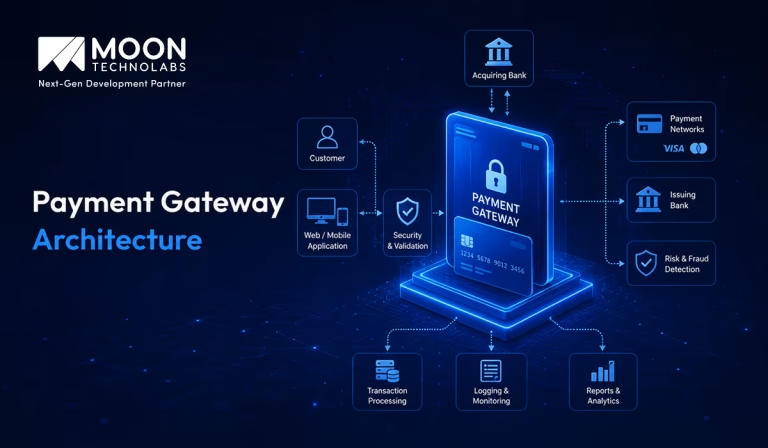
Payment gateway architecture refers to the technical structure used to securely capture, transmit, authorize, process, and track digital payments. It connects the merchant’s application with payment processors, acquiring banks, card networks, issuing banks, digital wallets, and other financial systems.
The architecture handles more than payment authorization. It may also manage tokenization, fraud checks, recurring billing, refunds, settlements, webhooks, transaction logs, reconciliation, and regulatory compliance.
A simplified payment architecture looks like this:
Customer
   ↓
Merchant Website or Mobile App
   ↓
Payment Gateway
   ↓
Payment Processor or Acquiring Bank
   ↓
Card Network
   ↓
Issuing Bank
   ↓
Authorization Response
   ↓
Merchant Application
The gateway acts as a secure bridge between the merchant’s system and the broader financial ecosystem.
Why is Payment Gateway Architecture Important?
Payment systems process sensitive financial data and directly affect revenue. Even a small failure in the architecture can cause abandoned checkouts, transaction errors, security incidents, or financial discrepancies.
A strong architecture improves payment success rates, protects customer data, supports multiple payment methods, and ensures reliable processing during high traffic. It also makes it easier to integrate fraud detection, reporting, subscriptions, refunds, and reconciliation workflows.
- Secure Handling of Payment Information
- High Transaction Reliability
- Support for Business Growth
Main Components of Payment Gateway Architecture
A modern payment gateway contains multiple technical and financial components. Each component performs a specific role in the transaction process.
Understanding these building blocks helps businesses design integrations that are secure, scalable, and easier to maintain.
- Customer Checkout Interface
- Merchant Application
- Payment Gateway.
- Payment Processor
- Acquiring Bank
- Card Network
- Issuing Bank
- Tokenization Service
- Fraud Detection Engine
- Webhook Service
How Does a Payment Gateway Work?
A payment gateway coordinates multiple steps between the customer and financial institutions. Most card authorizations happen within seconds, but several validation and routing operations occur during that time.
The exact workflow depends on the payment method, geography, provider, authentication requirements, and merchant configuration.
Step 1: Customer Initiates the Payment
The customer selects a product or service and proceeds to checkout. The application displays the total amount, currency, and available payment methods.
The customer then enters card details or selects a saved card, digital wallet, bank account, or another supported option.
Step 2: Payment Details Are Securely Captured
The payment interface sends sensitive data directly to the gateway or tokenization provider. Hosted fields and provider SDKs help ensure that raw card information does not pass through the merchant’s backend.
The gateway validates the format and generates a payment token where applicable.
Step 3: Merchant Creates the Payment Request
The merchant’s backend sends a request containing information such as:
{

"amount": 4999,

"currency": "USD",
"order_id": "ORD-5001",
"payment_token": "tok_7d92f8a4",
"customer_id": "CUS-2091"
}
Amounts are often represented in the smallest currency unit. For example, 4999 may mean $49.99.
Step 4: Gateway Performs Security and Fraud Checks
Before routing the request, the gateway may verify merchant credentials, validate the payment token, check transaction rules, and evaluate fraud risk.
Depending on the result, the transaction may be blocked, allowed, or sent through additional customer authentication.
Step 5: Transaction Is Routed for Authorization
The payment gateway sends the request to the processor or acquiring bank. The request then travels through the relevant network to the issuing bank.
Routing may depend on currency, card type, merchant location, transaction cost, regional rules, or processor availability.
Step 6: Issuing Bank Approves or Declines
The issuing bank checks the account and evaluates transaction risk.
Possible responses include:
Approved
Insufficient funds
Expired card
Incorrect authentication
Transaction not permitted
Suspected fraud
Issuer unavailable
The response returns through the same financial network.
Step 7: Merchant Receives the Payment Status
The gateway sends a normalized response to the merchant’s backend.
Example:
{
"payment_id": "pay_10293",
"status": "authorized",
"authorization_code": "A72819",
"order_id": "ORD-5001"
}
The merchant updates the order based on the trusted server-side response.
Step 8: Payment Is Captured
Authorization reserves the funds, while capture confirms that the merchant intends to collect them.
Some systems authorize and capture immediately. Others use separate capture for hotels, rentals, marketplaces, or businesses that confirm inventory before charging.
Step 9: Settlement Transfers the Funds
After capture, the transaction enters clearing and settlement. The payment network calculates fees and transfers the net funds to the acquiring bank or merchant account.
Settlement may take one or more business days depending on the provider, payment method, and region.
Payment Gateway Architecture Diagram
A production payment gateway architecture may look like this:
Customer Web or Mobile App
│
▼
Checkout UI / Hosted Fields / SDK
│
▼
API Gateway
│
▼
Payment Orchestration Service
┌────────┼───────────────┐
│        │               │
▼        ▼               ▼
Token   Fraud Engine   Payment Router
Service                  │
▼
Payment Processor(s)
│
▼
Card Network
│
▼
Issuing Bank
Supporting Services:
- Transaction Database
- Message Queue
- Webhook Dispatcher
- Reconciliation Service
- Ledger System
- Monitoring and Alerts
- Secrets and Key Management
The payment orchestration layer coordinates the workflow and prevents the merchant application from becoming tightly coupled to a single provider.
Payment Gateway Integration Models
Businesses can integrate payment gateways in several ways. The correct model depends on security requirements, user experience, customization needs, and compliance scope.
Each approach offers a different balance between control and implementation complexity.
- Hosted Payment Page
- Embedded Hosted Fields
- Direct API Integration
- Mobile SDK Integration
- Payment Orchestration Layer
Payment Orchestration and Multi-Gateway Architecture
Relying on a single payment provider can create availability, regional, and commercial risks. A multi-gateway architecture connects the platform to multiple processors or payment service providers.
The orchestration layer selects the most suitable gateway based on configurable rules.
Intelligent Payment Routing
Transactions may be routed according to:
- Customer country
- Currency
- Card type
- Transaction cost
- Approval rate
- Provider health
- Merchant account
- Payment method
- Risk score
For example:
US card + USD → Gateway A
EU card + EUR → Gateway B
Gateway A unavailable → Gateway C
Intelligent routing can improve authorization rates and system resilience.
Gateway Failover
If the preferred provider is unavailable, the platform may retry through another provider.
Failover must be handled carefully to prevent duplicate charges. The system should first determine whether the initial provider processed the request before submitting it elsewhere.
Provider Abstraction
A provider abstraction layer converts different gateway responses into a common internal format.
Example internal response:
{
"payment_id": "pay_10293",
"provider": "gateway_a",
"status": "authorized",
"provider_reference": "TX-998271"
}
This prevents provider-specific details from spreading across the entire codebase.
How to Prevent Duplicate Payments?
Duplicate charges can occur when customers click the payment button multiple times, browsers retry requests, network responses are lost, or background jobs repeat an operation.
Payment architecture should assume that requests may be submitted more than once.
Use Idempotency Keys
An idempotency key uniquely identifies a payment operation.
Example request:
POST /payments
Idempotency-Key: order-5001-attempt-1
When the same key is received again, the service returns the original result rather than creating another charge.
Lock the Checkout Action
The frontend should temporarily disable the payment button after submission and display a processing state.
However, frontend protection alone is not enough because requests can still be repeated through network retries or direct API calls.
Maintain Unique Business Constraints
The backend should define whether an order can have multiple payment attempts and whether more than one successful payment is allowed.
Database constraints and transactional logic can prevent conflicting successful records.
Asynchronous Processing in Payment Architecture
Not every payment action should run inside a synchronous API request. Webhook delivery, email notifications, analytics, reconciliation, and ledger updates can often be processed asynchronously.
Message queues improve resilience by separating the payment authorization path from supporting operations.
Example:
Payment Authorized
│
▼
Event Published to Queue
│
├── Update Order
├── Send Receipt
├── Update Ledger
├── Trigger Fulfillment
└── Record Analytics
The system should ensure that critical events are not lost if a service becomes temporarily unavailable.
Webhook Processing Architecture
Webhook processing is a critical part of payment systems because providers may send asynchronous updates for payments, refunds, disputes, and settlements.
A secure webhook handler should verify the sender, store the event, detect duplicates, and process the event asynchronously.
Basic Webhook Flow
Payment Provider
↓
Webhook Endpoint
↓
Signature Verification
↓
Store Raw Event
↓
Return HTTP 2xx
↓
Queue Event
↓
Update Payment State
Returning a successful response quickly prevents unnecessary provider retries.
Webhook Signature Verification Example
import hashlib
import hmac
def verify_signature(
payload: bytes,
received_signature: str,
secret: bytes,
) -> bool:
expected_signature = hmac.new(
secret,
payload,
hashlib.sha256,
).hexdigest()
return hmac.compare_digest(
expected_signature,
received_signature,
)
The exact verification method depends on the gateway’s documentation.
Security in Payment Gateway Architecture
Payment security must be built into every layer of the architecture. Sensitive information may be targeted during checkout, API communication, storage, operational access, or third-party integrations.
A secure design combines technical controls, governance, monitoring, and compliance processes.
- Encryption in Transit
- Encryption at Rest
- Tokenization
- Strong Authentication and Authorization
- Secrets Management
- Audit Logging
PCI DSS and Payment Gateway Compliance
Businesses that store, process, or transmit cardholder data may fall within the scope of Payment Card Industry Data Security Standard requirements.
The compliance responsibilities vary depending on the integration model and how much card information enters the merchant environment.
A hosted checkout or tokenized provider integration can reduce scope, but it does not remove the need for secure development, access controls, vulnerability management, and documented processes.
Organizations may also need to consider:
- Data privacy laws
- Strong customer authentication rules
- Local financial regulations
- Anti-money laundering requirements
- Record retention obligations
- Consumer protection requirements
Legal and compliance requirements should be reviewed for every market where the payment solution operates.
Scalability Requirements for Payment Gateways
Payment traffic is often unpredictable. E-commerce promotions, ticket releases, seasonal sales, or product launches can create sudden spikes.
The architecture should scale without compromising transaction accuracy or security.
- Stateless Payment APIs
- Load Balancing
- Message Queues
- Database Scaling
Payment Gateway Architecture for Recurring Billing
Subscription systems require recurring charges, saved payment methods, invoice generation, retries, and cancellation handling.
A recurring billing architecture may include:
Subscription Service
↓
Billing Scheduler
↓
Invoice Generation
↓
Payment Gateway
↓
Retry or Dunning Workflow
↓
Subscription Status Update
The system should not assume every recurring charge succeeds on the first attempt.
Dunning Management
Dunning is the process of recovering failed recurring payments.
It may include:
- Automated retries
- Customer notifications
- Payment method update links
- Grace periods
- Service restrictions
- Subscription cancellation
Retry timing should reflect issuer behavior and customer experience rather than using excessive repeated attempts.
Common Challenges in Payment Gateway Architecture
Payment platforms combine distributed systems with financial accuracy requirements. This creates challenges that are not always present in standard application development.
Teams must design for incomplete information, delayed responses, external dependencies, and strict auditability.
- Inconsistent Payment Status
- Provider Downtime
- Complex State Management
- Currency and Amount Errors
- Webhook Duplication and Reordering
How Moon Technolabs Helps with Payment Gateway Development?
Moon Technolabs helps businesses design and develop secure payment gateway integrations, digital wallets, subscription billing platforms, marketplace payment systems, fintech applications, and custom transaction-processing solutions.
Our development teams implement payment orchestration, tokenization, fraud checks, recurring billing, multi-currency support, webhook processing, refunds, reconciliation, and ledger workflows. We also integrate payment systems with mobile apps, websites, ERP platforms, accounting software, and cloud infrastructure.
Whether you need to integrate an existing payment provider or build a scalable payment platform for a complex business model, Moon Technolabs focuses on security, reliability, compliance-aware architecture, high availability, and seamless customer experiences.
Need Reliable Payment Infrastructure for Your Business?
From payment gateway integration and orchestration to recurring billing and webhook architecture, we build secure fintech solutions that scale with your business.
Conclusion
Payment gateway architecture connects customers, merchants, processors, banks, and payment networks through a secure and highly coordinated transaction flow. Although the customer sees only a short checkout process, the underlying system manages payment capture, tokenization, fraud checks, authorization, settlement, refunds, webhooks, and reconciliation.
A reliable architecture must handle duplicate requests, delayed responses, asynchronous status changes, gateway failures, and high transaction volumes without compromising financial accuracy. Idempotency, tokenization, explicit payment states, secure webhook handling, immutable audit records, and continuous reconciliation are therefore fundamental design requirements.


Stay ahead with insights into the latest technology trends shaping the future of digital innovation. From AI and blockchain to cloud computing, cybersecurity, IoT, and emerging software technologies, discover what's driving business transformation across industries. Follow this category to stay informed about the innovations defining tomorrow's digital landscape.
Get in Touch With Us
Submitting the form below will ensure a prompt response from us.