RPA vs AI: Key Differences, Features, and Examples

Jayanti Katariya
Last Updated: Jun 17, 2026 Total Views: 100
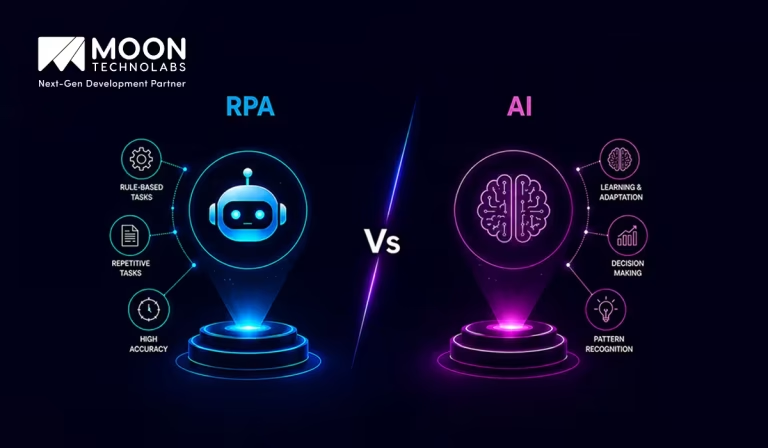
Table of Content


Blog Summary:
RPA and AI are completely distinct automation technologies, meant to serve different organizational needs. RPA excels at rule-based, repetitive tasks, while AI handles complexities and makes decisions. This article does a comparison RPA vs AI to examine both technologies in detail, explain their use cases, and help you make the right choice for your business.
Table of Content
The pressure to find the right automation solution for your organization is real. Currently, your team’s struggling with manual processes that drain productivity and delay the outcomes. That’s why your leadership has finally approved the exploration of automation technologies.
Now, you are facing a critical decision. Should you invest in RPA, a rule-based automation solution that has proven itself across industries, or pursue AI, the cognitive technology designed to handle complexities?
Both seem promising, but differ in cost, functionality, and the problems they solve. You need to understand which aligns best with your workflows, budget, and long-term business goals. To build the right business case, you must have concrete answers to what each technology does and how they compare. You must even check if they are the right fit for your operational needs.
This guide provides a comprehensive comparison of RPA vs AI, highlighting key differences and capabilities to help you make an informed decision.
What is RPA?
Let’s start with the basics. RPA stands for Robotic Process Automation, and despite the word “robot,” it has nothing to do with physical robots.
RPA is software technology that mimics the repetitive, rule-based actions your team performs every day. It is like hiring a digital worker who follows the script as is. They don’t improvise or make judgment calls; they offer a precise execution of the predefined rules.
Let’s see how this translates in practice. RPA bots interact with your existing systems the same way a human would. They log in to the apps, read data, enter information, copy/paste between systems, and complete tasks as per the instructions.
To embrace this technology, you don’t need to rebuild your IT infrastructure or replace legacy systems. RPA runs on top of your current tech stack, automating your workflows without requiring deep code changes.
RPA excels when you have processes with clear and consistent rules. If you have workflows that specifically mention what to do when an invoice arrives, RPA is the perfect choice. However, RPA struggles when your process requires decision-making beyond rules.
Why is RPA Important?
Are you wondering why you should care about RPA when it simply follows rules? The answer lies in the numbers. A 2025 study found that RPA can reduce operational costs by up to 55% and cut processing times by 65% by automating repetitive, rule-based workflows.
By automating repetitive tasks, you free your team to focus on work that matters and requires human creativity. That’s not just a feel-good statement; this will, in turn, impact your bottom line positively.
When implemented through effective RPA development, the efficiency gains become even more significant. The bots can work 24/7 without fatigue, holidays, or even sick days. They can process tasks faster than humans and make fewer errors. There’s a process within the organization that runs for about 8 hours a day. With an RPA bot, you can accomplish it in a fraction of that time. It translates into cost savings, faster turnaround times, and increased employee satisfaction in the long run.
Scalability is also a great reason to consider RPA. You don’t need to hire more staff to manage your increased volume as business grows; the bots scale easily. For organizations buried in manual processes, RPA offers a quick win. With a lower upfront investment, you get faster results.
Example of RPA
Imagine you are working in accounts payable for a minute. Every day, invoices clutter your inboxes. Your team’s expected to open each one manually, extract the vendor’s name, amount, and invoice number, and then enter the data into the accounting system. They have to cross-check each data point against purchase orders, flag data discrepancies, and file the documents.
That’s time-consuming and stressful. It can cause major human errors that should have been avoided. Accounting errors can slowly impact your bottom line. This is where RPA can enter and be most useful.
You can train the bot to do this: read the invoice, extract data, validate it against the PO, enter it into the accounting system, and automatically file it. Your team goes from spending 4 hours on this job daily to spending 0 hours. The bot works even when humans aren’t around and handles invoice spikes effortlessly.
Key Features of RPA
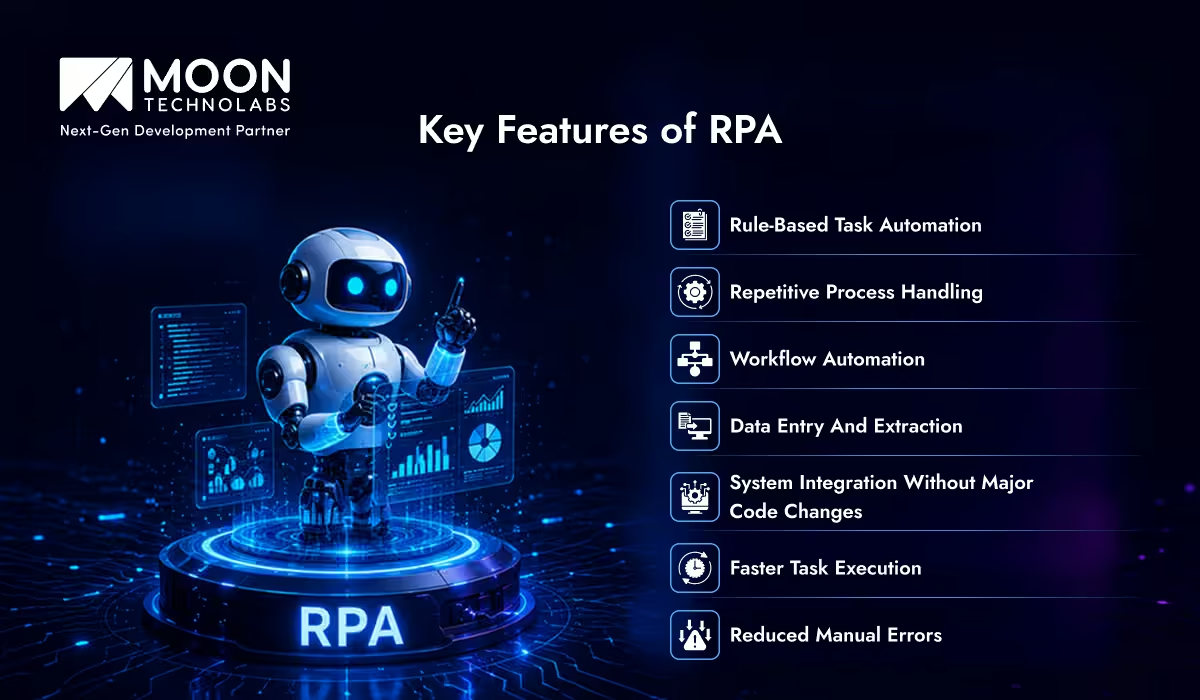
Now that you understand what RPA is and why it matters, we will dive deep into the features that make it a powerful tool for your automation strategy.
Rule-based Task Automation
RPA is built on rules. You define the conditions, and the corresponding actions, and the bot will follow them precisely. If X happens, you must do Y. That structure is powerful, predictable, and reliable. Your processes need not be complex; they should be consistent. The bot learns all the rules once and executes them with perfection every single time, without variation or interpretation.
Repetitive Process Handling
This technology thrives on repetition. If you have a highly repetitive process, RPA performs best. Whether you need to process hundreds of similar customer requests or enter data across multiple systems, RPA can easily handle high-volume repetitive work without fatigue. This is valuable for your team as it eliminates the monotony that drains morale and introduces error.
Workflow Automation
RPA doesn’t just automate individual tasks; it automates complete workflows. You can use it to orchestrate multi-step processes in which one task ends and triggers another. It is like a factory assembly line, moving projects from one stage to the next.. One bot extracts data, another validates it, and the third files this data. The entire workflow runs seamlessly without human intervention.
Data Entry and Extraction
The best use of RPA is for data handling. RPA bots can extract information easily from documents, web forms, and even emails with great accuracy. They will enter this data into your systems, including spreadsheets, databases, and enterprise applications. This feature can save your organization thousands of hours annually if you are doing it manually.
System Integration Without Major Code Changes
Here’s what makes RPA attractive. You don’t need to rebuild your technology stack; it works on existing systems, both old and new, by interacting with them as humans would. Since it doesn’t require complex custom integrations or expensive overhauls, your IT team can focus on strategic work.
Faster Task Execution
RPA bots can work at digital speed. What takes your team hours to complete gets accomplished in minutes with bots. This speed isn’t just about efficiency; it is also about responsiveness. Your customer requests are handled faster, invoices are processed quickly, and reports are generated on demand. This translates into better customer service and faster business insights.
Reduced Manual Errors
Human error is inevitable when repetitive manual work is involved. Your team tires easily or makes mistakes under pressure. RPA eliminates this issue. Once you program it properly, the bots execute tasks with 100% efficiency and consistency. With the right workflow design, you can eliminate risks
What is AI?
Let’s talk about the other side of automation that has been gaining momentum in recent years: Artificial Intelligence. AI is fundamentally different; like RPA, it doesn’t follow pre-determined rules. AI enables machines to learn from data, recognize patterns, and make decisions with minimal human guidance.
AI doesn’t need you to spell out every single rule as RPA does. Instead, you need to feed data and examples, allowing the system to learn from them and make accurate predictions and decisions.
The more it processes, the smarter it gets. AI is called cognitive automation as it mimics human thinking to a great degree. AI comes in several forms, but it is machine learning and deep learning for business automation.
Machine learning analyzes historical data to identify patterns and predict future outcomes. It teaches the system through examples rather than explicit instruction.
AI offers flexibility and can easily adapt. If your process requires judgment calls, nuance, or even the ability to handle unexpected scenarios, AI is the right choice. It understands context, learns from new situations, and improves continuously.
AI is more complex than RPA, requires more upfront data, and requires expert implementation. It takes longer to show the results you are seeking. However, it is invaluable when you need cognitive decision-making for your business.
Why is AI important?
AI is important because it tackles the problems that rule-based automation cannot resolve. You aren’t dealing with repetitive and predictable tasks anymore; you are dealing with complexity, variability, and situations that need intelligence to navigate.
Take customer service, for example. You can’t script every possible customer question or complaint. AI-powered chatbots, often built using AI development, can interpret context, recognize intent, and generate relevant responses even when they encounter variations they have not seen earlier.
Consider fraud detection as another example, where fraudsters keep evolving their tactics. Static rules will become obsolete in this case. AI systems can detect subtle patterns in transaction details that signal fraud. They adapt to criminals’ changing tactics.
AI enables you to extract data from unstructured data, such as feedback and images, where RPA may struggle. AI can even read, understand, and categorize vast amounts of unstructured data automatically.
If you are seeking a competitive edge, AI is the way to go. It improves decision-making and customer experiences by uncovering insights buried in the data.
Example of AI
Consider you are working in the insurance industry, managing claims. Every claim is different: the damage descriptions vary, the photos differ, and even the circumstances are unique.
As a claim adjuster, you review each one of them, estimate the damages, check for fraud, and approve/deny the claim. This requires deep intelligence and cannot be attained with RPA.
If you need to automate, you require an AI system. It is trained on thousands of previous claims, enabling the system to analyze a new claim in seconds. It examines claim details, reviews photos, and swiftly identifies fraud patterns without errors.
It also continuously learns from recent claims data, becoming smarter at detecting fraud and making more accurate assessments. What used to take your team several hours to complete now takes minutes, with better accuracy and fraud detection.
Key Features of AI
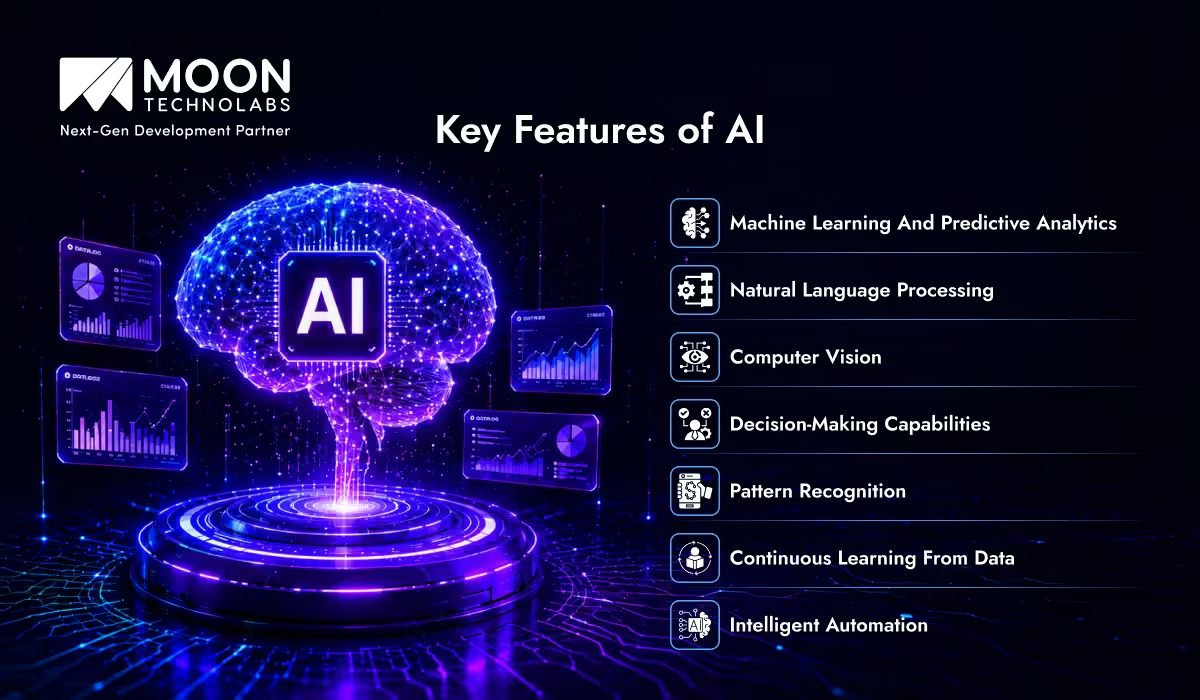
Let’s examine the specific capabilities that make AI such a transformative technology for automation.
Machine Learning and Predictive Analytics
Machine learning is the engine backing modern AI. It analyzes historical data to identify patterns and make predictions. Your system learns from examples instead of following set rules.
Lender AI system learns from thousands of loan applications to predict whether new applicants are likely to default. The system gets smarter as it keeps processing more data. This predictive power allows you to anticipate customer behavior, market trends, and even operational challenges before they happen.
Natural Language Processing
AI can easily understand and work with human languages, written and spoken. That’s huge because most business data exists in text form, such as emails, documents, customer feedback, and social media comments. NLP enables AI to read, understand, and extract meaning to generate responses. Your chatbot understands what the customer is asking for, even when the phrasing differs from the training data.
Computer Vision
AI can easily analyze images and video, allowing you to automate tasks related to visual inspection. Insurance companies can use it to assess vehicle damage, while manufacturing can use it to control the quality. If processes involved reviewing documents or inspecting products, computer vision can automate them.
Decision-making Capabilities
AI makes decisions by evaluating multiple factors, weighing probabilities, and determining outcomes based on learned patterns. Owing to this feature, AI can handle complexities and variabilities that would paralyze a rule-based system.
Pattern Recognition
AI is best at spotting patterns that humans would miss, especially when dealing with large datasets. Fraud detection systems use it to recognize suspicious patterns, while maintenance systems use it to predict equipment failure. Your data contains all the valuable signals, and AI uses them to find the patterns.
Continuous Learning from Data
AI systems improve with time. Every interaction, and even new data points, feed into the system’s learning. Your fraud detection gets better at catching new fraud tactics. This continuous improvement means your AI investment pays dividends over the years, not just months.
Intelligent Automation
When you combine all these features, you get true intelligent automation. It’s not just faster; it is smarter too. It handles every exception, adapts to changes, and even makes better decisions. It is the gold standard for organizations serious about transformation.
Automation transforms how your organization operates, freeing up your team, reducing costs, and driving growth. The path forward is clear, and it is time to take action.
RPA vs AI: Key Difference
You have now seen what both RPA and AI do individually. To make the right decision for your organization, you must also know how they differ. Let’s break down the core distinctions across key dimensions that matter to your business case.
| Feature | RPA | AI |
|---|---|---|
| Core Function | Follows predefined rules and instructions | Learns from data and makes intelligent decisions |
| Input Data | Structured data and clear workflows | Structured and unstructured data |
| Flexibility | Rigid, struggles with exceptions | Adaptive, can easily handle variations and exceptions |
| Decision Making | Rule-based execution | Cognitive, decision-making using patterns |
Core Function
The core function of the two is also the fundamental difference between them. RPA is a rule-based system that requires precise instructions for the system to follow; it executes them consistently and perfectly.
On the contrary, AI learns from the data. You don’t share specific rules. Instead, you share examples that help build patterns, which the system then applies to new situations.
RPA is prescriptive while AI is intelligent.
Input Data
RPA thrives on structured data organized into fields, databases, and clear formats. It should be able to read what’s in the box and process it.
AI works with both structured and unstructured data. This system can even analyze emails, images, audio, and text that don’t fit into a database.
If your processes include a lot of unstructured data, you should opt for AI.
Flexibility
The real-world gap becomes obvious at this point. RPA follows a programmed path rigidly. If you change even one instance in the process, you must reprogram it. AI adapts when it encounters variations. It can handle them because the systems understand context and intent instead of rules.
For dynamic, continuously evolving processes, you should choose AI.
Decision Making
RPA executes decisions that you have made using rules. But AI makes decisions after evaluating complex scenarios, weighing multiple factors, and determining outcomes.
If your process involves judgment, like assessing risks or determining eligibility, you should go with AI. RPA would need you to hardcode every scenario, which is impossible.
Understanding these differences is critical. You can choose based on whether your process needs rule-following consistency or intelligent adaptability.
Where RPA and AI Work Together?
Here’s where things get interesting. While RPA and AI are different, they aren’t competitors; they are complementary. The most powerful automation strategies emerge when you combine these technologies. RPA handles repetitive execution while AI offers intelligence. Together, they create intelligent process automation delivering maximum business value.
Intelligent Process Automation
RPA bots can manage routine tasks, but AI steps in the moment they encounter exceptions or decisions along the way. For example, RPA extracts invoice data. When it encounters an unusual format or discrepancy, AI takes over, evaluates, and decides how to proceed. With this hybrid approach, you can handle both volume and complexity without human intervention.
AI-powered Document Processing
When you regularly deal with multiple document types, such as contracts, applications, and invoices, you might need to think hybrid. RPA struggles with handling format variations that AI understands perfectly. It extracts high-value information regardless of format and passes it to RPA, which then automatically files and processes it. With hybrid solutions, high-volume document handling became faster and more reliable.
Customer Support Automation
RPA bots can handle simple and routine customer requests automatically. However, for complex inquiries that need context and judgment, you can use AI bots instead of handing them over to humans. This way, simple and complex ones are resolved swiftly.
Invoice and Claims Processing
RPA extracts data swiftly while AI validates it intelligently to detect fraud and anomalies before approving the decision. RPA routes approved invoices or claims for payments. Speed and accuracy are higher in this case.
Fraud Detection Workflows
RPA monitors transactions and flags suspicious ones, and AI analyzes them to confirm fraud using its patterns. RPA then blocks the confirmed fraudulent transactions. This makes fraud prevention proactive at scale.
HR and Payroll Automation
RPA automates data entry, calculation, and even payment distribution. AI manages unusual scenarios or benefits eligibility questions that need assessment and a thorough understanding. This makes payroll faster with fewer errors.
Predictive Business Operations
RPA provides real-time operational data, and AI analyzes it to predict staffing and inventory needs. According to AI system outputs, RPA will automatically adjust resources to enable forward-looking operations.
From choosing between RPA and AI to integrating the two and offering full-scale implementation, our team manages every step while you focus on your business.
Conclusion
Now you have a clear, comprehensive picture of RPA vs. AI, including their strengths and limitations. The real question isn’t which one is better; it is which one will solve your specific problem.
Choose RPA if your processes are repetitive, rule-based, and involve structured data. This will help you attain speed, accuracy, and even quick wins. RPA is faster to implement, involves low complexity, and offers immediate ROI. It is perfect for high-volume, predictable work.
Go with AI when your processes involve complexity, judgment calls, and handling variation. In such cases, you need pattern recognition, adaptability, and continuous improvement. AI can handle unstructured data and make intelligent decisions.
Here’s the real insight. The best strategy often isn’t choosing one of the two. It combines the two to achieve transformational results.
At this point, you have the clarity to make decisions with confidence and build a business case that aligns with your organizational goals.
If you are ready to move forward, Moon Technolabs can help assess automation opportunities and help implement the right strategy.
FAQs
01
Will RPA be replaced by AI?
No. RPA and AI serve different purposes. RPA will continue to handle fast, rule-based automation. Instead of replacement, we will see increasing integration with AI. RPA will become smarter by incorporating AI capabilities, creating intelligent automation for your business.02
Does RPA have a future?
Yes. RPA adoption is growing, not declining, and that itself answers this question. Organizations must recognize their value for quick wins and cost reduction. In the near future, RPA will incorporate AI capabilities to become more powerful.03
What are the top 3 RPA software?
The three most commonly used RPA software tools are Automation Anywhere, Blue Prism, and UiPath. Each offers robust capabilities for enterprise automation.04
Does RPA fall under AI?
No. RPA and AI are distinct technologies. RPA uses rule-based automation while AI uses cognitive automation.05
What are the 7 types of AI?
Narrow AI, artificial general intelligence, reactive machine AI, limited memory AI, Theory of mind AI, self-aware AI, and artificial superintelligence are the 7 types of AI.




Jayanti Katariya is the CEO of Moon Technolabs, a fast-growing IT solutions provider, with 18+ years of experience in the industry. Passionate about developing creative apps from a young age, he pursued an engineering degree to further this interest. Under his leadership, Moon Technolabs has helped numerous brands establish their online presence and he has also launched an invoicing software that assists businesses to streamline their financial operations.
Submitting the form below will ensure a prompt response from us.
We refine our expertise to deliver innovative business solutions.





205 N Michigan Avenue, #810, Chicago, 60601, Illinois, United States
13500 Long Is Dr, Pflugerville, TX 78660, USA

C/105 Ganesh Meridian, S.G. Highway, Ahmedabad, GJ 380060


Ayse D.
Co-Founder France
“ I highly recommend Moon Technolabs as the quality of service is wonderful. We have hired this company to develop the product based on some complex & technical issues. We get the best quality services as compared with others in the market. Huge Thanks to Moon Technolabs as the team is always ready to give the solution all time.”

Justin G.
Founder & CEO USA
USA“ Moon Technolabs is a pioneer in the WebRTC based project as they have fixed complicated segments of the module by fulfilling different product lines by providing 24X7 customer support. We really recommended Moon Technolabs as they are able to develop products as per the module deadline and project timeline.”

Flavio S.
Founder & Managing Director Germany
“I am happy to recommend Moon Technolabs for their app development services. They successfully developed apps for me, and I am highly satisfied with the overall outcomes. The development team has swiftly addressed the issues with responsive and effective communication to understand the requirement quickly and actively resolve the back-and-forth problems that arose...”

Jay M.
Founder & CEOUSA“Moon Technolabs is the best company that provides advanced apps and websites development services in the USA and Europe. I am a newbie to develop my app with an external team. I am really happy to work with them as I am not that much mobile apps user. Here, the team and specially the CEO of Moon Technolabs helps me to let me know about the benefits of my app to generate revenue....”


Our Offices
India
C/105 Ganesh Meridian,S.G. Highway, Ahmedabad, GJ 380060USA
205 N Michigan Avenue, #810, Chicago, 60601, Illinois, United StatesContact Information