Robotic Process Automation: A Guide to Enterprise Automation

Jayanti Katariya
Last Updated: Jun 16, 2026 Total Views: 110
Table of Content


Blog Summary:
Struggling with manual processing and thus increasing operational costs? This guide lets you delve into how RPA helps you overcome these challenges. It covers how this technology increases efficiency, scalability, and accuracy of organizations. Besides, it also includes the basics of this technology, its benefits, enterprise use cases, implementation strategies, right practices, etc.
Table of Content
In the past several years, the emergence of various technologies has restructured the business operations, one such technology is robotic process automation (RPA). It has transformed extensively how the majority of routine digital tasks are performed.
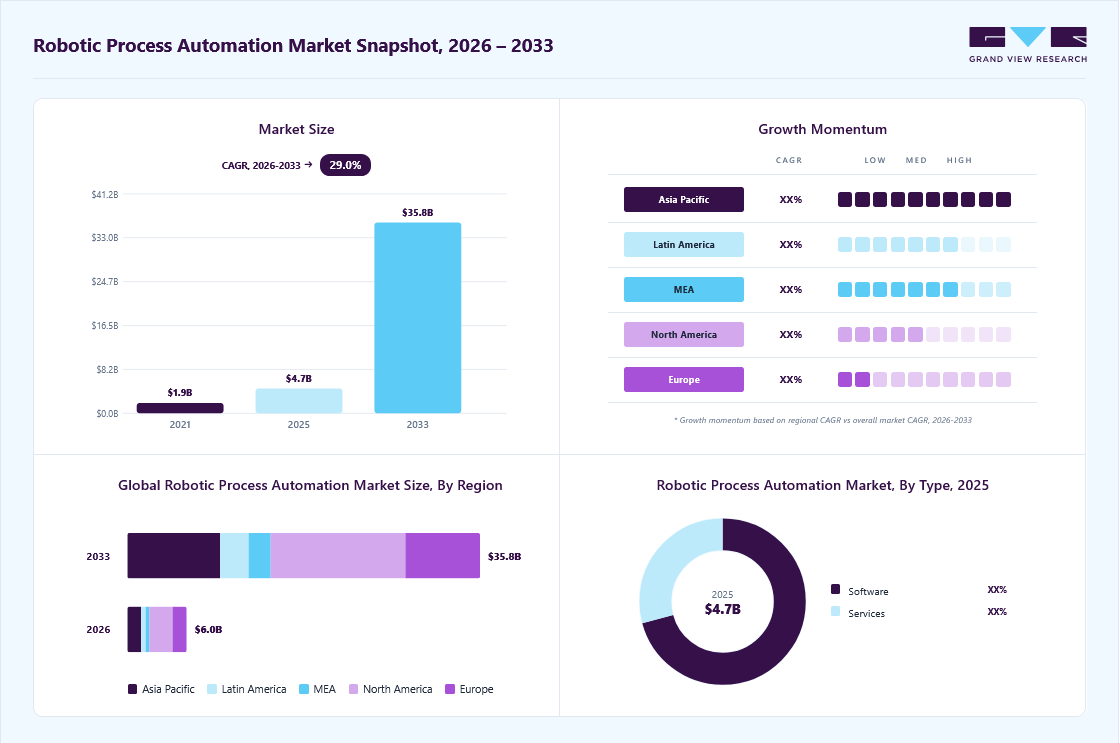
Today, many enterprises frequently leverage this technology to automate their day-to-day operation with improved efficiency. This has skyrocketed the adoption of RPA among businesses. A report from Grand View Research predicts that the robotic process automation market size is projected to grow up to $35.84 billion by 2033, at a CAGR of 29% between 2026 and 2033.
In this guide to robotic process automation, we will talk a lot about this technology and how it helps organizations grow.
Robotic Process Automation
Robotic process automation is now much more than just being a simple automation. It plays a vital role in enterprise digital transformation and lets organizations work fast and efficiently with AI integration. Let’s have a glimpse of powerful RPA:
- AI-augmented bots
- Hyperautomation
- Cloud-native deployments
- Intelligent document processing
- End-to-end process automation
What is Robotic Process Automation?
The RPA is basically a technology that harnesses the potential of intelligent bots to copy human activities — it automates mainly rule-based and repetitive business tasks. The bots contain the capability of interacting with apps, data processing, triggering actions, and completing workflows. It thus minimizes manual effort, errors, and helps employees focus on those tasks that bring value to your business.
Robotic Process Automation vs Intelligent Automation: Key Difference
RPA has the potential to automate repetitive tasks with the use of predefined rules, whereas intelligent automation blends it with AI to handle complex learning, decision-making, and unstructured data. We have described below the major differences between them:
| Criteria | RPA | Intelligent Automation |
|---|---|---|
| Technologies | It works on rule-based scripting, workflow bots, etc. | It leverages ML RPA, AI, computer vision, NLP, etc. |
| Data Handling | It handles structured data exclusively. | It handles both structured and unstructured data. |
| Learning Capability | It neither has any learning ability nor has self improvement. | It can learn continuously and adapt with the time. |
| Decision Making | It follows mainly predefined rules for decision making | It makes context-aware and smart decisions. |
| Human Intervention | It requires human insights most frequently. | It requires less human intervention. |
| Implementation Speed | It can be implemented fast and forward. | Its implementation takes a longer time mainly due to AI model training and integration. |
| Cost | It requires low initial investment. | It requires higher investment. |
Why is RPA Mission-Critical for Modern Enterprises?
RPA has become a necessity for modern enterprises for various reasons, like minimizing costs, errors, and increasing efficiency with the automation of repetitive tasks. Let’s find out some other reasons described below in detail:
Reducing Manual Workloads
Employees often spend hours performing mainly those tasks that are low-value yet repetitive, which indeed affects their productivity. RPA bots solve this by working 24/7, even without fatigue, and can handle high-volume manual processes in a fraction of the time.
Improving Operational Efficiency
RPA fosters process execution and completes even those tasks in minutes that once took hours. It minimizes process handoffs & bottlenecks, and ensures consistent execution. It thus helps enterprises achieve higher gains in resource utilization, throughput, and overall operational performance across multiple departments.
Enhancing Accuracy and Compliance
As mentioned, RPA works on predefined rules and implements tasks with near-perfect accuracy. This ensures compliance-heavy industries such as healthcare, banking, and insurance are specifically perfect for RPA adoption while ensuring audit traits, error-free reporting, regulatory adherence, etc., every time
Accelerating Digital Transformation
RPA supports digital transformation by bridging the gap between legacy systems and advanced platforms. This is possible even without expensive overhauls, which allows enterprises to modernize operations incrementally. It lays the groundwork for smart automation, especially when combined with AI and analytics.
Where RPA Creates Measurable Business Impact?
RPA offers a higher efficiency and a great value by increasing accuracy, minimizing costs, improving productivity, and accelerating processes across important functions and departments. Let’s have a detailed look:
Data Entry and Processing
The fact can’t be denied that manual data handling takes a huge time and also involves a lot of errors. RPA bots have adequate potential to collect, transform, validate, and migrate data across various systems at a higher speed. It processes thousands of records in minutes with accuracy.
Invoice and Payment Automation
RPA minimizes any chance of delay in accounts payable through automation of invoice capture, approval workflows, verification, payment reconciliation, etc. It helps businesses gain numerous benefits through fewer payment errors, financial closing cycles, less processing costs, which deliver a direct on profitability.
Customer Service Automation
Bots have the capability of handling routine service tasks like account lookups, ticket classification, query resolution, status updates, etc. It empowers human agents for handling high-value interactions, and with customers gaining a consistent and fast support experience that boosts both satisfaction and loyalty.
HR and Employee Onboarding
RPA can automate the entire employee lifecycle, from document verification to payroll enrollment. It ensures new hires get onboarded rapidly, compliance requirements are met, and HR teams reclaim valuable hours, etc. These are met even without putting any added manual effort.
IT Operations and Support
RPA bots have the capability of automating various IT-related tasks such as server monitoring, password resets, user account setup, incident tracking, patch deployment, etc. It limits downtime, helps desk workload, and ensures enterprise systems that operate at a higher performance across the clock.
We provide RPA solutions to minimize your operational costs, scale fast, and boost enterprise efficiency. Let’s transform your repetitive tasks into automated workflows.
Robotic Process Automation by Industry: Where the ROI Is Highest
RPA adoption varies across many industries, while every sector achieves different returns on investment (ROI). We have outlined here some of the industries where RPA has a higher impact on increasing ROI:
RPA for Financial Services and Banking
Whether it’s financial institutions or banks, they process a number of transactions on a regular basis. RPA automates loan processing, KYC verification, regulatory reporting, fraud detection workflows, and account reconciliation. It minimizes operational costs while improving audit readiness and compliance.
RPA for Insurance
Insurance organizations harness the potential of RPA to improve policy underwriting, claims processing, compliance documentation, and premium calculations. With bots, they perform those tasks in hours that used to take even days. It boosts customer satisfaction while minimizing administrative overhead.
RPA for Manufacturing
Manufacturing businesses use RPA to streamline even complex manufacturing workflows. Bots offer real-time data synchronization across ERP systems and minimize overall production delays. It enhances procurement efficiency.
RPA for Retail and E-Commerce
For retail and eCommerce, RPA tackles several tasks smoothly, including inventory tracking, supply chain management, and quality control reporting, etc. Bots also bring an immense possibility of real-time data synchronization across multiple ERP systems. It minimizes production delays and boosts procurement efficiency.
RPA for Healthcare
With RPA, healthcare organizations handle multiple tasks efficiently, whether it’s claims adjudication, automating patient scheduling, prior authorization, medical billing, compliance reporting, etc. It reduces clinical burden on clinical staff and improves revenue cycles.
RPA for Telecommunications
RPA is useful for telecom companies for various tasks like service provisioning, automating network monitoring, billing reconciliation, etc. It thus reduces billing errors, service activation times, and improves overall customer experience.
RPA Software and Platforms: What to Look for Before You Choose
The selection of the top RPA platform is something that is a strategic decision which impacts extensively your automation ROI. We have described below the following RPA software that redefines enterprise automation:
UiPath
UiPath provides an end-to-end automation platform that combines AI-driven bots, process mining, etc. Be it its robust community, extensive marketplace, or seamless integration capabilities, they make UiPath the right choice specifically for large-scale enterprise deployments.
Automation Anywhere
Automation Anywhere comes with a cloud-native platform that yields smart and intelligent automation with its document processing capabilities, AI-driven bots, strong analytics suites, etc. Its enterprise-grade security and intuitive interface make it a perfect match for organizations that focus on both governance and scalability.
Blue Prism
Blue Prism is highly popular and used extensively by regulated industries with strict security and compliance requirements. Its digital workforce platform offers robust process automation, smooth AI integration, enterprise scalability, etc. These make it a top choice for industries like insurance, banking, and government organizations.
Microsoft Power Automate
Microsoft Power Automate is a perfect option for businesses that already leverage Dynamics 365, Teams, Azure, etc. It offers low-code automation for these businesses. Besides, it also establishes a connection between citizen development and enterprise automation requirements efficiently and in a cost-effective way.
Pega RPA
Pega delivers smart end-to-end automation by combining CRM and BPM features. It works perfectly for customer service workflow and case management. It’s also good for businesses seeking a unified automation platform.
IBM Robotic Process Automation
The major advantage of IBM RPA is that it can be integrated perfectly with the hybrid and AI cloud ecosystem. It delivers smart document processing, robust enterprise integration, and advanced analytics. IBM RPA is best for businesses that already use IBM technology.
We prevent your team from repetitive tasks and help them focus on innovation and growth. Our world-class RPA solutions support your organization’s growth.
How is Robotic Process Automation Implemented? A Practical Framework?
Implementing RPA is a structured process that starts with discovering suitable processes, selecting the perfect tools, and defining automation goals. Let’s explore its various steps in-depth:
Process Discovery and Assessment
Every successful RPA starts with a complete audit of any existing business processes. At this stage, teams analyze existing workflows, discover pain points, document process steps, determine technical feasibility, etc.
Identifying Automation Opportunities
At this stage, teams focus on important tasks that need to be automated, which are rule-based, repetitive, predictable, and high-volume tasks. Businesses focus on processes according to complexity and impact.
Bot Design and Development
After processes are selected, developers craft both workflows with the use of the selected RPA platform. It includes mapping integrations, configuring logic, building reusable components, handling exceptions, etc. These ensure bots are scalable and maintainable.
Testing and Validation
Rigorous testing is something that is of great importance. It involves testing bots to ensure it functions as expected. In this, QA professionals perform a variety of tests like regression testing, functional testing, and user acceptance testing across different scenarios.
Deployment and Change Management
This step involves deploying bots into production environments with careful change management strategies. Whether it’s training initiatives, employee communication, or stakeholder support, they are necessary and help in ensuring a smooth adoption and minimizing resistance.
Monitoring and Continuous Optimization
Once deployed successfully, bot performance is monitored continuously through dashboards and analytics. At this stage, the team performs various tasks like checking processing times, exception rates, ROI metrics, etc., with the use of insights to redefine workflows and scale automation successfully.
Benefits of Robotic Process Automation: What Real Deployments Deliver
Once they are implemented successfully, organizations become entitled to avail of numerous advantages like fast operations, lower costs, improved productivity, etc. The following are some other advantages:
Increased Productivity and Efficiency
One of the major advantages of RPA bots is that they operate around the clock — it ensures a rapid execution of the process with no human intervention. Many enterprises have already witnessed a vast productivity gain in automated functions.
Cost Reduction and Resource Optimization
As mentioned, RPA has enormous capability of automating high-volume tasks and thus allows businesses to minimize their network expenses and labor costs and relocate human talent towards various revenue-generating activities.
Improved Accuracy and Reduced Errors
Bots complete any tasks by maintaining consistency and accuracy, which minimizes human errors in data entry, reporting, and calculation. Automation minimizes the possibility of errors when compared to manual work.
Enhanced Compliance and Audit Readiness
Whether you wish to record or trace, you will get every possibility with every bot. This creates a perfect audit trail that speeds up regulatory reviews, simplifies compliance reporting, and helps in minimizing overall business risk.
Better Employee and Customer Experience
RPA facilitates employees to focus on those tasks that really add value to their organization rather than engaging in repetitive tasks. It works better to boost job satisfaction and customer retention. On the other hand, customers also receive more accurate and faster support, which increases their satisfaction and loyalty.
Digital Transformation and RPA: How They Connect
Instead of becoming a future goal, digital transformation has become a business necessity. And RPA plays a leading role in this. We will describe below how both connect with each other:
RPA as a Foundation for Digital Transformation
RPA minimizes the gap between modern digital infrastructure and legacy systems. Businesses use RPA to automate existing processes to accelerate modernization timelines, unlock operational agility, and build automation muscle required to support vast transformation initiatives.
Integrating RPA With AI and Machine Learning
Automation becomes much more than just a simple rule-based task when RPA leverages technologies like AI and ML. Bots get the ability to understand unstructured data, discover patterns, make smart decisions, and thus improve continuously over time.
Building End-to-End Automated Workflows
RPA minimizes the overall barriers that cause businesses to slow down. Organizations can link multiple apps, systems, and departments through automated workflows to achieve end-to-end process automation from start to end without any manual transfers or delay.
Creating Intelligent Enterprise Operations
The major objective of any RPA-based transformation is a smart automated enterprise where data moves smoothly, and processes run independently. It allows employees to focus on both innovation and strategy. It helps them gain a competitive advantage as well.
How Moon Technolabs Helps Businesses Implement RPA Solutions?
We have the expertise to engineer smart automation strategies tailored to match your unique business requirements. We have a group of expert RPA teams to guide enterprises throughout each step of their implementation journey.
Our experts integrate RPA with AI, ML, and existing enterprise systems, while ensuring a smooth adoption with an improved ROI. We are committed to delivering scalable RPA solutions that are future-ready and boost efficiency.
Conclusion
RPA today is much more than just experimentation for an organization. It has become a growth engine for them by increasing their efficiency. Businesses that leverage RPA can develop more intelligent and resilient operations in the future.
Partnering with a reliable RPA development services provider like us helps you gain the strategy, expertise, and technology required to implement RPA and unlock its true potential.
FAQs
01
What is robotic process automation (RPA)?
RPA is basically a technology that leverages software bots to automate repetitive and time-consuming tasks. It helps organizations boost productivity and thus discover enormous growth opportunities.02
Which business processes are best suited for RPA?
RPA is appropriate for business processes like high-volume, repetitive, and rule-based processes. These tasks mainly include payroll management, invoice processing, data entry, report generation, customer onboarding, etc.03
How much does RPA implementation cost?
An average RPA implementation cost ranges from $10,000 to $15,000. Besides, it also varies on many factors like software licensing, number of bots, deployment scale, integrations, etc.04
What is the difference between RPA and AI?
RPA has the potential to automate rule-based and structured tasks based on predefined instructions. On the other hand, AI allows systems to learn, analyze, and recognize data patterns. And they make decisions accordingly.05
How long does it take to deploy an RPA solution?
The implementation of an RPA solution generally takes up to 3 months. It depends on many important factors such as business requirements, process complexity, and more.




Jayanti Katariya is the CEO of Moon Technolabs, a fast-growing IT solutions provider, with 18+ years of experience in the industry. Passionate about developing creative apps from a young age, he pursued an engineering degree to further this interest. Under his leadership, Moon Technolabs has helped numerous brands establish their online presence and he has also launched an invoicing software that assists businesses to streamline their financial operations.
Submitting the form below will ensure a prompt response from us.
We refine our expertise to deliver innovative business solutions.





205 N Michigan Avenue, #810, Chicago, 60601, Illinois, United States
13500 Long Is Dr, Pflugerville, TX 78660, USA

C/105 Ganesh Meridian, S.G. Highway, Ahmedabad, GJ 380060


Ayse D.
Co-Founder France
“ I highly recommend Moon Technolabs as the quality of service is wonderful. We have hired this company to develop the product based on some complex & technical issues. We get the best quality services as compared with others in the market. Huge Thanks to Moon Technolabs as the team is always ready to give the solution all time.”

Justin G.
Founder & CEO USA
USA“ Moon Technolabs is a pioneer in the WebRTC based project as they have fixed complicated segments of the module by fulfilling different product lines by providing 24X7 customer support. We really recommended Moon Technolabs as they are able to develop products as per the module deadline and project timeline.”

Flavio S.
Founder & Managing Director Germany
“I am happy to recommend Moon Technolabs for their app development services. They successfully developed apps for me, and I am highly satisfied with the overall outcomes. The development team has swiftly addressed the issues with responsive and effective communication to understand the requirement quickly and actively resolve the back-and-forth problems that arose...”

Jay M.
Founder & CEOUSA“Moon Technolabs is the best company that provides advanced apps and websites development services in the USA and Europe. I am a newbie to develop my app with an external team. I am really happy to work with them as I am not that much mobile apps user. Here, the team and specially the CEO of Moon Technolabs helps me to let me know about the benefits of my app to generate revenue....”


Our Offices
India
C/105 Ganesh Meridian,S.G. Highway, Ahmedabad, GJ 380060USA
205 N Michigan Avenue, #810, Chicago, 60601, Illinois, United StatesContact Information