


An Ultimate Guide to Retail Software Development

Jayanti Katariya
Last Updated: May 01, 2026 Total Views: 87
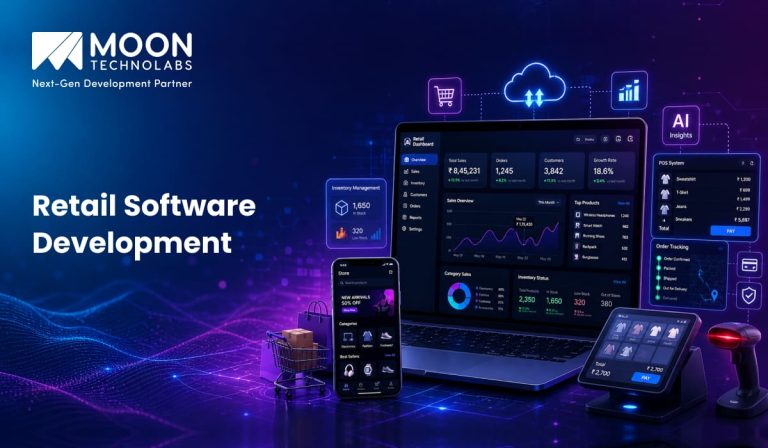
Table of Content


Blog Summary:
Retail software development is the foundation of modern commerce, powering everything from billing and inventory management to customer engagement and omnichannel shopping experiences. It enables retailers to operate efficiently, scale faster, and deliver consistent digital and in-store experiences. This guide covers core components of a retail software system, like backend, frontend, and integrations, along with the role of cloud computing, APIs, best practices, and emerging trends shaping modern retail systems.
Table of Content
Understanding the Architecture of Retail Software Systems
Retail software systems have become a critical foundation for modern commerce, enabling businesses to manage operations, enhance customer experiences, and scale across multiple channels. Today’s retail platforms extend far beyond basic transaction processing, supporting functions such as inventory management, customer engagement, analytics, and omnichannel coordination.
This evolution is reflected in strong market growth. According to Precedence Research, the global point-of-sale (POS) software market is valued at USD 16.37 billion in 2025 and is projected to reach approximately USD 45.34 billion by 2035, growing at a CAGR of 10.72% from 2026 to 2035. This underscores the rising demand for advanced and integrated retail technology solutions.
At their core, retail systems are built on three key components: backend (data processing and business logic), frontend (user interfaces), and integrations (connections with third-party services). Cloud computing and APIs further strengthen these systems by enabling scalability, flexibility, and real-time data access, forming the backbone of modern retail architecture.
Types of Retail Software That Power Modern Businesses
Modern retail businesses depend on a range of custom software solutions to operate smoothly, improve efficiency, and deliver better customer experiences. Each type of retail software management plays a specific role in managing different aspects of the business:
Point of Sale (POS) systems
POS systems are essential for handling daily sales transactions, billing, and payment processing. Today’s POS solutions also offer features like real-time sales tracking, reporting, and integration with inventory and customer data, helping retailers make informed decisions.
Inventory Management Software
Inventory management systems help retailers keep track of stock levels, manage product variations, and automate reordering. By using data insights and demand forecasting, businesses can avoid overstocking or running out of popular items, improving overall efficiency.
eCommerce Platforms
eCommerce platforms enable retailers to build and manage online stores. They support product listings, secure payments, and order processing. Many platforms also allow seamless integration with physical stores, creating an omnichannel shopping experience.
Customer Relationship Management (CRM) systems
CRM systems store and analyze customer information, including purchase history and preferences. This allows businesses to personalize marketing efforts, improve customer service, and build long-term loyalty.
Supply Chain and Logistics Software
These tools manage the movement of goods from suppliers to customers. They help coordinate procurement, track shipments, and ensure timely deliveries, improving transparency and operational control.
The Retail Software Development Process: Key Steps
Building an effective retail software requires a structured approach that aligns technology with business needs and customer expectations. Below are the essential stages involved in the retail software development process:
Requirement Gathering and Business Analysis
This initial phase lays the foundation for the entire project. It involves understanding the retailer’s business model, target audience, and operational workflows.
Key activities include:
- Conducting stakeholder interviews.
- Analyzing existing systems and processes.
- Identifying pain points and opportunities for improvement.
- Defining functional and non-functional requirements.
A thorough business analysis ensures that the final product solves real problems and supports business growth.
UI/UX Design Tailored for Retail Users
In retail, user experience plays a critical role in driving engagement and sales. The design must cater to both end customers and internal users, such as store staff and administrators.
This stage focuses on:
- Creating intuitive navigation and user flows.
- Designing visually appealing interfaces aligned with the brand.
- Ensuring mobile responsiveness and fast interactions.
- Building prototypes and wireframes for validation.
A well-designed interface enhances customer satisfaction and improves conversion rates.
Development and Integrations
During this phase, developers bring the design and requirements to life by building the software’s core functionality.
Key components include:
- Front-end and back-end development.
- Database setup and management.
- Integration with third-party systems such as payment gateways, inventory management tools, CRM systems, and shipping services.
Strong integrations are crucial for seamless operations, especially in omnichannel retail environments.
Testing and Quality Assurance
Before deployment, the software undergoes rigorous testing to ensure reliability, performance, and security.
Testing includes:
- Functional testing to verify features.
- Performance testing to handle high traffic volumes.
- Security testing to protect sensitive customer data.
- User acceptance testing to validate real-world usability.
This step minimizes risks and ensures a smooth user experience.
Deployment and Post-launch Support
Once the software passes all quality checks, it is deployed to a live environment. However, the process doesn’t end there.
Post-launch activities include:
- Monitoring system performance.
- Fixing bugs and addressing user feedback.
- Rolling out updates and new features.
- Ensuring system scalability as the business grows.
Continuous support and improvement help retail businesses stay competitive in a rapidly evolving market.
Challenges in Retail Software Development and Their Solutions
Retail software development involves multiple moving parts: inventory, integrations, security, and performance. Here’s a more concise look at key challenges and solutions:
Managing Real-time Inventory Updates
Challenge: Keeping inventory accurate across stores and online channels in real time.
Solution: Use centralized, cloud-based systems with real-time syncing via APIs and event-driven architecture to prevent stock mismatches.
Integration with Multiple Systems
Challenge: Connecting with payment gateways, ERP, CRM, and logistics systems without errors.
Solution: Adopt API-first and microservices architecture, along with middleware, to ensure smooth and flexible integrations.
Data Security and Compliance
Challenge: Protecting sensitive customer and payment data while meeting regulations.
Solution: Implement encryption, multi-factor authentication, secure coding practices, and compliance standards like PCI-DSS.
Handling High User Traffic
Challenge: Managing traffic spikes during sales or peak seasons without crashes.
Solution: Use cloud infrastructure with auto-scaling, load balancing, and caching (CDNs) to maintain performance.
Scalability Challenges
Challenge: Supporting business growth without system slowdowns.
Solution: Build with scalable technologies like microservices, containers, and cloud platforms, along with database optimization.
Scale Your Retail Business with Smart Software
Build powerful retail software that simplifies operations, connects channels, and enhances customer experience with modern, scalable technology.
Essential Tools and Technologies for Retail Software Development
Modern retail software development focuses on building scalable, fast, and customer-centric systems for online and offline retail operations. The right technology stack ensures smooth transactions, real-time inventory tracking, and personalized shopping experiences.
Programming Languages and Frameworks
Backend development in retail systems commonly uses Java, Python, and Node.js due to their reliability and scalability. These are often paired with frameworks such as Spring Boot for Java, Django for Python, and Express.js for Node.js to accelerate development and manage enterprise-level complexity.
On the frontend, JavaScript remains essential, with frameworks such as React, Angular, and Vue.js used to build responsive and interactive user interfaces. For mobile retail applications, cross-platform tools like Flutter and React Native enable faster deployment on both Android and iOS.
Cloud Platforms (AWS, Azure, GCP)
Cloud infrastructure is critical for handling traffic spikes, especially during sales events. Leading platforms like Amazon Web Services, Microsoft Azure, and Google Cloud Platform provide services for computing, storage, networking, and serverless applications.
Retail businesses use cloud systems to host e-commerce platforms, manage distributed databases, and ensure high availability. Features like auto-scaling and load balancing help maintain performance during peak demand.
Database Management Systems
Retail applications deal with large volumes of structured and unstructured data, making database selection important.
Relational databases such as MySQL, PostgreSQL, and Microsoft SQL Server are used for managing orders, payments, and customer records.
For more flexible and scalable data handling, NoSQL databases like MongoDB, Apache Cassandra, and Amazon DynamoDB support product catalogs, user activity tracking, and real-time analytics.
APIs and Third-party Integrations
APIs play a key role in connecting retail platforms with external services. They enable integration with payment gateways, logistics providers, and marketing tools.
Popular payment solutions include Stripe and PayPal. RESTful APIs and GraphQL are widely used to ensure efficient communication between microservices, mobile apps, and third-party systems.
These integrations help retailers expand functionality without rebuilding core systems.
Analytics and Reporting Tools
Data analytics is essential for understanding customer behavior and improving business decisions. Tools like Google Analytics provide insights into website traffic and user engagement, while Tableau and Power BI offer advanced visualization and reporting capabilities.
Retail platforms use analytics for demand forecasting, inventory optimization, personalized marketing, and sales performance tracking. Increasingly, machine learning models are also used to predict customer preferences and trends.
Real-world Applications of Retail Software
Retail software has transformed how businesses operate, making processes more efficient and customer-focused. From managing inventory to enhancing the shopping experience, modern retail IT solutions play a crucial role in both online and offline stores. Below are some key real-world applications:
Smart Inventory Tracking Systems
Smart inventory tracking systems help retailers monitor stock levels in real time. Using technologies such as barcode scanning, RFID, and cloud-based dashboards, businesses can avoid overstocking and stockouts. These systems also provide insights into sales trends, helping retailers make informed purchasing decisions and optimize warehouse management.
Omni-Channel Retail Solutions
Omni-channel retail solutions integrate multiple sales channels, such as physical stores, e-commerce websites, and mobile apps, into one seamless system. This allows customers to shop anytime, anywhere, while ensuring a consistent experience. For example, customers can order online and pick up in-store, or return online purchases at a physical location, enhancing convenience and satisfaction.
Personalized Shopping Experiences
Retail software leverages customer data to deliver personalized experiences. By analyzing purchase history, browsing behavior, and preferences, retailers can recommend relevant products, offer tailored discounts, and create targeted marketing campaigns. Personalization not only improves customer engagement but also increases conversion rates and brand loyalty.
Automated Billing and Checkout Systems
Automated billing and checkout systems streamline the payment process, reducing wait times and human errors. POS systems, self-checkout kiosks, and mobile payment solutions enable faster transactions and improve operational efficiency. These systems also integrate with inventory and accounting tools, ensuring accurate financial records.
Loyalty and Rewards Programs
Retail software enables businesses to design and manage loyalty programs that reward repeat customers. Through points, discounts, cashback offers, or exclusive deals, retailers can encourage customer retention. Advanced systems track customer activity and provide insights into buying patterns, allowing businesses to refine their loyalty strategies for better results.
Why Retail Software is Crucial for Business Growth?
Companies choose to integrate custom retail software to drive business growth, as it plays a vital role in simplifying and automating everyday business processes. It integrates sales, inventory management, billing, and reporting into a single system, reducing manual work and minimizing errors.
With real-time actionable insights into stock levels and sales performance, businesses can manage resources more effectively, avoid overstocking or shortages, and make smarter, data-driven decisions.
In addition, retail software significantly improves the customer experience. Faster checkout processes, multiple payment options, and personalized offers create a smooth and convenient shopping journey.
By analyzing customer preferences and buying patterns, businesses can tailor their strategies, increase customer satisfaction, and build long-term loyalty, ultimately driving steady and sustainable growth.
Cost of Custom Retail Software Development
The cost of custom retail software development typically ranges from around $10,000 to $50,000 for a basic solution with core features like inventory tracking, billing, and simple reporting.
For mid-level systems that include integrations, advanced analytics, and better UI/UX design, the cost can go between $50,000 and $150,000. Highly complex, enterprise-grade retail platforms with AI capabilities, omnichannel support, real-time data processing, and scalable architecture can exceed $200,000 or more, depending on requirements.
In addition to development, businesses should budget for ongoing costs such as maintenance (15–25% of the initial development cost annually), cloud hosting ($500 to $5,000+ per year), and regular updates or feature enhancements.
The final cost depends heavily on factors like the size of the development team, geographic location of developers, project timeline, and the level of customization required.
Future Trends in Retail Software Development
The retail industry is undergoing a rapid digital transformation, driven by evolving customer expectations and technological advancements. Several emerging technologies are shaping the future of retail software development, such as:
AI and Machine Learning in Retail
AI and ML are helping retailers better understand customer behavior and preferences. They enable personalized recommendations, dynamic pricing, and accurate demand forecasting. AI-powered chatbots also enhance personalized customer service by providing quick, relevant responses.
IoT-enabled Smart Stores
IoT is turning traditional stores into smart environments. Devices like sensors, RFID tags, and smart shelves provide real-time insights into inventory and customer activity. This helps reduce stock issues, optimize store layouts, and enable faster, automated checkout experiences.
Augmented Reality Shopping
AR enhances online and in-store shopping by allowing customers to try products or visualize them in real-life settings virtually. This interactive experience increases purchase confidence and helps reduce return rates.
Voice Commerce
Voice-enabled shopping is growing as smart assistants become more prevalent. Customers can browse, order, and track products through voice commands, making shopping more convenient and hands-free.
Automation and Robotics
Automation and robotics are improving efficiency across retail operations. From warehouse management to in-store assistance, these technologies help reduce manual work, increase accuracy, and speed up order fulfillment.
Ready to Upgrade Your Retail Experience?
Our experts launch custom retail software designed to optimize sales, inventory, and customer engagement across all channels.
Why Choose Moon Technolabs as Your Retail Software Development Partner?
Choosing Moon Technolabs as your retail software development partner means working with a team that understands both technology and the fast-evolving retail sector. We focus on building scalable, user-friendly, and modern retail solutions that enhance customer experience, streamline retail operations, and drive business growth.
With a strong emphasis on innovation, data-driven strategies, and seamless system integration, we help retailers stay competitive in an increasingly digital marketplace while ensuring reliability and long-term support.
Key Reasons to Choose Moon Technolabs:
- Expertise in end-to-end retail software development
- Customized solutions tailored to your business needs
- Strong focus on user experience and intuitive design
- Seamless integration with existing systems and platforms
- Scalable solutions to support business growth
- Use of the latest technologies and industry best practices
- Dedicated support and maintenance services
FAQs
01
How is retail software different from standard business software?
Retail software is specifically designed to handle retail operations such as inventory management, point-of-sale (POS), customer loyalty programs, and real-time sales tracking. In contrast, standard business software focuses on broader functions like accounting, HR, or project management. Retail software is more customer-centric and transaction-driven, with features tailored to both in-store and online shopping experiences.02
What type of retailers benefit the most from custom retail software?
Custom retail software is especially beneficial for mid-sized to large retailers, multi-store chains, and eCommerce businesses with unique workflows. Retailers with complex inventory systems, omnichannel sales strategies, or personalized customer engagement needs gain the most value. It’s also ideal for niche retailers who require specialized features that off-the-shelf solutions may not offer.03
Is it possible to integrate retail software with existing POS systems?
Yes, most custom retail software solutions are designed to integrate with existing POS systems. Through APIs and middleware, businesses can connect their retail software with POS, CRM, ERP, and other tools. This ensures seamless data flow, centralized reporting, and improved operational efficiency without replacing existing infrastructure.04
What role does AI play in retail software development?
AI plays a significant role in enhancing custom retail software by enabling features such as demand forecasting, personalized product recommendations, customer support chatbots, and fraud detection. It helps retailers analyze large volumes of data to make smarter decisions, optimize inventory, and improve customer experience through automation and insights.05
How scalable is retail software for growing businesses?
Robust retail software can be highly scalable, especially when built on a cloud-based architecture. As a business grows, the software can accommodate increased transactions, additional stores, more users, and expanded product catalogs. Scalable solutions ensure long-term flexibility, allowing businesses to add new features and integrations without major system overhauls.




Jayanti Katariya is the CEO of Moon Technolabs, a fast-growing IT solutions provider, with 18+ years of experience in the industry. Passionate about developing creative apps from a young age, he pursued an engineering degree to further this interest. Under his leadership, Moon Technolabs has helped numerous brands establish their online presence and he has also launched an invoicing software that assists businesses to streamline their financial operations.
Submitting the form below will ensure a prompt response from us.
We refine our expertise to deliver innovative business solutions.



205 N Michigan Avenue, #810, Chicago, 60601, Illinois, United States
13500 Long Is Dr, Pflugerville, TX 78660, USA

C/105 Ganesh Meridian, S.G. Highway, Ahmedabad, GJ 380060


Ayse D.
Co-Founder France
“ I highly recommend Moon Technolabs as the quality of service is wonderful. We have hired this company to develop the product based on some complex & technical issues. We get the best quality services as compared with others in the market. Huge Thanks to Moon Technolabs as the team is always ready to give the solution all time.”

Justin G.
Founder & CEO USA
USA“ Moon Technolabs is a pioneer in the WebRTC based project as they have fixed complicated segments of the module by fulfilling different product lines by providing 24X7 customer support. We really recommended Moon Technolabs as they are able to develop products as per the module deadline and project timeline.”

Flavio S.
Founder & Managing Director Germany
“I am happy to recommend Moon Technolabs for their app development services. They successfully developed apps for me, and I am highly satisfied with the overall outcomes. The development team has swiftly addressed the issues with responsive and effective communication to understand the requirement quickly and actively resolve the back-and-forth problems that arose...”

Jay M.
Founder & CEOUSA“Moon Technolabs is the best company that provides advanced apps and websites development services in the USA and Europe. I am a newbie to develop my app with an external team. I am really happy to work with them as I am not that much mobile apps user. Here, the team and specially the CEO of Moon Technolabs helps me to let me know about the benefits of my app to generate revenue....”


Our Offices
India
C/105 Ganesh Meridian,S.G. Highway, Ahmedabad, GJ 380060USA
205 N Michigan Avenue, #810, Chicago, 60601, Illinois, United StatesContact Information


