


The Complete Guide to Renewable Energy Software Development

Jayanti Katariya
Last Updated: Jul 08, 2026 Total Views: 82
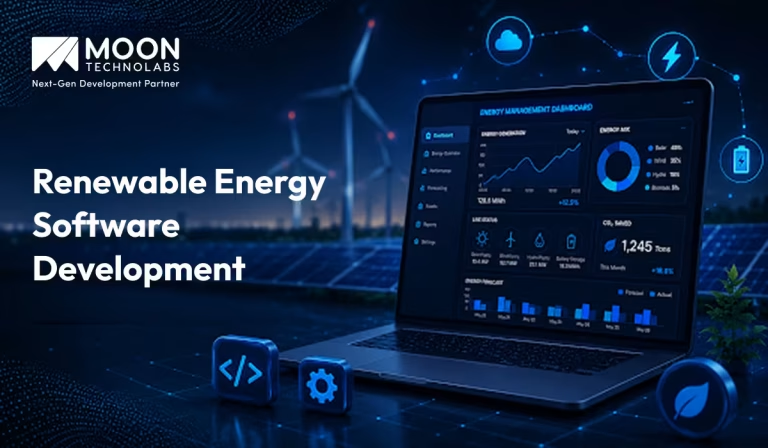
Table of Content


Blog Summary:
Renewable energy software development is reshaping how clean energy systems are monitored, managed, and optimized, enabling smarter grids, better efficiency, and data-driven decisions across solar, wind, and hybrid systems. As the renewable energy sector expands, such solutions are vital for scaling sustainable infrastructure. In this blog, we will explore its importance, core features, technologies, applications, costs, and how to choose the right development partner.
Table of Content
The global energy landscape is undergoing a major transformation, where renewable sources like solar and wind are rapidly moving from alternative options to mainstream power generation. But the real question is, how do we efficiently manage this growing complexity of decentralized, data-heavy energy systems?
As a result, Renewable Energy Software Development has become essential for managing everything from real-time energy production to predictive maintenance and grid optimization.
According to the Extrapolate Renewable Energy Market Report, the global renewable energy market is projected to reach around USD 2 trillion by 2030, reflecting the massive scale of clean energy infrastructure expansion.
This growth is also reshaping how energy companies operate, pushing them towards intelligent software systems that can improve visibility, reduce inefficiencies, and enable faster, data-driven decisions across the entire energy ecosystem.
Why Do Businesses Need Renewable Energy Software Development?
As businesses accelerate their shift toward clean energy, managing renewable assets and optimizing energy usage has become more complex. Renewable energy software development helps organizations monitor energy generation, automate operations, analyze real-time data, and improve the performance of solar, wind, and other renewable energy systems.
These custom solutions also support regulatory compliance, cost optimization, and informed decision-making. Unlike generic software, custom renewable energy software development addresses specific business requirements and seamlessly integrates with existing systems.
By leveraging technologies such as AI, IoT, cloud computing, and predictive analytics, businesses can improve operational efficiency, maximize energy output, and scale their renewable energy initiatives with confidence.
Types of Renewable Energy Software Solutions
Renewable energy software development helps businesses maximize energy production, reduce operational costs, and improve asset performance through real-time monitoring and intelligent analytics. Below are the various types of renewable energy solutions that provide the visibility and automation needed to achieve greater efficiency and sustainability:
Solar Energy Management Software
Maximize solar plant performance with intelligent monitoring and analytics. Track energy generation in real time, identify underperforming assets, automate fault detection, and streamline maintenance activities from a centralized dashboard. Built to help operators improve energy yield, reduce operational costs, and extend asset lifespan.
Wind Farm Monitoring Software
Maintain peak turbine performance with continuous monitoring and predictive insights. Analyze turbine health, monitor weather conditions, detect anomalies before failures occur, and optimize maintenance schedules to minimize downtime and increase power generation across wind farms.
Energy Management System (EMS)
Gain complete visibility into energy consumption and distribution through a centralized energy management system. Monitor usage patterns, optimize energy resources, automate operational controls, and reduce energy costs while supporting sustainability and regulatory compliance initiatives.
Smart Grid Management Software
Modernize grid operations with real-time monitoring, intelligent automation, and data-driven decision-making. Manage distributed energy resources, balance demand and supply, respond to grid events faster, and improve network reliability while supporting renewable energy integration.
Renewable Asset Monitoring Software
Monitor solar farms, wind turbines, battery storage systems, and hybrid energy assets through a unified platform. Access live performance data, receive instant alerts, forecast maintenance requirements, and improve asset utilization with advanced analytics designed for renewable energy operations.
Key Benefits of Custom Renewable Energy Software Development
Here are the benefits of custom renewable energy software development that help energy businesses move beyond traditional monitoring and adopt intelligent, data-driven operations. Have a look:
Intelligent Energy Forecasting
Move beyond basic weather predictions with AI-driven forecasting that combines historical production, live weather feeds, grid demand, and site-specific variables. Custom software helps energy providers anticipate generation fluctuations, balance supply and demand, and make informed dispatch decisions that improve overall grid efficiency.
Real-time Asset Monitoring
Gain complete visibility into distributed renewable assets from a single platform. Track equipment health, power output, environmental conditions, and operational status in real time across solar farms, wind turbines, battery storage systems, and microgrids. Instant alerts enable teams to respond quickly to performance issues before they impact energy production.
Lower Operational Costs
Replace disconnected spreadsheets and manual workflows with an integrated platform that automates reporting, maintenance scheduling, asset tracking, and performance analysis. By reducing administrative overhead, minimizing energy losses, and improving workforce productivity, organizations can achieve measurable reductions in operating costs.
Predictive Maintenance & Performance Optimization
Analyze sensor data, equipment history, and operational trends to identify early indicators of component degradation. Instead of relying on fixed maintenance schedules, service teams can prioritize interventions based on actual asset condition, reducing unplanned downtime, extending equipment life, and maintaining peak energy generation throughout the asset lifecycle.
Future-Proof Your Renewable Energy Business with Custom Solutions
Develop intelligent software solutions that improve asset management, streamline operations, reduce downtime, and maximize renewable energy performance.
Essential Features of Renewable Energy Software
Here are the benefits of custom renewable energy software development that help energy businesses move beyond traditional monitoring and adopt intelligent, data-driven operations. Have a look at the key advantages:
Third-party System Integration
Renewable energy software should seamlessly integrate with third-party systems to create a unified digital ecosystem. Integration with IoT devices, SCADA systems, ERP platforms, CRM software, weather forecasting services, and utility grids enables smooth data exchange and operational efficiency.
By eliminating data silos, organizations can automate workflows, improve asset monitoring, and make informed decisions based on real-time insights. String API support also allows businesses to connect with existing enterprise applications without disrupting ongoing operations.
Scalable Software Architecture
As renewable energy businesses expand, their software must be capable of handling increasing volumes of data, users, and connected assets. A scalable software architecture ensures that the platform can support additional solar farms, wind turbines, battery storage systems, or distributed energy resources without compromising performance.
Cloud-native infrastructure, modular design, and microservices architecture provide the flexibility to add new features, integrate emerging technologies, and accommodate future business growth while maintaining system reliability.
Regulatory Compliance and Reporting
The renewable energy industry operates under strict environmental, safety, and energy regulations. Effective renewable energy software simplifies compliance by automatically collecting operational data, generating audit-ready reports, and maintaining accurate documentation.
Built-in reporting tools help organizations meet local and international regulatory requirements, monitor emissions, track renewable energy certificates, and ensure transparency with stakeholders. Automated compliance management reduces manual effort, minimizes errors, and helps avoid costly penalties while supporting sustainable business practices.
Energy Storage Management
Efficient energy storage management is essential for maximizing the value of renewable energy systems. Renewable energy software enables organizations to monitor, control, and optimize battery energy storage systems (BESS) in real time. By tracking battery health, state of charge (SoC), charging and discharging cycles, and energy availability, businesses can improve storage efficiency and extend battery lifespan.
Advanced analytics and intelligent scheduling help store excess energy during periods of high generation and release it during peak demand or grid outages. This ensures better energy utilization, enhances grid stability, reduces energy costs, and supports uninterrupted power supply.
Demand Response Management
Demand response management enables organizations to balance electricity consumption with grid demand by automatically adjusting energy use during peak-load periods. Renewable energy software integrates with smart meters, IoT devices, and utility networks to monitor energy demand and execute demand response strategies in real time.
By leveraging automated load control, dynamic pricing insights, and predictive analytics, businesses can reduce peak energy consumption, lower operational costs, and participate in utility incentive programs. Demand response capabilities also improve grid reliability, minimize energy waste, and support a more resilient and sustainable energy ecosystem.
Asset Performance Analytics
It provides deep insights into the operational efficiency and health of renewable energy assets, including solar panels, wind turbines, inverters, transformers, and battery storage systems. The software continuously collects and analyzes performance data to identify trends, detect anomalies, and predict potential equipment failures before they occur.
With customizable dashboards, KPI tracking, and AI-driven analytics, operators can measure energy production, equipment utilization, downtime, and maintenance effectiveness. These insights enable proactive maintenance, optimize asset performance, increase energy output, reduce operational costs, and maximize the return on renewable energy investments.
Renewable Energy Software Development Process
Step 1: Define Business Goals and Requirements
Every successful renewable energy software project begins with a clear understanding of business objectives and user needs. Whether you’re developing a solar monitoring platform, wind farm management system, EV charging application, or energy management software, it’s essential to identify the problems the solution will solve.
Define the target audience, core features, compliance requirements, scalability goals, and expected outcomes. Gathering detailed functional and technical requirements at this stage helps minimize development risks and ensures the final product aligns with business goals.
Step 2: Conduct Market and Technology Research
Thorough research helps validate your product idea and identify opportunities in the renewable energy market. Analyze competitors, study customer pain points, and evaluate industry trends, including smart grids, IoT-enabled energy monitoring, AI-driven energy optimization, and predictive maintenance.
At the same time, assess the technologies, APIs, communication protocols, and regulatory standards required for your software. This research provides valuable insights that guide product strategy and technical decision-making.
Step 3: Choose the Right Tech Stack and Development Team
Selecting the appropriate technologies and experienced developers is critical to building reliable renewable energy software. Choose programming languages, frameworks, cloud platforms, databases, and IoT technologies that match your project’s complexity and scalability requirements.
If your solution integrates with smart devices, sensors, or renewable energy equipment, ensure your software development team has expertise in embedded systems, cloud computing, cybersecurity, and data analytics. A skilled team can accelerate development while maintaining quality and security.
Step 4: Design the Software Architecture
A well-planned architecture provides the foundation for a scalable, secure, and high-performing application. During this stage, developers create system workflows, database structures, API architecture, UI/UX wireframes, and integration plans.
The architecture should support real-time data collection, energy analytics, remote monitoring, and seamless integration with renewable energy devices and third-party platforms. Designing with scalability and flexibility in mind makes future upgrades and feature additions much easier.
Step 5: Develop, Test, and Deploy the Solution
Once the architecture is finalized, the development team begins building the application using agile development methodologies. Features are implemented in iterative sprints, allowing continuous feedback and improvement.
Comprehensive testing, including functional, performance, security, integration, and usability testing, ensures the software performs reliably under real-world conditions. After successful validation, the application is deployed to production with proper monitoring, security configurations, and documentation for a smooth launch.
Step 6: Provide Ongoing Maintenance and Support
Renewable energy software requires continuous maintenance to remain secure, efficient, and compatible with evolving technologies and regulations. Regular updates include bug fixes, performance optimization, feature enhancements, security patches, and integration updates for new devices or energy systems.
Continuous monitoring, technical support, and proactive maintenance help maximize system reliability, improve user experience, and ensure the software continues to meet changing business and industry requirements over time.
Need Expert Developers for Your Renewable Energy Software Project?
Partner with a skilled development team to build secure, scalable, and high-performing renewable energy software tailored to your goals.
How Much Does Renewable Energy Software Development Cost?
The cost of renewable energy software development can vary widely depending on system complexity, features, and level of customization. For a basic application, such as an energy monitoring dashboard or simple analytics tool, development typically starts at around $30,000 to $80,000. These solutions usually include core features such as data visualization, limited integration with IoT devices, and basic reporting capabilities.
For mid-level platforms that support real-time data processing, smart grid integration, predictive analytics, or AI-based energy forecasting, costs generally range from $80,000 to $250,000. At this level, development involves more advanced backend architecture, cloud infrastructure, cybersecurity measures, and integration with multiple renewable energy sources, such as solar and wind, as well as battery storage systems.
Enterprise-grade renewable energy projects, such as full-scale energy management systems, utility-scale grid optimization platforms, or AI-driven carbon tracking systems, can cost $250,000 or more and may reach $500,000 or more depending on scope. These projects require extensive R&D, regulatory compliance, high scalability, and ongoing maintenance, which significantly increase long-term investment requirements.
Future Trends in Renewable Energy Software Development
As renewable energy adoption grows, software is becoming essential for managing complex energy systems. Emerging technologies are making renewable energy solutions smarter, more efficient, and more secure. Below are some of the major trends shaping the future of renewable energy software development:
Virtual Power Plants (VPPs) and Decentralized Management
VPPs connect distributed energy resources such as solar panels, wind turbines, battery storage, and electric vehicles into a unified network. VPP software uses real-time monitoring and AI to balance energy supply and demand, improve grid stability, maximize renewable energy utilization, and reduce costs.
Smart Grid and Microgrid Integration
Smart grid software enables real-time communication between utilities, consumers, and distributed energy resources, improving energy management and efficiency. Microgrids complement this by integrating renewable energy sources and battery storage to provide reliable power, especially during outages.
AI-powered Predictive Analytics and Digital Twins
AI helps forecast energy production, electricity demand, and equipment maintenance needs, enabling better operational decisions. Digital twin technology creates virtual models of energy assets, allowing operators to monitor performance, test scenarios, and detect potential issues before failures occur.
Blockchain and Peer-to-Peer (P2P) Trading
Blockchain enables secure and transparent energy transactions, while peer-to-peer (P2P) trading platforms allow renewable energy producers to sell excess electricity directly to nearby consumers. Smart contracts automate billing and settlements, making energy trading more efficient.
Built-in Cybersecurity for Operational Technology (OT)
As renewable energy systems become more connected, cybersecurity is essential. Modern renewable energy software includes features such as encryption, multi-factor authentication, continuous monitoring, and threat detection to protect critical infrastructure from cyberattacks and ensure reliable operations.
Ready to Modernize Your Renewable Energy Software Solutions?
Discover how custom software can streamline renewable energy operations, reduce costs, improve performance, and accelerate your clean energy initiatives.
Why Choose Moon Technolabs for Renewable Energy Software Development?
Moon Technolabs stands out as a trusted technology partner for renewable energy software development, combining deep industry expertise with strong engineering capabilities. Our team brings hands-on experience in building scalable, data-driven systems for energy-intensive domains, helping businesses streamline operations, improve asset performance, and enable real-time decision-making.
With a focus on innovation and reliability, we deliver solutions that support complex energy ecosystems, from monitoring and automation to predictive maintenance and performance optimization.
What makes us a strong choice is our ability to tailor solutions to industrial-grade requirements, especially in sectors such as power generation and utilities. Our expertise in building robust platforms ensures seamless integration with existing infrastructure while maintaining high standards of security and compliance.
For organizations looking to modernize energy operations, our power plant software solutions provide a strong foundation for improving efficiency, reducing downtime, and enabling smarter energy management at scale.
A Final Word
Renewable energy software development is no longer just a supporting function; it has become a core driver of efficiency and scalability across solar, wind, and power distribution systems.
By leveraging advanced capabilities like real-time monitoring, predictive maintenance, and intelligent grid management, businesses can significantly improve energy output while reducing downtime and operational costs. As global demand for clean energy grows, software-driven optimization will play a defining role in how effectively renewable assets are managed.
For organizations looking to build robust, scalable solutions, partnering with a top-notch custom software development company ensures access to the right technical expertise and industry-focused engineering to transform renewable energy operations into intelligent, data-driven ecosystems.
FAQs
01
What are the 5 important aspects of renewable energy?
Sustainability, environmental benefits, energy efficiency, cost-effectiveness, and energy security are the key aspects of renewable energy. It also supports long-term economic growth by lowering operating costs and creating a more resilient energy system.02
How to integrate renewable energy into existing infrastructure?
It involves assessing current energy systems, identifying suitable renewable sources, upgrading grid connectivity, implementing energy storage solutions, and using advanced energy management software. Smart monitoring, predictive analytics, and automation help ensure seamless integration while maintaining grid stability, improving efficiency, and maximizing renewable energy generation.03
How does renewable energy software help mitigate project risks?
It reduces project risks by providing real-time monitoring, predictive maintenance, performance analytics, and regulatory compliance tracking. It helps identify potential equipment failures, optimize asset performance, improve forecasting accuracy, manage financial risks, and ensure projects stay on schedule and within budget. These insights enable proactive decision-making and minimize operational disruptions.04
What are the 4 renewable energy technologies?
Solar energy, wind energy, hydropower, and geothermal energy are the 4 best renewable energy technologies that play a vital role in reducing carbon emissions and supporting a sustainable energy future.




Jayanti Katariya is the CEO of Moon Technolabs, a fast-growing IT solutions provider, with 18+ years of experience in the industry. Passionate about developing creative apps from a young age, he pursued an engineering degree to further this interest. Under his leadership, Moon Technolabs has helped numerous brands establish their online presence and he has also launched an invoicing software that assists businesses to streamline their financial operations.
Submitting the form below will ensure a prompt response from us.
We refine our expertise to deliver innovative business solutions.




205 N Michigan Avenue, #810, Chicago, 60601, Illinois, United States
13500 Long Is Dr, Pflugerville, TX 78660, USA

C/105 Ganesh Meridian, S.G. Highway, Ahmedabad, GJ 380060


Ayse D.
Co-Founder France
“ I highly recommend Moon Technolabs as the quality of service is wonderful. We have hired this company to develop the product based on some complex & technical issues. We get the best quality services as compared with others in the market. Huge Thanks to Moon Technolabs as the team is always ready to give the solution all time.”

Justin G.
Founder & CEO USA
USA“ Moon Technolabs is a pioneer in the WebRTC based project as they have fixed complicated segments of the module by fulfilling different product lines by providing 24X7 customer support. We really recommended Moon Technolabs as they are able to develop products as per the module deadline and project timeline.”

Flavio S.
Founder & Managing Director Germany
“I am happy to recommend Moon Technolabs for their app development services. They successfully developed apps for me, and I am highly satisfied with the overall outcomes. The development team has swiftly addressed the issues with responsive and effective communication to understand the requirement quickly and actively resolve the back-and-forth problems that arose...”

Jay M.
Founder & CEOUSA“Moon Technolabs is the best company that provides advanced apps and websites development services in the USA and Europe. I am a newbie to develop my app with an external team. I am really happy to work with them as I am not that much mobile apps user. Here, the team and specially the CEO of Moon Technolabs helps me to let me know about the benefits of my app to generate revenue....”


Our Offices
India
C/105 Ganesh Meridian,S.G. Highway, Ahmedabad, GJ 380060USA
205 N Michigan Avenue, #810, Chicago, 60601, Illinois, United StatesContact Information


