


A Comprehensive Guide to Digital Twin Technology

Jayanti Katariya
Last Updated: Jun 25, 2026 Total Views: 149
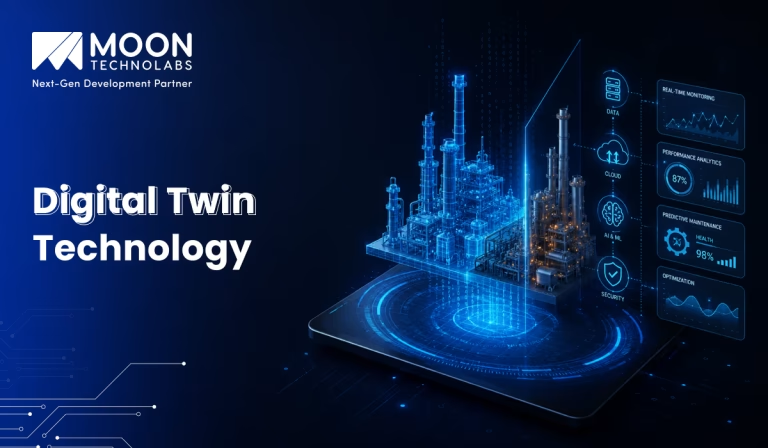
Table of Content


Blog Summary:
Digital twin technology is helping businesses move beyond reactive operations by enabling real-time monitoring and simulation of physical systems. This guide covers its core components, types, benefits, implementation approach, and industry use cases, demonstrating how it supports efficiency, predictive insights, and better operational outcomes.
Table of Content
As organizations accelerate their digital transformation efforts, Digital Twin Technology has emerged as a powerful tool for improving efficiency, decision-making, and innovation. By creating a virtual representation of a physical asset, process, or system and continuously updating it with real-time data, digital twins provide valuable insights into performance and future outcomes.
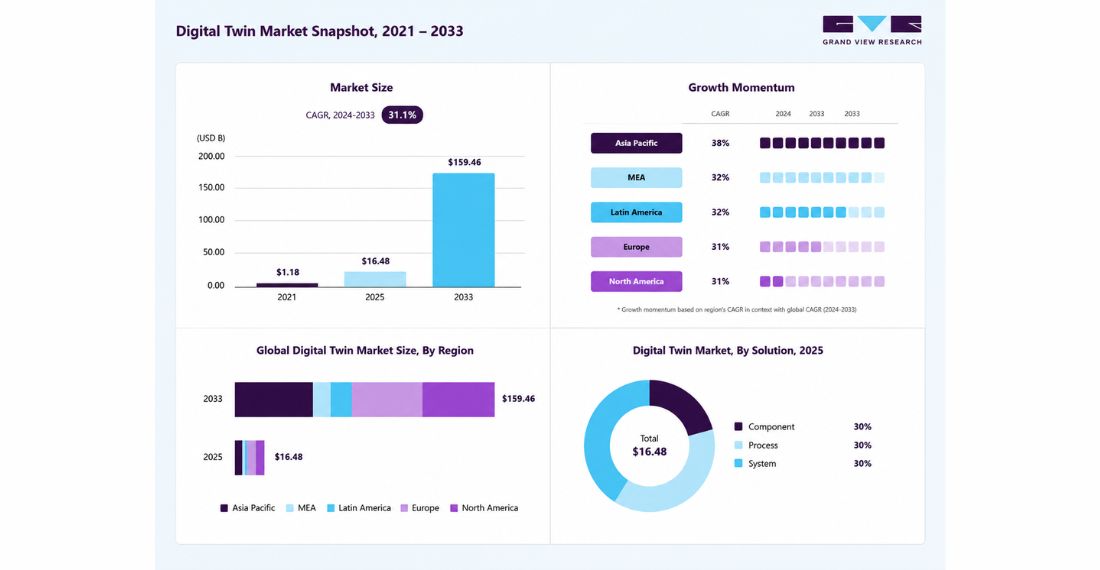
According to Grand View Research, the global digital twin market was valued at USD 35.8 billion in 2025 and is expected to reach USD 328.5 billion by 2033, growing at a CAGR of 31.1%. This rapid growth reflects the increasing adoption of digital twins across industries.
Data tells us what happened; digital twins help us understand what could happen next.
This ability to move beyond historical analysis and toward predictive intelligence is making digital twins a key enabler of Industry 4.0. In this guide, we’ll explore what digital twin technology is, how it works, its benefits, and its real-world applications.
What is Digital Twin Technology?
Digital twin technology is transforming how businesses design, monitor, and optimize physical assets by creating virtual replicas of real-world objects, systems, or processes. Using real-time data from sensors and IoT devices, along with advanced analytics, digital twins provide organizations with a dynamic view of operations, enabling better decision-making, predictive maintenance, and improved performance.
This technology is widely adopted across industries such as healthcare, manufacturing, construction, automotive, and smart cities to reduce costs and increase operational efficiency.
As organizations accelerate their digital transformation initiatives, digital twin technology becomes a strategic tool for innovation and risk management. By simulating different scenarios in a virtual environment, businesses can identify potential issues before they occur, streamline workflows, and enhance product development.
With the growing integration of artificial intelligence and machine learning, digital twins are helping companies achieve greater productivity, sustainability, and competitive advantage in an increasingly data-driven world.
Types of Digital Twins
Digital twins can be classified into several categories based on their scope and functionality. Each type serves a unique purpose in improving operational efficiency, predictive maintenance, and decision-making:
Component Twins
Component twins are the foundation of digital twin technology, representing individual parts or components within a larger asset. These virtual models monitor the performance, condition, and behavior of specific components in real time, helping organizations identify issues before they impact operations.
By enabling predictive maintenance and improving reliability, component twins reduce downtime and extend equipment lifespan.
Key Benefits:
- Real-time component monitoring
- Early fault detection
- Reduced maintenance costs
- Improved asset reliability
Asset Twins
Assent twins combine multiple component twins to create a complete virtual representation of a physical asset, such as a machine, vehicle, or industrial equipment. They provide a holistic view of asset performance, allowing businesses to optimize operations, improve efficiency, and make data-driven decisions throughout the asset lifecycle.
Key Benefits:
- Comprehensive asset visibility
- Enhanced operational efficiency
- Predictive maintenance insights
- Improved lifecycle management
System Twins
System twins connect multiple assets and components to model their interactions within a larger system. By analyzing relationships and dependencies, organizations can optimize workflows, identify bottlenecks, and improve overall system performance. System twins are particularly valuable in manufacturing plants, smart buildings, and complex industrial environments.
Key Benefits:
- End-to-end system visibility
- Better resource utilization
- Performance optimization
- Reduced operational risks
Process Twins
Process twins represent entire business or operational processes, providing insights into how systems, assets, and workflows function together over time. They enable organizations to simulate scenarios, test improvements, and optimize processes before implementing changes in the real world. This leads to greater efficiency, lower costs, and faster innovation.
Key Benefits:
- Process optimization and simulation
- Improved decision-making
- Reduced operational costs
- Faster innovation and continuous improvement
How Does a Digital Twin Work?
The process behind a digital twin involves data collection, model synchronization, analysis, and feedback mechanisms that help organizations effectively monitor and optimize physical systems:
Data Collection
Sensors on the physical asset collect information such as:
- Temperature
- Pressure
- Vibration
- Location
- Energy consumption
- Operational status
These sensors are typically connected through IoT ecosystems that enable continuous data gathering and communication.
You Might Also Like:
Data Transmission
The sensor data is sent through networks (IoT devices, cloud platforms, industrial networks) to the digital twin.
Virtual Modeling
The digital twin platform combines:
- Engineering models
- Physics-based simulations
- Historical data
- AI and machine learning algorithms
This creates a dynamic digital representation that behaves similarly to the real asset.
Analysis and Simulation
The twin can:
- Detect anomalies
- Predict failures
- Test “what-if” scenarios
- Evaluate design changes
For example, engineers can simulate how a jet engine would perform under extreme weather conditions without risking the actual engine.
Feedback and Optimization
Insights from the twin can be used to:
- Schedule maintenance
- Adjust operating parameters
- Improve efficiency
- Reduce downtime
In advanced systems, recommendations can be automatically applied to the physical asset.
See how digital twins provide a clearer view of assets, processes, and performance in real time.
Key Benefits of Digital Twins for Businesses
As digital twin technology continues to evolve, businesses are leveraging it in various ways. The following section highlights its major benefits:
Improved Operational Efficiency
Digital twins provide real-time visibility into assets, processes, and operations. This enables businesses to identify inefficiencies, optimize workflows, improve resource utilization, and enhance overall productivity.
Predictive Maintenance
By continuously analyzing equipment performance and sensor data, digital twins can detect potential issues before they lead to failures. This helps reduce unplanned downtime, lower maintenance costs, and extend asset lifespan.
Accelerated Time-to-Market
Digital twins allow businesses to simulate and validate products, processes, and operational changes in a virtual environment. This reduces testing time, minimizes risks, and enables faster product launches.
Faster Product Development
With virtual prototyping and real-world performance simulations, teams can identify design flaws early, make improvements quickly, and reduce the need for costly physical prototypes.
Cost Reduction
Digital Twins help optimize resource usage, reduce waste, prevent equipment failures, and improve operational planning. The result is lower operating costs and higher overall business efficiency.
Best Practices for Implementing a Digital Twin
The success of a digital twin initiative depends on how effectively it is planned, developed, and integrated into existing operations. The best practices below provide valuable guidance for organizations at every stage of implementation.
Define Clear Business Objectives
Start by identifying the specific problems your digital twin will solve, such as predictive maintenance, operational efficiency, asset monitoring, or process optimization. Clear goals help ensure measurable outcomes and ROI.
Ensure High-quality Data Integration
A digital twin is only as effective as the data it receives. Integrate reliable data from IoT devices, sensors, enterprise systems, and operational platforms while maintaining data accuracy, consistency, and real-time synchronization.
Build a Scalable and Flexible Architecture
Design your digital twin infrastructure to accommodate future growth. A scalable architecture allows you to add new assets, data sources, and functionalities without disrupting existing operations.
Prioritize Security and Data Governance
Implement robust cybersecurity measures, access controls, encryption, and compliance policies to protect sensitive operational data and ensure secure communication between physical and virtual environments.
Continuously Monitor, Validate, and Optimize
Regularly compare digital twin outputs with real-world performance, refine models, update data sources, and optimize algorithms to maintain accuracy and maximize long-term business value.
Industries Benefiting from Digital Twins
As digital transformation continues to accelerate, organizations across multiple industries are leveraging digital twins to enhance operations and improve decision-making.
The sectors below demonstrate some of the most prominent applications:
Manufacturing
Digital twins create virtual replicas of machines, production lines, and entire factories to monitor performance in real time.
Applications:
- Predictive maintenance
- Production optimization
- Quality control
- Equipment failure prediction
Example: Siemens uses digital twins to simulate factory operations and improve manufacturing efficiency.
Healthcare
Digital twins can represent individual patients, organs, or medical devices, helping doctors predict treatment outcomes before applying them.
Applications:
- Personalized treatment planning
- Surgical simulation
- Disease progression modeling
- Remote patient monitoring
Example: Researchers use digital heart twins to simulate cardiovascular conditions and evaluate treatment options.
Check Out Our Portfolio
Smart Cities
Cities use digital twins to model infrastructure, transportation networks, utilities, and environmental systems.
Applications:
- Traffic management
- Energy optimization
- Disaster preparedness
- Infrastructure maintenance
Examples: Singapore and Shanghai have developed city-scale digital twin platforms for urban planning and operations.
Aerospace & Aviation
Aircraft manufacturers and airlines use multiple digital twins to monitor aircraft health and optimize maintenance schedules.
Applications:
- Aircraft performance monitoring
- Predictive maintenance
- Flight simulation
- Fuel efficiency optimization
Example: GE Aerospace uses virtual twin technology to monitor jet engines and reduce downtime.
Energy & Utilities
Digital twins help manage power plants, wind farms, electrical grids, and oil & gas assets by simulating operational conditions.
Applications:
- Asset performance management
- Grid optimization
- Renewable energy forecasting
- Risk assessment
Example: Schneider Electric applies digital twins to improve energy efficiency and operational reliability.
See how digital twin technology enables real-time visibility, predictive insights, and smarter decision-making across operations.
How Moon Technolabs Helps Businesses Build Digital Twin Solutions?
Moon Technolabs helps businesses build powerful digital twin solutions that create virtual replicas of physical assets, processes, and systems for real-time monitoring, simulation, and optimization.
By combining expertise in AI development, IoT connectivity, cloud platforms, and data analytics, the company enables organizations to gain actionable insights, improve operational efficiency, reduce downtime, and make data-driven decisions across various industries.
- Developing customized digital twin platforms tailored to specific business requirements.
- We use AI development capabilities to enable predictive maintenance and intelligent decision-making.
- We create real-time monitoring dashboards for enhanced visibility and control.
- Our team implements simulation models to test scenarios and optimize performance before execution.
- We integrate sensors and devices via advanced IoT development services to enable real-time data collection.
- We connect digital twins with cloud infrastructure for scalable data processing and storage.
- Our team helps in enhancing asset lifecycle management through continuous tracking and analysis.
Conclusion
Digital twin technology is transforming the way businesses design, monitor, and optimize assets, processes, and systems throughout their lifecycle. By creating virtual replicas of real-world environments, organizations can make smarter decisions, improve operational efficiency, and reduce risks.
As adoption continues to grow across industries, investing in the right digital twin software and customized digital twin solutions can provide a significant competitive advantage.
Since digital twins rely heavily on real-time data collection and connected devices, partnering with a trusted IoT development services provider can help organizations build robust, scalable, and future-ready digital ecosystems that maximize the value of their digital twin initiatives.
FAQs
01
Why is digital twin technology important?
Digital Twin Technology helps businesses improve operational visibility, reduce maintenance costs, increase productivity, and make data-driven decisions. It enables organizations to predict equipment failures, optimize resource usage, and accelerate innovation while minimizing risks and downtime.02
Can small businesses use digital twin technology?
Yes, small businesses can adopt Digital Twin Technology through scalable cloud-based solutions. Modern platforms offer cost-effective options that help smaller organizations monitor assets, improve efficiency, reduce maintenance costs, and gain valuable operational insights without significant infrastructure investments.03
Are digital twins secure?
Digital twins can be secure when organizations implement strong cybersecurity measures, including encryption, authentication, access controls, and regular monitoring. Protecting connected devices and data networks is essential to prevent unauthorized access and maintain system integrity.04
Is digital twin technology only for large enterprises?
No, Digital Twin Technology is increasingly accessible to organizations of all sizes. Cloud-based platforms, scalable infrastructure, and affordable IoT solutions have reduced barriers to adoption, enabling small and medium-sized businesses to benefit from digital twin capabilities.05
How can a company get started with digital twin technology?
Companies can start by identifying a critical asset or process that would benefit from monitoring and optimization. After establishing data collection systems and selecting a suitable platform, they can gradually expand digital twin applications across operations.




Jayanti Katariya is the CEO of Moon Technolabs, a fast-growing IT solutions provider, with 18+ years of experience in the industry. Passionate about developing creative apps from a young age, he pursued an engineering degree to further this interest. Under his leadership, Moon Technolabs has helped numerous brands establish their online presence and he has also launched an invoicing software that assists businesses to streamline their financial operations.
Submitting the form below will ensure a prompt response from us.
We refine our expertise to deliver innovative business solutions.





205 N Michigan Avenue, #810, Chicago, 60601, Illinois, United States
13500 Long Is Dr, Pflugerville, TX 78660, USA

C/105 Ganesh Meridian, S.G. Highway, Ahmedabad, GJ 380060


Ayse D.
Co-Founder France
“ I highly recommend Moon Technolabs as the quality of service is wonderful. We have hired this company to develop the product based on some complex & technical issues. We get the best quality services as compared with others in the market. Huge Thanks to Moon Technolabs as the team is always ready to give the solution all time.”

Justin G.
Founder & CEO USA
USA“ Moon Technolabs is a pioneer in the WebRTC based project as they have fixed complicated segments of the module by fulfilling different product lines by providing 24X7 customer support. We really recommended Moon Technolabs as they are able to develop products as per the module deadline and project timeline.”

Flavio S.
Founder & Managing Director Germany
“I am happy to recommend Moon Technolabs for their app development services. They successfully developed apps for me, and I am highly satisfied with the overall outcomes. The development team has swiftly addressed the issues with responsive and effective communication to understand the requirement quickly and actively resolve the back-and-forth problems that arose...”

Jay M.
Founder & CEOUSA“Moon Technolabs is the best company that provides advanced apps and websites development services in the USA and Europe. I am a newbie to develop my app with an external team. I am really happy to work with them as I am not that much mobile apps user. Here, the team and specially the CEO of Moon Technolabs helps me to let me know about the benefits of my app to generate revenue....”


Our Offices
India
C/105 Ganesh Meridian,S.G. Highway, Ahmedabad, GJ 380060USA
205 N Michigan Avenue, #810, Chicago, 60601, Illinois, United StatesContact Information


