


Top Product Development Technologies Shaping Modern Products

Software Development Team
Last Updated: Aug 18, 2026 Total Views: 153
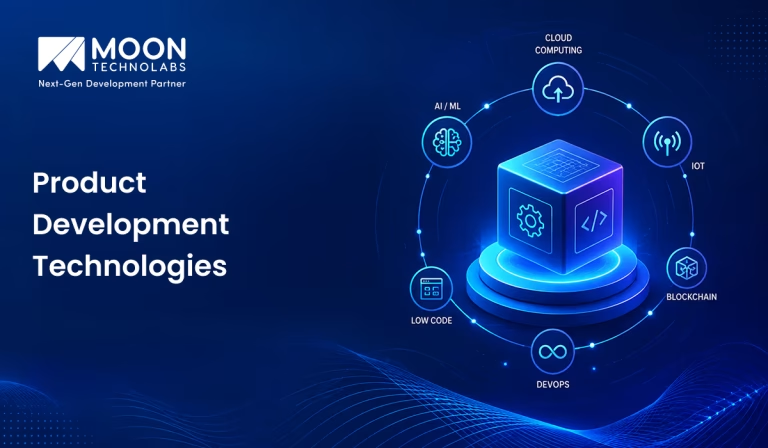
Table of Content


Blog Summary:
A great product idea can lose its edge if the technology behind it cannot keep up with user expectations. Slow performance, limited scalability, weak integrations, or outdated frameworks can turn technical decisions into business problems.
That’s why choosing the right product development technologies matters from the start. In this blog, we’ll look at the key technologies shaping modern product development, what they bring to the development process, and where they can make the biggest difference.
Table of Content
The way software products are designed, developed, and launched has changed dramatically. Product teams today are working with shorter timelines, higher customer expectations, and constant pressure to innovate.
Technologies such as generative AI, cloud computing, IoT, digital twins, automation, and advanced analytics are helping teams tackle these challenges by making development more efficient, data-driven, and adaptable.
More than just development tools, these product development technologies are becoming a strategic advantage, enabling businesses to test ideas faster, make informed decisions, and bring market-ready products to customers sooner.
Key Product Development Technologies Shaping the Future
Technology is transforming how digital products are conceived, developed, launched, and improved. Successful software product development increasingly depends on integrating intelligent automation, scalable infrastructure, secure development practices, and flexible architectures.
The following product development technologies are playing a major role in helping organizations build products faster, improve customer experiences, and respond to changing market demands.
Artificial Intelligence (AI) and Machine Learning (ML)
AI and ML have become central to modern product development. They can be used to personalize customer experiences, automate repetitive tasks, analyze large datasets, generate content, detect patterns, and support intelligent decision-making.
Advantages
- Enables personalized product experiences based on user behavior.
- Automates repetitive development and business processes.
- Supports predictive analytics and data-driven decision-making.
- Improves search, recommendations, chatbots, and customer support.
- Helps teams identify product opportunities and potential issues earlier.
Key Considerations for Implementation
Organizations should begin with clearly defined business problems rather than adopting AI simply because it is trending. Data quality, privacy, security, model accuracy, infrastructure costs, and ongoing monitoring should be considered from the beginning. Teams should also establish human oversight for high-impact AI-generated decisions.
Cloud Computing and Cloud-Native Platforms
Cloud computing provides flexible infrastructure and services that allow product teams to develop, deploy, and scale applications without maintaining all physical infrastructure themselves. Cloud-native application development takes this further through technologies such as containers, orchestration, serverless computing, and managed services.
Advantages
- Provides scalable infrastructure as product demand changes.
- Reduces the need for large upfront infrastructure investments.
- Supports faster development and deployment cycles.
- Makes global application delivery easier.
- Provides access to managed databases, AI services, analytics, and security tools.
Key Considerations for Implementation
Teams need to evaluate cloud costs, vendor dependence, data residency, security, availability, and performance. A poorly designed cloud architecture can create unnecessary complexity and unexpected expenses, so organizations should establish governance and cost-monitoring practices early.
Low-code and No-code Development Platforms
Low-code and no-code platforms enable the creation of applications and workflows using visual interfaces and preconfigured components. They can enable business teams and developers to create prototypes, internal tools, and certain customer-facing applications more rapidly.
Advantages
- Accelerates application development.
- Reduces the amount of repetitive coding.
- Enables greater collaboration between technical and business teams.
- Helps organizations prototype ideas quickly.
- Can reduce development backlogs for straightforward applications.
Key Considerations for Implementation
Organizations should evaluate platform scalability, integration capabilities, customization, security, data portability, and vendor lock-in. Low-code should complement professional software development rather than automatically replace it, particularly for complex or mission-critical products.
DevSecOps and CI/CD Automation
DevSecOps integrates security throughout the software development lifecycle, while continuous integration and continuous delivery (CI/CD) pipelines automate processes such as building, testing, and deploying.
Advantages
- Enables faster and more reliable software releases.
- Detects security vulnerabilities earlier.
- Automates repetitive testing and deployment tasks.
- Improves collaboration between development, operations, and security teams.
- Creates more consistent release processes.
Key Considerations for Implementation
Automation should cover code quality, dependency management, security testing, infrastructure, and deployment controls. Teams also need clear rollback strategies, monitoring, access controls, and appropriate approval processes for high-risk releases.
Internet of Things (IoT)
IoT connects physical devices and sensors to networks and software platforms, allowing organizations to collect data and remotely monitor or control connected products. IoT is particularly valuable in manufacturing, healthcare, logistics, smart buildings, retail, and consumer products.
Advantages
- Provides real-time operational data.
- Enables remote monitoring and management.
- Supports predictive maintenance.
- Creates opportunities for connected-product experiences.
- Can improve operational efficiency and resource utilization.
Key Considerations for Implementation
IoT products require careful attention to device security, connectivity, data management, firmware updates, hardware reliability, and interoperability. Organizations should also determine how device-generated data will be stored, processed, protected, and converted into useful product insights.
Augmented Reality (AR) and Virtual Reality (VR)
AR overlays digital information onto the physical environment, while VR creates immersive digital environments. Both technologies are being explored for training, education, entertainment, retail, design, collaboration, and product visualization.
Advantages
- Creates immersive and interactive user experiences.
- Enables virtual product demonstrations.
- Supports remote training and collaboration.
- Can improve visualization of complex products and environments.
- Opens opportunities for new forms of digital interaction.
Key Considerations for Implementation
Product teams should prioritize genuine user value over adding immersive technology solely for novelty. Hardware compatibility, usability, motion comfort, content production costs, privacy, and accessibility all need to be considered.
To see how AR and VR can be translated into a practical digital product, explore our next-gen AR/VR learning platform, which demonstrates how immersive environments, 3D visualization, interactive learning modules, and analytics can enhance the educational experience.
Blockchain Technology
Blockchain provides a distributed approach to recording and verifying transactions. Beyond cryptocurrencies, it can be considered for applications involving digital assets, provenance, decentralized identity, and multi-party data verification.
Advantages
- Provides tamper-resistant transaction records.
- Can improve transparency between multiple parties.
- Supports digital ownership and asset tracking.
- Can automate certain agreements through smart contracts.
- May reduce reliance on centralized intermediaries in suitable use cases.
Key Considerations for Implementation
Blockchain is not appropriate for every product. Teams should first determine whether decentralization, shared verification, or immutable records are genuinely required. Scalability, transaction costs, regulatory requirements, privacy, interoperability, and smart-contract security must also be evaluated.
API-first Development
API-first development treats application programming interfaces as a fundamental part of product design rather than something added after an application is built. Well-designed APIs allow different applications, services, and partners to communicate consistently.
Advantages
- Makes integrations easier to build and maintain.
- Supports web, mobile, and other application clients.
- Enables ecosystem and partner integrations.
- Encourages reusable services.
- Allows teams to develop different components in parallel.
Key Considerations for Implementation
Organizations should establish standards for API design, authentication, authorization, versioning, documentation, rate limiting, monitoring, and lifecycle management. APIs should be designed around clear business capabilities and developer usability.
Microservices Architecture
Microservices divide an application into smaller, independently deployable services. Each service can focus on a specific business capability and communicate with other services through well-defined interfaces.
Advantages
- Allows services to be developed and deployed independently.
- Supports targeted scaling of high-demand components.
- Can enable teams to work more autonomously.
- Limits the impact of some individual service failures.
- Provides flexibility in evolving large applications.
Key Considerations for Implementation
Microservices introduce operational complexity. Distributed systems require strong observability, service discovery, security, testing, deployment automation, and monitoring. For smaller products, a well-structured monolith may be more efficient than prematurely adopting microservices.
AI-powered Product Development Tools
AI-powered development tools are increasingly assisting developers, designers, product managers, testers, and analysts. These tools can support coding, documentation, testing, debugging, research, prototyping, and content generation.
Advantages
- Speeds up routine development activities.
- Helps generate and explain code.
- Supports automated test creation and documentation.
- Accelerates prototyping and experimentation.
- Can help teams analyze product feedback and requirements.
Key Considerations for Implementation
AI-generated output should be reviewed rather than accepted automatically. Teams should consider intellectual-property risks, data privacy, security vulnerabilities, hallucinations, code quality, and the handling of confidential information. Organizations also benefit from establishing clear policies for responsible AI-assisted development.
Process Automation and Robotic Process Automation (RPA)
Process automation uses software to reduce manual work, while robotic process automation uses software bots to perform structured, repetitive activities across applications. These technologies can be especially useful for administrative, financial, operational, and customer-service workflows.
Advantages
- Reduces repetitive manual work.
- Can improve processing speed and consistency.
- Frees employees to focus on higher-value activities.
- Helps reduce errors in rule-based processes.
- Provides opportunities to standardize business workflows.
Key Considerations for Implementation
Organizations should automate processes that are stable, repetitive, and clearly defined. Automating a poorly designed process can simply make inefficiency happen faster. Teams should also consider exception handling, access controls, auditability, maintenance, integration requirements, and the long-term cost of automation.
Build Better Products With Next-Generation Technologies
Partner with our experts to adopt emerging technologies that improve product development, efficiency, innovation, and business outcomes.
How to Choose the Right Product Development Technologies?
Choosing the right technologies is an important step in building a successful digital product. The technology stack should support your business goals, provide a smooth user experience, and remain flexible enough to adapt as your product grows. Consider the following factors before making your decision:
Understand Business Requirements
Start by clearly defining your product’s goals, target audience, key features, and business objectives. The technology you choose should align with your product requirements rather than simply following current technology trends. Consider factors such as the type of application, expected users, functionality, and required platforms.
Evaluate Scalability and Performance
Choose technologies that can handle your expected workload and scale with your user base. Evaluate factors such as application speed, database performance, server capacity, and the ability to support increasing traffic. A scalable technology stack can help prevent expensive redevelopment as your product expands.
Consider Security and Compliance
Security should be a priority from the beginning of product development. Select technologies with strong security features, regular updates, and reliable community or vendor support. Depending on your industry, you should also consider compliance requirements related to data protection, privacy, payments, healthcare, or other regulations.
Assess Integration Capabilities
Modern products often need to connect with third-party services, APIs, payment gateways, cloud platforms, analytics tools, and other systems. Choose technologies that offer reliable integration capabilities and support commonly used APIs and protocols. Good integration support can make development faster and reduce technical limitations.
Estimate Development Cost and Timeline
Technology choices can significantly affect development costs and delivery timelines. Consider developer availability, licensing fees, infrastructure costs, maintenance requirements, and development complexity. A popular, well-supported technology may also make it easier to find skilled developers and accelerate development.
Plan for Future Growth
Think beyond the initial product launch. Choose technologies that allow you to add new features, support more users, and adapt to changing business requirements. A flexible and maintainable technology stack can reduce technical debt and make future improvements easier.
Future Trends in Product Development Technologies
Here are some of the key future trends in product development technologies that will shape how businesses build, innovate, and deliver products; have a look:
AI-native Products
These AI-native products are built with artificial intelligence as a core part of their functionality. They can learn from user behavior, provide personalized experiences, automate tasks, and improve continuously through data and feedback. AI-native design is expected to become common across industries.
Autonomous Software Development
It uses AI to assist with coding, testing, debugging, documentation, and deployment. These tools can speed up development, reduce repetitive work, and help developers focus on creativity, strategy, and complex problem-solving. Human supervision will still be important for quality and security.
Edge Computing
Edge computing processes data closer to the devices and users that generate it, rather than relying entirely on centralized cloud servers. This reduces latency and improves performance and reliability. It will be especially useful for IoT devices, smart cities, healthcare systems, and autonomous technologies.
Digital Twins
Digital twin technology is a virtual representation of physical products, machines, or systems that are updated using real-world data. They allow organizations to simulate operations, monitor performance, predict failures, and test improvements before applying them to physical systems. This can reduce costs and improve product quality.
Quantum Computing Readiness
It has the potential to solve certain complex problems beyond the capabilities of traditional computers. Although widespread adoption is still developing, organizations should begin exploring possible applications and preparing for quantum-safe cybersecurity. Industries such as finance, healthcare, logistics, and research may benefit significantly.
Sustainable Software Engineering
It focuses on reducing the environmental impact of software and digital infrastructure. Developers can achieve this through efficient code, optimized data usage, energy-efficient systems, and responsible cloud resource management. Sustainability will increasingly become an important part of product design and development.
Ready to Transform Your Product Development Strategy?
We bring the right product development technologies and expertise together to help you create high-performing products and move from idea to market with confidence.
How Moon Technolabs Helps You Choose Product Development Technologies?
Every product has different technical requirements, so choosing a technology stack shouldn’t be a one-size-fits-all decision. At Moon Technolabs, we consider factors such as product complexity, expected traffic, integrations, security needs, and future scalability before recommending the right technologies.
As a software product development company, we work with technologies such as AI, cloud, APIs, modern frontend and backend frameworks, and DevOps tools, tailored to the product’s specific needs. The focus is on selecting technologies that meet current requirements without introducing unnecessary technical overhead.
We also support the implementation process, from architecture and development to testing and deployment. This allows businesses to validate technical decisions early, avoid costly rework, and build a product that can evolve as user and business requirements change.
Conclusion
Choosing the right product development technology can influence a product’s performance, scalability, security, and long-term growth. Instead of following every trend, businesses should select technologies based on their product goals, users, and future requirements.
With the right technology strategy and software product engineering services, businesses can build reliable, scalable products while creating a strong foundation for continuous improvement and innovation.
FAQs
01
What are product development technologies?
Product development technologies are the tools, platforms, frameworks, and methodologies used to build, design, test, launch, and improve digital or physical products.02
Which technologies are most important for product development?
The most important technologies depend on the product and business goals. However, cloud computing, AI, and machine learning, data analytics, cybersecurity, APIs, DevOps, and mobile/web development technologies are widely used. Emerging technologies such as generative AI, IoT, blockchain, and augmented reality can also provide competitive advantages in suitable use cases.03
How do I choose the right technology stack for my product?
Start by defining your product requirements, target users, scalability, security requirements, budget, and development timeline. Then evaluate technologies based on performance, flexibility, integration capabilities, availability of skilled developers, maintenance requirements, and long-term costs. The best technology stack is one that supports your current needs while allowing the product to scale and evolve.04
What is the cost of implementing modern product development technologies?
The cost varies significantly depending on the product's complexity, technology stack, development team, infrastructure, integrations, and ongoing maintenance. Cloud services and SaaS tools may reduce upfront infrastructure costs, while advanced technologies and custom software can require greater investment. Businesses should consider both initial development costs and long-term operational expenses.05
Why should businesses adopt emerging product development technologies?
Emerging technologies can help businesses develop products faster, improve customer experiences, automate processes, reduce operational costs, and respond more quickly to market changes. They can also create new products and revenue opportunities. However, businesses should adopt new technologies based on clear business value rather than using them simply because they are new.



The Software Development Team at Moon Technolabs includes experienced developers, solution architects, and technology consultants who contribute content on software engineering, application development, system architecture, and digital innovation. Their articles are based on real-world project experience and aim to help businesses make informed technology decisions.
Submitting the form below will ensure a prompt response from us.
We refine our expertise to deliver innovative business solutions.





205 N Michigan Avenue, #810, Chicago, 60601, Illinois, United States
13500 Long Is Dr, Pflugerville, TX 78660, USA

C/105 Ganesh Meridian, S.G. Highway, Ahmedabad, GJ 380060




Ayse D.
Co-Founder France
“ I highly recommend Moon Technolabs as the quality of service is wonderful. We have hired this company to develop the product based on some complex & technical issues. We get the best quality services as compared with others in the market. Huge Thanks to Moon Technolabs as the team is always ready to give the solution all time.”

Justin G.
Founder & CEO USA
“ Moon Technolabs is a pioneer in the WebRTC based project as they have fixed complicated segments of the module by fulfilling different product lines by providing 24X7 customer support. We really recommended Moon Technolabs as they are able to develop products as per the module deadline and project timeline.”

Flavio S.
Founder & Managing Director Germany
“I am happy to recommend Moon Technolabs for their app development services. They successfully developed apps for me, and I am highly satisfied with the overall outcomes. The development team has swiftly addressed the issues with responsive and effective communication to understand the requirement quickly and actively resolve the back-and-forth problems that arose...”

Jay M.
Founder & CEOUSA“Moon Technolabs is the best company that provides advanced apps and websites development services in the USA and Europe. I am a newbie to develop my app with an external team. I am really happy to work with them as I am not that much mobile apps user. Here, the team and specially the CEO of Moon Technolabs helps me to let me know about the benefits of my app to generate revenue....”


Our Offices
India
C/105 Ganesh Meridian,S.G. Highway, Ahmedabad, GJ 380060USA
205 N Michigan Avenue, #810, Chicago, 60601, Illinois, United StatesContact Information


