


Loop Engineering vs Graph Engineering: Key Differences, Benefits, and Use Cases

Marketing Team
Last Updated: Sep 01, 2026 Total Views: 109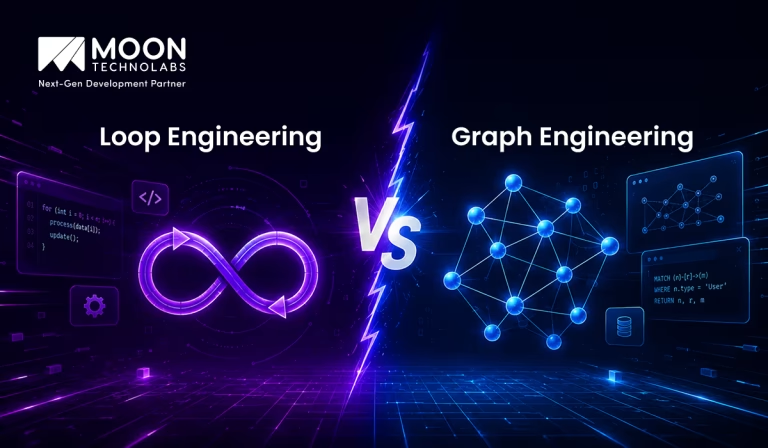
Table of Content


Blog Summary:
Loop Engineering enables continuous improvement through iterative feedback and development, while Graph Engineering manages dependencies, relationships, and workflows. In this post, we will explore both approaches in terms of their importance, benefits, and major differences, and how businesses can select or combine them for software development.
Table of Content
With businesses’ growing reliance on digital solutions, software development has become pivotal to efficiency, innovation, and growth. This has pushed up the demand for advanced software solutions worldwide. According to Fortune Business Insights, the global software development market is projected to grow from $172.94 billion in 2026 to $826.48 billion by 2034, at a CAGR of 21.60% over this period.
As apps become more connected and smarter, software development teams require the right approach to manage increasing complexity and continuous change. This is where they find loop and graph engineering to be the right solutions.
Both approaches provide distinct ways to create and manage advanced software systems. Loop engineering emphasizes continuous feedback and iteration, while graph engineering focuses on dependencies, relationships, and flexible workflows.
In this post, we will compare loop engineering and graph engineering to help you understand which option is right for you.
What Is Loop Engineering?
Loop engineering is an important practice for designing systems in which tasks are executed and performed in a cycle until an objective is met. It doesn’t follow a straight path and repeats steps, analyzes results, and then makes changes before moving ahead. Loop engineering is mainly used in both automation and programming, where repeating steps effectively improves speed, accuracy, and efficiency over time.
Core Features of Loop Engineering
Loop engineering has gained widespread acceptance in the software development industry due to key features that make systems smarter and more reliable. Some of its core features include:
Iterative Development Cycles
In loop engineering, teams often work in small rounds rather than creating everything from scratch. Every iteration adds new things and tests, then moves ahead once everything works better.
Continuous Feedback Loops
In this process, feedback continuously comes from systems, users, and automated checks. It enables teams to get details to fix something right away.
Automated Testing and Validation
Rather than checking everything manually, automated tools ensure testing is done in the background. It not only saves time but also minimizes human error.
Continuous Monitoring
Continuous monitoring is necessary to ensure systems are properly monitored for bugs, performance issues, and unusual behavior. It ensures issues are caught early rather than piling up unnoticed.
Incremental Optimization
Loop engineering mainly focuses on small but steady improvements. With time, these small upgrades add up to a more reliable and stronger system.
AI-Assisted Development
AI tools have a direct impact on loop engineering. They play a leading role in discovering patterns, speeding up testing, suggesting fixes, and thus giving teams extra support, even without replacing any judgment.
Advantages of Loop Engineering
Loop engineering is much more than just a development practice. It offers many real, practical advantages for both teams and businesses. Some of them are as follows:
Faster Feedback and Iteration
Since feedback flows throughout the entire loop engineering process, teams don’t have to wait long to know whether something works better. It ensures problems are discovered early and resolved fast.
Continuous Product Improvement
Since the engineering loop never “stops”, products continue to improve even after launch. It ensures that new changes, updates, and improvements are added daily, allowing final products to grow with changing user needs.
Reduced Development Risks
Building and improving products through a short development cycle helps teams discover issues early, before they become an expensive issue. Teams generally don’t bet everything on a single big release.
Easier Testing and Debugging
By running automated tests during each development iteration, teams can quickly catch bugs before they impact later stages of the process. This makes the debugging process easier, since developers work on recent, small changes.
Faster Time-to-Market
Since teams work in focused, short cycles, products are released quickly. Loop engineering allows businesses to launch a powerful working version and keep refining it.
Loop Engineering Use Cases
Loop engineering works best, especially in industries where products require fast, continuous updates. We will take a detailed look at some important areas where it works:
SaaS Product Development
SaaS products require regular updates, bug fixes, and the latest features according to user feedback. Loop engineering supports this by enabling teams to release even small updates, keeping products fresh.
AI-Powered Applications
When it comes to AI models, they improve with repeated training, fine-tuning, and testing, which means basically loop engineering in practice. In this approach, developers continuously feed in new data, adjust the model, and check the results.
DevOps and CI/CD Workflows
CI/CD pipelines depend mainly on loops. In this approach, code is developed, tested, and then deployed in repeated cycles. It allows teams to detect errors early and make updates fast.
Continuous Product Optimization
Loop engineering also allows businesses to improve their products over time. Be it simplifying a checkout process, increasing load speed, or adjusting any feature based on user behavior, small changes can lead to measurable improvements.
Mobile and Web Application Development
With loop engineering, development teams generally push day-to-day improvements, whether that’s adding new features, fixing bugs, or optimizing performance. And they can do it even without a massive overhaul.
We help you select the best engineering approach to create intelligent, tailored software that matches your specific business objectives.
What Is Graph Engineering?
As an approach that focuses on how multiple systems or data points connect, graph engineering maps relationships among elements to understand how information flows from one point to another. It highlights relationships, including a web of connected points. This makes it easy to understand complex networks, interactions, and dependencies, making it ideal for many areas such as system architecture and data modeling.
Core Features of Graph Engineering
Graph engineering comes with a variety of features that can help you understand connections between systems. We have outlined below some of its core features:
Node and Edge-Based Modeling
Graph engineering reflects information as nodes and edges. This structure indeed makes it convenient to understand not just what the system includes but also how it’s connected.
Relationship Mapping
Since graph engineering focuses mainly on how things are connected, it’s useful primarily for detecting patterns. It helps you understand how a single change affects networks of connected elements.
Dependency Management
Many systems depend on components that work together in a particular order. Graph engineering makes it easy for the team to check these dependencies.
Non-Linear Workflow Design
Graph-based workflows are completely different from step-by-step processes and can move in multiple directions simultaneously. This flexibility works better for systems where tasks don’t always follow a predefined sequence.
Graph-Based Data Processing
Graph engineering manages data in a connected structure rather than storing it in a simple list. This makes it convenient to understand relationships, run queries, and gather important insights from vast datasets.
Complex System Orchestration
A graph ensures efficient coordination when various systems or services work together. This is especially important in large-scale apps where various moving parts must sync properly.
Advantages of Graph Engineering
Graph engineering offers great value for those systems where connections are more important than sequence. Here are some other reasons why it’s worth considering:
Better Management of Complex Relationships
If a system includes multiple moving parts that interact in different ways, a graph makes these relationships easy to visualize and manage. It helps the team get a complete picture of how everything connects.
Flexible Workflow Modeling
Graph engineering enables workflows to merge and take different paths as needed. This makes it a perfect match for systems with different possible conditions and outcomes.
Improved Dependency Visibility
Teams often fail to visualize how one component impacts another in a larger system. Graphs help them discover potential issues before they cause bigger problems down the line.
Efficient Knowledge Representation
Graphs work best to organize information in a way that reflects how things actually relate in the real world. This makes it convenient to search, store, and retrieve knowledge in systems that handle large, interconnected datasets.
Support for Complex AI Systems
Many modern AI apps rely heavily on understanding the relationships among data points. Graph engineering provides the complete structure required to support this type of connected, complex reasoning.
Graph Engineering Use Cases
Graph engineering plays an indispensable role in industries where understanding connections is important for making smart decisions. Let’s have a detailed look at where it’s used most commonly:
AI Agent Workflows
Modern AI agents often need to make decisions based on several possible paths, rather than a single fixed sequence. Graph engineering is useful in determining these decision points.
Knowledge Graphs
Many popular companies leverage knowledge graphs to connect multiple pieces of information, including places, people, and events. This structure makes it convenient to retrieve, search, and understand details.
Recommendation Systems
Many top-rated platforms, such as Amazon, rely on graphs to understand relationships among products, users, and preferences. They can suggest products and content that are likely to match someone’s preferences.
Fraud Detection Systems
Graph engineering enables the detection of suspicious connections, including unusual transaction patterns between accounts. This tends to go unnoticed in a traditional dataset.
Network and Dependency Analysis
It’s crucial to understand how components depend on one another in a large IT infrastructure. Graphs make it easy to visualize these important networks. It enables teams to identify weak points and predict where failures can occur.
Complex Workflow Orchestration
Graphs make it possible to organize everything better when different teams or systems are required to manage tasks that don’t follow a simple order. It ensures that all moving parts are well connected, even in complex workflows.
Loop Engineering vs Graph Engineering: Key Differences
Though both loop and graph engineering are used to handle complexity in software development, they differ. Let’s have a look at the major differences between these two approaches based on several factors:
| Points of Differences | Loop Engineering | Graph Engineering |
|---|---|---|
| Architecture & Structure | It mainly follows a cyclical and linear structure, with steps that repeat. | It follows a network-driven structure with interconnected edges and nodes. |
| Execution Flow | Loop engineering follows a step-by-step, sequential process that loops back until the objective is met. | It mainly follows non-linear execution, merging and taking different paths at once. |
| Feedback Mechanism | In this, feedback is continuous throughout each cycle, driving the next iteration. | In graph engineering, feedback comes from analyzing relationships among connected nodes. |
| Complexity Management | Loop engineering can manage complexity by dividing tasks into small, repeatable steps. | It can manage complexity by determining both relationships and dependencies. |
| State Management | It can analyze state with every loop cycle. | It analyzes state across the entire network based on node interactions. |
| Scalability | Loop engineering scales perfectly for incremental improvements and repetitive tasks. | Graph engineering scales perfectly to large, interconnected systems with diverse relationships. |
| Debugging & Observability | It’s quite easy to debug as issues are generally tied to any specific step or cycle. | It can indeed be complex for debugging mainly due to various interconnected paths. |
| Best Use Cases | Loop engineering is mainly used for CI/CD pipelines, SaaS updates, app development, and AI model training. | It’s used mainly in recommendation systems, knowledge graphs, AI agents, and fraud detection. |
We assist you in adopting an advanced engineering approach to develop adaptive, scalable, and smart software that evolves with changing, complex workflows.
Loop Engineering vs Graph Engineering: Which One Should You Choose?
Your choice between loop engineering and graph engineering depends mainly on the type of workflow, software system, business objective, and other factors. Besides, you also need to consider the following important things:
Choose Loop Engineering When…
If you handle a project that involves frequent updates, repetitive tasks, and step-by-step improvements, loop engineering can be the right option for you. It works better for CI/CD pipelines, SaaS platforms, and AI model training.
Choose Graph Engineering When…
Graph engineering can be the right option for you when you handle a system that relies on understanding relationships such as dependencies, behavior, interconnected data, etc. It’s perfect for recommendation engines, knowledge graphs, and fraud detection.
When to Combine Loop and Graph Engineering
Many advanced systems benefit from leveraging both approaches. For instance, an AI agent can use graph engineering to determine decision paths, while relying on loop engineering to continuously test and refine its overall responses.
How Is AI Changing Loop and Graph Engineering?
AI has significantly changed how both graph and loop engineering work. Let’s take some examples to understand it better:
AI Agents and Autonomous Workflows
AI agents can handle tasks on their own, using graphs to identify loops and decision paths, thereby redefining their actions over time. This combination lets agents work independently.
Dynamic Workflow Optimization
AI has the potential to analyze workflows in real time and also suggest the most important ways to structure them. Be it identifying a more efficient graph path or a faster loop cycle, AI ensures fine-tuned processes that once needed manual adjustment.
Intelligent Decision-Making
With graph engineering, AI considers different possible paths and selects the right one based on the situation. This makes the system smart, since decisions are based not only on fixed rules but also on relationships and patterns that AI discovers.
Automated Testing and Evaluation
AI has redefined the testing process within loops. It eliminates the need for manual checks and can quickly determine results, highlight issues, and suggest necessary fixes. This makes every cycle fast and reliable.
Human-in-the-Loop Systems
Though automation is fast-paced, human oversight remains relevant. Most systems now combine AI efficiency with human judgment, which enables people to step in, analyze decisions, and make corrections when required.
How Moon Technolabs Helps You Implement the Right Engineering Approach
We help you choose and implement the right engineering approach according to your product requirements, growth objectives, and technical complexity. Our software consulting process includes technical planning, requirements analysis, development, architectural design, and ongoing optimization.
We provide DevOps, AI development, software product engineering services, CI/CD, and more. We are committed to combining both technical expertise with a highly structured development process. With us, you can select, implement, and redefine the approach that best matches your software objectives.
Final Thoughts
Whether it’s loop engineering or graph engineering, each offers distinct methods for developing and managing advanced software systems. Loop engineering primarily emphasizes continuous improvement through repeated development cycles, whereas graph engineering addresses complex, non-linear workflows.
So, selecting the perfect approach relies mainly on your technical complexity, product requirements, business objectives, etc. Partnering with us helps you select the right approach and implement it better.
FAQs
01
Can Loop Engineering and Graph Engineering be used together?
Yes, loop and graph engineering can be used together to analyze relationships and loops, enabling continuous learning, testing, and decision-making that are enhanced by connections.02
Which approach is better for building AI agents?
There’s no individual approach perfect for creating AI agents. The right choice depends mainly on complexity, use case, required autonomy, data, scalability, and other factors.03
Is Graph Engineering more scalable than Loop Engineering?
Well, graph engineering is highly scalable for interconnected and complex data, whereas loop engineering scales through continuous iteration and improvement. So, the right choice depends on the specific needs of the system.04
What tools are commonly used for Loop and Graph Engineering?
There are many tools commonly used for graph and loop engineering. Some of them include LangGraph, Neo4j, Apache AGE, NetworkX, and more.05
How do you choose between loop-based and graph-based architectures?
The right choice relies mainly on the actual requirements of your systems. You can leverage a loop-based architecture for continuous interaction and feedback, whereas a graph-based architecture models complex relationships, connected data, and dependencies.




Jayanti Katariya is the CEO of Moon Technolabs, a fast-growing IT solutions provider, with 18+ years of experience in the industry. Passionate about developing creative apps from a young age, he pursued an engineering degree to further this interest. Under his leadership, Moon Technolabs has helped numerous brands establish their online presence and he has also launched an invoicing software that assists businesses to streamline their financial operations.
Submitting the form below will ensure a prompt response from us.
We refine our expertise to deliver innovative business solutions.





205 N Michigan Avenue, #810, Chicago, 60601, Illinois, United States
13500 Long Is Dr, Pflugerville, TX 78660, USA

C/105 Ganesh Meridian, S.G. Highway, Ahmedabad, GJ 380060


Ayse D.
Co-Founder France
“ I highly recommend Moon Technolabs as the quality of service is wonderful. We have hired this company to develop the product based on some complex & technical issues. We get the best quality services as compared with others in the market. Huge Thanks to Moon Technolabs as the team is always ready to give the solution all time.”

Justin G.
Founder & CEO USA
USA“ Moon Technolabs is a pioneer in the WebRTC based project as they have fixed complicated segments of the module by fulfilling different product lines by providing 24X7 customer support. We really recommended Moon Technolabs as they are able to develop products as per the module deadline and project timeline.”

Flavio S.
Founder & Managing Director Germany
“I am happy to recommend Moon Technolabs for their app development services. They successfully developed apps for me, and I am highly satisfied with the overall outcomes. The development team has swiftly addressed the issues with responsive and effective communication to understand the requirement quickly and actively resolve the back-and-forth problems that arose...”

Jay M.
Founder & CEOUSA“Moon Technolabs is the best company that provides advanced apps and websites development services in the USA and Europe. I am a newbie to develop my app with an external team. I am really happy to work with them as I am not that much mobile apps user. Here, the team and specially the CEO of Moon Technolabs helps me to let me know about the benefits of my app to generate revenue....”


Our Offices
India
C/105 Ganesh Meridian,S.G. Highway, Ahmedabad, GJ 380060USA
205 N Michigan Avenue, #810, Chicago, 60601, Illinois, United StatesContact Information


