


LangChain Use Cases: Real-World Applications, Benefits, and Business Impact

Artificial Intelligence Team
Last Updated: Sep 16, 2026 Total Views: 87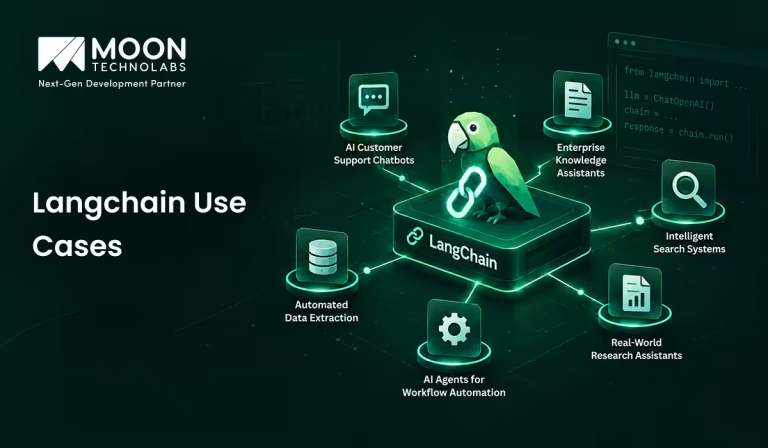
Table of Content


Blog Summary:
LangChain makes it easier to build AI applications that can retrieve information, use external tools, and carry out tasks within existing business processes. This blog breaks down where LangChain delivers practical value, from customer support and document-based Q&A to workflow automation and AI agents. It also covers the benefits, implementation potential, and business impact of using LangChain beyond simple chatbot development.
Table of Content
Building an AI application is no longer just about connecting an LLM to a prompt. Businesses want AI systems that can understand context, work with company data, call external tools, remember previous interactions, and fit into existing workflows.
LangChain helps make that possible by providing the building blocks to develop AI applications that go beyond simple chat interfaces—from retrieval-augmented generation (RAG) and AI agents to document processing, customer support, and intelligent automation.
But where does LangChain actually create value for a business? The answer depends on how it is applied. In this blog, we’ll look at practical LangChain use cases, the problems they solve, and the benefits they can deliver across real business functions.
What is LangChain?
LangChain is a framework that helps developers build applications where an LLM needs to do more than simply generate text. It can connect a model to company documents, databases, APIs, search tools, and other sources, giving the application access to the right information when needed.
For example, instead of building a chatbot that only answers from its training knowledge, developers can use LangChain to create one that searches internal documents, retrieves relevant information, and then generates an answer based on that context. This makes LangChain useful for RAG applications, AI agents, research tools, and business automation.
LangChain Workflow: How Does LangChain Work?
Now that we’ve covered what LangChain is, let’s take a closer look at how a LangChain workflow works:
Connect With Large Language Models
LangChain connects applications with leading large language models (LLMs), including OpenAI, Anthropic, Google, and other providers. Developers can configure models to meet application requirements, manage prompts, and build flexible workflows without being locked into a single LLM provider.
Integrate External Data Sources
LangChain lets AI applications connect to external data sources such as databases, specific documents, websites, cloud storage, and enterprise knowledge bases. This lets applications access relevant business information and respond based on proprietary or real-time data.
Retrieve and Process Context
LangChain can retrieve relevant information from connected data sources and provide it to the LLM as context. Through RAG, applications can improve response accuracy, reduce irrelevant answers, and generate responses grounded in specific information.
Connect Tools and APIs
LangChain allows AI applications to interact with external tools and APIs, such as search engines, calculators, CRMs, databases, and business platforms. These integrations let AI systems take action, access live information, and complete tasks beyond basic text generation.
Execute Chains and AI Agents
LangChain combines models, prompts, data, tools, and logic into structured chains or autonomous AI agents. Chains follow predefined workflows, while agents can dynamically decide which tools and actions to use, making them suitable for complex, multi-step tasks.
Build LangChain Applications Around Your Business Needs
Get expert guidance to design and develop LangChain-powered AI solutions that address specific challenges and support your business goals.
17 Real-world LangChain Use Cases Across Industries
LangChain helps developers build AI applications that connect LLMs with data, APIs, databases, tools, and business workflows. Its flexibility makes it useful across industries, from customer service and healthcare to finance, e-commerce, and software development.
Here are 17 practical LangChain use cases:
AI Customer Support Chatbots
LangChain helps businesses build intelligent customer support chatbots that connect with FAQs, product databases, and knowledge bases. These assistants can answer customer questions, troubleshoot common issues, provide personalized responses, and escalate complex requests to human agents.
Retrieval-augmented Generation (RAG)
LangChain is widely used to build RAG applications that retrieve relevant information before generating responses. RAG allows AI systems to work with private, domain-specific, and frequently updated data while producing accurate, contextual, and grounded answers.
Enterprise Knowledge Assistants
Organizations can create AI knowledge assistants using LangChain to connect internal documents, policies, wikis, databases, and business systems. Employees can ask questions naturally and quickly access relevant company information without manually searching across multiple platforms.
Document Question-answering Systems
LangChain can transform PDFs, contracts, reports, manuals, and research papers into interactive question-answering systems. Users can ask questions, summarize documents, locate specific information, compare content, and extract important details without reading every page.
AI Agents for Workflow Automation
LangChain helps developers build AI agents that can use APIs, databases, search tools, and external applications. These agents can perform multi-step tasks such as gathering information, generating reports, updating CRM records, processing data, and automating repetitive workflows.
Intelligent Search Systems
LangChain supports intelligent search systems that understand user intent and context rather than relying only on keywords. Businesses can use these systems to search websites, product catalogs, enterprise databases, technical documentation, and large internal knowledge repositories.
Personalized Recommendation Systems
LangChain can combine LLMs with customer preferences, product catalogs, browsing information, and business rules to create personalized recommendations. AI assistants can suggest relevant products or services, answer follow-up questions, and explain why particular options match customer needs.
AI Coding Assistants
LangChain can power coding assistants connected to source-code repositories, documentation, APIs, and development tools. These assistants can explain existing code, generate functions, troubleshoot errors, suggest improvements, answer technical questions, and automatically create useful documentation.
Automated Data Extraction
Businesses can use LangChain with LLMs to extract structured information from invoices, emails, contracts, forms, reports, and other unstructured documents. Extracted information can be categorized, validated, stored in databases, and integrated directly into existing business workflows.
Healthcare AI Assistants
Healthcare organizations can use LangChain to build assistants for medical literature search, documentation support, information retrieval, and administrative workflows. Such systems require strong privacy protections, security controls, validation processes, and qualified human oversight for responsible implementation.
Financial Research and Analysis
LangChain can help financial professionals analyze annual reports, earnings documents, market research, filings, and financial data. Applications include investment research, earnings analysis, risk assessment, document summarization, and internal financial knowledge assistants for faster information discovery.
E-commerce Shopping Assistants
LangChain enables conversational shopping assistants that understand customer requirements and connect them with product catalogs. These assistants can recommend suitable products, compare features, answer product questions, summarize reviews, and guide customers throughout their purchasing journey.
Legal Document Analysis
Legal teams can use LangChain to analyze contracts, regulations, case documents, and other legal materials. AI systems can identify clauses, summarize documents, compare contract versions, retrieve relevant information, and support legal research while maintaining professional human review.
Sales Automation
LangChain can support sales teams by automating lead research, customer information retrieval, CRM updates, call summarization, lead qualification, and personalized communication. Connecting AI with sales systems helps representatives reduce repetitive tasks and focus more on customer relationships.
Marketing Content Automation
Marketing teams can combine LangChain with LLMs, brand guidelines, product information, and customer data to automate content creation. Applications include blog posts, product descriptions, email campaigns, advertisements, social media content, and personalized marketing communications.
Research Assistants
LangChain can power research assistants that retrieve information, analyze documents, summarize sources, compare findings, and organize research. These systems can support academic studies, market research, competitive analysis, technology research, and other information-intensive professional activities.
Multi-agent AI Systems
LangChain can support multi-agent AI systems where specialized agents collaborate on complex tasks. For example, one agent can conduct research, another can analyze findings, and another can generate or review the final report for improved workflow efficiency.
Applications of LangChain in Business and Technology
Here are some of the key applications of LangChain in business and technology. Let’s take a look at how businesses are using LangChain across different use cases and where it can add practical value:
Generative AI Application Development
From intelligent content generation to AI-powered productivity tools, LangChain provides the building blocks needed to create applications around large language models. Developers can combine models with prompts, data sources, tools, and custom workflows to deliver more capable generative AI experiences.
Enterprise Workflow Automation
AI-driven workflows can enhance repetitive business processes by understanding information, making decisions, and triggering actions. LangChain can connect language models with APIs, databases, internal systems, and other tools to automate tasks such as document processing, information extraction, and routine operations.
RAG Application Development
Businesses can build RAG solutions that allow AI systems to retrieve relevant information from company documents and knowledge bases before generating responses. This is particularly useful for applications that need accurate, context-specific answers based on proprietary or frequently updated data.
AI Agent Development
AI agents can go beyond generating text by using tools and carrying out multi-step tasks. LangChain provides components for developing agent-based systems that can interpret requests, choose appropriate tools, retrieve information, and execute actions based on the task at hand.
Enterprise Data Integration
Connecting AI applications to existing enterprise data is essential for making them useful in real-world environments. LangChain can connect to databases, APIs, cloud storage, document repositories, and other data sources, allowing AI systems to work with information already used across an organization.
Conversational AI Solutions
Customer support assistants, internal help desks, virtual agents, and knowledge assistants can use LangChain to create more context-aware conversations. By combining LLMs with memory, retrieval, business data, and external tools, organizations can develop conversational experiences tailored to specific users and use cases.
Key Benefits of LangChain
Here are some of the key benefits of LangChain for businesses and AI application development. Let’s take a look at how LangChain can simplify development, improve flexibility, and support more capable AI solutions:
Faster LLM Application Development
Building an LLM-powered application from scratch can involve significant development effort. LangChain provides pre-built components for prompts, workflows, memory, document handling, and model interactions, helping developers reduce development time and move from concept to production faster.
Flexible LLM Integration
Applications can work with different AI models and providers without being tightly tied to a single platform. This flexibility makes it easier to choose, switch, or combine models based on cost, performance, capabilities, and project requirements.
Seamless Connection With External Data
AI applications often need access to information beyond a model’s built-in knowledge. LangChain makes it easier to connect LLMs to databases, APIs, documents, websites, and other data sources, enabling applications to work with business-specific, up-to-date information.
Support for RAG and AI Agents
Modern AI applications need more than simple question-and-answer capabilities. With RAG support, developers can retrieve relevant information and provide it to the model before generating a response. Agent capabilities also enable applications to use tools, make decisions, and complete multi-step tasks.
Modular and Extensible Architecture
A modular design lets developers assemble AI applications from individual components such as models, prompts, retrievers, tools, and memory. Developers can customize or replace these components as requirements evolve, making solutions easier to maintain, test, and scale.
Easier Enterprise AI Integration
Organizations can connect AI capabilities with their existing data, applications, and business processes. This enables practical enterprise solutions for intelligent search, customer support, document analysis, knowledge management, workflow automation, and other use cases.
Challenges and Limitations of LangChain
While LangChain offers several advantages for building AI applications, it also comes with certain challenges. Let’s take a closer look at the limitations and considerations businesses should keep in mind when working with LangChain:
Complex Workflow Management
Advanced applications may combine multiple models, tools, APIs, retrieval systems, and processing steps. Managing these interconnected components can make workflows more complex and difficult to maintain as the application grows.
Debugging and Observability
LLM applications can be difficult to debug because results may depend on prompts, model behavior, retrieved data, and tool interactions. Proper logging, tracing, and monitoring are important for identifying errors and understanding application performance.
LLM Latency and API Costs
Multiple model calls and external API requests can increase response times and operational costs. Choosing suitable models, optimizing prompts, caching results, and reducing unnecessary calls can help control both latency and expenses.
Data Privacy and Security
Connecting AI systems to enterprise databases and documents can expose sensitive information if access is not properly controlled. Strong authentication, authorization, encryption, and data-handling policies are essential for protecting business and customer data.
Hallucinations and Response Accuracy
LLMs can sometimes generate inaccurate or unsupported information. RAG, source validation, output evaluation, and human oversight can help improve reliability, but they cannot completely eliminate the risk of incorrect responses.
Production Scalability
Scaling an LLM application requires handling increasing users, API limits, concurrent requests, and infrastructure costs. Effective monitoring, caching, load management, and fault-tolerant architecture are important for maintaining consistent performance in production.
Take Your LangChain Use Case From Idea To Execution
Partner with our team to build reliable LangChain applications that fit your technology environment and solve real business challenges.
Transforming the Future of AI Applications With LangChain
Let’s take a look at how LangChain is shaping the future of AI application development and enabling businesses to build more capable, connected, and practical AI solutions:
Rise of Agentic AI
AI agents are evolving beyond simple question-and-answer interactions to plan, reason, and execute multi-step tasks. With LangChain, developers can build autonomous agents that use tools, make decisions, and adapt their actions to changing requirements.
Advanced RAG Applications
RAG lets AI applications work with relevant, trusted information from external sources. With LangChain, businesses can build sophisticated RAG solutions that retrieve context from documents, databases, and knowledge bases to deliver more accurate, relevant responses.
Multi-agent AI Systems
Complex business processes can benefit from multiple specialized AI agents working together. LangChain enables developers to design collaborative systems where individual agents handle tasks such as research, analysis, planning, and execution while contributing to a shared objective.
Enterprise AI Automation
Businesses can integrate AI with existing databases, APIs, applications, and internal workflows to automate repetitive operations. These capabilities can streamline processes such as customer support, document analysis, reporting, research, and data processing while improving overall productivity.
More Context-aware AI Applications
Modern AI applications need to understand more than individual prompts; they need relevant information and conversation history. By connecting LLMs with contextual data sources, LangChain helps create personalized applications that deliver more meaningful, accurate, and situation-aware experiences.
Conclusion
LangChain gives businesses a practical way to turn LLM capabilities into AI applications that work with their data, tools, and workflows. From intelligent assistants and RAG systems to task automation and AI agents, the right implementation can solve specific business challenges and deliver real operational value.
As a prominent Agentic AI development company, we help businesses identify the right use cases and build LangChain-powered solutions that are designed around their goals, workflows, and growth.
FAQs
01
What are the most common LangChain use cases?
LangChain is commonly used to build AI chatbots, virtual assistants, RAG applications, document processing systems, content generation tools, and intelligent search solutions. It also helps developers connect LLMs with external data, APIs, databases, and business tools for more capable AI applications.02
Is LangChain suitable for enterprise AI applications?
Yes, LangChain is suitable for enterprise AI applications. It supports scalable architectures, workflow orchestration, retrieval-augmented generation, tool integration, and multiple LLM providers. With appropriate security, monitoring, access controls, and infrastructure, businesses can develop reliable AI solutions tailored to complex enterprise requirements.03
What types of AI agents can be built using LangChain?
LangChain can power various AI agents, including customer support agents, research assistants, sales and marketing agents, data analysis agents, coding assistants, workflow automation agents, and knowledge management systems. These agents can use tools, APIs, databases, and external information to complete multi-step tasks.04
Can LangChain be used with different LLMs and vector databases?
Yes. LangChain is designed to work with multiple LLM providers, including OpenAI, Anthropic, Google, and others. It also integrates with popular vector databases such as Pinecone, Weaviate, Chroma, and FAISS, allowing developers to choose technologies based on application requirements.05
How much does it cost to develop a LangChain-based application?
The cost depends on application complexity, features, integrations, infrastructure, and development time. A basic chatbot costs significantly less than an enterprise-grade AI platform with custom RAG, multiple integrations, advanced agents, security, and monitoring. A detailed estimate requires an evaluation of your specific project requirements.



Explore the latest insights on Artificial Intelligence, including Generative AI, Agentic AI, natural language processing, computer vision, automation, and enterprise AI solutions. This category covers industry trends, practical applications, implementation strategies, and innovations that help businesses leverage AI for smarter decision-making and digital transformation. Stay updated with evolving AI technologies that are reshaping industries worldwide.
Submitting the form below will ensure a prompt response from us.
We refine our expertise to deliver innovative business solutions.





205 N Michigan Avenue, #810, Chicago, 60601, Illinois, United States
13500 Long Is Dr, Pflugerville, TX 78660, USA

C/105 Ganesh Meridian, S.G. Highway, Ahmedabad, GJ 380060


Ayse D.
Co-Founder France
“ I highly recommend Moon Technolabs as the quality of service is wonderful. We have hired this company to develop the product based on some complex & technical issues. We get the best quality services as compared with others in the market. Huge Thanks to Moon Technolabs as the team is always ready to give the solution all time.”

Justin G.
Founder & CEO USA
USA“ Moon Technolabs is a pioneer in the WebRTC based project as they have fixed complicated segments of the module by fulfilling different product lines by providing 24X7 customer support. We really recommended Moon Technolabs as they are able to develop products as per the module deadline and project timeline.”

Flavio S.
Founder & Managing Director Germany
“I am happy to recommend Moon Technolabs for their app development services. They successfully developed apps for me, and I am highly satisfied with the overall outcomes. The development team has swiftly addressed the issues with responsive and effective communication to understand the requirement quickly and actively resolve the back-and-forth problems that arose...”

Jay M.
Founder & CEOUSA“Moon Technolabs is the best company that provides advanced apps and websites development services in the USA and Europe. I am a newbie to develop my app with an external team. I am really happy to work with them as I am not that much mobile apps user. Here, the team and specially the CEO of Moon Technolabs helps me to let me know about the benefits of my app to generate revenue....”


Our Offices
India
C/105 Ganesh Meridian,S.G. Highway, Ahmedabad, GJ 380060USA
205 N Michigan Avenue, #810, Chicago, 60601, Illinois, United StatesContact Information


