


How to Build a SaaS Product: A Complete Guide

Jayanti Katariya
Last Updated: Jul 10, 2026 Total Views: 155
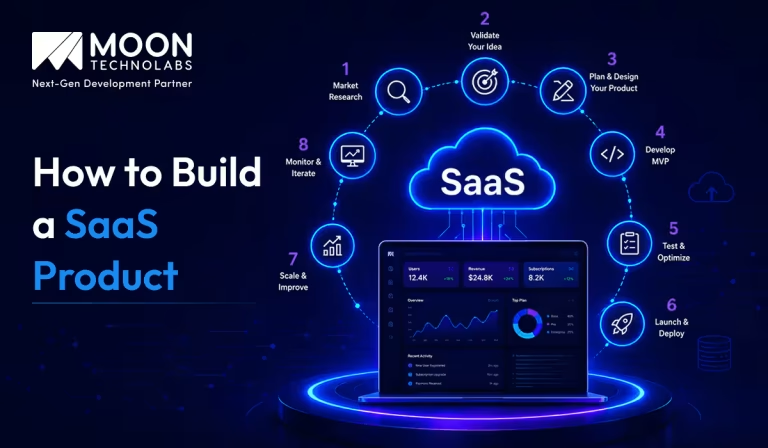
Table of Content


Blog Summary:
Building a successful SaaS product is more than a good idea. It requires following a thorough process from start to finish. This blog walks you through every stage, from validating your idea to defining the MVP and choosing the right tech stack. You will also get a realistic cost breakdown to help you plan and build your SaaS product with confidence.
Table of Content
Every business runs on a stack of SaaS tools for communication, project management, finance, and customer relationship management. Each of these tools is deeply embedded in the business operations, and you never think of where it came from. But each of these tools started the same way yours will, with a single idea meant to solve a specific problem for a specific niche.
What actually separates a SaaS company that has grown into a category leader from the one that quietly faded after launch isn’t the strength of the original idea or its technical ability. It is the process that turns the idea into something that users are ready to pay for.
From market validation to product design and the right technology choices, every aspect plays a crucial role in ensuring the product doesn’t become a costly problem later.
In this blog, you will learn How to Build a SaaS Product, from identifying the market need to scaling the product post-launch.
What is a SaaS Product?
A SaaS (Software as a Service) product is software hosted in the cloud and delivered to users over the internet, rather than installed and run on individual computers or servers. Instead of buying a license and maintaining the software yourself, you subscribe to it. This happens on a monthly or annual basis, where the provider handles everything on the backend, from hosting and security to updates and maintenance.
That’s why SaaS has become the default way for businesses to adopt software. You don’t need an IT team to set it up or worry about outdated versions. You can easily access the software from anywhere, across any device, as long as you are connected to the Internet.
As a business building a SaaS product, you will find this model completely changes your relationship with users. You must prove value continuously, not just at the point of sale, but also after the sale, as access can be canceled easily with subscription-based solutions.
Take Slack, Zoom, and even Salesforce, some of the top SaaS products. Each offers different functionality, but they are all built on the same underlying model.
The Importance of SaaS in Modern Business
Adopting new software a decade ago meant enduring lengthy procurement cycles, upfront licensing costs, and an IT team dedicated to installation and maintenance. The barrier alone kept several businesses running on their outdated versions for a long time. SaaS changed that completely.
Today, businesses can adopt enterprise-grade software swiftly. They don’t need to provision servers, go through lengthy installations, or have a dedicated infrastructure team. This shift has made software accessible and redefined how businesses operate on a daily basis.
Business teams can collaborate in real time across locations, and decisions are backed by live data rather than static reports. Moreover, operations can scale up or down without the business being locked into rigid and expensive systems.
This shift represents a genuine opportunity for you as you get started building your SaaS product. As more people and businesses are looking for tools that solve their specific operational problems, they will be willing to pay for a solution that gets them there faster. The market isn’t just open; it is actively searching for what you may build for it.
Types of SaaS Products
It helps to know where your idea fits before you start building your SaaS products. Here are all the broad categories that your SaaS product generally fits into, solving a distinct set of business problems:
Customer Relationship Management (CRM) Software
If you are building a CRM, you will help businesses manage interactions with prospects and customers, enabling them to track everything from first contact to closed deals. This helps centralize communication history, making it easier for your users to nurture relationships and consistently close sales.
Enterprise Resource Planning (ERP) Software
You integrate core business processes such as finance, inventory, and supply chain into a single unified platform using an ERP system. It will give your users a real-time view of operations across all the departments.
Human Resource Management System (HRMS)
HRMS handles everything about workforce management, from hiring and payroll to attendance and performance tracking. You will take a chunk of manual HR work off your users’ plates once you build something for the HR department.
Explore Our Work
Project Management Software
You help teams plan, assign, and track work with the project management software. This helps teams maintain the project on schedule and ensures everyone stays aligned on priorities and deadlines.
Financial Management Software
With financial SaaS tools, your users can manage everything from budgeting and invoicing to expense tracking and reporting. It gives your users clear visibility into their financial health.
Collaboration Software
The collaboration software is built for real-time teamwork. You enable distributed teams to communicate, share files, and work together regardless of their physical location.
eCommerce Platform
Using an eCommerce platform, businesses can build, manage, and scale online stores. You help the teams handle everything from product listings to payments and order fulfillment.
Whichever category your idea falls into, the underlying principle for building a high-performing SaaS product remains the same. You must identify a repetitive and high-friction task and build your solution around it.
Moving Forward with Your SaaS Strategy
Now that you’ve identified your product’s place in the SaaS landscape, let’s explore why this model is a strategic choice for long-term growth and success.
Benefits of SaaS Product Development
Once you know what kind of SaaS product you want to build, it is important to understand why the SaaS model works in your favor. Here are all the benefits of SaaS product development:
Development Flexibility
With SaaS product development, you are no longer locked into a rigid, one-time product release. It allows you to build your product in stages, ship updates continuously, and approve features that match real user needs without waiting for version overhauls.
Elevated Performance
SaaS development lets you optimize performance centrally because you control the infrastructure. Whether you improve the speed, security or reliability, it reaches users at once without depending on them to manually update the application.
Decreased Costs
The typical costs involved in traditional software distribution are packaging, physical installation, and per-device licensing. You will save on these costs because cloud infrastructure lets you scale resources based on actual demand rather than over-provisioning upfront.
Predictable and Recurring Revenue
The subscription model confirms you aren’t relying on one-time purchases. It provides consistent, recurring revenue from your user base, making it easier to forecast growth, plan investments, and build a sustainable business over time.
How to Build a SaaS Product?
By now, you have a clear picture of what a SaaS product is, where your idea fits, and why the model works in your favor. So, how do you actually get there? To build a successful SaaS product, you must break it down into three phases: planning and validation, design and development, and launch and growth. Here’s how each stage works:
Planning and Validation Phase
Every successful SaaS product begins with clarity, not code. If you skip this phase, you risk building something that you don’t know if the market actually needs.
Step 1: Identify a Market Need
Start by looking for a problem that is real, recurring and painful enough that people are already trying to solve, even if it is with spreadsheets. You don’t need to look for a completely untapped idea. A gap in the existing solution for a problem could also become your market need.
Step 2: Research Your Target Audience
Once you have identified the genuine need, you dig into the people who experience this issue most. Understand their budget constraints, the daily workflows, and even what they are using at the moment as a dedicated solution. The more specific you get about your target audience, the easier it becomes to make a decision.
Step 3: Define Your Value Proposition
Next, you must articulate why your product deserves a spot in your user’s workflow. What can the product do faster or more cheaply than the alternatives? Your value proposition should be simple enough to be explained in a single line and specific enough that it doesn’t apply to every competitor in your space.
Step 4: Validate Your Product Idea
Test your assumption about the market before you write a single line of code. Talk to potential users, run surveys, and build a simple landing page to gauge the user’s interest. Look for signals like sign-ups, direct feedback, and even people willing to prepay, which tell you whether people want what you are building.
Design and Development Phase
It is time to start shaping the idea once you have finished validating it. This is the phase where your product starts to take shape. Each decision you make will impact how easily you can build, launch, and improve it later.
Step 5: Plan Features and Create an MVP
Don’t try to build everything you have envisioned right away. Identify the smallest feature set that will help solve your user’s core problem. Build this first to create the minimum viable product (MVP). The MVP will get feedback from real users as quickly as possible. It need not be a complete feature.
Step 6: Design an Intuitive User Experience
The design of your product should feel effortless to your users, guiding them naturally towards the value you promised without requiring a manual to understand it. Prioritize clear navigation, minimal friction and usable interfaces. Your design should prove your product’s credibility as soon as users begin using it.
Step 7: Choose the Right Technology Stack
Choose a tech stack that meets your product’s needs, not what is trending. Consider your team’s expertise, product scalability needs and long-term maintenance costs while committing to a stack. The right stack lets you build reliably and scale without increasing your rebuild costs.
Step 8: Develop and Test Your SaaS Product
Test continuously as you build the product, rather than at the end of the build. This way, you can catch bugs early, validate whether features actually work, and ensure your product performs reliably in real-world conditions. With testing, you can prevent costly fixes and reputation loss after launch.
Launch and Growth Phase
Your product is built and tested. Now, put it in front of your target audience and keep improving it based on how users respond.
Step 9: Launch Your SaaS Product
Plan your entire launch with intention instead of treating it as a single moment. Line up your marketing, prepare the onboarding flow and make sure support systems are ready before launch. Decide which channels you aim to use to reach your users early.
A well-prepared launch gives your initial users a strong first impression, one that shapes whether they will stick around or churn. Don’t aim for a perfect launch. Go for a launch that gets your product in front of the right people.
Step 10: Gather Feedback and Improve
Once real users are inside your product, listen closely to how they use it, not just what they say they want. Track their usage patterns, know where they drop off, and pay attention to the features they engage with the most. Combine this with direct feedback conducted through surveys, support conversations and user interviews to build a full picture of what is working and what’s not.
Prioritize the changes that remove friction and offer more value to your users. This should be ongoing work and not a one-time effort.
Step 11: Scale and Grow Your Product
As you grow, focus on scaling what is already working, whether it is expanding your feature set, entering new markets, or strengthening your infrastructure to support more users. Revisit your pricing strategy, invest in customer success to reduce churn, and build integrations that make the product stickier within your users’ existing workflows.
SaaS Product Development Cost Breakdown
It is equally important to ask how much it will cost to build a SaaS product. It entirely depends on several factors, including the tech stack and features. Here is a general breakdown to help you plan realistically:
Discovery and Planning
This would cost you the least, usually a few thousand dollars, and it sets the foundation for everything else. The total cost includes market research, competitor analysis, and product requirement definition. Skipping or rushing through this stage doesn’t save you money. It just moves the cost to the next stages, where it becomes expensive to fix.
MVP Development
It is where the bulk of the initial budget goes. The cost depends on the feature set, complexity of your tech stack, and whether you are planning in-house development or partnering with an agency.
A simple MVP with core functionality costs you somewhere between $15,000 and $40,000. Complex products with integrations, advanced logic, and custom infrastructure cost more than $180,000.
UI/UX Design
It adds to your budget separately and usually ranges from $5,000 to $20,000, depending on how many screens and user flows you need. This cost is easy to underestimate. However, a well-designed interface directly impacts how easily your users adopt your product and stick with it.
Testing and Quality Assurance
This is often treated as an afterthought, but accounts for 15-25% of your total SaaS development cost. Skipping this step will save you upfront expenses but will cost you a lot later in the form of bug fixes, downtime, and lost user trust.
Post-launch Maintenance
This is an ongoing cost you must plan for indefinitely, not just at launch. This covers regular updates, server and hosting costs, security patches and customer support. It will account for 15-20% of your original development cost annually.
Let’s Build Something Users Will Pay For
Get expert guidance across validation, design and deployment to launch SaaS products faster, avoid costly missteps and create solutions built to scale from day one.
How Moon Technolabs Turns SaaS Concepts into Scalable Success?
Now you have a clear roadmap for building your SaaS product. But knowing the steps and executing them are two different things. That’s where having the right partner makes a measurable difference.
At Moon Technolabs, we have helped businesses across industries take their SaaS idea from concept to launch. Our team works with you through every phase, from idea validation and MVP development to tech stack selection and post-launch scaling.
We understand that every SaaS product has its own constraints, such as timeline, budget, and technical complexity. Our team tailors the development approach to ensure a smooth transition from idea to scale.
A Last Word
Building a SaaS product is rarely a linear path. Every successful product you use today went through its version of trial, feedback, and refinement before it became the solution people depend on. What matters isn’t getting every step perfect the first time; it is following the process that helps you learn quickly and adjust along the way.
The entire process from validating your idea to scaling products to deliver value to your users is clearly laid out in this blog. The outcome depends on how you apply it to your product idea. Partnering with the right team can also help you succeed with your idea. Moon Technolabs is ready to turn your SaaS idea into a product your users will love.
Get in touch with us today and convert your idea into a product faster.
FAQs
01
Is SaaS being replaced by AI?
No. AI isn’t replacing SaaS; it is becoming part of it. Most SaaS products today are integrating AI to enhance their existing functionality, from automation to predictive insights. If you are building a SaaS product, think of AI as a strategy instead of a competitor to worry about.02
What is the rule of 40 for SaaS?
The rule of 40 is a benchmark used to evaluate the health of a SaaS business. You must add the growth rate to the profit margin. The result should be at least 40%. If you are growing fast but burning cash or are profitable with slow growth, this rule helps find the balance.03
What are the main phases of building a SaaS product?
The development of a SaaS product generally involves three main phases: Planning and Validation, Design and Development, and Launch and Growth.04
Is ChatGPT a SaaS product?
Yes. ChatGPT does fit the SaaS model. It is hosted on the cloud, accessed through a subscription, and needs no installation. All the core characteristics indicate that it is a SaaS product, even though it is built around AI rather than traditional software functionality.




Jayanti Katariya is the CEO of Moon Technolabs, a fast-growing IT solutions provider, with 18+ years of experience in the industry. Passionate about developing creative apps from a young age, he pursued an engineering degree to further this interest. Under his leadership, Moon Technolabs has helped numerous brands establish their online presence and he has also launched an invoicing software that assists businesses to streamline their financial operations.
Submitting the form below will ensure a prompt response from us.
We refine our expertise to deliver innovative business solutions.





205 N Michigan Avenue, #810, Chicago, 60601, Illinois, United States
13500 Long Is Dr, Pflugerville, TX 78660, USA

C/105 Ganesh Meridian, S.G. Highway, Ahmedabad, GJ 380060


Ayse D.
Co-Founder France
“ I highly recommend Moon Technolabs as the quality of service is wonderful. We have hired this company to develop the product based on some complex & technical issues. We get the best quality services as compared with others in the market. Huge Thanks to Moon Technolabs as the team is always ready to give the solution all time.”

Justin G.
Founder & CEO USA
USA“ Moon Technolabs is a pioneer in the WebRTC based project as they have fixed complicated segments of the module by fulfilling different product lines by providing 24X7 customer support. We really recommended Moon Technolabs as they are able to develop products as per the module deadline and project timeline.”

Flavio S.
Founder & Managing Director Germany
“I am happy to recommend Moon Technolabs for their app development services. They successfully developed apps for me, and I am highly satisfied with the overall outcomes. The development team has swiftly addressed the issues with responsive and effective communication to understand the requirement quickly and actively resolve the back-and-forth problems that arose...”

Jay M.
Founder & CEOUSA“Moon Technolabs is the best company that provides advanced apps and websites development services in the USA and Europe. I am a newbie to develop my app with an external team. I am really happy to work with them as I am not that much mobile apps user. Here, the team and specially the CEO of Moon Technolabs helps me to let me know about the benefits of my app to generate revenue....”


Our Offices
India
C/105 Ganesh Meridian,S.G. Highway, Ahmedabad, GJ 380060USA
205 N Michigan Avenue, #810, Chicago, 60601, Illinois, United StatesContact Information


