


The Ultimate Guide to Healthcare User Experience Design for Organizations

Jayanti Katariya
Last Updated: September 26, 2025 Total Views: 453
Table of Content


Blog Summary:
The UI/UX design for healthcare systems goes beyond aesthetics; it is about adhering to compliance, delivering secure solutions, building trust, and encouraging adoption. This guide will examine the core UX principles, design processes, and challenges specific to healthcare system design. It will also help you understand why partnering with a leading healthcare UI/UX design team is essential to obtaining reliable solutions.
Table of Content
As a healthcare leader, you are aware of the stakes involved when your technology is not secure, reliable, and user-friendly. One data breach can cost your organization millions, while a poorly designed solution can drive your patients & providers away. For hospitals and healthtech companies, confirming compliance with HIPAA and GDPR guidelines is non-negotiable. At the same time, you must deliver digital products with Healthcare User Experience Design that people actually use.
So, how would you balance airtight security with simple and intuitive access, especially in high-stress environments? Similarly, how would you ensure that the same design is meant for everyone, including tech-savvy providers and elderly patients?
When you add to this mix of complexities, outdated systems, and intricate workflows, you will recognize that the challenge is indeed real. Yes, when done right, your UX design can positively impact patient experience, business performance, and user adoption.
This guide will help you understand how healthcare organizations can overcome these UX design challenges while maintaining security, compliance, and user-friendliness.
Key Principles of Healthcare User Experience Design

While compliance and usability help you get started with healthcare user experience when designing your solution, these principles will make the entire design effective. Each of these principles will transform your complex technology into world-class experiences for the end users.
Patient-centric and Provider-centric Design
Healthcare systems tend to serve multiple user types. Your end user could be a patient trying to book an appointment, a doctor reviewing a patient’s medical history, or an administrator managing workflows. Each user uniquely interacts with the system.
When you design your system keeping the patient and provider needs in mind, you create something for the entire ecosystem. Your patients need clarity and simplicity, while providers must access data quickly with minimal disruption. By striking a balance, you can lay the foundation for user adoption.
Privacy/Security by Design
Trust is non-negotiable when you are designing systems for the healthcare industry. HIPAA, GDPR, and other frameworks exist for a great reason. However, when you include a lot of compliance, it can act as a barrier to usability.
With strong UX, you can treat your privacy and security as invisible layers that are tightly woven into your design.
For instance, simple features like secure logins or clear consent flows can help protect the sensitive data without slowing down the app for users. When you build compliance into your UX, patients will feel secure, and providers can focus on delivering care.
Empathy and Emotional Intelligence
Healthcare is a personal experience, which can be quite stressful for all stakeholders involved. That’s why a good UX is a must. It can anticipate the user’s emotional state. For example, you might have a patient nervously waiting for their test results or a nurse updating records at the end of their shift.
With an easy tone, friendly design, and thoughtful approach, you remove friction, ease the user’s experience, and build trust. Empathetic design can enhance usability by humanizing technology.
Accessibility and Inclusivity
All your end users may be young, able-bodied, or tech-savvy. Some of the users may have accessibility issues, while others may be older. You need to make sure that the app is usable and accessible to everyone.
For instance, you can introduce screen readers, design for high-contrast modes, and simplify navigation so that elderly people and those with disabilities can participate. Being inclusive also means designing for diverse cultures and language differences while ensuring the technology is completely usable.
Clarity and Information Architecture
Medical data can be complex, but your users need it presented in a clear and concise manner. This would help them make swift decisions. When you use a good information architecture, it prioritizes important details, groups relevant content, and guides users properly.
So, whether you are sharing lab results or medication schedules, the data is converted into decisions.
Clear Micro-interactions and Feedback
Every small detail matters. Whether it is a confirmation message sent to the user after they complete booking the appointment or a progress bar that indicates the data is being uploaded, these micro-interactions reduce uncertainty. Consistent feedback in these formats can help build your users’ confidence and strengthen user adoption.
Redefine Digital Healthcare with a Smarter UX
Help your patients and providers effortlessly embrace the tools to boost adoption rates by striking a balance between simplicity, compliance, and security.
Get Started
The Healthcare App & Interface Design Process for Organizations
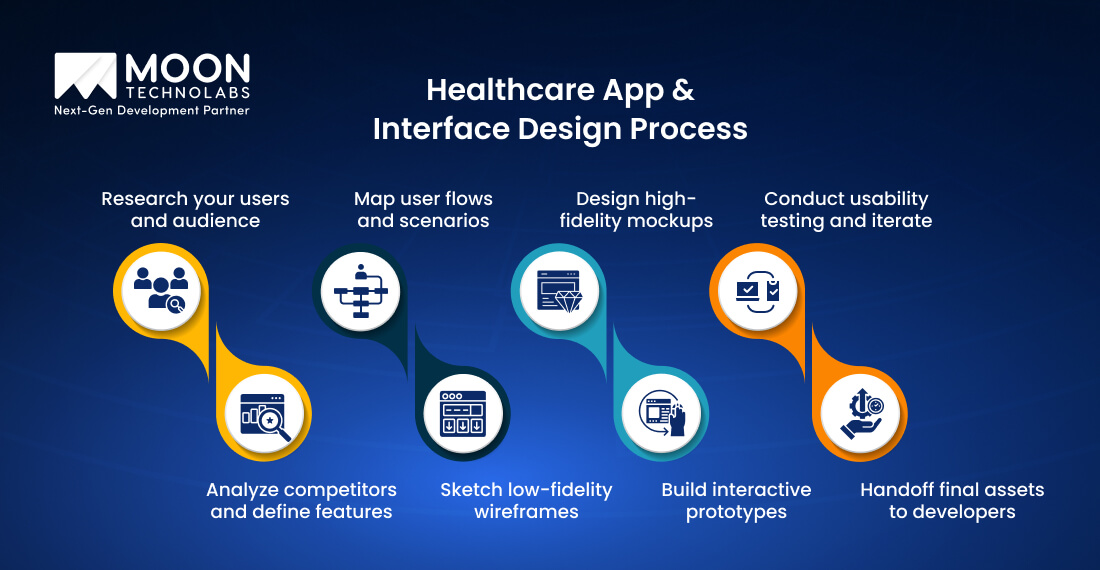
Designing your healthcare software isn’t just about aesthetics; it is about building a system that fits seamlessly into your clinical realities while staying compliant and user-friendly. Here are ways in which organizations can approach the healthcare user experience design in a step-by-step manner:
Stakeholder Interviews
This phase begins with you listening to your end users. It could be doctors, nurses, administrators, and even IT leaders. This listening can help you gain unique insights into pain points and system constraints.
With structured interviews, you will gain a deeper understanding of feature requests, compliance needs, cultural challenges, and workflow bottlenecks, and work towards solving them. This alignment in terms of compliance, culture, and features can help you prevent expensive redesigns.
User and Persona Research
Healthcare apps serve diverse purposes and are used by multiple users across age groups and abilities. That’s why you must conduct persona-backed research. It will help your design team understand the differences between the various users.
There are different techniques, like shadowing, surveys, and contextual inquiry, that can help you understand what users truly need. This removes assumptions from your user goals.
Mapping Workflows, Tasks, and Core Journeys
Once you have the insights, your next step involves mapping the workflows and users’ journeys. You should determine how patients can schedule, access, and track their care on your application. Equally important is to map how physicians can document and share the data.
By visualizing the journeys, you can also identify friction points and ensure that the designs don’t introduce unnecessary complexities.
Information Architecture, Wireframing, and Prototyping
Having clear workflows can help you move into planning the information architecture and wireframing. Healthcare data is complex, as it includes lab reports, medication schedules, and even insurance details.
If you have a poor structure, it can cause users to be overwhelmed. Thoughtful architecture prioritizes critical information first, followed by wireframes and prototypes, to validate usability before your team begins development.
Cross-team Iterative Validation and Compliance Checks
Healthcare system design is never a one-time effort. That’s why you need to invest in cross-team validation with the patients, providers, IT teams, and compliance.
It will help confirm your product is safe, usable, and regulation-friendly. Moreover, iteration can help keep the design grounded, avoiding compliance pitfalls.
Development Handoff
Clarity is crucial when transitioning from design to development. You can use a well-documented design system that includes accessibility guidelines, reusable components, and compliance considerations. This can reduce inconsistencies and expedite cycles during handoffs for optimal outcomes.
Launch Planning, Onboarding, and Measurement
If you don’t have a proper release plan, your best designs can fail. You should plan the launch to include details such as provider onboarding, patient education, and in-app guidance to motivate user adoption.
You should also include measurement strategies, such as monitoring task completion rates, user satisfaction, and error reduction. It can help track your team’s success and refine continuously.
With this step-by-step guide, you can ensure that the apps are compliant and intuitive. When you ground your design in research and validate it with stakeholders, you can deliver products that are trustworthy and lead to better user outcomes.
Overcoming Healthcare UX & UI Design Challenges
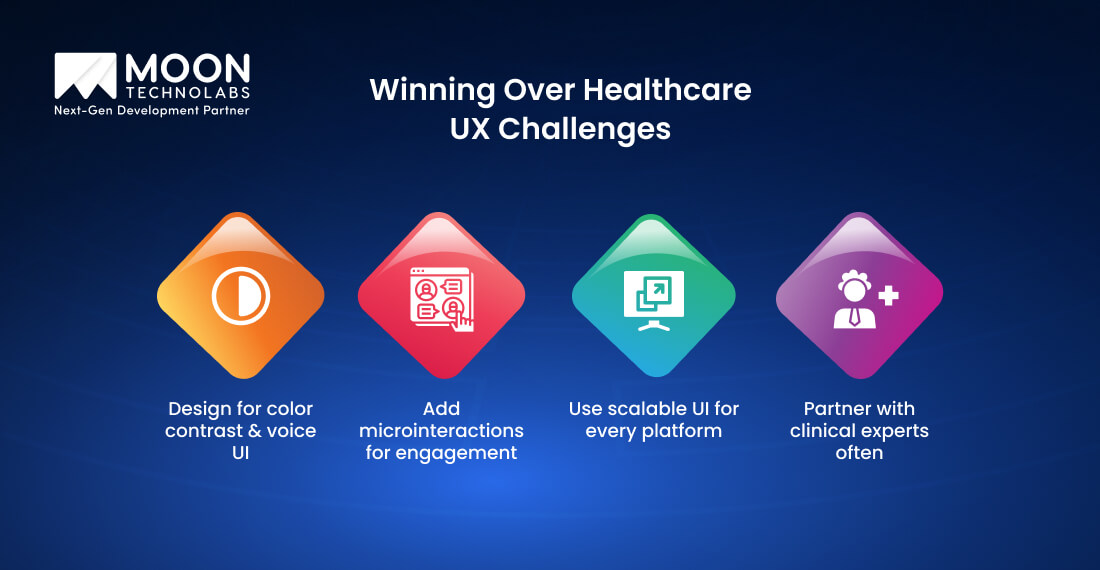
Designing a digital healthcare solution can be a complex process. It requires understanding both UX and UI design. The diverse users and unimaginable constraints make it challenging to design app solutions. That’s where thoughtful design can be of great help.
Usability in High-pressure, Multi-tasking Medical Settings
Healthcare professionals often work in high-stress, multi-tasking environments. Every second matters in this case. When you create interfaces that are overloaded with options, leading to confusion, or with poorly structured navigation, you slow them down.
That’s why you must simplify the workflows, from streamlining the screens to including context-aware design. This would help build faster and clearer interactions, allowing your users to focus on care instead of technology.
Ensuring Security Without Creating Friction
HIPAA-like regulations are non-negotiable. However, if the login or verification steps are cumbersome, it can cause users to lose their patience.
You should add security features that make them feel seamless instead of obstructive. Adding features such as biometric authentication, single sign-on, and role-based controls can help strike a balance between usability and safety.
Blending the security measures with the workflow can help build trust among the users.
Addressing Language Barriers and Literacy Issues in Critical Moments
Healthcare technology is mostly used when your users are vulnerable. For example, patients awaiting their test results or caregivers giving remote care may use your application. When you add language barriers, you reduce health literacy while increasing stress.
Your design must address the user’s realities with clear, plain language for effective communication, provide multi-lingual support, and incorporate visual cues. Adding these small design elements, such as feedback messages, can reduce anxiety while maintaining clarity.
Integrating New UX/UI with Legacy EHRs and Hospital Software
Your biggest hurdle when creating UI/UX design for a healthcare solution is integrating new experiences with the hospital or EHR management systems. Most legacy systems aren’t built using modern healthcare user experience design principles.
Designers need to work around these constraints by creating interoperable layers, modular interfaces, and APIs that connect to older systems. A smooth integration guarantees that users don’t resist adopting the tool.
Building and Testing Data Visualization for Medical Decision-making
While there is a good amount of healthcare data, the raw numbers may not support quick decisions. Moreover, clunky dashboards can overwhelm providers due to information overload.
You can make the UX effective by translating rich data into actionable insights using clear charts, intuitive filters, and context-backed visuals. You may want to test these visual tools with real users to ensure accurate outputs that inform your practice.
With a well-designed healthcare UI/UX, you can eliminate these challenges. Moreover, you can prioritize clarity, empathy, and seamless security to support care providers and their patients.
Best Practices for Healthcare UX Designers & Teams
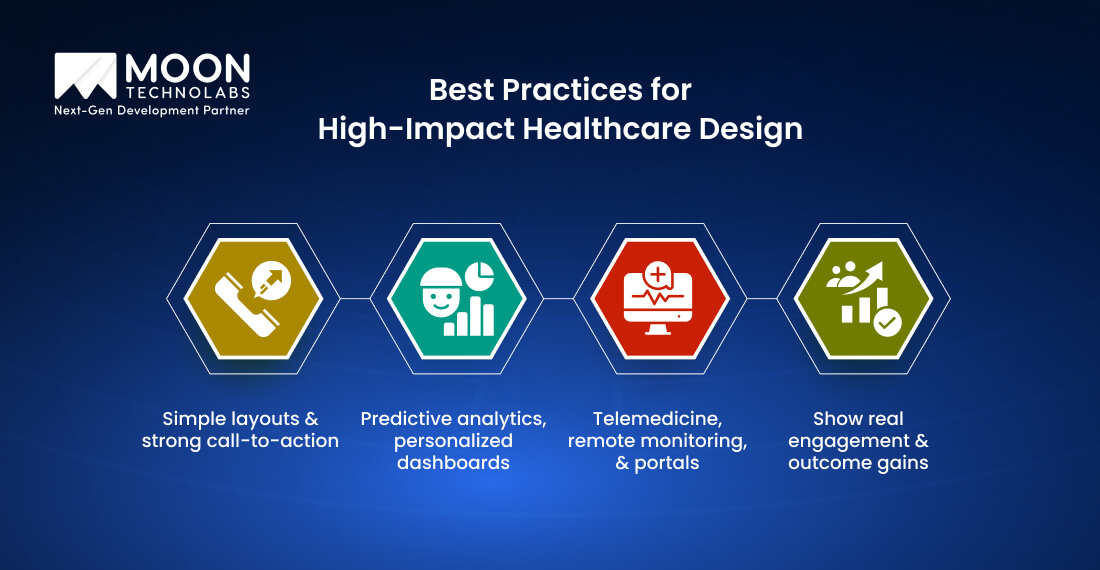
To create a healthcare solution that is usable, secure, and adopted by all your users, you need to use a disciplined approach and continuous collaboration. Here are a few best practices that can help your UX designers and teams:
Establish Continuous Feedback Loops with Real User Cohorts
You should get your design teams engaged with real users in the early stages of your project. This way, you will get critical insights from diverse users, such as patients, clinicians, and administrative staff, revealing their pain points.
With continuous feedback loops in usability testing, surveys, and in-context observation, you can ensure that the design meets the actual needs of users. Iterating with real user data enables you to reduce errors while enhancing app adoption.
Embrace Accessibility, From Color Contrast to Voice UI
Your application should be compatible with all user types. That’s why you should implement accessibility aspects, such as colour contrast, font sizing, screen reader compatibility, and voice UI. Accessibility shouldn’t be an afterthought but a crucial part of your design.
By prioritizing accessibility, you ensure your app is designed for elderly users, people with disabilities, and patients with limited technical understanding. It will eventually help you improve engagement and enhance health outcomes.
Use Gamification and Micro Interactions for Patient Engagement
Adding small design elements can improve your design. You should add micro-interactions like progress confirmations, gentle reminders and achievement cues to ensure that patients embrace the treatment plans.
Gamification can transform routine tasks into opportunities for engagement, motivating users to stay on the app. These techniques eventually improve patient engagement.
Standardize and Scale UI Libraries for Cross-platform Consistency
Your app should be consistent across platforms, as users can access it using their laptops, desktops, or even mobiles. Designing a standardized healthcare UI design library can help you create consistency by using uniform typography, interactions, and components.
It would eventually reduce the cognitive load and training requirements for the app user, simplifying maintenance.
Document All Regulatory and Error-handling Flows
Documenting everything that occurs during healthcare app development is a great way to provide a reliable reference for developers and future teams.
You should consider documenting everything, from the workflows meant for sensitive data to system errors. With clear workflows and protected patient safety, you can transfer the knowledge reliably.
Collaborate with Clinical Subject Matter Experts
UX teams don’t operate in isolation. You must involve subject matter experts throughout the design sprints to align your healthcare system user interface design with real-world practices. These inputs will prioritize critical tasks and validate workflows to help create a product that clinicians want.
Build Digital Health Tools That Clinicians Love
Partner with our healthcare design experts to create efficient, secure, and accessible designs to boost trust and usability.
Book a Call
Healthcare System User Interface Design Trends & Examples
Patient expectations, innovation needs, and tech advances drive innovation in healthcare system UI/UX design. Modern interfaces must be functional and intuitive as well as personal and engaging. Here are the top trends that shape UI design:
Clean UIs With Prominent Calls to Action
Simplicity adds sophistication to your design. That’s why healthcare system design is moving towards minimalist designs prioritizing clarity. The use of prominent buttons, readable typography, and straightforward navigation is considered important.
This minimalist design enables patients and providers to complete critical tasks on the application without confusion or overwhelm.
Voice, Gesture, and Assistive Tech Integration
Hands-free as well as assisted interactions are growing increasingly common, especially in clinical settings where hygiene is important. That’s why many healthcare solutions are implementing gesture-based navigation, voice commands, and accessibility features. This enables users to interact with the system effectively.
Use of Predictive Analytics and Personalized Dashboards
With the increasing use of Artificial Intelligence in healthcare technologies, predictive analytics and personalized dashboards have gained momentum. Predictive analytics will highlight potential health risks to your users, suggest follow-ups as needed, and help prioritize tasks.
Personalized dashboards, on the other hand, help users focus on the relevant information while reducing cognitive load. Both these trends can help the users make better decisions.
Patient Portal, Telemedicine, and Remote Monitoring UI Innovations
With remote care, patient-provider interaction is expected to improve. When implementing features like real-time monitoring and appointment scheduling for these platforms, use an intuitive and mobile-friendly design. These elements will enhance accessibility and compliance with regulations.
Examples of Leading Apps and Their Measurable Outcomes
| Leading Application | Measured Outcome | What They Did |
|---|---|---|
| InteliChat Portal | User adoption increased by 250% after the portal was modernized. | Modernized the portal experience by offering unified features to enhance patient engagement. They include two-way texting, reminders, and online scheduling. |
| Doxy.me | Moved from 80k users to 700k users within 2 months of introducing the portal changes. | Made the telemedicine portal browser-based and simplified, minimizing the friction for providers and patients. |
When you incorporate these trends into your healthcare technology, you build interfaces that are secure and usable. An effective UI enhances engagement and supports better healthcare.
Tools, Platforms & Resources for Healthcare UX/UI Interface Design
With the right tools, platforms, and resources, you can accelerate projects, adhere to compliance standards, and make the application more inclusive.
Prototyping Tools
Tools like Figma, Adobe XD, and Sketch deliver high standards of wireframing and prototyping. For healthcare, these platforms enable your designers to visualize complex workflows, such as patient intake and provider dashboards, before development.
The collaborative features allow all your stakeholders, including designers, IT leaders, and developers, to stay aligned while iterating on features.
Testing/Accessibility Tools
UserZoom and Hotjar are two tools that make it easier for you to test app usability with real users, identifying pain points in navigation and data entry. aXe makes accessibility audits easier, ensuring your designs meet WCAG standards.
Compliance Tools
The tools like HiTrust and Medcurity help align your app with HIPAA compliance, incorporate data security protocols, and implement privacy-by-design practices. When you pair them with accessibility audit tools, you help teams build products that are safe, secure, and compliant with regulatory requirements.
Industry-specific Tools
The UI kits and regulatory design libraries specifically created for healthcare also have pre-validated components. Utilizing these resources, your team can accelerate development, minimize errors, and ensure consistency across patient portals, internal tools, and telemedicine applications.
Conclusion & Next Steps for Healthcare Organizations
UX/UI isn’t just another great thing to have; it is a must to meet the design and regulatory standards of the digital health landscape. Your end users, especially the patients, expect seamless and intuitive digital experiences. Subsequently, the regulators need compliance with HIPAA, GDPR, and accessibility standards.
If you fall short on either front, it can result in frustrated users, lowered adoption, and increased costs for you. That’s why every design decision you make must prioritize usability and empathy. If your digital tools understand the emotions and challenges of the user, you will see an increased adoption and better outcomes.
You must decide whether you aim to build internally, partner strategically, or collaborate with specialists for developing the healthcare system. While each approach has its merits, working with an experienced healthcare UI/UX team enables you to gain speed, compliance, and confidence that drives user adoption.
Moon Technolabs is a leading healthcare software development company. We have helped several organizations and clinics deliver secure, compliant, and delightful healthcare products. If you are ready to take the next step, connect with our team to schedule a consultation.
FAQs
01
What skills does a healthcare UX designer need beyond general UX/UI?
Healthcare UX designers should have a deep knowledge of regulations like HIPAA, an understanding and the ability to simplify complex data to deliver secure and usable digital experiences.02
How do organizations balance compliance, security, and usability in healthcare design?
Organizations can maintain balance by using privacy-by-design principles, adhering to HIPAA/GDPR compliance and implementing security protocols into their workflows. Enabling cross-team collaboration also allows you to balance compliance, security and usability while offering accessibility and intuitive navigation to increase user trust.03
How can you test healthcare user experience design effectively?
To test the UX of your healthcare system effectively, you must engage your diverse users, like patients, providers and administrators, in real & simulated environments. For this purpose, you can use methods like usability testing, accessibility audits and stress testing in high-pressure scenarios. This will help validate your designs in critical and real-world situations.04
Which trends will define user experience design in healthcare apps in the future?
Trends such as voice interfaces, AI-backed personalisation, predictive dashboards, and remote monitoring UIs are expected to see stronger adoption among healthcare apps going forward. More healthcare apps will also adopt trends like accessibility first design and empathetic microinteractions.




Jayanti Katariya is the CEO of Moon Technolabs, a fast-growing IT solutions provider, with 18+ years of experience in the industry. Passionate about developing creative apps from a young age, he pursued an engineering degree to further this interest. Under his leadership, Moon Technolabs has helped numerous brands establish their online presence and he has also launched an invoicing software that assists businesses to streamline their financial operations.
Submitting the form below will ensure a prompt response from us.
We refine our expertise to deliver innovative business solutions.





205 N Michigan Avenue, #810, Chicago, 60601, Illinois, United States
13500 Long Is Dr, Pflugerville, TX 78660, USA

C/105 Ganesh Meridian, S.G. Highway, Ahmedabad, GJ 380060


Ayse D.
Co-Founder France
“ I highly recommend Moon Technolabs as the quality of service is wonderful. We have hired this company to develop the product based on some complex & technical issues. We get the best quality services as compared with others in the market. Huge Thanks to Moon Technolabs as the team is always ready to give the solution all time.”

Justin G.
Founder & CEO USA
USA“ Moon Technolabs is a pioneer in the WebRTC based project as they have fixed complicated segments of the module by fulfilling different product lines by providing 24X7 customer support. We really recommended Moon Technolabs as they are able to develop products as per the module deadline and project timeline.”

Flavio S.
Founder & Managing Director Germany
“I am happy to recommend Moon Technolabs for their app development services. They successfully developed apps for me, and I am highly satisfied with the overall outcomes. The development team has swiftly addressed the issues with responsive and effective communication to understand the requirement quickly and actively resolve the back-and-forth problems that arose...”

Jay M.
Founder & CEOUSA“Moon Technolabs is the best company that provides advanced apps and websites development services in the USA and Europe. I am a newbie to develop my app with an external team. I am really happy to work with them as I am not that much mobile apps user. Here, the team and specially the CEO of Moon Technolabs helps me to let me know about the benefits of my app to generate revenue....”


Our Offices
India
C/105 Ganesh Meridian,S.G. Highway, Ahmedabad, GJ 380060USA
205 N Michigan Avenue, #810, Chicago, 60601, Illinois, United StatesContact Information


