


Edge Computing in IoT: How It Works & Why It Matters

Jayanti Katariya
Last Updated: Jul 06, 2026 Total Views: 90
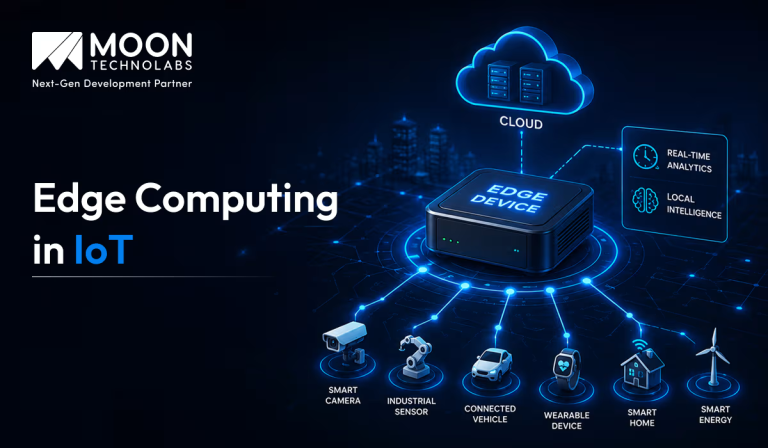
Table of Content


Blog Summary:
This comprehensive guide explores edge computing in IoT, bringing data processing from distant cloud servers to devices and gateways near your data. Edge computing in IoT solves critical challenges such as reducing cloud costs, eliminating latency, and enhancing security. This blog takes you through edge architecture, key benefits of edge computing, and real-world use cases across industries.
Table of Content
Your IoT devices are drowning in data. Every second, thousands of sensors, cameras, and even smart devices across all your operations generate massive amounts of data. Traditionally, all this data gets funneled to cloud servers located thousands of miles away, creating cascades of problems. This simple operation skyrockets bandwidth costs, increases latency, and exposes critical data.
That’s why edge computing in IoT is essential, as it processes and stores data locally on your devices and gateways instead of sending everything to the cloud. It lets you reclaim control, reduces breach risk, and meets compliance requirements such as HIPAA and GDPR.
This shift addresses the key needs of your business: faster real-time processing without cloud delays, significantly reduced infrastructure costs, and genuine data security without constant exposure across transmission points.
In this guide, you will learn how edge computing architecture enhances data privacy, protects your IoT ecosystem, and broadens the use cases that weren’t possible earlier due to security constraints.
What is Edge Computing in IoT?
Edge computing in IoT is a distributed computing architecture in which data is processed locally on devices, edge gateways, and local servers, rather than being sent to centralized cloud data centers.
You process the data where it is created, bringing intelligence closer to your IoT data rather than moving it to a distant data center.
Here are all the traditional problems you are facing. Every sensor, camera, and device in the IoT setup continuously streams raw data to the cloud. The cloud processes this raw data, makes necessary decisions, and sends the commands back. The whole process is slow, bandwidth-hungry, and exposes sensitive information at all major points of transmission. That’s precisely why traditional transmission is not ideal.
Edge computing changes this process. Instead of moving data between data centers, it lets your devices and gateways process data locally and instantly. For example, the smart building’s occupancy sensor won’t send every footstep to the cloud; instead, it will count the occupants on-site and report summaries.
Similarly, your manufacturing equipment doesn’t continuously stream raw vibration data to the cloud. It detects problems locally and alerts you whenever something seems wrong.
Edge computing isn’t replacing the cloud; it is working with the cloud. Edge handles real-time, urgent, and sensitive work locally, while the cloud handles long-term analytics and broader insights. Together, they create a smarter and faster ecosystem.
Edge computing lets your IoT network think for itself, instantly and securely.
Why Edge Computing Matters for Modern IoT Applications
The IoT ecosystem has transformed dramatically. It started as a handful of smart devices and has now evolved into millions of sensors and smart devices operating simultaneously across industries. Consequently, it has revealed a critical problem that your traditional cloud-only architectures cannot solve.
As your IoT deployments scale, sending all the data to the cloud causes bottlenecks. It strains network bandwidth, delays processing, and increases infrastructure costs. Moreover, you are adding unnecessary latency.
This delay becomes dangerous for applications where speed is critical. For instance, you must be able to detect failures in manufacturing equipment immediately. If you work in healthcare, remote patient monitoring systems must alert doctors in real time. In this case, the cloud round trip cannot meet real-time requirements.
Additionally, every transmission from the Internet to the distant cloud center exposes the data, laying the ground for a potential breach. Continuous data exposure creates unacceptable compliance and security risks for industries that handle sensitive data, such as healthcare and finance.
Edge computing can address all these challenges simultaneously. It processes data where it is generated, eliminating latency, reducing bandwidth costs, and securely maintaining sensitive data on your network.
Edge computing makes your IoT deployments efficient and secure.
How does Edge Computing in IoT Work?
Now that you understand why edge computing matters, let’s see how it actually works. The process isn’t complex, but understanding each layer helps you see why it is so powerful:
IoT Devices and Sensors
It all starts with your devices. The IoT sensors, cameras, and smart devices collect raw data from your environment. Instead of sending everything to the cloud, the data is routed to the edge gateway. This is the local processing unit between your sensors and the cloud.
Edge Gateways and Edge Devices
The gateway becomes your data’s first filter. An edge device sits on your network, receives data from thousands of sensors, and prepares it for intelligent processing. The gateways serve as the bridge between raw sensor data and actionable insights.
Local Data Processing
The gateway analyzes incoming data in real time using AI models and machine learning algorithms you have configured. For example, when a temperature sensor reading arrives at the gateway, the gateway checks whether it falls within the normal range. If yes, the gateway will summarize and store; otherwise, it will trigger an alert without waiting for cloud validation.
Cloud Integration and Data Synchronization
Only the most relevant data goes to the cloud. Instead of sending gigabytes of raw sensor data in real time, you will send filtered insights, summaries, and exceptions. This significantly reduces bandwidth usage and costs.
Additionally, the cloud can perform deep analytics, train machine learning models, and store historical data. All these insights are then sent to edge devices to improve local decision-making continuously.
Consequently, you gain real-time responsiveness at the edge and long-term intelligence in the cloud, making your IoT system distributed, efficient, and intelligent.
Modernize Your IoT Infrastructure with Edge Computing
Speak with our specialists to identify the right edge computing approach for your applications, devices, and business objectives.
The Architecture of IoT Edge Computing
Understanding edge computing architecture means recognizing how the four distinct layers work together to build an intelligent IoT system. Each layer has a specific role. When properly integrated, they deliver the speed, security, and efficiency you need. Below are the main layers of IoT edge computing, illustrating its architecture and system design:
Device Layer
The IoT sensors, cameras, wearables, and even your smart devices sit at the device layer. These devices continuously collect data from the environment, such as temperature readings, motion detection, video feeds, and operational metrics. These are lightweight devices optimized for data collection. They are used to gather information and pass it along, not to make decisions.
Edge Layer
Local intelligence resides in this layer. It includes edge gateways, edge servers, and intelligent devices used to process data in real time. It is also where your machine learning models are present, anomalies are detected, and immediate decisions are made. The edge layer is positioned close to your devices, minimizing latency and enabling immediate responses in critical situations.
Network Layer
The network layer is the communication backbone of your edge computing architecture, connecting all the layers. It includes 5G connections, WiFi, cellular networks, and your local network infrastructure.
This layer enables all your devices to talk to edge gateways. It also helps edge devices communicate with cloud systems. This layer ensures reliable, secure data transmission while minimizing bandwidth waste.
Cloud Layer
This is the layer that performs deep analytics on your processed data, trains and updates machine learning models, and stores historical records. The cloud also manages device orchestration, sends updated algorithms back to edge devices, and maintains your system’s intelligence.
All four of these layers create a resilient, intelligent system in which real-time decisions are made instantly, while long-term intelligence continuously improves your entire IoT ecosystem.
Key Benefits of Edge Computing in IoT
Let’s explore why organizations are rapidly adopting edge computing in IoT. These benefits directly impact your operations, costs, and competitive position:
Faster Data Processing
Edge computing processes data locally as soon as it is created, eliminating the round-trip delay to your cloud. Your IoT systems respond instantly, rather than waiting for cloud servers to analyze the data and respond. As a result, your operations can adapt to a changing environment instantly.
Ultra-Low Latency
Latency, the time delay in data transmission, is negligible when processing occurs at the edge gateway. Every millisecond matters in use cases such as autonomous vehicles, remote surgery, and real-time manufacturing monitoring. Edge computing reduces cloud latency and enables split-second decisions.
Reduced Bandwidth and Cloud Costs
You no longer send gigabytes of raw sensor data into your cloud every day. Instead, you filter the insights and summarize the data for the cloud. It reduces bandwidth consumption and improves cloud storage & processing costs. Organizations that have adopted edge computing have reported a significant reduction in their cloud computing expenses.
Enhanced Data Security and Privacy
With edge computing, sensitive data stays on your network rather than repeatedly traveling through the cloud. It helps reduce exposure points, minimize breach risks, and meet compliance requirements such as HIPAA and GDPR with ease. Adopting edge computing in IoT also improves data sovereignty because information stays in your control.
Real-time Decision Making
You no longer need cloud validation to make a decision. Edge computing enables quick action. Manufacturing equipment stops before it fails, and healthcare systems alert providers immediately. Basically, it helps make your IoT system proactive instead of reactive.
Optimized Resource Utilization
When you distribute processing across edge devices rather than centralizing it in the cloud, you optimize computing resources. Your IoT devices consume less power, network bandwidth is used efficiently, and infrastructure operates sustainably.
Top Edge Computing in IoT Use Cases
Edge computing has real-world applications across every industry. Organizations have begun deploying edge solutions to address specific problems, reduce costs, and gain competitive advantages. Here are the most impactful use cases that show how edge computing in IoT has transformed various sectors:
Smart Manufacturing and Industrial IoT (IIoT)
Manufacturing facilities generate massive amounts of sensor data from production lines, quality control systems, and machinery. With edge computing in IoT, they can analyze data instantly on the factory floor.
Equipment vibration sensors help detect anomalies before failures occur, preventing expensive downtime. Computer vision systems run at the edge gateway to inspect products in real time with greater accuracy. Predictive maintenance models run locally and alert technicians regarding problems before they grow big.
Consequently, manufacturers improve quality control, reduce unplanned downtime, and optimize production efficiency without sending a lot of raw data to the cloud daily.
Healthcare and Remote Patient Monitoring
Most patient monitoring devices and wearables have edge computing technology. The edge devices analyze the patterns locally and alert providers when intervention is needed. So, not every heartbeat, blood pressure reading, or glucose measurement is sent to the cloud.
When the patient’s wearable data detects irregular heart rhythms, the cardiologist is immediately notified. Continuous glucose monitors process all these readings at the edge and adjust insulin pump recommendations within milliseconds.
Using this approach, providers can improve patient outcomes, reduce unnecessary hospital visits, and protect sensitive health data by keeping it encrypted on local devices.
Smart Cities and Intelligent Infrastructure
IoT in smart cities deploys thousands of sensors across street cameras, parking systems, and environmental monitors. With edge computing in IoT, the data is processed locally. The traffic management systems analyze congestion patterns at the edge and adjust signal timing in real time to optimize traffic flow.
Parking apps use this to manage availability in real time, while environmental sensors detect air quality and alert authorities when it becomes concerning. Cities that implemented edge computing reported massive improvements in traffic flow and resource allocation.
Autonomous Vehicles
Self-driving vehicles can’t rely on cloud connectivity for safety-critical decisions. Edge computing, on the other hand, runs AI models on your vehicle hardware. The onboard edge computer processes camera feeds, radar information, and LIDAR data in real time, helping to make split-second decisions about braking, steering, and even acceleration.
Navigation algorithms in self-driving cars use the edge to optimize routes instantly. They also communicate with other vehicles using a peer-to-peer edge. Cloud connectivity supports long-term learning and map updates, while edge computing ensures vehicle safety.
Retail and Smart Stores
Retailers use edge computing in their cameras, point-of-sale systems, and smart shelves. Using computer vision models at the edge, you can alert staff as soon as a shelf is empty. It helps cashier-less stores process transactions at high speed and offer personalized recommendations using customer behavior analytics.
Even inventory systems can use edge computing to track products in real time, optimizing stock levels while reducing shrinkage.
Energy and Smart Grid Management
Smart grids deploy edge computing across their electrical infrastructure. With edge devices at the substations and distribution points, they can analyze power consumption patterns instantly, preventing outages.
The use of edge computing in renewable energy sources like solar and wind farms helps predict output and adjust grid distribution in real time. Smart home systems also benefit from this technology, as energy data is processed locally, optimizing heating, cooling, and appliance use.
Agriculture and Precision Farming
In the agriculture industry, farmers use sensors in their fields to monitor soil moisture, temperature, and pest activity. Edge computing helps them process data instantly without cloud latency.
Eventually, irrigation systems can make real-time watering decisions based on soil conditions, while drone imagery helps detect crop diseases before they cause issues. Predictive models run locally to forecast yield and optimize harvest.
Logistics and Supply Chain Monitoring
Supply chain operations require real-time visibility across shipments and warehouses. Edge computing processes the tracking data instantly without sending it to the cloud. GPS and sensors can detect route deviations and optimize delivery paths immediately.
Moreover, temperature sensors alert handlers as soon as cargo spoils, while warehouse systems track inventory movement and auto-recorders are triggered when levels drop. Eventually, you reduce delivery times, prevent cargo loss, and improve supply chain visibility.
Design Your Edge Computing Strategy Now
Our IoT architects help assess your current infrastructure, identify edge computing opportunities, and create a tailored deployment roadmap for your organization.
Future Trends of Edge Computing in IoT
The edge computing landscape is fast-evolving. New technologies and approaches are continuously emerging, reshaping how organizations deploy and manage edge infrastructure. By understanding these trends, you stay prepared for what’s coming next:
AI at the Edge
Machine learning models are now smaller, faster, and more efficient than before. Sophisticated AI won’t run exclusively in the cloud anymore; it will run directly on edge devices. Small language models, computer vision systems, and even predictive analytics will run in real time on your gateways and devices.
For your IoT systems, this means genuine intelligence will be available locally, enabling complex decisions to be made efficiently without cloud dependency. Edge AI will also eliminate privacy concerns, reducing latency to near zero.
5G-Enabled Edge Computing
5G networks are accelerating edge adoption by offering ultra-fast and low-latency connectivity between edge and cloud. You can create hybrid scenarios where devices can use both local intelligence and cloud resources seamlessly. Autonomous vehicles, industrial automation, and even remote robotic surgery will benefit from this.
Edge-to-Cloud Orchestration
Managing a multi-edge device infrastructure that is distributed across locations is complex. That’s why future platforms will offer centralized orchestration. That means they will automatically deploy applications, update models, and manage resources across the edge network while maintaining local autonomy.
Digital Twins
Digital twin technology is becoming increasingly powerful when combined with edge computing. By processing and synchronizing operational data in real time, edge devices enable digital twins to perform accurate simulations, predictive analytics, and system optimization with minimal latency.
Edge-native Applications
Developers can build applications designed for the edge environment only, instead of adapting cloud-native apps for the edge. These edge-native apps will be smaller, more efficient, and optimized for distributed processing. They will come with built-in resilience and offline capabilities.
How does Moon Technolabs Help Build Intelligent Edge Computing in IoT Solutions?
Building an effective edge computing strategy requires someone with hands-on expertise in architecture design, model optimization, and real-world deployment. Moon Technolabs provides top-notch IoT development services and works with organizations to transform edge computing into working systems tailored to your needs.
Whether you are designing an infrastructure for your small manufacturing facility or deploying edge intelligence for healthcare monitoring, Moon Technolabs brings practical experience across all use cases. We help design edge architectures that balance local processing and cloud integration to optimize machine learning models and ensure they run efficiently on edge devices.
Our team understands the unique challenges each industry faces. That’s why we don’t force a one-size-fits-all solution. Instead, we build edge systems that solve real problems while fitting within your budget constraints and existing infrastructure.
Whether you want to design a distributed edge infrastructure or need machine learning models to run locally, we help you implement edge strategies that reduce costs, improve security, and enable real-time decision-making.
Conclusion
Edge computing in IoT is no longer a distant future technology; it is the architectural evolution your IoT deployments need now, addressing problems such as escalating cloud costs and unacceptable latency. By distributing intelligence to the edge of your network, you gain better control, can respond instantly, and protect what matters most to your business.
By deploying edge computing, you also gain competitive advantages such as efficiency, speed, and security. The question is no longer whether you should implement edge to transform your operations; it is when to implement it for your business.
If you are exploring how edge architecture can solve specific challenges for your business, Moon Technolabs can help. Our edge computing experts can help deliver a tailored plan and execute it seamlessly to deliver the defined outcomes.
FAQs
01
What are examples of edge computing?
Here are a few examples of edge computing—a fitness tracker analyzing workout data locally before syncing it to the cloud. Security cameras detecting motion on your property without processing are another example. Manufacturing sensors that detect equipment problems instantly on the factory floor are also a form of edge computing in action.02
Is edge computing the same as IoT?
No, they are totally different. IoT refers to connected devices that collect data. Edge computing helps process data locally, on the devices or nearby gateways.03
What are the three layers of edge computing?
The three core layers of edge computing are the device layer, where data originates; the edge layer, where processing occurs on gateways and servers; and the cloud layer, which handles analytics and storage.04
Does Netflix use edge computing?
Yes, Netflix deploys servers at internet service providers' locations globally and caches content locally. When you press play, Netflix streams from the nearest edge server rather than distant data centers, reducing latency and improving quality.05
What are the 4 types of IoT?
Consumer IoT, Enterprise IoT, Industrial IoT, and Infrastructure IoT are the four main types of IoT.




Jayanti Katariya is the CEO of Moon Technolabs, a fast-growing IT solutions provider, with 18+ years of experience in the industry. Passionate about developing creative apps from a young age, he pursued an engineering degree to further this interest. Under his leadership, Moon Technolabs has helped numerous brands establish their online presence and he has also launched an invoicing software that assists businesses to streamline their financial operations.
Submitting the form below will ensure a prompt response from us.
We refine our expertise to deliver innovative business solutions.





205 N Michigan Avenue, #810, Chicago, 60601, Illinois, United States
13500 Long Is Dr, Pflugerville, TX 78660, USA

C/105 Ganesh Meridian, S.G. Highway, Ahmedabad, GJ 380060


Ayse D.
Co-Founder France
“ I highly recommend Moon Technolabs as the quality of service is wonderful. We have hired this company to develop the product based on some complex & technical issues. We get the best quality services as compared with others in the market. Huge Thanks to Moon Technolabs as the team is always ready to give the solution all time.”

Justin G.
Founder & CEO USA
USA“ Moon Technolabs is a pioneer in the WebRTC based project as they have fixed complicated segments of the module by fulfilling different product lines by providing 24X7 customer support. We really recommended Moon Technolabs as they are able to develop products as per the module deadline and project timeline.”

Flavio S.
Founder & Managing Director Germany
“I am happy to recommend Moon Technolabs for their app development services. They successfully developed apps for me, and I am highly satisfied with the overall outcomes. The development team has swiftly addressed the issues with responsive and effective communication to understand the requirement quickly and actively resolve the back-and-forth problems that arose...”

Jay M.
Founder & CEOUSA“Moon Technolabs is the best company that provides advanced apps and websites development services in the USA and Europe. I am a newbie to develop my app with an external team. I am really happy to work with them as I am not that much mobile apps user. Here, the team and specially the CEO of Moon Technolabs helps me to let me know about the benefits of my app to generate revenue....”


Our Offices
India
C/105 Ganesh Meridian,S.G. Highway, Ahmedabad, GJ 380060USA
205 N Michigan Avenue, #810, Chicago, 60601, Illinois, United StatesContact Information


