


Data Readiness for AI: A Complete Guide to Preparing Your Data for AI

Artificial Intelligence Team
Last Updated: Oct 07, 2026 Total Views: 87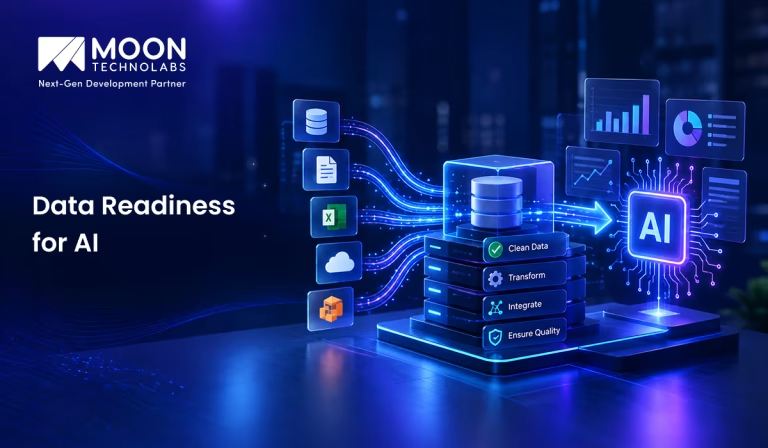
Table of Content


Blog Summary:
Successful AI deployment hinges on data readiness—the process of auditing, cleansing, and structuring enterprise datasets for seamless model integration. Raw, siloed, or inaccurate information drives high project failure rates. Still, robust governance and modern ETL pipelines turn disorganized records into strategic assets that deliver reliable predictions, regulatory compliance, and maximum ROI.
Table of Content
Before an enterprise deploys cutting-edge AI models, it must confront a sobering reality: AI capabilities are strictly bounded by the quality of the underlying data. Gartner research predicts that organizations will abandon up to 60% of AI projects that lack AI-ready data—not because of faulty algorithms, but because messy, ungoverned data yields untrustworthy results.
Data readiness is no longer an invisible technical detail; it is the strategic bedrock that determines whether an initiative moves to production or ends as an expensive failure. Preparing your data for AI requires moving beyond basic storage to focus on architecture, governance, and relevance.
This guide walks through the essential stages of evaluating data health, eliminating silos, and building scalable pipelines. By achieving true data readiness for AI today, you ensure your organization’s AI initiatives deliver accurate, actionable, and resilient business value from day one.
What is Data Readiness for AI?
Data readiness for AI means preparing an organization’s data so artificial intelligence and machine learning systems can use it effectively. This includes ensuring data is accurate, complete, relevant, and available in the right formats.
It also involves organizing and integrating data from different sources while maintaining proper security, privacy, and governance. Clean and well-structured data helps AI models produce more reliable and meaningful results.
A strong data readiness strategy enables organizations to adopt AI with greater confidence. By establishing high-quality data foundations, businesses can improve decision-making, automate processes, and unlock valuable insights from their data.
Why Data Readiness Matters for AI
Data readiness is a critical foundation for successful AI implementation. AI systems rely heavily on data quality, consistency, and availability to generate accurate, useful results. When data is clean, organized, secure, and properly managed, organizations can reduce risks, improve AI performance, and make better use of their AI investments.
- Improves AI accuracy: High-quality and consistent data helps AI models produce more accurate and reliable outputs.
- Reduces errors and bias: Identifying incomplete, duplicate, or inconsistent data helps minimize errors and potential bias in AI results.
- Enables faster AI adoption: Well-prepared and accessible data makes it easier for teams to develop, test, and deploy AI solutions.
- Supports better decision-making: Reliable data allows AI systems to generate meaningful insights that support informed business decisions.
- Strengthens data security: Proper data governance ensures sensitive information is protected and accessed only by authorized users.
- Improves scalability: A strong data foundation lets organizations expand AI initiatives across teams, processes, and business functions.
- Maximizes AI investments: Better data quality helps organizations achieve greater value and measurable outcomes from their AI initiatives.
Build a Robust Foundation for Your AI Initiatives
Our end-to-end data preparation services eliminate project failure risks, turning unstructured records into accurate, business-ready AI training assets.
Key Characteristics of AI-Ready Data
AI-ready data is the foundation of successful AI implementation. Simply having large amounts of data is not enough; the data must be accurate, organized, accessible, secure, and relevant to the business problem. When data meets these characteristics, organizations can build more reliable AI models, generate better insights, and scale AI solutions more effectively.
High-performing algorithms depend entirely on the foundational quality of your enterprise datasets. Here are the core traits that define datasets capable of delivering accurate results:
High-quality Data
AI systems rely on the quality of the data they receive. AI-ready data should be accurate, complete, consistent, and free from unnecessary duplicates or errors. Poor-quality data can lead to unreliable predictions and incorrect AI outputs. Regular data validation and cleansing help maintain data quality over time.
Well-structured and Standardized Data
Data should follow consistent formats, naming conventions, definitions, and structures. Standardization makes it easier for AI systems to process information from different sources and reduces inconsistencies. Properly structured data also simplifies integration, analysis, and model development.
Accessible and Available Data
AI systems need timely access to the data required for training, testing, and ongoing operations. Authorized users and systems should be able to access data easily through reliable data platforms and pipelines. Reducing data silos and improving data availability can help organizations develop and deploy AI solutions more efficiently.
Context-rich Data
Data needs sufficient context to be meaningful to an AI system. Information such as metadata, timestamps, data definitions, relationships, source information, and business context can help AI understand what the data represents. Context-rich data improves interpretation and supports more relevant AI-generated insights.
Secure and Governed Data
AI-ready data must be managed with strong security, privacy, and governance practices. Organizations should define who can access data, how it can be used, where it is stored, and how long it should be retained. Strong governance helps protect sensitive information while supporting regulatory and organizational requirements.
Relevant and Representative Data
Data should be directly related to the business objective or AI use case. It should also represent the different users, conditions, and scenarios that the AI system may encounter. Relevant and representative data help models perform more effectively in real-world situations and reduce the risk of incomplete or misleading results.
Scalable and Up-to-Date Data
AI initiatives often grow over time, increasing both the volume and variety of data that needs to be managed. AI-ready data infrastructure should scale as requirements grow. Data should also be updated regularly so AI models and applications can work with current, relevant information.
Steps to Make Your Data AI-ready
Turning unstructured, fragmented records into reliable AI assets demands a focused preparation strategy. Here are the actionable steps to transform your datasets:
Identify Your AI Use Cases
Begin by clearly defining the business goals and AI use cases you want to support. Determine which problems AI should solve, what outcomes are expected, and what data types are required. This helps organizations focus data preparation on information with a clear purpose and business value.
Inventory and Assess Your Data
Create a comprehensive inventory of data available across databases, applications, spreadsheets, cloud platforms, data warehouses, and other sources. Assess each dataset for accuracy, completeness, consistency, relevance, freshness, and accessibility. This assessment helps identify data gaps, duplication, outdated information, and other issues that may affect AI performance.
Clean and Standardize Your Data
Data often contains duplicates, missing values, incorrect records, inconsistent formats, and outdated information. Clean the data by identifying and correcting these issues. Standardize names, formats, units, categories, and other values so AI systems can process and analyze data from different sources consistently.
Establish Data Governance
Strong data governance ensures that data is managed responsibly and consistently across the organization. Define data ownership, quality standards, access permissions, privacy policies, retention rules, and compliance requirements. Clear governance also establishes accountability, making it easier to maintain trustworthy data as AI initiatives grow.
Integrate and Organize Data
AI solutions often require information from multiple systems and sources. Integrate relevant data using reliable data pipelines, warehouses, lakes, or other data platforms. Organizing data in a centralized, accessible environment reduces data silos and lets AI teams work with consistent, connected information.
Add Context and Metadata
Data becomes significantly more useful when its meaning and background are clearly documented. Add metadata, business definitions, source information, timestamps, relationships, classifications, and other contextual details. This helps both AI systems and data teams better understand how to interpret and use the data.
Secure Sensitive Data
Before using data for AI, identify information that may contain personal, confidential, financial, or other sensitive details. Apply appropriate security controls such as access management, encryption, masking, anonymization, and monitoring. Protecting data throughout its lifecycle helps reduce security and privacy risks while supporting responsible AI adoption.
Monitor and Improve Data Quality
Treat enterprise data AI readiness as a continuous process, not a one-time project. Regularly monitor data for accuracy, completeness, consistency, freshness, and availability. Automated quality checks, alerts, and periodic reviews can help identify problems early and keep datasets reliable as business requirements and AI applications evolve.
You May Also Like:
Data Readiness Checklist
Evaluating your enterprise datasets before model development prevents costly delays and project failures. Here is a practical checklist to guide your readiness assessment—have a look:
- AI Use Cases Defined: Business goals, AI use cases, and expected outcomes are clearly identified.
- Data Sources Identified: Relevant internal and external data sources have been documented.
- Data Quality Assessed: Data is checked for accuracy, completeness, consistency, and duplication.
- Data Standardized: Formats, naming conventions, units, and data structures are consistent.
- Data Integrated: Relevant data from different systems is connected and organized effectively.
- Metadata Added: Data definitions, sources, timestamps, and business context are documented.
- Data Governance Established: Ownership, access rules, quality standards, and usage policies are clearly defined.
- Sensitive Data Protected: Personal and confidential information is secured through appropriate controls.
- Data Accessibility Ensured: Authorized teams and AI systems can access the required data when needed.
- Data Freshness Maintained: Data is regularly updated to remain relevant and useful.
- Quality Monitoring in Place: Data quality is continuously monitored using defined checks and metrics.
- Scalability Considered: Data infrastructure can support growing volumes, sources, and AI workloads.
- Compliance Requirements Addressed: Applicable privacy, security, and regulatory requirements are considered.
- Continuous Improvement Planned: Processes are in place to review, maintain, and improve data readiness over time.
Common Data Readiness Challenges
Preparing enterprise data for AI often exposes hidden operational and technical roadblocks. Here are the top challenges organizations face on their readiness journey—have a look:
Data Silos Across Systems
Organizations often store data across multiple applications, databases, departments, and cloud platforms. These disconnected data sources make it difficult to create a unified view of information. Data silos can cause duplication, limited access, and delays in analysis. Integrating data across systems is therefore essential to create a reliable, centralized data environment.
Poor Data Quality and Inconsistency
Data may contain errors, duplicates, missing values, outdated information, or inconsistent formats. When different systems use different definitions or standards for the same data, analytical results become difficult to trust. Data validation, cleansing, standardization, and quality-monitoring processes help improve the accuracy and reliability of organizational data.
Legacy Systems and Infrastructure
Many organizations still rely on older systems not designed to support modern analytics, cloud platforms, or AI workloads. These systems may have limited integration capabilities, outdated architectures, or performance constraints. Modernizing infrastructure or adding suitable integration layers can make legacy data more accessible and usable.
Lack of Data Governance and Ownership
Without clear governance, organizations may not know who is responsible for collecting, maintaining, securing, and approving data. Different teams may also use different definitions, policies, and standards. A strong data governance framework establishes clear ownership, accountability, common standards, and processes for managing data throughout its lifecycle.
Data Security, Privacy, and Compliance Issues
Data readiness also depends on protecting sensitive and confidential information. Organizations must address risks such as unauthorized access, data breaches, inappropriate data sharing, and non-compliance with applicable regulations. Implementing access controls, encryption, monitoring, privacy practices, and compliance processes helps ensure that data can be used securely and responsibly.
Ready to Transform Your Raw Data Into AI Power?
Our data experts audit, clean, and structure your enterprise data to build scalable pipelines that guarantee accurate, production-ready AI models from day one.
Why Choose Moon Technolabs for AI Data Readiness?
At Moon Technolabs, we help businesses build a strong and reliable data foundation for their AI initiatives. Our AI data readiness approach covers data assessment, cleaning, structuring, integration, and validation to ensure your data is accurate, organized, and ready to support AI applications.
Every business has different data sources, workflows, and AI goals. Our team works closely with you to identify data gaps, resolve inconsistencies, and improve overall data quality. As an experienced AI development company, we combine technical expertise with a clear understanding of business needs to prepare data for meaningful AI implementation.
With Moon Technolabs, you get a structured and scalable approach to AI data readiness. We help transform fragmented, unstructured information into usable, high-quality data that supports AI models, automation, analytics, and future digital initiatives.
Conclusion
Data readiness is one of the most important steps toward building successful AI solutions. While AI models and technologies continue to evolve, their performance ultimately depends on the quality, structure, availability, and relevance of the data they use.
From identifying and collecting the right data to securing and validating it, businesses need a well-planned approach before moving into AI development. Taking time to address data gaps, privacy concerns, and governance requirements can build a stronger foundation for accurate, reliable AI outcomes.
Preparing data for AI should not be a one-time activity but an ongoing process that evolves with your business and AI goals. By establishing clear data management practices, monitoring data quality, and continuously improving data pipelines, organizations can make their information more useful for AI applications while reducing implementation challenges.
Businesses can also hire AI developers to bring specialized expertise in data preparation, AI integration, model development, and deployment, helping turn AI-ready data into practical business solutions. With the right strategy and technical expertise, organizations can build an AI-ready ecosystem that supports smarter decision-making, automation, personalization, and long-term innovation.
FAQs
01
How do we know if our data is actually "ready" for AI?
Data readiness for AI adoption relies on five core dimensions: accuracy, completeness, accessibility, governance, and relevance. Your data is ready when it is properly labeled, free from critical errors, stored securely in an accessible pipeline, and directly aligned with your specific business use case.02
Can we deploy AI if our data is scattered across legacy systems?
Yes, but you must unify raw legacy data first. You must build an ETL pipeline or data lakehouse to extract, centralize, and standardize information from disparate systems, creating a clean, accessible stream for AI models without disrupting legacy operations.03
How do we ensure data privacy and regulatory compliance?
Compliance is embedded directly into the preparation pipeline using strict governance rules. Sensitive data is protected through masking, tokenization, or synthetic generation, while role-based access controls ensure models only process permissioned data in line with regulations like GDPR or HIPAA.04
How long does the data preparation phase usually take before we can build models?
Data preparation typically accounts for 60% to 80% of the entire AI project timeline. For simple, structured datasets, initial preparation might take 2 to 4 weeks. For complex enterprise environments with heavily siloed or unstructured data, the process can take 2 to 4 months. Building automated pipelines during this phase significantly speeds up all future AI initiatives.05
Should we clean all enterprise data at once or project by project?
Adopt a project-by-project approach. Cleaning an entire enterprise data repository at once causes scope creep and delays ROI. Instead, prepare only the datasets needed for high-value use cases, building reusable data infrastructure incrementally.




Explore the latest insights on Artificial Intelligence, including Generative AI, Agentic AI, natural language processing, computer vision, automation, and enterprise AI solutions. This category covers industry trends, practical applications, implementation strategies, and innovations that help businesses leverage AI for smarter decision-making and digital transformation. Stay updated with evolving AI technologies that are reshaping industries worldwide.
Submitting the form below will ensure a prompt response from us.
We refine our expertise to deliver innovative business solutions.





205 N Michigan Avenue, #810, Chicago, 60601, Illinois, United States
13500 Long Is Dr, Pflugerville, TX 78660, USA

C/105 Ganesh Meridian, S.G. Highway, Ahmedabad, GJ 380060


Ayse D.
Co-Founder France
“ I highly recommend Moon Technolabs as the quality of service is wonderful. We have hired this company to develop the product based on some complex & technical issues. We get the best quality services as compared with others in the market. Huge Thanks to Moon Technolabs as the team is always ready to give the solution all time.”

Justin G.
Founder & CEO USA
USA“ Moon Technolabs is a pioneer in the WebRTC based project as they have fixed complicated segments of the module by fulfilling different product lines by providing 24X7 customer support. We really recommended Moon Technolabs as they are able to develop products as per the module deadline and project timeline.”

Flavio S.
Founder & Managing Director Germany
“I am happy to recommend Moon Technolabs for their app development services. They successfully developed apps for me, and I am highly satisfied with the overall outcomes. The development team has swiftly addressed the issues with responsive and effective communication to understand the requirement quickly and actively resolve the back-and-forth problems that arose...”

Jay M.
Founder & CEOUSA“Moon Technolabs is the best company that provides advanced apps and websites development services in the USA and Europe. I am a newbie to develop my app with an external team. I am really happy to work with them as I am not that much mobile apps user. Here, the team and specially the CEO of Moon Technolabs helps me to let me know about the benefits of my app to generate revenue....”


Our Offices
India
C/105 Ganesh Meridian,S.G. Highway, Ahmedabad, GJ 380060USA
205 N Michigan Avenue, #810, Chicago, 60601, Illinois, United StatesContact Information


