


10 Best CRM for Manufacturing to Streamline Operations

Jayanti Katariya
Last Updated: May 03, 2026 Total Views: 267
Table of Content


Blog Summary:
Using a powerful CRM system is no longer optional; it is a necessity. A CRM for manufacturing helps streamline operations, enhance communication, and improve customer relationships by centralizing vital data on a single accessible platform. It enables real-time insights, task automation, and better decision-making, all of which contribute to greater efficiency and productivity. By managing everything from customer inquiries to order tracking, a CRM for manufacturing helps companies stay ahead of the competition and foster long-term growth.
Table of Content
Manufacturing businesses in 2026 operate in a highly competitive environment where efficiency, coordination, and real-time data are essential. To manage production, supply chains, and customer relationships effectively, many manufacturers are turning to a CRM as a central solution. Modern CRM platforms go beyond sales management; they help streamline operations, improve collaboration, and boost overall productivity.
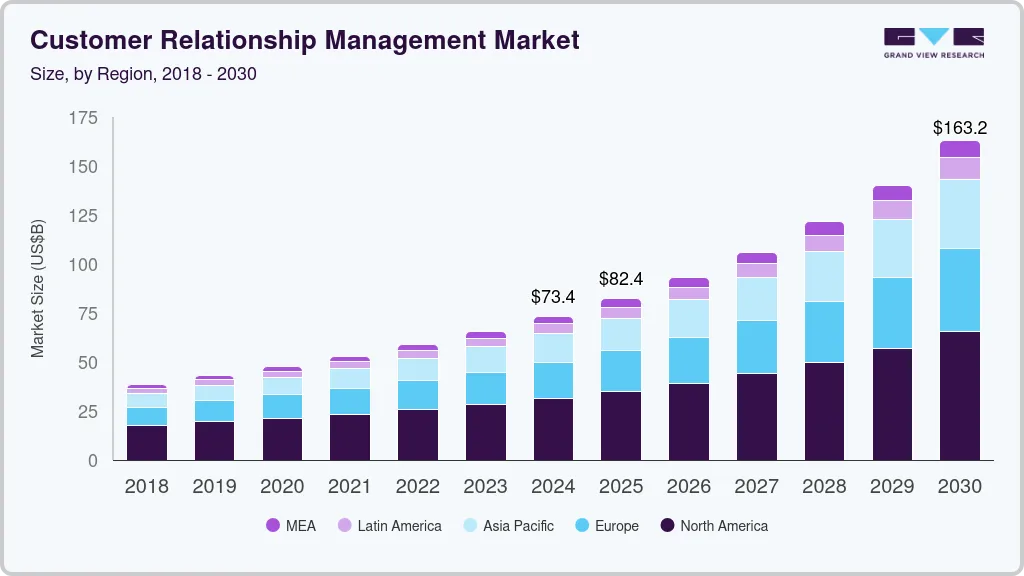
This growing demand is reflected in market trends as well. According to a report by Grand View Research, the global CRM market was valued at USD 73.40 billion in 2024 and is projected to reach USD 163.16 billion by 2030, growing at a CAGR of 14.6% from 2025 to 2030.
In this blog, we’ll explore the 10 best CRM solutions for manufacturing to help businesses streamline operations and drive growth.
What is CRM for Manufacturing?
CRM for Manufacturing is a system designed specifically for manufacturing businesses to manage customer interactions, dealer networks, and complex sales processes. It helps track leads, orders, and customer requirements while integrating sales activities with production and supply chain operations.
Using the best CRM for a manufacturing business can improve customer satisfaction, streamline sales, and provide better visibility into performance. It also provides valuable insights into customer behavior and market trends, helping manufacturers make informed decisions and drive business growth.
Why Do Manufacturing Businesses Need CRM Software?
Manufacturing businesses operate in a complex environment where customer demands, production schedules, inventory levels, and sales pipelines must all stay aligned. Without a structured system, managing these moving pacers can quickly become overwhelming. This is where manufacturing CRM software becomes essential, helping businesses stay organized and responsive:
Centralized Customer Data Management
One of the biggest challenges for manufacturing businesses is keeping track of customer information across multiple systems, departments, or even spreadsheets. CRM software consolidates all customer-related data in one central hub.
This includes contact details, purchase history, communication records, and service requests. With easy access to this information, manufacturers can better understand customer preferences, anticipate their needs, and offer more personalized service.
Better Sales Pipeline Visibility
In the CRM manufacturing industry, maintaining a smooth sales pipeline is crucial.CRM software allows businesses to track potential sales at every stage of the sales process, from lead generation to closed deals.
With visibility into the status of each opportunity, sales teams can prioritize their efforts, follow up effectively, and identify bottlenecks that may be delaying conversations. This transparency leads to more informed decision-making and ultimately accelerates sales cycles.
Improved Demand Forecasting
Accurate demand forecasting is essential for managing production schedules and inventory. By integrating CRM software with other business systems, manufacturers can gather valuable insights into customer purchasing patterns and market trends.
This data helps forecast demand more accurately, ensuring that production schedules align with expected orders. As a result, businesses can minimize overproduction, avoid stockouts, and ensure they have the right products available at the right time.
Stronger Customer Relationships
In the competitive world of industrial manufacturing automation, retaining existing customers is just as important as acquiring new ones. Having the best CRM software for manufacturing helps companies build stronger relationships by enabling more frequent and meaningful customer interactions.
Automated follow-up reminders, targeted marketing campaigns, and tailored service offerings all contribute to enhanced customer satisfaction. When manufacturers maintain proactive, personalized communication, it fosters loyalty and creates long-term partnerships.
Streamlined Order and Inventory Processes
Managing orders and inventory can be a logistical nightmare for manufacturers, especially as production volumes scale up. CRM manufacturing software integrates seamlessly with other systems (such as enterprise resource planning and inventory management systems) to streamline these processes.
It provides real-time visibility into stock levels, order statuses, and production schedules, enabling manufacturers to manage supply chains and fulfill customer orders on time efficiently. This integration reduces the risk of errors, delays, and lost opportunities.
Key Features to Look for in CRM for Manufacturing
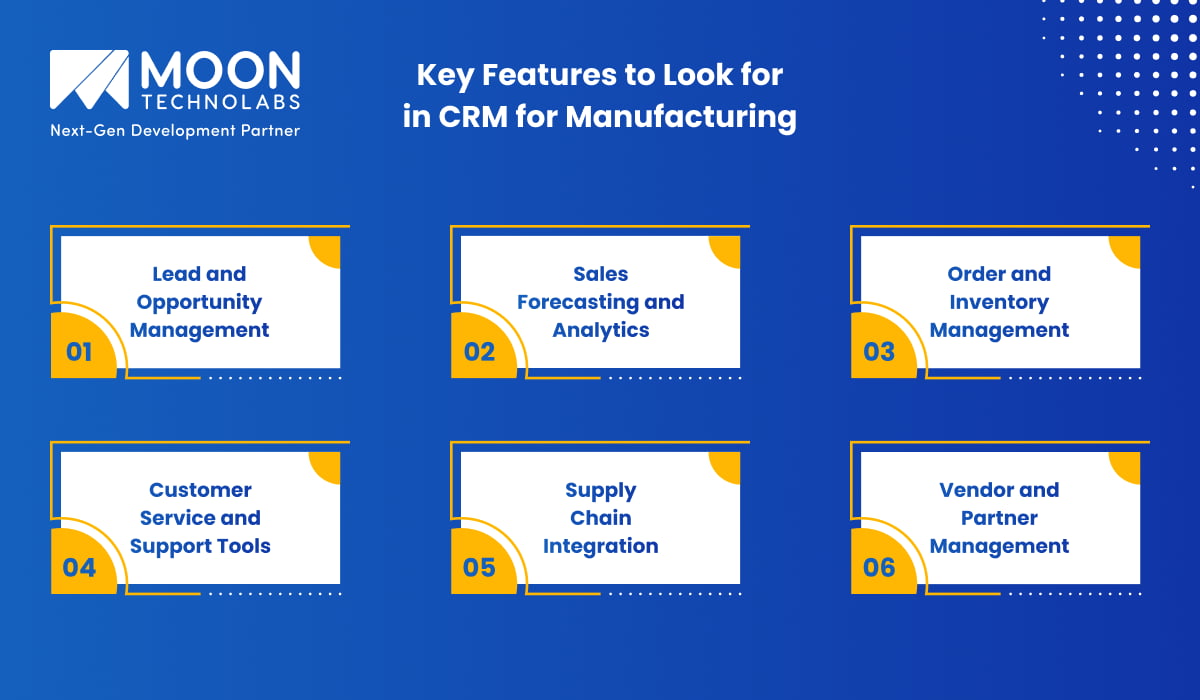
Selecting the right CRM system is crucial for manufacturers looking to streamline operations, improve customer relationships, and boost sales efficiency. Not all CRMs are created equal, and manufacturing companies have unique needs that require specialized features. Here’s a breakdown of the essential capabilities to consider:
Lead and Opportunity Management
A robust CRM should enable manufacturers to capture, track, and nurture leads efficiently. From the first inquiry to closing a deal, the system should provide visibility into the sales pipeline, helping sales teams prioritize opportunities and reduce the risk of lost deals.
Features like automated follow-ups, lead scoring, and activity tracking can ensure that no potential customer falls through the cracks.
Sales Forecasting and Analytics
Accurate sales forecasting is critical for planning production schedules and managing resources. A manufacturing-focused CRM should offer advanced analytics tools that provide insights into sales trends, pipeline health, and revenue projections.
Real-time reporting enables decision-makers to identify opportunities, anticipate demand, and adjust strategies proactively.
Order and Inventory Management
For manufacturers, integrating order management with inventory tracking is a game-changer. The CRM should allow seamless tracking of orders from quotation to delivery while keeping inventory levels up to date.
This ensures that production aligns with customer demand and reduces the risk of overstocking or stockouts, ultimately improving efficiency and customer satisfaction.
Customer Service and Support Tools
Customer satisfaction is a key differentiator in manufacturing. A CRM with built-in customer service tools can help support teams manage inquiries, track service requests, and resolve issues quickly.
Features such as ticketing systems, knowledge bases, and automated responses enhance communication and ensure timely service, thereby strengthening customer relationships.
Supply Chain Integration
A modern manufacturing CRM should integrate with supply chain systems to provide visibility into procurement, production, and delivery processes.
By connecting suppliers, production schedules, and logistics, companies can optimize workflows, reduce lead times, and improve overall operational efficiency.
Vendor and Partner Management
Manufacturers are dependent on a network of vendors and partners to deliver products on time. A CRM that supports vendor and partner management helps track contracts, performance, and communications.
This feature ensures stronger collaboration, reduces procurement delays, and fosters long-term business relationships.
You Might Also Like:
CRM Software Development: From Blueprint to Booming Business
10 Best CRM Software for the Manufacturing Industry
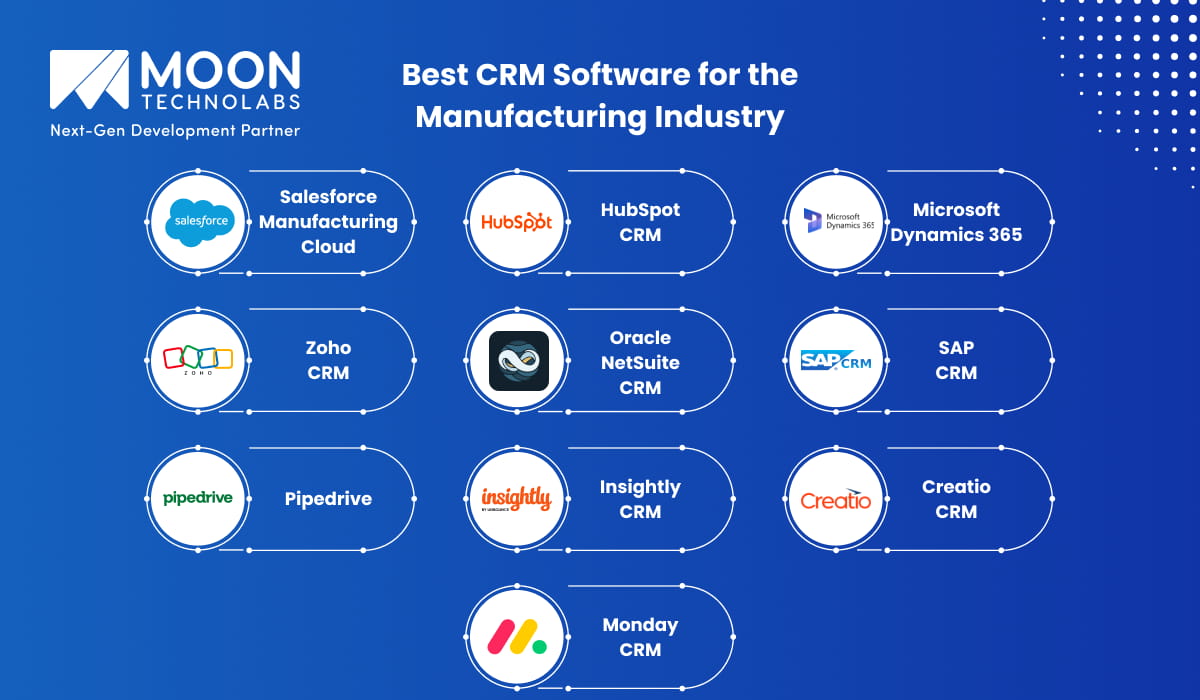
Manufacturing CRMs are designed to handle complex B2B sales cycles, distributor networks, inventory coordination, and after-sales service, helping businesses improve visibility and operational efficiency.
Below are the 10 best CRM software solutions for the manufacturing industry:
Salesforce Manufacturing Cloud
Best for large enterprises and complex operations
Salesforce Manufacturing Cloud is one of the most powerful CRMs tailored specifically for manufacturers. It connects sales, service, and operations across the entire value chain.
Key Features:
- Account-based forecasting and demand planning
- Partner and distributor management
- AI-powered insights and automation
- Seamless ERP integrations
It helps manufacturers reduce operational silos and improve forecasting accuracy while boosting ROI and productivity.
HubSpot CRM
Best for growing manufacturers and inbound marketing
HubSpot CRM is a user-friendly, scalable platform ideal for mid-sized manufacturers. It combines sales, marketing, and service tools into a single platform.
Key Features:
- Free CRM with powerful automation
- Lead tracking and pipeline management
- Marketing automation and email workflows
- Easy customization without coding
It’s particularly effective for managing long B2B sales cycles and centralizing customer data.
Microsoft Dynamics 365
Best for enterprises using the Microsoft ecosystem
Microsoft Dynamics 365 offers a robust combination of CRM and ERP capabilities, making it ideal for manufacturers needing deep operational integration.
Key Features:
- AI-driven analytics and insights
- Integration with Office 365 and Azure
- Supply chain and finance modules
- Custom workflows for manufacturing
Zoho CRM
Best for small to mid-sized manufacturers
Zoho CRM is a cost-effective, flexible solution with robust customization capabilities.
Key Features:
- Omnichannel communication
- Workflow automation
- Integration with Zoho inventory and finance tools
- AI assistant (Zia)
It’s especially popular among businesses looking for affordability without sacrificing functionality.
Oracle NetSuite CRM
Best for unified ERP + CRM solution
Oracle NetSuite CRM provides a fully integrated cloud-based suite combining CRM, ERP, and eCommerce.
Key Features:
- Real-time dashboards and reporting
- Order and inventory management
- Customer lifecycle tracking
- Global business support
Ideal for manufacturers needing a single system for all operations.
SAP CRM
Best for large-scale manufacturing enterprises
SAP CRM is designed for complex manufacturing environments with extensive operational requirements.
Key Features:
- Advanced analytics and reporting
- Strong integration with SAP ERP
- Customer service and support tools
- Scalable architecture
Pipedrive
Best for sales-focused manufacturing teams
Pipedrive is a simple yet powerful CRM focused on pipeline management and deal tracking.
Key Features:
- Visual sales pipelines
- Activity reminders and automation
- Easy-to-use interface
- Integration with third-party tools
Perfect for manufacturers prioritizing sales efficiency.
Insightly CRM
Best for project-based manufacturing businesses
Insightly CRM combines CRM with project management, making it ideal for manufacturers handling custom orders.
Key Features:
- Project and pipeline management
- Workflow automation
- Email marketing integration
- Relationship linking
Creatio CRM
Best for process automation and customization
Creatio CRM is known for its low-code platform, enabling manufacturers to easily customize workflows.
Key Features:
- No-code/low-code customization
- End-to-end process automation
- Sales, marketing, and service modules
- AI-driven insights
Monday CRM
Best for visual workflow management
Monday CRM (by Monday.com) offers a highly visual and customizable CRM experience.
Key Features:
- Drag-and-drop workflow builder
- Project and sales tracking
- Team collaboration tools
- Easy integrations
It’s ideal for teams that want flexibility and ease of use.
How to Choose the Right CRM for Manufacturing Business?
Choosing the right CRM for a manufacturing business isn’t about picking the most popular tool; it is about finding a system that fits your operations, sales cycle, and growth plans. Manufacturing requires features such as supply chain visibility and dealer management, so your CRM must go beyond basic contact management. Here is how to choose the right CRM for manufacturing:
Identify Business Requirements
Start by clearly defining what you need the CRM to accomplish. Are you looking to improve lead management, streamline distributor communication, manage inventory-linked sales, or optimize after-sales support?
Manufacturing companies often deal with long sales cycles and multiple stakeholders, so mapping automated workflows from inquiry through delivery and service is essential. Without this clarity, even the most advanced CRM will fall short.
Evaluate Scalability
Your CRM should grow with your business. As production expands, the customer base grows, and new markets open, your system must handle larger volumes of data and more complex business processes. Look for a CRM that supports customization, additional users, and modular features so you don’t outgrow it in a few years or face costly migrations later.
Check Integration Capabilities
Manufacturing businesses rely on multiple systems, such as ERP, inventory management, accounting, and supply chain tools. Your CRM should seamlessly integrate with these platforms to ensure smooth data flow and avoid silos.
For example, syncing CRM with ERP can provide real-time insights into stock levels, order status, and billing, improving both sales efficiency and customer satisfaction.
Consider Ease of Use
A powerful CRM is useless if your team doesn’t use it. Choose a platform with an intuitive interface and a minimal learning curve. Sales teams, production planners, and service staff should all be able to navigate it comfortably. Training time, user adoption, and ongoing support should all factor into your decision.
Analyze Pricing and ROI
Don’t just look at the upfront cost; consider the total cost of ownership, including implementation, customization, training, and maintenance. Compare this against the potential return on investment: increased sales efficiency, better customer retention, reduced manual work, and improved forecasting. A slightly higher investment can often deliver significantly better long-term value.
Future Trends of CRM in the Manufacturing Industry
Manufacturing CRM systems are evolving from basic data tools into intelligent, connected platforms that drive business growth. Here are several key trends shaping their future:
AI and Machine Learning Integration
AI and ML enable CRM systems to analyze data, predict demand, and automate tasks. Manufacturers can improve sales forecasting, identify high-value leads, and enhance decision-making while eliminating manual work.
Internet of Things (IoT) Connectivity
IoT in manufacturing enables CRM systems to collect real-time data from connected machines. This empowers manufacturers to track product performance, anticipate maintenance needs, and offer proactive customer service.
Unified CRM+ERP Platforms
Modern systems are combining CRM with ERP to create a single, integrated platform. This provides a complete view of sales, operations, and inventory, improving coordination and reducing data silos.
Hyper-Personalization and Analytics
Advanced analytics enable manufacturers to deliver personalized experiences based on customer data. This leads to better targeting, stronger relationships, and more effective decision-making.
Partner with us to implement a CRM that empowers your team, improves decision-making, and accelerates business growth.
Why Choose Moon Technolabs for CRM Development in Manufacturing?
Choose Moon Technolabs for manufacturing CRM development for its deep understanding of industry-specific processes, including supply chain management, production workflows, and distributor networks. Our customized CRM development solutions are tailored to how manufacturers operate, helping improve lead tracking, internal communication, and overall visibility across operations.
We also focus on scalability and seamless integration with existing systems, such as ERP and inventory tools. Our solutions support automation, real-time insights, and data-driven decisions, making it easier for manufacturing businesses to enhance operational efficiency and manage customer relationships effectively.
Conclusion
To stay ahead of the competition, manufacturing businesses need more than disconnected systems and manual workflows; modern CRM solutions act as central hubs that unify sales, production, inventory, and service teams while improving forecasting, customer relationships, and after-sales support.
When choosing the right CRM, it is essential to prioritize seamless integration, industry-specific capabilities, and scalability to match your operations and growth plans. Ultimately, the right investment helps streamline processes, reduce bottlenecks, and deliver better customer experiences, positioning manufacturers for long-term success in an increasingly competitive market.
FAQs
01
What are the 4 types of CRM systems?
CRM systems include four types: Operational CRM automates sales, marketing, and service processes. Analytical CRM analyzes customer data to provide insights and support decision-making. Collaborative CRM improves communication across departments. Strategic CRM focuses on long-term customer relationships, retention, and satisfaction by understanding customer needs and delivering personalized experiences to build loyalty and value.02
What are the 7 C's of CRM?
The 7 C’s of CRM are Customer, Content, Context, Communication, Consistency, Customization, and Convenience. These principles focus on understanding customer needs, delivering relevant information, maintaining clear communication, ensuring a consistent experience, personalizing interactions, and making services easy to access, helping businesses build strong, lasting, and effective customer relationships.03
Is SAP a CRM or ERP system?
SAP is primarily an ERP system designed to manage core business operations such as finance, procurement, and supply chain. However, it also offers CRM capabilities through solutions like SAP Customer Experience. This means SAP is mainly ERP-focused but includes integrated CRM tools that help businesses manage customer relationships alongside operational processes efficiently.04
Is Microsoft considered a CRM?
Microsoft itself is not a CRM, but it provides CRM solutions through Microsoft Dynamics 365. This platform offers tools for sales automation, marketing, customer service, and relationship management. It is widely used by businesses to manage customer interactions and data. Therefore, Microsoft is considered a CRM provider due to its comprehensive Dynamics 365 CRM applications.05
What are examples of CRM tools?
Salesforce, HubSpot CRM, Zoho CRM, Microsoft Dynamics 365, and SAP CRM are examples of CRM tools. These tools are used by businesses to manage customer interactions, store data, track sales activities, and improve customer service and engagement efficiently.




Jayanti Katariya is the CEO of Moon Technolabs, a fast-growing IT solutions provider, with 18+ years of experience in the industry. Passionate about developing creative apps from a young age, he pursued an engineering degree to further this interest. Under his leadership, Moon Technolabs has helped numerous brands establish their online presence and he has also launched an invoicing software that assists businesses to streamline their financial operations.
Submitting the form below will ensure a prompt response from us.
We refine our expertise to deliver innovative business solutions.




205 N Michigan Avenue, #810, Chicago, 60601, Illinois, United States
13500 Long Is Dr, Pflugerville, TX 78660, USA

C/105 Ganesh Meridian, S.G. Highway, Ahmedabad, GJ 380060


Ayse D.
Co-Founder France
“ I highly recommend Moon Technolabs as the quality of service is wonderful. We have hired this company to develop the product based on some complex & technical issues. We get the best quality services as compared with others in the market. Huge Thanks to Moon Technolabs as the team is always ready to give the solution all time.”

Justin G.
Founder & CEO USA
USA“ Moon Technolabs is a pioneer in the WebRTC based project as they have fixed complicated segments of the module by fulfilling different product lines by providing 24X7 customer support. We really recommended Moon Technolabs as they are able to develop products as per the module deadline and project timeline.”

Flavio S.
Founder & Managing Director Germany
“I am happy to recommend Moon Technolabs for their app development services. They successfully developed apps for me, and I am highly satisfied with the overall outcomes. The development team has swiftly addressed the issues with responsive and effective communication to understand the requirement quickly and actively resolve the back-and-forth problems that arose...”

Jay M.
Founder & CEOUSA“Moon Technolabs is the best company that provides advanced apps and websites development services in the USA and Europe. I am a newbie to develop my app with an external team. I am really happy to work with them as I am not that much mobile apps user. Here, the team and specially the CEO of Moon Technolabs helps me to let me know about the benefits of my app to generate revenue....”


Our Offices
India
C/105 Ganesh Meridian,S.G. Highway, Ahmedabad, GJ 380060USA
205 N Michigan Avenue, #810, Chicago, 60601, Illinois, United StatesContact Information


