


AI Proof of Concept (PoC): A Complete Guide to Validating AI Ideas

Artificial Intelligence Team
Last Updated: Sep 10, 2026 Total Views: 92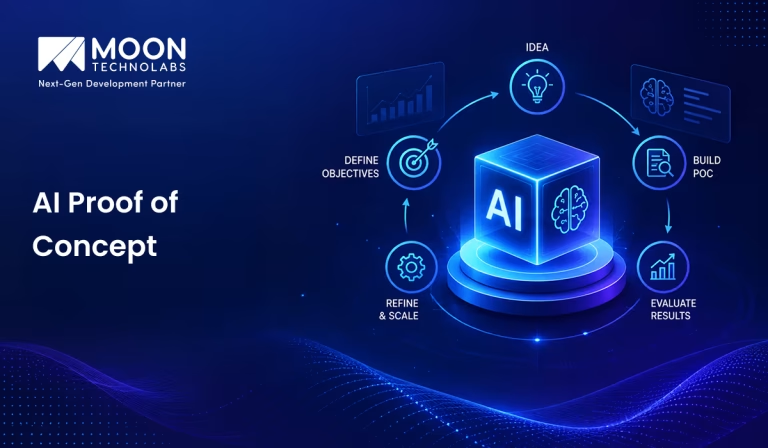
Table of Content


Blog Summary:
An AI Proof of Concept helps businesses validate AI ideas before investing in full-scale development. This guide explains how AI PoCs work, their benefits, popular use cases, development process, costs, and key considerations. Learn how to validate technical feasibility, measure business value, reduce development risks, and confidently move promising AI solutions from concept to production.
Table of Content
Have an AI idea but aren’t sure it will work? An AIProof of Concept (PoC) helps you test that idea before committing significant time and resources to full-scale development. It validates technical feasibility, performance, and potential business value in a controlled environment.
In this guide, we’ll cover what an AI PoC is, why it matters, common use cases, development steps, costs, and how to move a successful PoC toward production.
What is an AI Proof of Concept?
An AI Proof of Concept is a small, focused implementation that tests whether an AI idea can solve a specific business problem. Instead of building a full product, teams use real or representative data to validate the approach, model performance, and expected outcomes.
A good AI PoC answers practical questions early: Can the model produce reliable results? Does it integrate with existing systems? How much manual work can it reduce? For example, a company might build a PoC that extracts key information from invoices before investing in a complete accounts-payable automation platform
The goal is not to create a production-ready AI solution. It reduces technical and business uncertainty before you commit significant time and budget. A successful PoC provides enough evidence to decide whether to move the idea to a pilot, redesign it, or drop it.
Why is an AI Proof of Concept Important?
Before investing heavily in an AI solution, businesses need to know whether the idea will work in a real-world setting and deliver measurable value. Here’s why an AI PoC is important:
Validate Technical Feasibility
An AI PoC tests whether the proposed solution can actually work with the available technology, data, systems, and infrastructure. It helps confirm that the desired outcomes are achievable before moving into full-scale development.
Test Business Value
A PoC demonstrates whether AI can solve the intended business problem and deliver measurable benefits. Organizations can evaluate improvements in efficiency, accuracy, customer experience, revenue, or cost savings.
Reduce AI Development Risks
AI projects can involve technical, operational, and financial uncertainties. An AI PoC allows teams to identify potential issues early, test assumptions, and make necessary adjustments before committing to a full-scale implementation.
Estimate Cost and Resource Requirements
By building a small-scale solution, organizations can better understand the infrastructure, technology, talent, data, and development effort required. This helps create more realistic budgets and project timelines.
Gain Stakeholder Confidence
A working prototype provides stakeholders with tangible evidence of what the AI solution can achieve. Demonstrating real results can help secure leadership support, funding, and organizational buy-in.
Identify Data and Integration Challenges Early
A successful AI PoC can reveal issues such as incomplete or inconsistent data, access limitations, security requirements, API constraints, and system compatibility before they become costly problems. This is particularly important when planning for AI integration with existing enterprise systems and workflows.
Don’t Scale An AI Idea You Haven’t Tested
Build a focused PoC to challenge assumptions, evaluate outcomes, and determine whether your AI idea deserves investment.
When Should Businesses Build an AI Proof of Concept?
Not every AI idea needs a Proof of Concept, but testing early can make a big difference when the technology, use case, or expected outcomes are still uncertain. Here’s when businesses should build an AI PoC:
Before Making a Large AI Investment
An AI PoC allows businesses to test an idea on a small scale before investing heavily in technology, infrastructure, talent, or implementation. It helps identify potential challenges early and supports more confident investment decisions.
When Testing a New AI Use Case
If a business is exploring applications such as AI-powered customer support, automation, predictive analytics, or content generation, a PoC can demonstrate whether the proposed use case works effectively in a real-world scenario.
When Data Feasibility Is Uncertain
AI solutions depend heavily on data availability, quality, and accessibility. A PoC can help businesses determine whether their existing data is sufficient, reliable, and suitable for training or running an AI system.
Before Integrating AI Into Existing Systems
Integrating AI with existing software, databases, workflows, or business processes can introduce technical challenges. A PoC helps validate compatibility and identify integration issues before full-scale deployment.
When Evaluating AI Models and Technologies
Businesses may need to compare different AI models, platforms, or technologies. A PoC provides a practical way to evaluate accuracy, performance, scalability, cost, and usability against specific business requirements.
AI Proof of Concept Development Process: 7 Essential Steps
Developing an AI PoC requires a structured approach to determine whether an AI solution is technically feasible and can deliver measurable business value. Here are seven essential steps involved in the AI PoC development process:
Step 1: Define the Business Problem
Start by clearly identifying the business challenge you want AI to solve. Define the current process, key pain points, and expected business impact. A well-defined problem helps keep the PoC focused and aligned with real business needs.
Step 2: Establish PoC Goals and Success Criteria
Set clear objectives and measurable success criteria for the PoC. These may include accuracy, response time, cost reduction, automation rate, customer satisfaction, or productivity improvements. Clearly defined KPIs make it easier to determine whether the PoC has achieved its intended outcomes.
Step 3: Assess and Prepare the Required Data
Data is a critical component of any AI PoC. Identify the data sources required and evaluate their quality, availability, relevance, and volume. Clean, organize, and prepare the data before development to improve model performance and ensure reliable results.
Step 4: Select the Right AI Models and Technology Stack
Choose AI models, frameworks, APIs, cloud services, and development tools based on the specific requirements of the use case. Consider factors such as accuracy, scalability, cost, security, integration requirements, and development complexity.
Step 5: Build the AI Proof of Concept
Develop a focused prototype that demonstrates the core AI functionality. Integrate the selected model with the required data sources, applications, or workflows. The goal at this stage is not to build a production-ready system but to create a working solution that can effectively validate the concept.
Step 6: Test and Measure the Results
Test the PoC using relevant real-world scenarios and evaluate its performance against the predefined success criteria. Analyze factors such as accuracy, reliability, speed, user experience, and business impact. Testing helps identify technical limitations and areas that require improvement.
Step 7: Evaluate, Refine, and Plan for Production
Review the PoC results to determine whether the solution warrants further investment. Address identified issues, refine the AI solution, and estimate the resources required for production deployment. If the PoC shows sufficient value and feasibility, develop a roadmap to scale the solution securely and efficiently.
Key Components of a Successful AI Proof of Concept
A successful AI Proof of Concept needs more than a promising idea—it requires the right data, clear objectives, practical testing, and measurable outcomes. Here are the key components:
Clearly Defined Use Case
Start with a specific business problem and a clear objective. The use case should identify what the AI solution is expected to achieve, who will use it, and how it will improve the existing process. A focused use case makes the PoC easier to develop, evaluate, and demonstrate.
Quality and Relevant Data
Data is the foundation of any AI solution. The PoC should use accurate, relevant, representative, and sufficiently available data. Assess data quality early to identify missing values, inconsistencies, bias, duplication, or other issues that could affect AI performance.
Suitable AI Model
Selecting the right AI model or approach is critical. Choose the AI model based on business requirements, data type, expected accuracy, complexity, cost, and performance needs. The goal is not necessarily to use the most advanced model, but the one that best fits the specific use case.
Measurable Success Metrics
Define clear KPIs before starting the PoC. Metrics may include accuracy, response time, automation rate, cost reduction, productivity improvement, or user satisfaction. Measurable criteria make it possible to objectively determine whether the PoC has achieved its goals.
Scalable Technical Architecture
The PoC should be designed with future growth in mind. Although it is a small-scale implementation, its architecture should support integration with existing applications, APIs, cloud infrastructure, data pipelines, monitoring, and deployment requirements. This makes it easier to transition from PoC to production.
Security and Data Governance
AI solutions must protect sensitive information and comply with relevant policies and regulations. The PoC should consider data access controls, privacy, encryption, model security, auditability, and responsible AI practices from the beginning rather than treating them as later-stage requirements.
You May Also Like:
AI Adoption Framework: A Complete Guide for Enterprise AI Success
Popular AI Proof of Concept Use Cases
Organizations can use AI Proof of Concepts to validate business value, test technical feasibility, and identify automation opportunities before moving to full-scale implementation. Some of the most popular AI PoC use cases include:
Generative AI Assistants
Build intelligent AI assistants that can understand natural language, answer questions, summarize information, generate content, and help employees complete everyday tasks. For assistants that need to work with private or business-specific information, exploring RAG use cases can help identify suitable retrieval-based applications.
AI-powered Customer Support
Improve customer service with AI-powered chatbots and virtual agents that can handle common queries, provide instant responses, assist with troubleshooting, and route complex issues to human agents. A PoC can demonstrate improvements in response time, customer satisfaction, and support efficiency.
Businesses exploring this area can also learn more about AI in customer service and its practical applications. A PoC can demonstrate improvements in response time, customer satisfaction, and support efficiency.
Predictive Analytics
Use machine learning and AI to analyze historical data and predict future outcomes. Predictive analytics PoCs can help businesses identify customer churn, forecast sales, anticipate equipment failures, assess risks, and make more data-driven decisions.
Recommendation Systems
Create personalized recommendations based on customer behavior, preferences, purchase history, and other relevant data. Recommendation PoCs are commonly used for products, content, services, and personalized experiences to improve engagement and conversion.
Fraud Detection
Leverage AI to identify unusual patterns and potentially fraudulent transactions in real time. A fraud detection PoC can evaluate historical transaction data, detect anomalies, reduce false positives, and help organizations strengthen their risk management processes.
Computer Vision
Apply AI to images and video to automatically detect, classify, and analyze visual information. Computer vision PoCs can support quality inspection, object detection, security monitoring, inventory management, document analysis, and workplace safety.
Document Processing and Automation
Automate the extraction, classification, validation, and processing of information from invoices, contracts, forms, reports, and other documents. AI-powered document processing can reduce manual effort, improve accuracy, and accelerate document-heavy workflows.
Demand Forecasting
Use AI and machine learning to predict future demand based on historical sales, market trends, seasonality, pricing, and other business factors. Demand forecasting PoCs can help optimize inventory, reduce stockouts, minimize excess inventory, and improve supply-chain planning.
AI Proof of Concept Tech Stack
The technology choices behind an AI Proof of Concept can directly affect its accuracy, scalability, development speed, and overall feasibility. Here’s what the AI PoC tech stack typically includes:
AI and Machine Learning Models
AI/ML models form the core of the PoC. Depending on the use case, teams may use classification, prediction, recommendation, computer vision, natural language processing, or other machine learning models. Select the model based on factors such as accuracy, performance, complexity, and business requirements.
LLMs and Generative AI Platforms
For applications involving text generation, conversational AI, summarization, content creation, or intelligent assistants, teams can integrate Large Language Models (LLMs) and Generative AI platforms into the PoC. These platforms enable teams to quickly test AI-powered experiences and evaluate the quality and usefulness of generated outputs.
AI Development Frameworks
Development frameworks provide the tools required to build, train, test, and integrate AI solutions. Frameworks can simplify model development, data processing, experimentation, API integration, and application deployment, helping development teams accelerate the PoC lifecycle.
Vector Databases
Vector databases are particularly useful for generative AI applications that need to search and retrieve information based on semantic meaning. They store and retrieve vector embeddings, enabling semantic search, document retrieval, recommendation systems, and Retrieval-Augmented Generation (RAG).
Cloud AI Services
Cloud platforms provide access to computing infrastructure, AI APIs, model hosting, storage, databases, and other services required for AI development. Cloud AI services help organizations build PoCs faster while providing the flexibility to scale resources as the solution evolves.
How Much Does an AI Proof of Concept Cost?
The cost of an AI PoC typically depends on use-case complexity, data requirements, AI models, integrations, and development time. A simple PoC may require a smaller investment, while advanced solutions involving custom models, large datasets, or multiple integrations can cost significantly more.
For most businesses, an AI PoC can range from $5,000 to $50,000+, depending on the scope and technology involved. Generative AI assistants and document automation may be relatively straightforward, while computer vision, predictive analytics, and complex enterprise solutions often require more development and testing.
A PoC aims to validate feasibility and business value before a larger investment. By defining clear objectives, selecting the right technology, and limiting the initial scope, businesses can reduce costs and determine whether the solution is ready for full-scale development.
Make Your Next AI Move With Greater Certainty
We help you turn promising AI concepts into focused PoCs that reveal feasibility, value, and the path ahead.
How Moon Technolabs Helps Businesses Build AI Proofs of Concept?
We help businesses validate AI ideas by turning them into focused, working Proofs of Concept. We start by understanding the business objective, identifying the right AI use case, and selecting suitable models, technologies, and data. Rather than overbuilding, our team builds a practical prototype that demonstrates how the solution would perform in a real business environment.
Our approach to AI proofs of concept also considers integration, accuracy, scalability, security, and potential ROI from the beginning. Whether the goal is automating repetitive workflows, adding intelligent features to an existing product, or testing a new AI-driven application, we help businesses identify technical challenges early and decide whether to move from PoC to full-scale development.
Conclusion
An AI Proof of Concept helps businesses move from an idea to a validated AI solution with less risk and investment. By defining clear goals, using the right data and technology, and measuring real outcomes, organizations can identify what works before scaling.
If you’re planning an AI initiative, an experienced AI development company can help you build, test, and refine a PoC that aligns with your business goals and prepares your solution for production.
FAQs
01
What is an example of proof of concept?
An example of a PoC is developing a basic AI chatbot to determine whether a large language model can accurately answer customer questions using company data. The PoC focuses on technical feasibility, accuracy, and performance before investing in a complete, production-ready chatbot.02
What are the key steps involved in developing a PoC?
Key steps include defining the objective, setting success criteria, selecting the technology stack, building a minimum viable implementation, testing with relevant data, analyzing results, identifying limitations, and deciding whether the solution is ready for further development.03
Are POC and prototype the same?
No. A PoC validates whether an idea or technology is technically feasible, while a prototype demonstrates how a solution could look or function. A PoC answers “Can it work?”, whereas a prototype focuses on “How will it work?” or “What will it look like?”04
What are the five types of prototypes?
The five common types of prototypes are paper prototypes, low-fidelity prototypes, high-fidelity prototypes, functional prototypes, and evolutionary prototypes. They range from simple sketches and wireframes to working versions that improve through testing and user feedback.05
What technologies are commonly used for AI PoCs?
Common technologies for AI PoCs include Python, TensorFlow, PyTorch, scikit-learn, Hugging Face, OpenAI APIs, vector databases, and cloud AI platforms such as AWS, Microsoft Azure, and Google Cloud. Generative AI PoCs may also use LLMs, RAG, embeddings, vector search, and agent frameworks.



Explore the latest insights on Artificial Intelligence, including Generative AI, Agentic AI, natural language processing, computer vision, automation, and enterprise AI solutions. This category covers industry trends, practical applications, implementation strategies, and innovations that help businesses leverage AI for smarter decision-making and digital transformation. Stay updated with evolving AI technologies that are reshaping industries worldwide.
Submitting the form below will ensure a prompt response from us.
We refine our expertise to deliver innovative business solutions.




205 N Michigan Avenue, #810, Chicago, 60601, Illinois, United States
13500 Long Is Dr, Pflugerville, TX 78660, USA

C/105 Ganesh Meridian, S.G. Highway, Ahmedabad, GJ 380060


Ayse D.
Co-Founder France
“ I highly recommend Moon Technolabs as the quality of service is wonderful. We have hired this company to develop the product based on some complex & technical issues. We get the best quality services as compared with others in the market. Huge Thanks to Moon Technolabs as the team is always ready to give the solution all time.”

Justin G.
Founder & CEO USA
USA“ Moon Technolabs is a pioneer in the WebRTC based project as they have fixed complicated segments of the module by fulfilling different product lines by providing 24X7 customer support. We really recommended Moon Technolabs as they are able to develop products as per the module deadline and project timeline.”

Flavio S.
Founder & Managing Director Germany
“I am happy to recommend Moon Technolabs for their app development services. They successfully developed apps for me, and I am highly satisfied with the overall outcomes. The development team has swiftly addressed the issues with responsive and effective communication to understand the requirement quickly and actively resolve the back-and-forth problems that arose...”

Jay M.
Founder & CEOUSA“Moon Technolabs is the best company that provides advanced apps and websites development services in the USA and Europe. I am a newbie to develop my app with an external team. I am really happy to work with them as I am not that much mobile apps user. Here, the team and specially the CEO of Moon Technolabs helps me to let me know about the benefits of my app to generate revenue....”


Our Offices
India
C/105 Ganesh Meridian,S.G. Highway, Ahmedabad, GJ 380060USA
205 N Michigan Avenue, #810, Chicago, 60601, Illinois, United StatesContact Information


