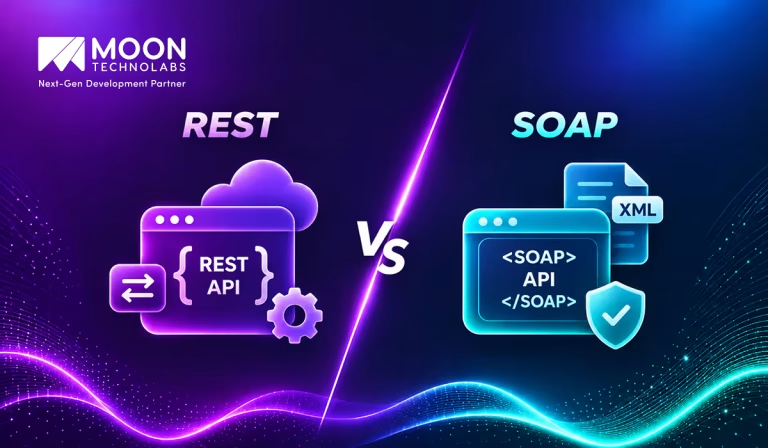
REST vs SOAP: Key Differences, Architecture, Benefits, and Use Cases

App Development Team
Last Updated: Nov 18, 2026 Total View: 84
REST or SOAP? Unsure Which API Fits Your Project?
If you’re stuck choosing between REST and SOAP for your application, differences in security, performance, and integration complexity can make the decision tricky. Get expert guidance before development.
- API architecture consultation
- Security & performance evaluation
- REST & SOAP integration support
- Scalable API development


APIs are essential in modern software development because they enable applications, services, and systems to share data. No matter whether one develops mobile applications, integrates payment gateways or works on enterprise solutions, proper use of APIs is a key factor.
Two widely used approaches to web service communication are REST (Representational State Transfer) and SOAP (Simple Object Access Protocol).
Representational State Transfer (REST) is an architectural model that is extensively employed for designing web APIs. SOAP is a protocol for exchanging structured information using standardized rules.
Although REST is widely used in web and mobile applications, SOAP remains important in enterprise environments that need formally defined service contracts, message-based security, and standardized transactions.
Understanding REST vs SOAP helps developers and businesses select an appropriate integration approach based on technical requirements rather than popularity alone.
This guide explains how REST and SOAP work, their features, advantages, limitations, performance differences, and practical use cases.
What is REST?
REST stands for Representational State Transfer. Roy Fielding introduced it as an architectural style in his 2000 doctoral dissertation.
REST defines principles for designing distributed systems in which clients interact with resources through standardized interfaces.
REST APIs commonly use HTTP methods such as GET, POST, PUT, PATCH, and DELETE to perform operations on resources.
Although REST does not require JSON, JSON is widely used because it is lightweight and supported across programming languages.
How Does REST Work?
REST APIs typically follow a client-server communication model.
A client sends an HTTP request to a resource identified by a URL. The server processes the request and returns a response containing data, an HTTP status code, and relevant headers.
For example, a client can request customer information using:
GET /api/customers/101 HTTP/1.1
Host: example.com
Accept: application/json
The server might return:
{
  "id": 101,
  "name": "John Smith",
  "email": "john@example.com"
}
The response represents the requested resource. Each request should contain the information needed for the server to process it.
Key Features of REST
REST provides architectural constraints that support scalable and maintainable systems.
- Stateless communication: Each request contains the information required to process it.
- Resource-based design: Resources are identified through URLs.
- Uniform interface: Consistent interaction rules simplify communication.
- Cacheability: Responses can specify whether and how they may be cached.
- Layered architecture: Clients can communicate through intermediaries such as gateways and proxies.
- Flexible representations: APIs can return JSON, XML, or other supported formats.
These characteristics make REST a practical choice for many modern web applications.
What is SOAP?
SOAP stands for Simple Object Access Protocol. It is an XML-based messaging protocol for exchanging structured information between applications.
SOAP defines a standardized message structure, processing rules, and fault-handling mechanisms.
Unlike REST, which is an architectural style, SOAP is a formal protocol with defined messaging requirements.
SOAP messages are commonly transported over HTTP or HTTPS, although other transport mechanisms are possible.
How Does SOAP Work?
SOAP communication involves sending XML messages between a client and a web service.
A SOAP message contains an envelope that identifies the message structure, an optional header, and a body containing the request or response data.
For example:
<?xml version="1.0" encoding="UTF-8"?>
<soap:Envelope
xmlns:soap="http://schemas.xmlsoap.org/soap/envelope/"
xmlns:m="https://example.com/customer">
<soap:Body>
<m:GetCustomer>
<m:CustomerId>101</m:CustomerId>
</m:GetCustomer>
</soap:Body>
</soap:Envelope>
The service processes the request and returns a corresponding SOAP response.
Many SOAP services use Web Services Description Language (WSDL) documents to describe available operations, message formats, and service endpoints.
Key Features of SOAP
SOAP provides a structured approach to service communication, particularly in complex enterprise environments.
- XML-based messaging: SOAP messages follow standardized XML structures.
- Formal service contracts: WSDL can define operations and data types.
- Extensible headers: SOAP headers can carry additional processing information.
- Standardized faults: SOAP defines mechanisms for communicating processing errors.
- Security extensions: WS-Security supports message-level security features.
- Enterprise interoperability: SOAP standards support integration across heterogeneous systems.
These features make SOAP suitable for environments requiring strict contracts and standardized messaging behavior.
Advantages of REST APIs
REST is widely used because it supports straightforward communication and integrates well with modern web technologies.
Lightweight Data Exchange
REST APIs frequently use JSON, reducing message complexity compared with verbose XML structures.
This can benefit mobile applications and services operating under bandwidth constraints.
Flexible Application Integration
REST APIs can connect websites, mobile applications, cloud platforms, and third-party services.
Their reliance on common HTTP conventions makes them accessible across many programming languages.
Scalable Architecture
Stateless interactions make it easier to distribute requests across multiple application servers.
REST also supports caching and layered infrastructure designs.
Easier Development and Testing
Developers can test REST APIs using tools such as Postman, curl, and automated API testing frameworks.
Readable endpoints and familiar HTTP methods simplify common development workflows.
Limitations of REST APIs
Despite its flexibility, REST is not ideal for every integration requirement.
REST does not prescribe one mandatory security framework, transaction protocol, or service contract format.
Developers must select appropriate solutions for authentication, authorization, validation, and reliability.
Poorly designed REST APIs may also suffer from inconsistent resource structures, excessive requests, and unclear error responses.
Additionally, stateless communication requires applications to manage conversational workflows without relying on hidden server-side session context.
Advantages of SOAP APIs
SOAP remains useful for organizations that require standardized communication and formal integration contracts.
Standardized Messaging
SOAP defines a consistent XML message structure, reducing ambiguity in how requests and responses are processed.
Strong Contract Support
WSDL documents can describe service operations, data types, and communication requirements. This supports contract-driven development and integration with enterprise systems.
Message-level Security
WS-Security provides mechanisms for protecting SOAP messages through digital signatures, encryption, and security tokens. These capabilities can be valuable in distributed enterprise environments.
Enterprise Transaction Support
Specifications such as WS-AtomicTransaction can support coordinated transactional behavior when participating systems implement them.
This makes SOAP relevant to certain complex business workflows.
Limitations of SOAP APIs
SOAP introduces additional complexity compared with many lightweight REST implementations.
Its XML message format can increase payload size and processing requirements.
Developers may also need specialized tooling to manage WSDL contracts, schemas, and security extensions.
SOAP integrations can require more configuration, especially when working with advanced enterprise standards.
For simple mobile or public-facing APIs, this complexity may provide little practical benefit.
REST vs SOAP: Practical API Examples
Understanding how both approaches represent the same operation helps clarify their differences.
Consider an application that retrieves customer information.
REST API Example
A REST API might use an HTTP GET request:
GET /customers/101 HTTP/1.1
Host: api.example.com
Accept: application/json
Example response:
{
"customerId": 101,
"customerName": "John Smith",
"status": "active"
}
The resource URL identifies the customer, and the HTTP method describes the requested action.
SOAP API Example
A SOAP service might expose a GetCustomer operation:
<soap:Envelope
xmlns:soap="http://schemas.xmlsoap.org/soap/envelope/"
xmlns:c="https://example.com/customer">
<soap:Body>
<c:GetCustomer>
<c:CustomerId>101</c:CustomerId>
</c:GetCustomer>
</soap:Body>
</soap:Envelope>
The SOAP message explicitly identifies the operation and its parameters.
Both approaches can retrieve the same information, but they organize communication differently.
When Should You Use REST?
REST is generally suitable for applications that require lightweight communication, flexible integrations, and scalable API architectures.
Web and Mobile Applications
REST APIs commonly connect frontend interfaces with backend services. Their support for JSON and HTTP makes them practical for mobile and browser-based applications.
Microservices Architecture
REST is frequently used for communication between independently deployed services. For more information about distributed service design, explore microservices best practices.
Cloud-based Applications
Cloud platforms often expose REST APIs to manage resources, integrate services, and automate infrastructure workflows.
Public APIs and Third-party Integrations
REST is widely used for developer-facing APIs because of its familiar HTTP conventions and broad tooling support.
When Should You Use SOAP?
SOAP is appropriate when integration requirements emphasize standardized contracts, message-level security, or compatibility with existing enterprise systems.
Banking and Financial Systems
Some financial integrations use SOAP because of established service contracts and requirements for secure, structured messaging. However, financial applications also widely use REST APIs.
Healthcare Integrations
SOAP may be used in healthcare environments where existing systems rely on formal XML contracts and enterprise messaging standards. The appropriate protocol depends on the integration specification and regulatory requirements.
Enterprise Resource Planning
Some ERP and enterprise applications expose SOAP services for business operations and integration with existing infrastructure.
Legacy System Integration
SOAP is often necessary when connecting to established systems whose supported interfaces are defined through WSDL. Replacing these interfaces may be impractical without broader application modernization.
Can REST and SOAP Work Together?
Yes. REST and SOAP services can coexist within the same software architecture.
For example, a modern mobile application may communicate with a REST API, while the backend integrates with an existing SOAP-based enterprise service.
An API gateway or integration layer can translate requests and responses between the two approaches.
However, translation requires careful handling of data formats, authentication, error messages, and transaction behavior.
This hybrid approach allows organizations to modernize applications without immediately replacing every legacy integration.
REST vs SOAP: Which is Better for Your Project?
Neither REST nor SOAP is universally better.
REST is often the practical choice for new web applications, mobile platforms, and cloud-based services that benefit from lightweight communication.
SOAP remains valuable when applications require established XML contracts, message-level security standards, or compatibility with existing enterprise infrastructure.
Before selecting an approach, evaluate performance expectations, security requirements, development resources, integration dependencies, and long-term maintenance.
Choose the option that best supports your application’s functional and operational requirements.
How Moon Technolabs Helps With REST and SOAP API Development
Moon Technolabs provides custom software development and API integration services to help businesses connect applications, streamline data exchange, and modernize existing systems. Our development teams can help design REST APIs, integrate SOAP-based enterprise services, implement secure communication, and build scalable backend architectures tailored to business requirements.
Whether you are developing an application from scratch, adding third-party platforms to your software, or integrating a modern system with an older one, we will help you assess the right API architecture and integration strategy. Our goal is to provide a sustainable solution.
Conclusion
The REST vs SOAP comparison highlights two different approaches to application communication.
REST is an architectural style that emphasizes resource-based interactions, stateless communication, and flexible data representations. It is commonly used for web applications, mobile platforms, microservices, and cloud integrations.
SOAP is an XML-based messaging protocol that provides standardized message structures, formal service contracts, and support for enterprise security and transaction specifications.
REST is often preferable for lightweight, modern APIs, while SOAP remains relevant for complex enterprise integrations and established systems.
Ultimately, choosing between REST and SOAP requires evaluating security, performance, compatibility, scalability, and maintenance needs, not assuming one approach fits every application.

Stay updated with the latest trends, frameworks, and best practices in mobile app development. From Android and iOS to cross-platform technologies, this category explores development strategies, app architecture, performance optimization, and user experience to help build scalable mobile applications. Find valuable insights that support successful mobile app development from idea to deployment.
Get in Touch With Us
Submitting the form below will ensure a prompt response from us.