Ruby vs Python: Key Differences, Features, Performance, and Use Cases

Trending Technologies
Last Updated: Nov 04, 2026 Total View: 98
Can’t Decide Between Ruby and Python for Your Project?
Choosing Ruby or Python for your next application? If framework selection, development speed, or long-term scalability is holding you back, get expert guidance to choose the right technology.
- Language & framework selection
- Performance & scalability analysis
- Development cost evaluation
- Project architecture planning


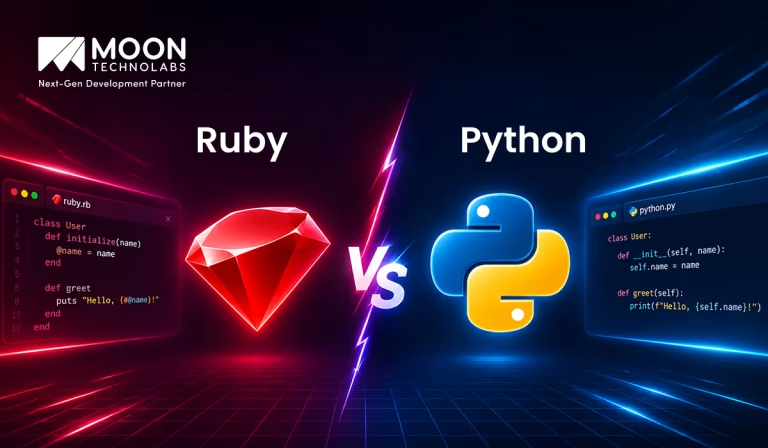
Choosing the right programming language matters when developing web applications, automation tools, enterprise software, or data-driven solutions. Two popular options are Ruby and Python, both known for their readable syntax, developer-friendly features, and extensive ecosystems.
However, when comparing Ruby vs Python, developers often wonder which language offers better performance, easier development, stronger frameworks, and greater flexibility for modern applications.
Ruby is widely recognized for its elegant syntax and the Ruby on Rails framework, which simplifies web application development. Python, on the other hand, is extensively used in web development, artificial intelligence, machine learning, data analytics, and automation.
Although both languages support object-oriented programming and rapid development, they differ in their design philosophies, libraries, performance characteristics, and typical applications.
This guide explores the differences between Ruby and Python, including their features, advantages, limitations, practical examples, and factors to consider when selecting a language for your next project.
What is Ruby?
Ruby is a high-level, interpreted programming language created by Yukihiro Matsumoto and first publicly released in 1995. It was designed to make programming productive and enjoyable while keeping code readable and expressive.
Ruby follows an object-oriented approach in which values such as numbers, strings, and collections are objects.
Its flexible syntax lets developers express complex operations in relatively concise code.
Ruby gained significant popularity through Ruby on Rails, a web application framework that provides conventions and built-in tools for developing database-backed applications.
Key Features of Ruby
Ruby offers several features that simplify application development.
- Object-oriented programming: Ruby treats values as objects and supports classes, inheritance, and modules.
- Expressive syntax: Developers can write readable code with relatively little boilerplate.
- Dynamic typing: Variable types are determined during program execution.
- Metaprogramming: Ruby allows programs to define and modify behavior dynamically.
- Ruby on Rails: The framework accelerates development of conventional web applications.
Ruby is particularly suitable for web platforms, business applications, and projects where developer productivity is a priority.
What is Python?
Python is a high-level, general-purpose programming language created by Guido van Rossum and first released in 1991.
It emphasizes readability, simplicity, and maintainability, making it accessible to beginners while remaining powerful enough for complex software development.
Python supports multiple programming paradigms, including object-oriented, procedural, and functional programming.
Its extensive standard library and third-party ecosystem make it useful across many industries.
Python is commonly used for backend development, automation, artificial intelligence, machine learning, scientific computing, and data analysis.
Key Features of Python
Python provides several capabilities that support diverse development requirements.
- Readable syntax: Its indentation-based structure encourages consistent formatting.
- Extensive libraries: Python supports development through packages such as NumPy, Pandas, and Requests.
- Multiple programming paradigms: Developers can combine object-oriented, procedural, and functional approaches.
- Cross-platform compatibility: Python applications can run on Windows, Linux, and macOS.
- AI and data science ecosystem: Frameworks such as PyTorch and TensorFlow support machine learning development.
Python’s versatility makes it a strong option for businesses developing applications that involve automation, analytics, or AI capabilities.
Ruby vs Python: Key Differences at a Glance
Although Ruby and Python share several characteristics, their development approaches and ecosystems differ.
| Parameter | Ruby | Python |
|---|---|---|
| First released | 1995 | 1991 |
| Creator | Yukihiro Matsumoto | Guido van Rossum |
| Primary philosophy | Developer happiness and expressiveness | Readability and simplicity |
| Typing | Dynamic | Dynamic |
| Programming paradigms | Primarily object-oriented, with other styles supported | Object-oriented, procedural, functional |
| Popular web frameworks | Ruby on Rails, Sinatra, Hanami | Django, Flask, FastAPI |
| AI and machine learning | Smaller ecosystem | Extensive ecosystem |
| Data analysis | Available libraries, smaller ecosystem | NumPy, Pandas, SciPy |
| Automation | Suitable for scripting | Widely used for scripting |
| Package manager | RubyGems/Bundler | pip and other Python tools |
| Common applications | Web platforms, SaaS, business applications | Web apps, AI, automation, data analytics |
The right choice depends on the project’s requirements rather than one language being universally superior.
Ruby vs Python: Syntax and Code Readability
Both languages prioritize readable code, but they use different syntax conventions.
Ruby allows developers to write expressive statements and often provides multiple ways to perform the same operation.
Python emphasizes consistency through indentation and a relatively uniform coding style.
Ruby Code Example
def greet(name)
puts "Hello, #{name}!"
end
greet("John")
Output:
Hello, John!
Python Code Example
def greet(name):
print(f"Hello, {name}!")
greet("John")
Output:
Hello, John!
Both examples produce the same result.
Ruby uses the end keyword to close method definitions, while Python uses indentation to define code blocks.
Python’s formatting conventions can make large codebases easier to read consistently. Ruby’s expressive style offers flexibility that experienced developers may appreciate.
Ruby vs. Python: Performance and Execution Speed
Performance is an important consideration when comparing programming languages, particularly for applications handling large workloads.
Ruby and Python are generally executed through virtual machines or interpreters rather than compiled directly into standalone native machine code in their most common implementations.
Ruby’s default implementation is CRuby, while Python commonly uses CPython.
Actual execution speed depends on the runtime version, application architecture, libraries, workload, and optimization techniques.
Ruby Performance
Ruby performs well for many web applications and business systems.
Ruby’s YJIT compiler can improve performance for supported workloads by compiling frequently executed code paths.
However, performance-sensitive operations may still require careful optimization.
Python Performance
Python is effective for backend applications, automation, and data processing.
Although ordinary Python loops may be slower than optimized native implementations, libraries such as NumPy execute many computational operations using compiled code.
This makes Python especially useful for scientific and numerical workloads.
Which is faster?
Neither language is consistently faster across every workload. Developers should benchmark representative application tasks before making performance-based decisions.
Ruby vs Python for Web Development
Both languages provide mature frameworks for building web applications, APIs, and backend services.
Ruby for Web Development
Ruby on Rails is Ruby’s best-known framework.
It follows conventions that simplify common development tasks such as database management, routing, authentication integration, and application structure.
Rails also provides Active Record, a database abstraction layer that helps developers interact with relational databases.
Ruby is particularly suitable for conventional database-backed applications and rapid product development.
Python for Web Development
Python supports several frameworks designed for different application requirements.
Django provides a comprehensive framework with built-in administrative interfaces, database tools, and security features.
Flask offers a lightweight approach for developers who prefer to select individual application components.
FastAPI is commonly used for building APIs with type-hint-based validation and automatic API documentation.
Python provides flexibility when building web applications that may later integrate AI, analytics, or automation capabilities.
Ruby vs Python for Automation and Scripting
Both Ruby and Python can automate repetitive tasks and simplify system administration.
Ruby supports file handling, command execution, data processing, and scripting.
Python is widely used for workflow automation, web scraping, report generation, API integration, and infrastructure management.
Python Automation Example
The following script renames a file using Python:
from pathlib import Path
old_file = Path("report.txt")
new_file = Path("monthly_report.txt")
if old_file.exists():
old_file.rename(new_file)
print("File renamed successfully")
else:
print("File not found")
Python’s standard library makes many common automation tasks straightforward.
Ruby can perform similar operations, but Python often has more specialized tools available for data-intensive and AI-related automation.
Advantages and Disadvantages of Ruby and Python
Both languages offer benefits and trade-offs.
Advantages of Ruby
Ruby provides expressive syntax, strong object-oriented features, and productive web development through Rails.
Its conventions can reduce repetitive development work for conventional applications.
Limitations of Ruby
Ruby has a smaller ecosystem for scientific computing and machine learning.
Its flexibility can also make code harder to understand when teams use inconsistent conventions.
Advantages of Python
Python offers readable syntax, extensive libraries, strong community support, and versatility across different technology domains.
It is especially suitable for automation, AI, data analysis, and backend development.
Limitations of Python
Python may require additional optimization for CPU-intensive tasks.
Dynamic typing can also allow certain type-related errors to remain undetected until execution unless developers use testing and static analysis tools.
When Should You Choose Ruby?
Ruby is worth considering when building web applications that benefit from Rails conventions and its established ecosystem.
It can be a suitable choice for SaaS platforms, database-driven websites, administrative systems, and business applications.
Ruby may also be preferable when an organization already has an experienced Ruby development team or an existing Rails codebase.
Choosing a language that aligns with current technical expertise can reduce development and maintenance complexity.
When Should You Choose Python?
Python is particularly suitable when projects involve artificial intelligence, machine learning, automation, data analysis, or API development.
It is also useful for businesses developing applications that require integration with data processing systems.
Python can be a strong choice for backend services, analytics platforms, AI-powered tools, and automated business workflows.
Its extensive ecosystem helps developers connect different technologies without switching programming languages for every task.
How Moon Technolabs Helps With Python Development
Moon Technolabs provides Python development services to help businesses build scalable, secure, and high-performing applications. Our experienced developers specialize in custom software development, backend solutions, API integrations, and AI-powered applications tailored to specific business requirements.
Whether you’re developing a new application, modernizing an existing system, or integrating artificial intelligence and automation, Moon Technolabs helps you choose the right technologies and build reliable solutions. Our team delivers maintainable, efficient, future-ready Python applications that support long-term business growth.
Conclusion
The Ruby vs Python comparison highlights two powerful programming languages with different strengths and development ecosystems.
Ruby is particularly effective for web application development, especially when using Ruby on Rails. Its expressive syntax and framework conventions can help teams build conventional applications efficiently.
Python offers broader capabilities across web development, artificial intelligence, machine learning, automation, and data analysis.
For projects focused on Rails-based web development, Ruby remains a practical option. For applications involving AI, data processing, or diverse integrations, Python often provides greater flexibility.
Ultimately, the best programming language depends on your project’s technical requirements, available development expertise, long-term maintenance needs, and business goals.


Stay ahead with insights into the latest technology trends shaping the future of digital innovation. From AI and blockchain to cloud computing, cybersecurity, IoT, and emerging software technologies, discover what's driving business transformation across industries. Follow this category to stay informed about the innovations defining tomorrow's digital landscape.
Get in Touch With Us
Submitting the form below will ensure a prompt response from us.