What is Recall in Machine Learning?

Marketing Team
Last Updated: Aug 28, 2025 Total View: 599
Get in Touch With Us
Submitting the form below will ensure a prompt response from us.


In the world of machine learning, especially in classification problems, evaluating a model’s performance is just as important as building the model itself. Accuracy alone cannot always provide a complete picture, particularly when dealing with imbalanced datasets. That’s where evaluation metrics such as precision, recall, and F1-score come into play. What is Recall in Machine Learning? It’s a metric that focuses on how well a model can identify positive instances, making it particularly useful in cases where false negatives are costly.
This article will focus on Recall in Machine Learning, what it is, why it matters, how it is calculated, and how you can implement it in Python.
What is Recall in Machine Learning?
Recall (also known as Sensitivity or True Positive Rate) measures how well a model can identify positive cases out of all actual positive cases in a dataset.
In simpler terms, recall answers the question:
👉 Out of all the actual positive cases, how many did the model correctly identify?
It is particularly useful in scenarios where missing positive cases can be very costly, such as:
- Detecting cancer in medical diagnosis
- Identifying fraudulent transactions
- Spam email filtering
Recall Formula
The mathematical formula for recall is:

Where:
- True Positives (TP): Correctly predicted positive cases.
- False Negatives (FN): Actual positive cases that were incorrectly predicted as negative.
A higher recall means the model is successfully capturing more positive cases.
Recall in a Confusion Matrix
To better understand recall, let’s consider the confusion matrix of a binary classification model:
| Predicted Positive | Predicted Negative | |
|---|---|---|
| Actual Positive | True Positive (TP) | False Negative (FN) |
| Actual Negative | False Positive (FP) | True Negative (TN) |
- Recall focuses only on Actual Positive cases (TP + FN).
- It calculates how many of them are captured as True Positives.
Example: Medical Diagnosis
Imagine a model designed to predict whether a patient has a particular disease:
- If the model predicts a sick patient as healthy, that’s a False Negative (FN), which can be very dangerous.
- To avoid this, we need a high recall score so that most actual patients are detected.
Let’s say we are building a medical model to detect diabetes.
- 100 patients are tested.
- 40 patients actually have diabetes (positive cases).
- Our model predicts 35 patients as positive, but only 30 are correct.
Here’s the confusion matrix breakdown:
- TP = 30 (correctly predicted diabetics)
- FN = 10 (diabetics incorrectly predicted as healthy)
- FP = 5 (healthy predicted as diabetics)
- TN = 55 (healthy predicted as healthy)

So, the recall is 75%. This means the model detects 75% of all diabetic patients, but misses 25%.
Python Example: Calculating Recall
Let’s see how to compute recall using Python and scikit-learn:
from sklearn.metrics import recall_score

# Actual labels
y_true = [1, 0, 1, 1, 0, 1, 0, 0, 1, 1]

# Predicted labels
y_pred = [1, 0, 1, 0, 0, 1, 0, 1, 1, 0]

# Calculate Recall
recall = recall_score(y_true, y_pred)

print("Recall Score:", recall)
Output:
Recall Score: 0.7142857142857143
Here, the recall is approximately 71.4%, meaning the model correctly identified about 71% of all actual positive cases.
Recall vs Precision
Recall is often compared with Precision, which focuses on the correctness of positive predictions.
- Precision = Out of all predicted positive cases, how many are actually positive.
- Recall = Out of all actual positive cases, how many are captured.
👉 In applications like spam detection, precision is more important (you don’t want to mark genuine emails as spam).
👉 In medical diagnosis, recall is more important (better to flag more patients than to miss one).
Balancing Recall with F1 Score
Sometimes, focusing solely on recall can result in a high number of False Positives. To balance both Precision and Recall, we use the F1-Score, which is the harmonic mean of the two.
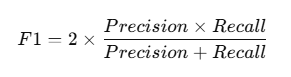
This ensures the model does not overly sacrifice precision for recall.
When to Prioritize Recall?
Recall becomes the top priority in scenarios where missing a positive instance has severe consequences. Examples include:
- Healthcare: Detecting diseases early.
- Finance: Identifying fraudulent transactions.
- Security: Detecting intrusions or suspicious activity.
In such use cases, recall ensures we minimize False Negatives, even if it means slightly increasing False Positives.
Master Key Metrics Like Recall in Machine Learning
Precision, recall, and F1 score are critical for accurate AI models. Let our experts help you apply the right metrics to improve your machine learning projects.
Conclusion
Recall in machine learning is a critical metric that measures how effectively a model can detect positive cases among all actual positives. It plays a key role in domains where missing positive outcomes is risky or costly.
By understanding recall, how it’s calculated, and how to implement it in Python, data scientists and machine learning engineers can make better decisions when building and evaluating models.
👉 Remember: A good machine learning evaluation doesn’t rely on a single metric—recall should be analyzed alongside precision, accuracy, and F1-score to gain a complete understanding of model performance.


Jayanti Katariya is the CEO of Moon Technolabs, a fast-growing IT solutions provider, with 18+ years of experience in the industry. Passionate about developing creative apps from a young age, he pursued an engineering degree to further this interest. Under his leadership, Moon Technolabs has helped numerous brands establish their online presence and he has also launched an invoicing software that assists businesses to streamline their financial operations.
Get in Touch With Us
Submitting the form below will ensure a prompt response from us.