


White Label App Development: The Complete Guide [2026]

Jayanti Katariya
Last Updated: Jun 10, 2026 Total Views: 706
Table of Content


Blog Summary:
The guide describes about white-label app development that helps you launch your app fast, scale, and minimize costs. It also covers detailed information regarding features, use cases, launching steps, and more. .
Table of Content
White label app development is a business model where companies purchase pre-built, fully functional applications and rebrand them as their own — launching in weeks instead of months, at 60–70% lower cost than custom development. With the global white label market projected to exceed $335 billion by 2026, this approach has become the go-to strategy for startups, agencies, and enterprises looking to enter the app market quickly.
So, you already have an app idea, targeted customers, and validated market demand. But the development process takes several months. It means that your competitors will already grab the market by the time your app gets developed and launched. Well, this is a common challenge that the majority of businesses come across.
So, what’s the solution to get rid of this scenario? You can opt for white label app development to avoid this challenge. It prevents you from building your app from scratch. You can launch feature-rich and branded apps with the use of scalable and pre-built frameworks, which leads to fast, lower-risk launch, and quick ROI.
In this guide, we will take a look at how white label app development is carried out, along with its real benefits, cost breakdown, challenges, and how to choose the right development partner.
What is White Label App Development?
White label app development is a process where a third-party provider builds a ready-made application that businesses can rebrand, customize, and launch under their own brand name — without writing a single line of code from scratch. Think of it as purchasing a fully built house and repainting it with your colors, logo, and furniture.
Also known as a ready-made app solution, white-label app development gives businesses the liberty to customize, rebrand, and launch their app even without creating it from scratch. In this, app developers use pre-developed architecture, functionality, and features.
They also implement various branding elements such as colors, UI, logos, and features. These are tailored to match the identity of a particular business. It helps businesses develop the app with minimized cost and launch it fast. It thus helps them focus on growth and user acquisition rather than any lengthy development cycles.
According to recent industry data, 88% of smartphone users spend their time in apps, making mobile presence non-negotiable. White label solutions enable businesses to tap into this market without the heavy investment of custom software development.
White Label App Examples That Work
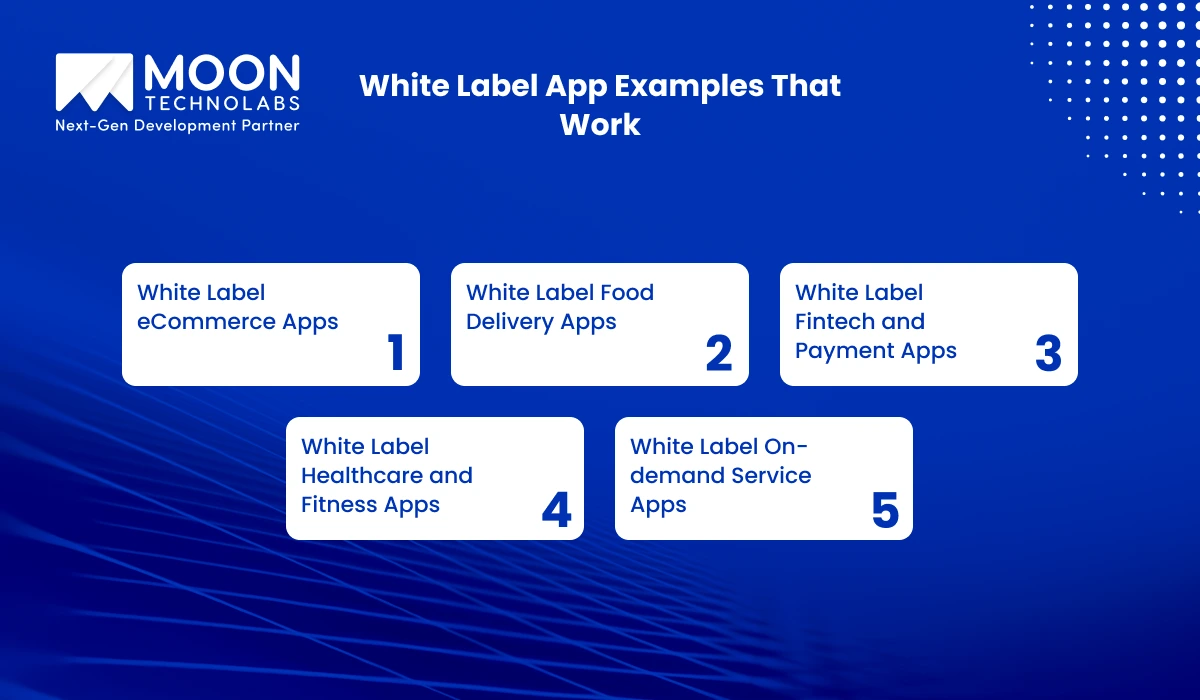
Companies from many industries have already adopted white-label apps that deliver value and outstanding outcomes. Let’s discuss some of the most popular examples:
White Label eCommerce Apps
With white-label e-commerce apps, retailers find the possibility to launch their online stores with less development effort, yet fully functional. It allows them to customize UI, branding, and interactions while scaling smoothly with their increasing demand.
This model is appropriate and the most effective for both traditional retailers and startups. White-label e-commerce apps are available with the following features:
- Secure payment gateways
- Product catalogs
- Inventory management
- Order management
- Customer account
Platforms like Shopify and BigCommerce have popularized this model, enabling thousands of businesses to launch eCommerce applications under their own brand.
White Label Food Delivery Apps
Food delivery is another popular example of white label app, which witnessed its surging demand among cloud kitchens, restaurants, local aggregators, and more. These apps let businesses focus on both operations and partnerships while supporting high order volumes. White label food delivery apps boast the following features:
- Real-time delivery tracking
- Online ordering
- Loyalty programs
- In-app payments
The on-demand food delivery market is projected to reach $320 billion by 2029, making white label food delivery app development a highly profitable investment.
White Label Fintech and Payment Apps
A large number of fintech companies nowadays rely on white label software development for various reasons, be it launching their digital wallets, lending platforms, payment gateways, or expense management tools fast.
It helps businesses get benefits from minimized risk, fast regulatory alignment, and the ability to scale their services with increased transaction volumes. These apps are available with the following features:
- Compliance-ready frameworks (PCI-DSS, GDPR, SOC 2)
- Built-in security with end-to-end encryption
- Multi-currency and multi-language support
- Integration capability with banking APIs
White Label Healthcare and Fitness Apps
Whether it’s wellness brands, healthcare providers, or fitness startups, they also leverage a white-label app. They use this app for various purposes such as offering teleconsultation, appointment booking, medication reminders, or workout tracking.
These apps follow regulatory compliance (including HIPAA for US healthcare) and secure data privacy, and thus are an apt choice for a regulated environment. White-label healthcare and fitness apps are available with the following important features:
- Appointment management
- Wearable device integration
- Virtual coaching and teleconsultation
- Brand customization
- Analytics and reporting
White Label On-demand Service Apps
On-demand service apps are necessary for many businesses, such as beauty and salon, logistics, home services, maintenance, and others. They support real-time tracking, provider management, service booking, digital payments, and more.
White-label models are useful for businesses to expand into new locations even without the redevelopment of the app infrastructure. This app includes the following features:
- Multi-service support
- Real-time booking
- In-app payment
- User, provider, and admin panel
White Label vs Custom App Development
One of the most important decisions businesses face is choosing between white label and custom app development. Here is a detailed comparison to help you choose the right approach:
| Factor | White Label App | Custom App |
|---|---|---|
| Development Time | 2 to 6 weeks | 3 to 12+ months |
| Cost | $2,000 to $50,000 | $50,000 to $500,000+ |
| Customization | Moderate (branding, UI, features) | Full (built from scratch) |
| Source Code Ownership | Typically licensed (vendor retains code) | Full ownership |
| Scalability | Good (within platform limits) | Unlimited (custom architecture) |
| Maintenance | Handled by provider | Your responsibility |
| Best For | Startups, MVPs, quick market entry | Enterprises, unique workflows, complex needs |
| Risk Level | Low (pre-tested frameworks) | Higher (untested architecture) |
When to choose White Label: If you need to launch quickly, have a limited budget, or want to validate your business idea before investing in a fully custom solution. White label is ideal for MVP development and market testing.
When to choose Custom: If you have unique business requirements, need full source code ownership, or require deep integrations that a pre-built solution cannot provide.
Reasons to Choose White Label App Development
White-label app development is considered to be decisive for businesses, especially those looking to move fast without sacrificing scalability and quality. The following data points and advantages make the case clear:
Faster Time-to-Market
White-label apps minimize the overall development timelines since the majority of functionality is already developed and tested properly. You can customize the app quickly and can go live within 2 to 6 weeks rather than spending months on designing, coding, and testing. It thus allows you to grab market opportunities, respond to customers fast, and thus stay ahead of competitors.
Reduced Development Cost
White-label app development removes the necessity of much of its expense by sharing the development costs across many clients. Studies show businesses can achieve 60 to 70% cost savings compared to custom development. In this, businesses need to pay only a fee for licensing and customization. Being cost-effective, it is good for startups and small businesses with limited budgets.
Lower Technical and Business Risk
Launching a new app involves a lot of risks, such as adoption challenges, performance issues, etc. White-label app solutions minimize this risk as they are developed on pre-selected and already tested frameworks. It minimizes the overall risks of security vulnerabilities, technical failures, and unexpected downtime.
Easy Scalability and Customization
White-label apps can scale as your business grows. When you upgrade your app by adding new features and functionalities, you do not need to rebuild the entire app. Customization allows you to redefine workflows, UI, features, and integration to meet the evolving requirements. It ensures the relevance of apps with the business expansion.
Focus on Marketing and Growth
With white-label app solutions, businesses can spend more time and budget on customer acquisition, marketing, partnerships, and more. This shift focuses mainly on helping organizations to grow fast, boost user management, and develop a powerful brand presence.
Challenges and Limitations of White Label App Development
While white label app development offers significant advantages, it is important to understand the potential drawbacks before making a decision. Being transparent about these challenges helps you plan better:
Limited Deep Customization
White label apps are built on pre-existing frameworks, and while they allow branding and feature configuration, deep-level changes to core functionality can be restricted. If your business model requires highly unique workflows or proprietary algorithms, a white label solution may not fully meet your needs.
Vendor Dependency and Lock-in
When using a white label platform, businesses become dependent on the provider for updates, bug fixes, security patches, and infrastructure. If the vendor discontinues the product, raises prices, or changes terms, your business can be directly impacted. Always review exit clauses and data portability options.
No Source Code Ownership
Unlike custom software product development, white label solutions typically operate on a licensing model, meaning you do not own the underlying source code. This can limit your ability to make independent modifications or migrate to a different platform in the future.
Potential Long-Term Cost Implications
While the upfront cost is lower, recurring licensing fees, per-user charges, and premium feature add-ons can accumulate over time. For high-volume businesses, the total cost of ownership (TCO) of a white label app may eventually approach or exceed that of a custom-built solution.
Security and Compliance Considerations
Since the core codebase is shared across multiple clients, a vulnerability in the platform affects all users. It is critical to verify your white label provider’s compliance certifications (GDPR, HIPAA, PCI-DSS, SOC 2) and security audit practices before committing.
White Label App Development Trends
White label solutions are not only about rebranding but also help businesses stay competitive through the integration of advanced technologies and implementing the latest trends. Let us explore some of the trends:
AI-powered White Label Apps
AI is used extensively for developing white-label apps. It includes mainly AI-powered features such as personalized recommendations, chatbots, automated workflows, predictive analytics, and more. These features help businesses redefine their operations, enhance user engagement, and deliver a personalized experience. The global AI development market is expected to reach $407 billion by 2027, driving significant investment in AI-powered white label solutions.
No-Code and Low-Code White Label Platforms
The rise of no-code and low-code development platforms has transformed the white label space. Platforms like Bubble, Adalo, and AppGyver allow entrepreneurs and agencies to build and customize white label apps with minimal programming knowledge. This democratization of app development has expanded the market to non-technical founders who can now launch branded apps quickly. For businesses that need more advanced capabilities, combining no-code platforms with professional full-stack development services provides the best of both worlds.
Industry-specific White Label Solutions
Rather than using generic app frameworks, app developers of late provide custom app development solutions to match the specific needs of multiple sectors like fintech, healthcare, education, and others. They create apps with built-in workflows and also keep compliance in mind. It minimizes the customization effort and provides a faster alignment with industry standards.
SaaS-based White Label Platforms
When it comes to SaaS-based white-label platforms, they have gained enormous popularity due to many reasons, such as subscription-based pricing models and flexibility. With these platforms, you need to use centralized dashboards to handle SaaS app deployment, management, and updating apps. Whether it is feature rollouts, automatic updates, or maintenance, they reduce daily operational costs.
Cloud-native White Label Applications
Cloud-native white-label apps harness the power of scalable cloud infrastructure. They support fast scaling even during a sudden surge in traffic, smooth performance, and higher availability. Cloud-native solutions also bring the possibility of integration with third-party services, fast deployments, and affordable resource management.
Enhanced Security and Compliance
Security is considered to be a crucial factor for white-label app development, especially in scenarios where data privacy is a major concern. To minimize the security threat, modern apps use secure APIs, advanced encryption, compliance-ready frameworks (GDPR, HIPAA, PCI-DSS), and role-based access control.
Our app developers help you create a future-proof white-label app by using advanced technologies. We deliver solutions that scale and adapt based on your business goals.
8 Steps to Launch a White Label App
Launching a white-label app is a process that requires a proper strategy and approach to do it successfully. The entire process includes multiple steps that are as follows:
Market Research and Business Validation
To start the white-label app development process, you need to first perform market research and then validate your app development idea. You need to analyze your target audience, their pain points, competitors, determine the value proposition, and more.
Selecting the Right White Label Platform
The next task is to choose the right platform for your app development. You can take several factors into consideration while selecting the platforms, including customization flexibility, technology stack, scalability, feature completeness, support capabilities, etc. It is crucial to check ownership rights, licensing terms, future, and upgrade options.
Branding and UI Customization
At this step, your app designers customize the app branding based on your business identity. For this, they use various elements such as color schemes, typography, logos, overall UI design, and more. A user-friendly and cohesive interface is useful in creating brand recognition and enhancing user engagement.
Feature Configuration and Integrations
At this phase, your app development team integrates the core features and functionalities into your app. They integrate various third-party tools like analytics platforms, payment gateways, notification services, CRM systems, and more. It is necessary to make the app align better with your operational workflow.
Backend Setup and Admin Panel Configuration
Backend setup involves setting up permissions, user roles, reporting, content management, transaction monitoring, etc., by using the admin panel. A proper backend configuration yields real-time insights, smooth app management, and vast control over daily operations.
Quality Assurance and Testing
After development, your team tests the app thoroughly. They conduct varieties of testing such as security, performance, functional, and usability testing across a range of platforms and devices. These help them check performance issues, bugs, user experience gaps, and more. And they resolve issues quickly.
App Store Deployment
After successful testing, your development team now performs app deployment on various platforms such as the Apple App Store and Google Play Store. It involves optimizing app descriptions, matching store guidelines, and complying with platform policies.
Post-Launch Support and Updates
Post-launch support offers continuous monitoring, support, and updates. It includes collecting user feedback, fixing issues, releasing improvements, scaling features, and more, with the increasing demand.
Essential White Label App Features
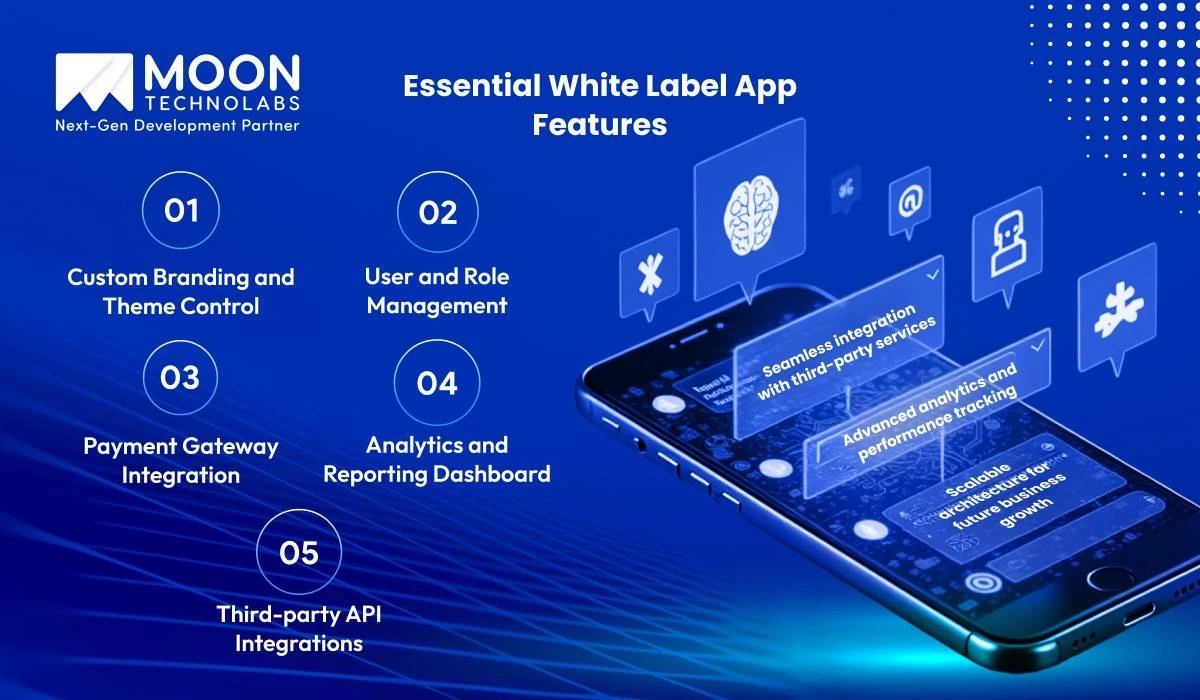
A white-label app should include a set of features to be integrated into an existing business ecosystem and managed efficiently. Let us explore some of the top features you need to consider to implement while developing your white-label app:
Custom Branding and Theme Control
The app should provide complete control over color schemes, logos, UI elements, and fonts to match the exact brand identity. Theme control provides full consistency across a range of platforms and thus helps businesses provide a fully branded and seamless user experience.
User and Role Management
Role management is another important feature that helps businesses to define permissions and access levels for multiple stakeholders. These include vendors, admins, end users, and service providers. This feature boosts security, improves operations, and ensures sensitive data.
Payment Gateway Integration
A flexible and secure payment gateway integration keeps great significance. Make sure your white-label apps support digital wallets, payment gateways, currencies, etc., to serve multiple user preferences. A smooth checkout experience boosts conversion rates.
Analytics and Reporting Dashboard
With an analytics and reporting dashboard, you will gain real-time information regarding user behavior, performance metrics, transactions, and growth trends. These details help you make the right business decision and thus transform your market strategies accordingly.
Third-party API Integrations
Make sure your white-label apps support third-party APIs. These include marketing tools, CRM systems, communication services, and logistics platforms. This kind of flexibility enables businesses to automate workflow, extend functionality, and also adapt to the changing operational needs.
Get ready to launch your app fast to tap the missed opportunities. We develop a scalable white-label app tailored to match your brand objectives.
3 Things to Consider Before Choosing a White Label App
Selecting a perfect white-label app is something that requires a lot of things to be taken into account. The following are some of these factors you need to consider:
Level of Customization Available
You need to first look for the level of control you get over features, branding, UI elements, workflows, and more. Make sure your white-label solutions offer a meaningful customization even without complex workarounds. It ensures your app aligns better according to your business model and evolves with your changing business requirements.
Ownership and Licensing Terms
Never forget to check ownership rights and licensing agreements. You need to know who owns the data, source code, and intellectual property. It is important to check whether the providers impose restrictions on feature expansion, resale, and platform migration. It prevents you from any unexpected costs when your app scales.
Scalability and Performance Limits
For long term growth, scalability is of great importance. You need to check the performance of the app under increased data volumes, user load, and transactions. Be it upgrade options, infrastructure limits, or performance benchmarks, you need to ensure the platform supports business expansion by minimizing downtime.
How Much Does White Label App Development Cost?
The white-label app development cost is influenced by numerous factors. Here is a detailed breakdown to help you budget effectively:
Cost Breakdown by App Complexity
| App Type | Cost Range | Timeline | Features Included |
|---|---|---|---|
| Basic/MVP | $2,000 to $10,000 | 1 to 3 weeks | Core features, basic branding, single platform |
| Mid-Range | $10,000 to $50,000 | 3 to 8 weeks | Custom UI, multi-platform, API integrations, admin panel |
| Enterprise | $50,000 to $150,000+ | 2 to 4 months | Advanced features, compliance, scalable infrastructure, dedicated support |
Factors Affecting White Label App Development Cost
White-label app pricing relies on the platform you select, the features you enable, and the level of customization needed. Key cost factors include:
- Platform choice (iOS, Android, or cross-platform)
- Level of customization (basic branding vs. deep UI/UX overhaul)
- Third-party integrations (payment gateways, CRM, analytics)
- Compliance requirements (HIPAA, GDPR, PCI-DSS add 15 to 30% to cost)
- Multi-language and multi-currency support
- Vendor location (US-based: $100 to $250/hr vs. offshore: $25 to $80/hr)
Cost Comparison: White Label vs Custom Apps
| Cost Component | White Label | Custom Development |
|---|---|---|
| Initial Development | $2,000 to $50,000 | $50,000 to $500,000+ |
| Annual Maintenance | $1,000 to $10,000/yr | 15 to 20% of initial cost/yr |
| Time to Launch | 2 to 8 weeks | 3 to 12+ months |
| Total 3-Year Cost (Mid-Range) | $30,000 to $80,000 | $150,000 to $600,000+ |
Ongoing Maintenance and Upgrade Costs
You should not forget to consider the ongoing expenses for these apps, though it has less initial cost. These expenses mainly include security updates, subscription fees, hosting, technical support, feature upgrades, and more. Typically, annual maintenance costs range from $1,000 to $10,000 for white label apps, compared to 15 to 20% of the initial development cost for custom apps. The most interesting thing about white-label apps is that maintenance is handled by the service provider.
How to Choose the Right White Label App Development Partner?
Choosing the right white label app development company is crucial for the success of your project. Here are the key factors to evaluate:
Proven Industry Experience and Portfolio
Look for a partner with a strong track record of delivering white label apps across multiple industries. Review their case studies, client testimonials, and portfolio to assess the quality and diversity of their work.
Technology Stack and Platform Expertise
Your development partner should be proficient in the latest technologies, including React Native, Flutter, Node.js, and cloud platforms like AWS and Azure. Their technology stack should align with your scalability and performance requirements.
Customization Depth and Flexibility
Ensure the partner offers meaningful customization options, not just skin-deep branding changes. You should have control over UI/UX elements, feature configuration, API integrations, and workflow modifications.
Post-Launch Support and SLA Commitments
A reliable partner provides ongoing support, regular updates, bug fixes, and performance monitoring. Look for clear Service Level Agreements (SLAs) that define response times, uptime guarantees, and escalation procedures.
Transparent Pricing and No Hidden Costs
The best white label development partners offer transparent pricing models with no hidden charges. Understand what is included in the base price and what constitutes additional costs, such as premium features, third-party API fees, or dedicated hosting.
Data Security and Compliance
Verify that your partner follows industry-standard security practices including end-to-end encryption, secure APIs, regular security audits, and compliance with standards like GDPR, HIPAA, and PCI-DSS as applicable to your industry.
How Moon Technolabs Helps Businesses Go Live Quickly With White Label Apps?
We are committed to helping businesses launch their app fast and grab the missed growth opportunities. With us, you get fully customizable and powerful white-label solutions that cater to the specific needs of your business.
Our developers use ready-made solutions like scalable cloud infrastructure, pre-built architectures, and industry-ready features to launch your app even within weeks. We have successfully delivered 900+ mobile and web applications across industries including healthcare, fintech, eCommerce, and on-demand services.
From UI customization and branding to integration and deployment, our iOS and Android app development team handles everything with higher efficiency. We provide white-label app development services with the sole purpose of helping you focus on growth instead of sticking to development complexities.
Final Word
So, you now have complete information regarding white-label software development, right? You have also understood how creating this solution is a win-win for your business. And you can launch a solid app even without compromising flexibility and quality.
With the white label market growing rapidly and businesses increasingly prioritizing speed-to-market, investing in a white label app is more strategic than ever. Whether you are a startup launching your first MVP or an enterprise expanding into new verticals, white label app development provides a proven path to growth.
It is now time to proceed with app development with a proven strategy. Meanwhile, developing a white-label app requires professional expertise. Partner with a reliable mobile app development company like us to create the top-rated solutions.
FAQs
01
Can white-label apps be scaled for enterprise use?
Yes, it’s possible. You can scale white-label apps for enterprise with the use of leveraging cloud infrastructure, modular architecture, robust security frameworks, API integrations, and more.




Jayanti Katariya is the CEO of Moon Technolabs, a fast-growing IT solutions provider, with 18+ years of experience in the industry. Passionate about developing creative apps from a young age, he pursued an engineering degree to further this interest. Under his leadership, Moon Technolabs has helped numerous brands establish their online presence and he has also launched an invoicing software that assists businesses to streamline their financial operations.
Submitting the form below will ensure a prompt response from us.
We refine our expertise to deliver innovative business solutions.





205 N Michigan Avenue, #810, Chicago, 60601, Illinois, United States
13500 Long Is Dr, Pflugerville, TX 78660, USA

C/105 Ganesh Meridian, S.G. Highway, Ahmedabad, GJ 380060


Ayse D.
Co-Founder France
“ I highly recommend Moon Technolabs as the quality of service is wonderful. We have hired this company to develop the product based on some complex & technical issues. We get the best quality services as compared with others in the market. Huge Thanks to Moon Technolabs as the team is always ready to give the solution all time.”

Justin G.
Founder & CEO USA
USA“ Moon Technolabs is a pioneer in the WebRTC based project as they have fixed complicated segments of the module by fulfilling different product lines by providing 24X7 customer support. We really recommended Moon Technolabs as they are able to develop products as per the module deadline and project timeline.”

Flavio S.
Founder & Managing Director Germany
“I am happy to recommend Moon Technolabs for their app development services. They successfully developed apps for me, and I am highly satisfied with the overall outcomes. The development team has swiftly addressed the issues with responsive and effective communication to understand the requirement quickly and actively resolve the back-and-forth problems that arose...”

Jay M.
Founder & CEOUSA“Moon Technolabs is the best company that provides advanced apps and websites development services in the USA and Europe. I am a newbie to develop my app with an external team. I am really happy to work with them as I am not that much mobile apps user. Here, the team and specially the CEO of Moon Technolabs helps me to let me know about the benefits of my app to generate revenue....”


Our Offices
India
C/105 Ganesh Meridian,S.G. Highway, Ahmedabad, GJ 380060USA
205 N Michigan Avenue, #810, Chicago, 60601, Illinois, United StatesContact Information


