


What is SAP BPC? How It Simplifies Business Data

Software Development Team
Last Updated: Oct 26, 2026 Total Views: 82
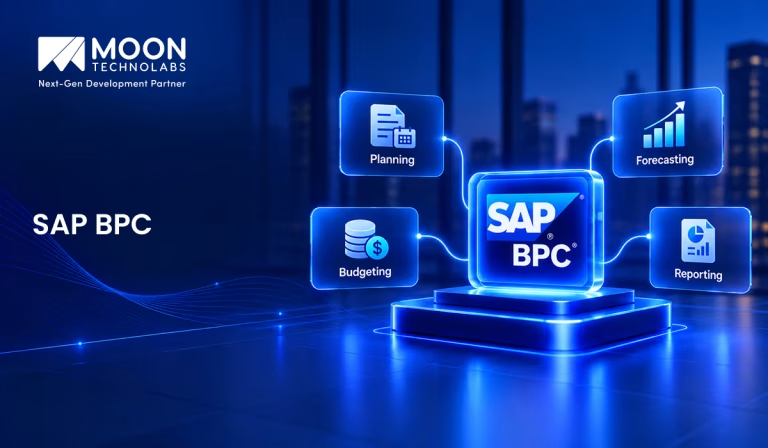
Table of Content


Blog Summary:
SAP BPC helps organizations streamline financial planning, budgeting, forecasting, and consolidation through a centralized platform. This blog explores its key features, benefits, and practical use cases, highlighting how businesses can improve data accuracy, automate financial processes, and enhance reporting. Discover how SAP BPC supports better collaboration, financial transparency, and informed decision-making to achieve business goals and improve overall financial performance.
Table of Content
SAP Business Planning and Consolidation (SAP BPC) is a powerful solution that helps organizations simplify financial planning, budgeting, forecasting, and consolidation. It lets finance teams bring data from multiple sources into one centralized platform, improving accuracy, streamlining workflows, and supporting stronger financial management. Understanding how SAP BPC works can help businesses manage their financial processes more efficiently.
In this blog, we’ll explore SAP BPC’s key features, major benefits, and practical use cases across different business functions. Whether you’re a finance professional, SAP consultant, or business leader, this guide will help you understand how SAP BPC supports informed decision-making and effective financial planning.
What is SAP BPC?
SAP BPC enables organizations to align financial plans with business objectives by providing visibility into performance gaps and potential risks. Finance teams can analyze variances between actual and planned results, evaluate different business scenarios, and adjust financial strategies based on changing business needs.
The platform lets organizations automate budgeting, forecast finances, consolidate financial statements, and analyze business performance. With features such as scenario planning, workflow management, reporting, and integration with SAP systems, it reduces manual effort and simplifies complex financial processes. Its integration with Microsoft Excel also provides users with a familiar interface for working with financial data.
SAP BPC supports better collaboration, stronger financial controls, and more efficient reporting across departments and business units. By providing greater visibility into financial performance and future projections, it helps organizations identify potential risks, evaluate business opportunities, and align financial plans with strategic objectives.
How Does SAP BPC Work?
SAP BPC collects financial and operational data from SAP ERP systems, spreadsheets, and other business applications. The collected data is organized and validated to maintain consistency and accuracy.
Finance teams use this data to prepare budgets, create forecasts, and plan financial activities. They can compare actual results with planned figures to identify variances and take corrective actions. SAP BPC also supports workflow management, allowing teams to review, collaborate on, and approve financial plans.
For financial consolidation, SAP BPC combines financial data from multiple departments, subsidiaries, and business units. It supports currency translation, intercompany reconciliation, and eliminations to prepare consolidated financial statements.
Finally, SAP BPC generates financial reports and dashboards that help management monitor performance, analyze trends, track business goals, and make informed financial decisions.
Speak with our specialists to explore practical SAP BPC solutions that align with your financial planning and reporting needs
Key Features of SAP BPC
Explore the key features of SAP BPC that help streamline financial planning, budgeting, forecasting, consolidation, and reporting for better business decision-making:
Unified Planning and Consolidation
SAP BPC enables finance teams to work with consistent financial data across departments and business units. It simplifies coordination between planning and consolidation activities, reduces data discrepancies, and provides a comprehensive view of organizational performance.
Built-In Financial Intelligence
Advanced financial intelligence supports currency conversion, intercompany eliminations, account transformations, and financial calculations. These capabilities help automate complex accounting tasks, improve reporting accuracy, and ensure consistent financial results across business units and reporting entities.
Microsoft Office & Web Reporting Integration
Integration with Microsoft Office and web-based reporting tools allows users to access, analyze, and present financial information through familiar interfaces. Teams can create dynamic reports, perform detailed analysis, and share insights efficiently while maintaining access to centralized business data.
Flexible Planning Methods
Support for top-down planning, bottom-up budgeting, rolling forecasts, and driver-based models lets organizations adapt planning to their specific requirements. This flexibility helps finance teams incorporate changing business assumptions, improve forecasting accuracy, and align financial plans with strategic objectives.
Business Process Flow (BPF) Guidance
BPF guidance helps users follow structured steps for budgeting, planning, and financial reporting activities. By defining tasks, responsibilities, and workflows, BPF improves process consistency, supports accountability, tracks progress, and ensures timely completion of critical financial activities.
Benefits of Using SAP BPC
Discover the key benefits of using SAP BPC to improve financial planning, enhance reporting accuracy, streamline budgeting processes, and support data-driven business decisions:
Familiar Microsoft Excel Interface
With a familiar Microsoft Excel interface, users can manage financial data using tools they already know. This reduces the learning curve, simplifies reporting tasks, and improves productivity across finance and accounting teams.
Accelerated Cycle Times
Automating repetitive tasks and standardizing workflows streamlines budgeting, planning, forecasting, and financial consolidation. This reduces manual effort, shortens reporting cycles, improves operational efficiency, and enables finance teams to deliver timely insights for faster decision-making.
Scenario Planning and What-If Modeling
Finance teams can evaluate multiple business scenarios and perform what-if analyses using different assumptions. Modeling potential outcomes helps organizations assess risks, forecast financial performance, identify opportunities, and make informed strategic decisions with greater confidence.
Real-time SAP Integration
Seamless integration with SAP systems facilitates the flow of financial and operational data across business functions. This reduces manual data transfers, improves data consistency, supports timely reporting, and provides a reliable foundation for financial planning and analysis.
Strict Compliance and Control
Robust governance features, including controlled workflows, user permissions, audit trails, and standardized reporting processes, help maintain data accuracy and enforce approval procedures. These capabilities support regulatory compliance and improve transparency throughout budgeting and financial consolidation activities.
You May Also Like:
The Ultimate Guide to SAP ABAP Development for Growing Businesses
SAP BPC Use Cases Across Industries
Explore how SAP BPC is used across industries to streamline financial planning, budgeting, forecasting, and reporting while helping businesses improve efficiency and make informed decisions:
Oil, Gas, and Chemicals
Organizations in the oil, gas, and chemicals sector use SAP BPC to manage complex budgets, forecast commodity prices, and monitor operational costs. It supports capital expenditure planning, profitability analysis, and financial consolidation across multiple facilities and business units.
Manufacturing & Heavy Industry
Manufacturing companies leverage SAP BPC to plan production costs, manage capital investments, and forecast demand. By consolidating financial and operational data, businesses can analyze cost variances, optimize resource allocation, improve budget accuracy, and align production strategies with financial goals.
Retail & Consumer Goods
Retailers and consumer goods companies use SAP BPC to forecast sales, plan inventory costs, and manage promotional budgets. It helps evaluate product profitability, analyze regional performance, and adapt financial plans to seasonal demand, changing consumer behavior, and market fluctuations.
Public Sector & Government
Government agencies and public sector organizations use SAP BPC to streamline budgeting, monitor departmental expenditures, and manage financial planning. Centralized reporting improves budget transparency, supports compliance requirements, strengthens accountability, and helps allocate public resources effectively across departments and programs.
SAP BPC Standard vs Embedded Model (TABLE)
Understand the key differences between SAP BPC standard and embedded models, including their architecture, data integration, planning capabilities, and ideal use cases to help you choose the right SAP solution for your business:
| Criteria | SAP BPC Standard | SAP BPC Embedded |
|---|---|---|
| Foundation & Architecture | Uses a dedicated BPC application layer with its own planning models and business logic. | Built on SAP BW architecture, leveraging BW data models and planning capabilities. |
| Data Replication | Often requires data loading or replication into BPC models for planning and consolidation. | Can use existing SAP BW data directly, reducing the need to duplicate data. |
| Data Modeling | Uses dimensions, members, applications, and models managed within the BPC environment. | Uses SAP BW objects, such as InfoProviders, aggregation levels, and planning functions. |
| Logic Scripting | Supports business rules, script logic, and data manager packages for calculations and data processing. | Uses BW integrated planning functions, planning sequences, formulas, and FOX or ABAP-based logic. |
| Consolidation Support | Provides dedicated financial consolidation capabilities, including currency translation and intercompany eliminations. | Primarily focuses on planning; consolidation capabilities depend on the solution and configuration used. |
| User & Administration | Managed through BPC administration tools, including model configuration, security, and business process controls. | Relies more heavily on SAP BW administration, authorization concepts, and planning configuration. |
| Reporting Tools | Supports Microsoft Excel through EPM add-in capabilities and web-based reporting interfaces. | Supports SAP Analysis for Microsoft Office and other compatible SAP BW reporting tools. |
| Ownership | Typically suited to finance teams that want more independence in managing planning and consolidation applications. | Typically suited to organizations where IT and BW teams manage the underlying data models and planning infrastructure. |
SAP BPC Architecture and Components
Explore the architecture and core components of SAP BPC to understand how its data models, planning engines, integration tools, and reporting capabilities work together to support efficient financial planning and consolidation:
Administration & Modeling Layer
The administration and modeling layer manages application configuration, business rules, dimensions, and security settings within SAP BPC. It lets administrators define planning models, configure workflows, maintain metadata, and establish financial logic to support consistent budgeting, forecasting, and consolidation.
Data Storage & Integration Layer
This layer manages financial data and connects to SAP and other source systems. It supports data loading, transformation, validation, and consolidation, ensuring reliable information flows between operational systems and planning applications for accurate financial analysis.
Presentation & Front-end Layer
The presentation and front-end layer provides users with interfaces to enter data, create reports, analyze results, and manage planning activities. Through Microsoft Excel, web interfaces, and reporting tools, potential users can access financial information, collaborate across teams, and make informed business decisions.
Connect with our experts to explore how SAP BPC can streamline your financial processes and support smarter business decisions.
Common SAP BPC Challenges
Understand the common challenges of SAP BPC and how they can affect business operations, helping organizations identify potential obstacles and improve overall system efficiency:
Report and Template Slowdowns
Complex reports, large data volumes, and poorly optimized templates can slow down SAP BPC performance. These delays reduce productivity, extend reporting cycles, and make financial analysis less efficient, especially during peak budgeting and consolidation periods.
Parent-level Input Limitations
Restrictions on entering data directly at parent-level members can complicate planning and budgeting processes. Users may need additional workarounds to capture aggregated inputs, increasing manual effort, creating inconsistencies, and making it harder to maintain accurate financial plans.
Source System Discrepancies
Differences in data formats, account mappings, master data, and update schedules across source systems can lead to inconsistent financial results. These discrepancies complicate reconciliation, reduce reporting reliability, and require additional validation before financial information can be consolidated.
Vulnerable Access Controls
Inadequate user permissions, poorly defined security roles, and inconsistent access policies can expose sensitive financial information to unauthorized users. Weak access controls also increase compliance risks, making regular permission reviews, role-based security, and audit monitoring essential for effective governance.
Conclusion
SAP BPC helps organizations streamline financial planning, budgeting, forecasting, and consolidation. Its features and benefits enable businesses to improve data accuracy, simplify financial reporting, and make informed decisions. By understanding its key capabilities and use cases, organizations can better evaluate how SAP BPC supports their financial management and business planning goals.
For businesses looking to optimize their SAP ecosystem, partnering with an experienced SAP consulting provider can improve system integration, streamline workflows, and enhance overall operational efficiency. Choosing the right SAP expertise helps organizations align technology with business objectives and support long-term growth.
FAQs
01
Is SAP BPC still relevant for modern businesses?
Yes, SAP Business Planning and Consolidation (BPC) remains relevant for businesses using established SAP environments. However, organizations pursuing cloud-based planning, real-time analytics, and greater scalability increasingly consider modern alternatives such as SAP Analytics Cloud.02
Is SAP BPC an ERP system?
No, SAP BPC is not an ERP system. It is a financial planning, budgeting, forecasting, consolidation, and reporting solution. It integrates with ERP systems, including SAP ECC and SAP S/4HANA, to support financial management and decision-making.03
Is SAP BPC part of SAP S/4HANA?
No, SAP BPC is not inherently part of SAP S/4HANA. It is a separate solution that can integrate with SAP S/4HANA. Organizations can also explore SAP Analytics Cloud for modern planning and analytics capabilities.04
What are the alternatives to SAP BPC?
Popular alternatives to SAP BPC include SAP Analytics Cloud, Oracle Cloud EPM, Anaplan, Workday Adaptive Planning, and OneStream. The right choice depends on an organization's planning complexity, financial consolidation needs, existing technology ecosystem, and cloud adoption strategy.



The Software Development Team at Moon Technolabs includes experienced developers, solution architects, and technology consultants who contribute content on software engineering, application development, system architecture, and digital innovation. Their articles are based on real-world project experience and aim to help businesses make informed technology decisions.
Submitting the form below will ensure a prompt response from us.
We refine our expertise to deliver innovative business solutions.





205 N Michigan Avenue, #810, Chicago, 60601, Illinois, United States
13500 Long Is Dr, Pflugerville, TX 78660, USA

C/105 Ganesh Meridian, S.G. Highway, Ahmedabad, GJ 380060




Ayse D.
Co-Founder France
“ I highly recommend Moon Technolabs as the quality of service is wonderful. We have hired this company to develop the product based on some complex & technical issues. We get the best quality services as compared with others in the market. Huge Thanks to Moon Technolabs as the team is always ready to give the solution all time.”

Justin G.
Founder & CEO USA
“ Moon Technolabs is a pioneer in the WebRTC based project as they have fixed complicated segments of the module by fulfilling different product lines by providing 24X7 customer support. We really recommended Moon Technolabs as they are able to develop products as per the module deadline and project timeline.”

Flavio S.
Founder & Managing Director Germany
“I am happy to recommend Moon Technolabs for their app development services. They successfully developed apps for me, and I am highly satisfied with the overall outcomes. The development team has swiftly addressed the issues with responsive and effective communication to understand the requirement quickly and actively resolve the back-and-forth problems that arose...”

Jay M.
Founder & CEOUSA“Moon Technolabs is the best company that provides advanced apps and websites development services in the USA and Europe. I am a newbie to develop my app with an external team. I am really happy to work with them as I am not that much mobile apps user. Here, the team and specially the CEO of Moon Technolabs helps me to let me know about the benefits of my app to generate revenue....”


Our Offices
India
C/105 Ganesh Meridian,S.G. Highway, Ahmedabad, GJ 380060USA
205 N Michigan Avenue, #810, Chicago, 60601, Illinois, United StatesContact Information


