


The Ultimate Guide to SAP ABAP Development for Growing Businesses

Jayanti Katariya
Last Updated: January 07, 2026 Total Views: 318
Table of Content


Blog Summary:
Check out this blog and gain an in-depth understanding of ABAP programming in the SAP ecosystem. It covers SAP ABAP application types, real-world use cases, future trends, and more, helping developers to optimize, build, and troubleshoot ABAP applications. Whether you are a new developer or a proficient in SAP ABAP development, this post will help you strengthen your skills and navigate the development environment effectively.
Table of Content
ABAP (Advanced Business Application Programming) is SAP’s primary high-level programming language, created by the German software company. It is used to build and customize applications and to extend SAP ERP and SAP S/4HANA systems. ABAP supports both object-oriented programming and procedural programming paradigms, making it a versatile SAP business technology platform for a wide range of apps.
SAP uses ABAP to implement its own applications, and SAP customers use ABAP to modify the functionality of SAP applications or create their own on the NetWeaver ABAP platform. As ABAP now supports modern development, it integrates with SAP HANA for efficient processing and powers everything from RESTful services to classic transactions and cloud-native apps on SAP BTP.
What is SAP ABAP Development?
SAP ABAP (Advanced Business Application Programming) development involves creating custom applications, reports, and enhancements within SAP systems using the ABAP language. It enables businesses to tailor SAP solutions such as SAP ERP and SAP S/4HANA to meet specific operational needs. ABAP development often centers on extending standard SAP functionality to support unique business processes.
As a core SAP programming language, ABAP allows software developers to implement business logic, interfaces, and integrations within the SAP environment. SAP ABAP programming supports both object-oriented and procedural programming, making it versatile for building custom modules and forms to optimize and personalize SAP platforms.
Why Choose SAP ABAP Development?
SAP ABAP (Advanced Business Application Programming) is the programming language that powers the majority of enterprise applications in the SAP ecosystem. As businesses grow and develop, SAP ABAP development plays a significant role in customizing, integrating, and optimizing business processes to meet specific needs. Here are several reasons why businesses go with SAP ABAP development:
Customization of SAP Modules
ABAP allows businesses to customize SAP modules to fit their unique strategies and rules. From creating custom reports to modifying transaction behavior, ABAP ensures the steps align with definite business workflows, enhancing flexibility and streamlining.
SAP Integration
ABAP enables smooth integration with SAP and other enterprise systems, such as CRM and ERP systems. Custom interfaces produced with ABAP ensure smooth data trade, helping businesses maintain accuracy and align workflow automation across multiple platforms.
Business Processes Optimization
ABAP enables the automation of tasks and streamlining of workflows within SAP. Custom fixes, such as self-driven reports and accurate-time data analysis, improve efficiency, reduce manual errors, and accelerate decision-making, ultimately increasing overall business performance.
Security & Compliance
ABAP progress elevates web application security and ensures compliance with regulations such as GDPR and HIPAA. SAP Developers can implement access restrictions, encryption, and audit trails to protect sensitive data and ensure compliance with legal and industry standards.
Real-time Reporting
ABAP development enables accurate, real-time reporting in SAP, enabling businesses to generate the insights and performance metrics they need. Dashboards and custom reports provide decision-makers with up-to-date information, enabling them to make data-driven decisions quickly and stay ahead of the competition.
Types of SAP ABAP Applications
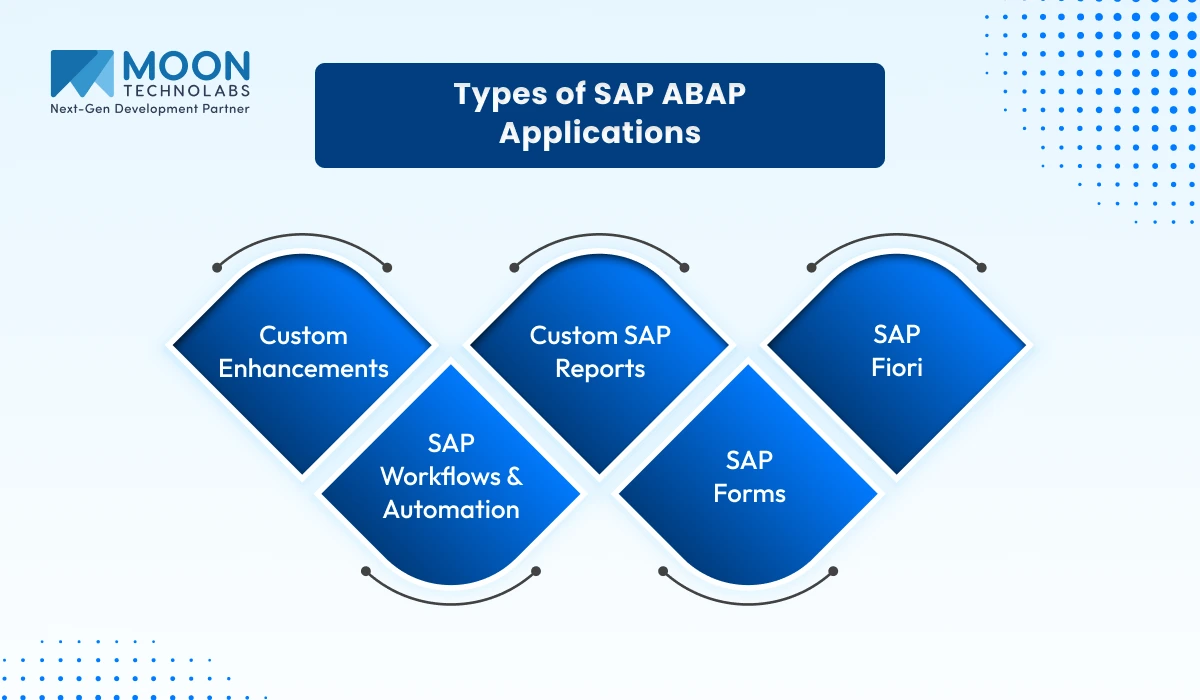
SAP ABAP applications come in various forms, particularly developed to address unique business needs within the SAP natural system. Below are the key types of SAP ABAP applications that organizations typically develop to optimize their SAP systems.
Custom Enhancements
Custom enhancements in SAP ABAP are created to modify standard SAP functionality to better align with specific business strategies. Using tools such as user exits, BAdIs (Business Add-Ins), and customer exits, organizations can incorporate custom code into SAP applications without modifying the core SAP methods. This ensures the system can be tailored to meet unique business needs while maintaining the integrity of the base SAP code and facilitating more convenient upgrades.
Custom SAP Reports
Custom SAP reports are built in ABAP to provide tailored realizations not workable in standard SAP reports. These reports can pull data from various SAP modules, such as finance, sales, and inventory, and display it in a customized format that adheres to clear business rules. ABAP enables the creation of in-depth reporting logic, strengthening decision-making and visibility by fetching key metrics, patterns, and data assessments specific to an organization’s ways of working.
SAP Fiori
Fiori applications streamline user experiences through a common, role-based design, ensuring users can interact with SAP systems quickly and effectively, whether in the office or on the go. Fiori applications streamline user experiences with a basic, role-driven design, ensuring users can interact with SAP systems without delay.
SAP Workflows & Automation
SAP Workflows systematize and streamline mission-critical business processes within SAP, reducing manual intervention and ensuring tasks are completed on time. With ABAP, businesses can build custom workflows, such as endorsement methods for purchase orders or leave requests, by characterizing automated steps and notifications. This merger of workflow systematization increases productivity, ensures conformity with business requirements, and fosters collaboration across teams by ensuring tasks are executed according to predefined systems.
SAP Forms
SAP Forms are customized templates used for generating documents such as invoices, delivery notes, and purchase orders, which can be printed or sent automatically. ABAP is used to create these forms using tools such as SAPscript, SmartForms, or Adobe Lifecycle Designer, ensuring that documents meet both effectiveness and design specifications. By customizing the layout, content, and form of forms, organizations can ensure their documents reflect their branding and comply with relevant regulations, while enhancing overall user comprehension.
Real-world Use Cases of SAP ABAP Development
SAP ABAP (Advanced Business Application Programming) is a programming language used to customize and extend SAP applications. Below are key use cases where ABAP programming enhances existing SAP systems:
Custom Financial & Tax Reports
SAP ABAP improvement enables the creation of tailored financial and tax reports to meet targeted business needs. Custom reports can program tax calculations, ensure compliance with local regulations, and consolidate data from multiple SAP function modules for accurate, timely reporting.
Procurement & Logistics Enhancements
ABAP programming language is used to enhance procurement and logistics systems, such as automating inventory management or building custom vendor management systems. These custom answers ensure smoother workflows and better integration with third-party systems.
Manufacturing & Production Planning Extensions
In manufacturing, ABAP programming is used to customize production decision systems. This includes creating scheduling ABAP tools that account for strength restrictions, machine availability, and labor shifts to optimize production and reduce downtime.
Automation of Approval Workflows
SAP ABAP helps digitize approval workflows for processes such as order requests and employee leave requests. Custom ABAP workflows ensure approvals are routed efficiently, speeding up processes and reducing manual errors.
Facing Technical Gaps in SAP and Need Skilled ABAP Developers On Demand?
Gain access to experienced talent right when you need it.
Hire Experts
Tech Stack Required for SAP ABAP Development
Building robust, scalable, and enterprise-level SAP strategies requires a well-rounded tech stack. All layers in the SAP ABAP environment play unique roles in ensuring seamless enterprise application development, efficient execution, and modern user experiences. Here’s a breakdown of the crucial technologies all ABAP developer works with:
SAP ABAP Workbench
The SAP ABAP Workbench is the core improvement environment inside the SAP GUI. It includes tools like the ABAP Editor, Data Dictionary (SE11), Function Builder, and Class Builder. SAP Developers use it to write, test, and debug custom applications, enhancements, and integrations. Nevertheless, newer tools have emerged, but ABAP Workbench remains foundational for old-fashioned backend growth.
ABAP Development Tools (ADT)
SAP ABAP development tools, further known as ABAP in Eclipse, are the latest SAP web IDE for modern ABAP development. With features such as code completion, syntax checks, versioning, fast fixes, and Git integration, ADT notably improves developer productivity. It’s crucial for working with ABAP RESTful Application Programming Model (RAP) and SAP S/4HANA environments.
SAP NetWeaver Application Server
SAP NetWeaver AS is the runtime platform for modern ABAP applications. It handles request processing, data access, safety, and system communication. Whether you’re building custom reports, enhancements, or hard integrations, the NetWeaver Application Server ensures stability, scalability, and approval across the SAP environments.
SAP HANA Database
SAP HANA is an in-memory database that enhances performance by promoting real-time data processing. ABAP developers use HANA features such as Native SQL and database views to optimize code and improve transaction performance, making them essential for SAP S/4HANA and other SAP environments.
OData Services & SAP Gateway
OData, via the SAP Gateway, allows ABAP developers to expose SAP data as web services. These services enable third-party applications to perform CRUD operations on SAP systems, making them key for integrating modern, mobile-friendly applications with SAP backend systems.
SAPUI5/Fiori
SAPUI5 is a framework for building responsive UIs, while SAP Fiori ensures a uniform, user-friendly design. Modern ABAP developers unite OData services to connect the backend with Fiori apps, delivering modern, role-driven applications that improve user expertise and procedure usability.
Well-known SAP ABAP Applications in the Industry
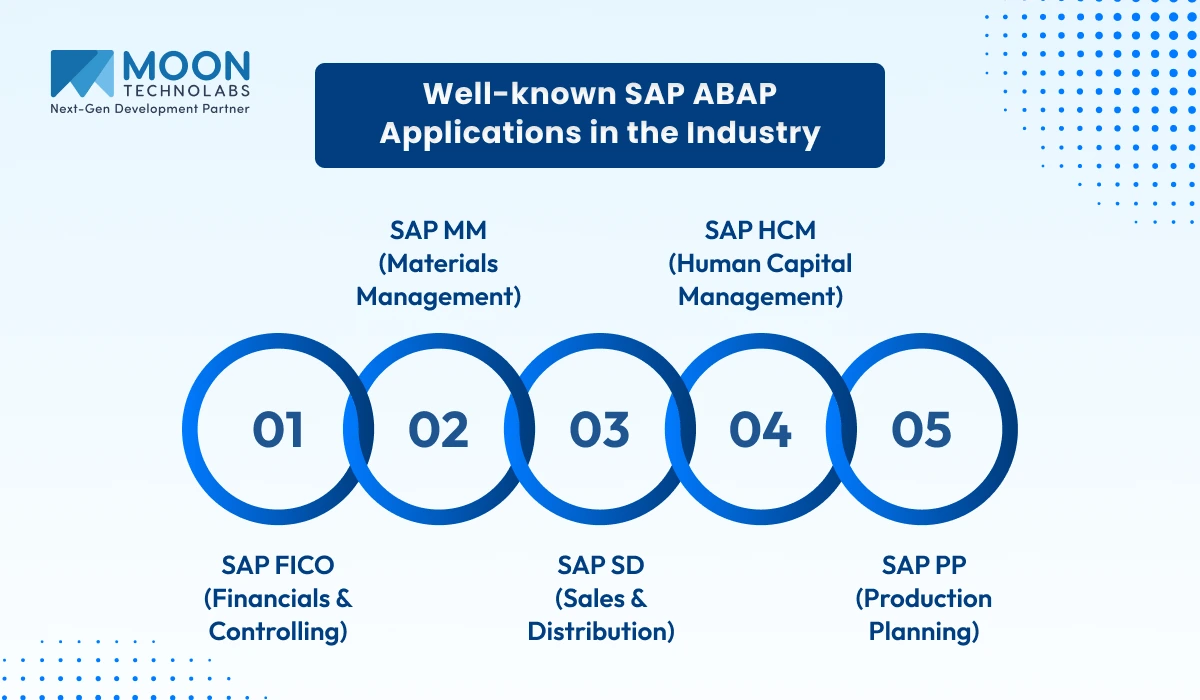
In the SAP ecosystem, ABAP applications are widely used across industries to improve business processes and efficiency. Have a look at some of the most popular SAP APAB applications that are commonly implemented in enterprises.
SAP FICO (Financials & Controlling)
SAP FICO is one of the most essential modules that facilitates businesses to manage their financial accounting and internal cost tracking. This module provides two important components, FI (Financial Accounting) and CO (Controlling). Here, FI handles manifested reporting, such as average leader, accounts payable, and asset management, whereas CO focuses on internal cost and performance management. These modules ensure proper financial reporting, effective financial negotiation, and planned cost control, while introducing consequences and building impressions.
SAP MM (Materials Management)
SAP MM is introduced to replace the organization’s procurement and inventory management approaches. It streamlines material purchasing, manages supplier relationships, and handles inventory management. With its extensive suite of development tools, SAP MM automates procurement, tracks material movement, and ensures the right material is available at the right time, reducing production delays and supply chain costs.
SAP SD (Sales & Distribution)
SAP SD allows businesses to manage everything when it comes to sales actions, from creating orders, costing, shipping, and pricing, ensuring a comprehensive custom knowledge. By tracking customer orders and optimizing the sales cycle, SAP Sales and Distribution helps organizations enhance order fulfillment, strengthen customer relationships, and manage inventory, ultimately driving revenue growth.
SAP HCM (Human Capital Management)
SAP HCM streamlines HR functions, including employee administration, payroll, time tracking, and talent management. It helps organizations manage their workforce more effectively by automating processes like hiring, performance appraisals, and compensation management. SAP HCM ensures startups comply with labor laws while improving employee satisfaction and productivity, offering a comprehensive human resources management solution.
SAP PP (Production Planning)
SAP PP focuses on formulating, scheduling, and managing the production procedures in manufacturing environments. It helps businesses optimize material constraints, plan material rules, and monitor production progress. With tools for capability planning, material management, and order tracking, SAP PP ensures smooth manufacturing operations, reducing downtime and delivering products on time to meet customer demand.
Future Trends in SAP ABAP Development
As SAP continues to evolve, so do the latest trends shaping ABAP development. The latest cutting-edge technologies and methodologies are shaping the future of SAP ABAP, enabling enterprises and startups to stay ahead of the competition. Have a sneak peek at some of the major future trends in SAP ABAP development that you can’t miss out on:
SAP S/4HANA Migration
As businesses shift to SAP S/4HANA, ABAP growth emphasizes HANA-optimized coding, skilled SQL processing, and unwritten core values. Developers are increasingly focusing on considering custom ABAP code, converting older ABAP objects, and leveraging CDS Views and AMDPs to push logic to the database for excellent performance.
Cloud Integration
With SAP BTP and the ABAP Cloud area evolving central to SAP’s strategy, ABAP developers are building cloud-ready extensions using APIs, events, and gathering communication models. This trend supports hybrid landscapes in which on-premises and cloud systems work seamlessly through modular core data services and unification layers.
Low-code/No-code Platform
Tools like SAP Design are uplifting business users to make painless applications. ABAP developers now center on delivering stable backend logic, reusable services, and governed SAP APIs that these platforms rely on. This collaboration raises productivity while ensuring enterprise-grade reliability.
IDE-agnostic Development
Modern ABAP development is shifting away from the SAP GUI and toward ADT and browser-based editors. These environments back up Git repositories, self-driven testing, code inspections, and CI/CD pipelines. This makes ABAP improvement more streamlined with modern SAP application development practices and encourages team-driven advancement.
Open Source and APIs
The ABAP environment is embracing open-source tools such as abapGit and data-driven libraries. At the same time, SAP’s API-first approach encourages developers to build loosely coupled services that integrate quickly with SAP and non-SAP systems. This results in more flexible, scalable, and future-proof SAP solutions.
Shape Your SAP ABAP Development Journey with Moon Technolabs
Kickstart your SAP ABAP improvement journey with Moon Technolabs, a trusted partner in delivering innovative SAP approaches that drive business transformation. With deep expertise in SAP ABAP programming, Moon Technolabs helps organizations unlock the full capabilities of their SAP systems through customized development. From building powerful custom reports to optimizing business systems, their proficient team ensures your SAP applications are tailored to your business’s unique needs, thereby improving efficiency and boosting productivity.
At Moon Technolabs, your SAP ABAP improvement is in capable hands. Their specialized services span from initial consulting to the design and operation of scalable, high-performance solutions. With an interest in both the technical and cautious aspects of SAP programming, Moon Technolabs enables seamless integration and refined functionality within your existing SAP infrastructure. Whether you’re looking to upgrade, assemble, or innovate, their team delivers reliable, future-proof SAP resolutions that help you stay on top in a rapidly adapting digital landscape.
Need Expert Support for Your SAP ABAP Development?
Get reliable, scalable SAP ABAP solutions tailored to your business needs from our experienced team.
Contact Us Today
Conclusion
SAP ABAP prosperity plays a key role in customizing and optimizing SAP solutions to address the specific challenges of businesses across industries. As the SAP programming language continues to evolve, ABAP remains fundamental for creating custom reports, extending standard functionality, and integrating third-party systems into the SAP ecosystem. With its versatility and expertise in enhancing SAP application capabilities, ABAP empowers organizations to streamline operations, improve productivity, and drive innovation.
As SAP S/4HANA, cloud technologies, and AI reshape the digital landscape, the future of SAP ABAP development is set to be more dynamic than ever. Developers will need to adapt to new tools, modernize existing applications, and embrace cutting-edge technologies to ensure their solutions remain scalable and efficient. The rise of SAP Fiori and the focus on mobile-first, user-centric designs will further shift the landscape of ABAP development, making it more responsive and intuitive.
For businesses, staying ahead of the curve in SAP ABAP development is critical to maintaining a competitive edge. By investing in the right tools and expertise, organizations can unlock the full potential of their SAP infrastructure, ensuring long-term success in an increasingly digital and data-driven world. As SAP ABAP continues to evolve, it will remain an invaluable asset for companies looking to optimize their SAP systems, drive digital transformation, and achieve business excellence.
FAQs
01
Can ABAP help in SAP data migration projects?
Yes, ABAP is essential for SAP data migration. It’s used to develop custom programs for extracting, transforming, and loading data into SAP, ensuring the data is formatted correctly and transferred through IDocs, BAPIs, or custom interfaces.02
What are BADIs and User Exits in ABAP?
BADIs (Business Add-Ins): These are flexible, object-oriented enhancements in SAP that allow custom logic without modifying standard code. User Exits: Older, function-based hooks in SAP programs for inserting custom logic, typically less flexible than BADIs.03
Is SAP ABAP full of coding?
Yes, ABAP requires coding, especially for custom reports and logic. However, tools like Screen Painter and Smart Forms can reduce the need for coding in certain scenarios.04
Is ABAP the same as SQL?
No, ABAP is a programming language for creating custom SAP applications, while SQL is used for querying databases. ABAP often uses SQL for database operations, but it is much more than that.05
What is the role of the debugging tool ST05?
ST05 is a performance tracing tool that helps identify SQL performance issues and optimize database queries by tracing and analyzing database access and system activities.




Jayanti Katariya is the CEO of Moon Technolabs, a fast-growing IT solutions provider, with 18+ years of experience in the industry. Passionate about developing creative apps from a young age, he pursued an engineering degree to further this interest. Under his leadership, Moon Technolabs has helped numerous brands establish their online presence and he has also launched an invoicing software that assists businesses to streamline their financial operations.
Submitting the form below will ensure a prompt response from us.
We refine our expertise to deliver innovative business solutions.





205 N Michigan Avenue, #810, Chicago, 60601, Illinois, United States
13500 Long Is Dr, Pflugerville, TX 78660, USA

C/105 Ganesh Meridian, S.G. Highway, Ahmedabad, GJ 380060


Ayse D.
Co-Founder France
“ I highly recommend Moon Technolabs as the quality of service is wonderful. We have hired this company to develop the product based on some complex & technical issues. We get the best quality services as compared with others in the market. Huge Thanks to Moon Technolabs as the team is always ready to give the solution all time.”

Justin G.
Founder & CEO USA
USA“ Moon Technolabs is a pioneer in the WebRTC based project as they have fixed complicated segments of the module by fulfilling different product lines by providing 24X7 customer support. We really recommended Moon Technolabs as they are able to develop products as per the module deadline and project timeline.”

Flavio S.
Founder & Managing Director Germany
“I am happy to recommend Moon Technolabs for their app development services. They successfully developed apps for me, and I am highly satisfied with the overall outcomes. The development team has swiftly addressed the issues with responsive and effective communication to understand the requirement quickly and actively resolve the back-and-forth problems that arose...”

Jay M.
Founder & CEOUSA“Moon Technolabs is the best company that provides advanced apps and websites development services in the USA and Europe. I am a newbie to develop my app with an external team. I am really happy to work with them as I am not that much mobile apps user. Here, the team and specially the CEO of Moon Technolabs helps me to let me know about the benefits of my app to generate revenue....”


Our Offices
India
C/105 Ganesh Meridian,S.G. Highway, Ahmedabad, GJ 380060USA
205 N Michigan Avenue, #810, Chicago, 60601, Illinois, United StatesContact Information


