


Wearable App Development Explained: Features, Cost & Process

Jayanti Katariya
Last Updated: May 20, 2026 Total Views: 177
Table of Content


Blog Summary:
This blog explores the importance of wearable app development for businesses, revolutionizing how they deliver data-driven and personalized user experiences across multiple devices. It lets you walk through everything about development of wearable apps, including its benefits, features, development stages, etc. Keep reading the entire post to develop your next wearable app.
Table of Content
Imagine a scenario where a patient’s heart rate spikes suddenly, and doctors are instantly notified with the help of a smartwatch. It reflects how wearable technology is transforming everyday experiences. In fact, recent reports by Grand View Research suggest the global wearable technology market is set to surpass $229.97 billion by 2033.
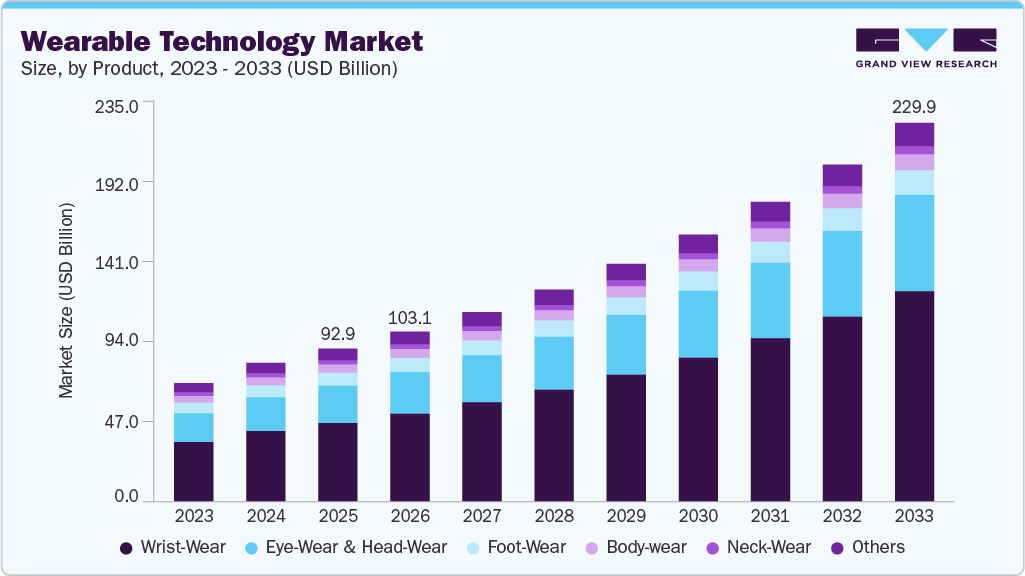
The stats reflect the increasing demand for this technology and encourage businesses to invest in wearable app development to deliver real-time, data-driven, and personalized solutions.
However, building such applications isn’t straightforward, as it requires in-depth research, careful planning, and the right technical approach. To help you understand this, this blog covers everything you need to know about wearable application development. Let’s dive in.
When Do Businesses Need Wearable App Development?
Wearable technology has become necessary for businesses, especially with the growing usage of devices like AR glasses, fitness bands, smartwatches, etc. Businesses nowadays have already realized the significance of developing wearable apps for gaining the numerous benefits that are as follows:
- Improve workplace safety in high-risk environments.
- Improve real-time communication
- Deliver quick notifications
- Increase customer engagement
- Improve operations
Types of Wearable Applications
Getting ideas for the different types of wearable apps is important before you start your project. Let’s explore some of the important types of apps:
Consumer Wearable Apps
As one of the most recognized types of apps, consumer wearable applications are meant to improve daily living and personal well-being. They power both fitness bands and smartwatches, which allow users to track several steps, manage sleep patterns, monitor heart rate, set workout objectives, and more. On the other hand, lifestyle apps facilitate users with the following things:
- Control smart home devices
- Manage calendars
- Make payment
- Receive navigation prompts
Enterprise Wearable Apps
Businesses these days frequently leverage wearable apps to improve operational efficiency. Enterprise wearable solutions help employees with complete hands-free access to task management tools, real-time data, communication platforms, etc.
Warehouses mainly use smart glasses for inventory management. On the other hand, field workers mostly use wearable devices for shift monitoring, location tracking, instant reporting, and more.
Healthcare Wearable Apps
Healthcare wearables reflect as one of the impactful apps of this important technology. These apps include the capability of bridging the gap between patients and healthcare service providers. By using telehealth integration, doctors get the freedom to access live vital signs, get alerts for abnormal readings, and make better decisions without the need for in-person visits.
Types of Wearable Applications
Based on functionality, you will come across a variety of wearable apps – each of them performs some specific tasks. We have described some of popular types of wearable applications:
Fitness and Activity Tracking Apps
Fitness and activity tracking apps are pivotal for the consumer wearable market. They have the capability of analyzing several physical performance metrics, including calorie burn, step count, workout intensity, distance covered, and active minutes throughout the day. They sync smoothly with smartphones to offer detailed progress reports, personalized fitness goals, and more.
Health Monitoring Apps
Health monitoring apps can continuously track important health conditions, whether it’s blood oxygen levels, heart rate, menstrual cycles, stress indicators, sleep stages, and more. The data collected by these apps allow healthcare providers to detect early warning signs of potential health conditions.
Smartwatch Companion Apps
When it comes to smartwatch companion apps, they work as an extension of the user’s overall smartphone experience, with shorter interaction windows and optimized for a small screen.
From notifications and calendar reminders to messages and music controls, they deliver everything. Organizations of late also leverage companion apps to offer loyalty rewards, timely alerts, customer updates, and more.
AR/VR-based Wearable Applications
AR and VR wearable apps have transformed how users interact with physical and digital environments. Developed for smart glasses, AR apps overlay contextual information, including navigation arrows, product details, equipment instructions, and more, into the real world.
For enterprises, AR wearable redefines remote assistance, training, complex assembly processes, etc. On the other hand, VR creates an immersive environment used for simulation-based training, gaming, virtual collaboration spaces, and more.
Navigation and Location-based Apps
Whether it’s location-based or navigation wearable apps, they bring the actual power of GPS and geofencing directly to the user’s body. Be it cyclists or runners, they use smartwatch navigation apps for turn-by-turn route guidance even without putting out their phones. In the logistics sector, these apps allow managers to track the exact location of workers, optimize delivery routes, and more.
We turn your wearable app idea into a complete solution with amazing design and robust features. Let’s make user-centered and scalable apps.
Benefits of Wearable App Development for Businesses
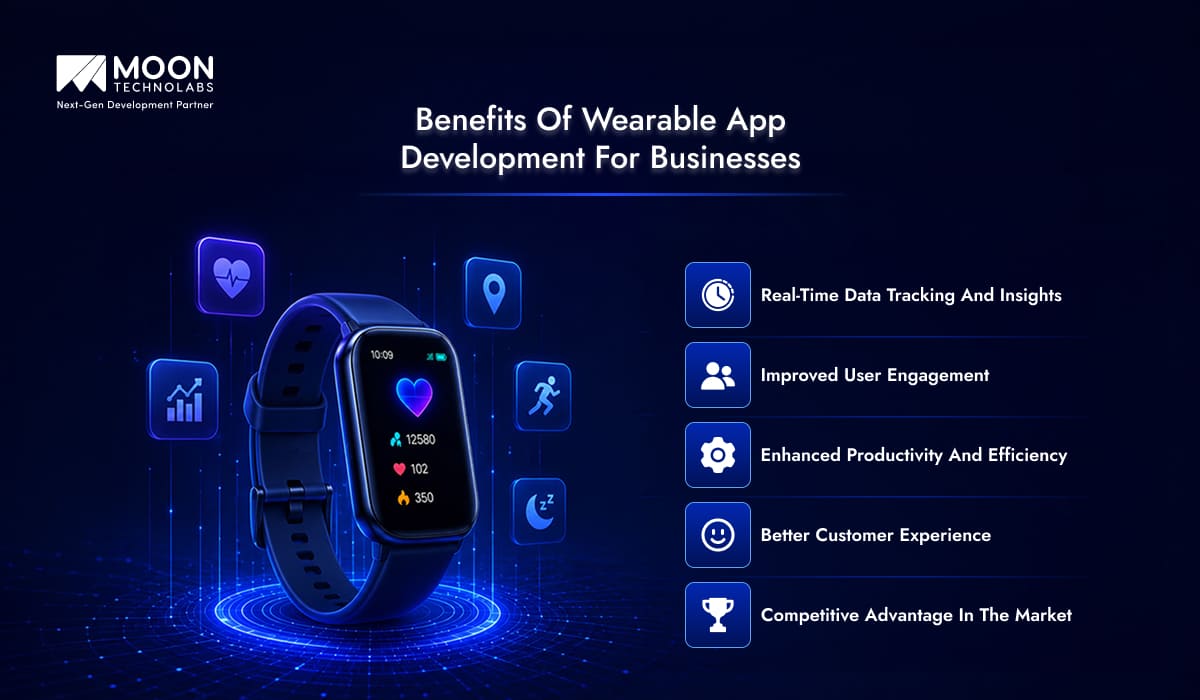
Investing in wearable device app development is more than just keeping up with the technological trends. It, in fact, adds complete business value along with the benefits. We will explore some of them as follows:
Real-time Data Tracking and Insights
Wearable apps include the potential to gather and process data in real time while maintaining continuity. They allow your organization to gain vast access to health metrics, a constant stream of user behavior, location data, activity patterns, and more. All of these are possible without manual input. This updated data flow ensures smart and fast decision-making across multiple departments.
Improved User Engagement
Wearable apps offer a unique and intimate connection between users and brands. Wearable devices are meant to be worn throughout the day, so such apps are important for users to achieve various important things that are certainly not possible with smartphones. Whether it’s personalized notifications, timely nudges, or context-aware interactions, they allow users to engage even without feeling intrusive.
Enhanced Productivity and Efficiency
Wearable apps are useful for enterprises as well, when it comes to increasing productivity. Your employees can use instant alerts, hands-free access to information, streamlined communication tools, etc., to work fast and smart. And they don’t need to break their workflow to check any computer or phone.
Better Customer Experience
Wearable apps also help businesses to offer a hyper-personalized experience at the right moment. They can keep engaging with customers in both relevant and timely ways. This standard of personalization indeed elevates the entire customer experience and thus improves the emotional brand connections as well.
Competitive Advantage in the Market
Another major advantage of wearable app development for organizations is that it helps them stay ahead of competitors. In today’s heavily crowded markets, technology differentiation has become an important factor in acquiring new customers. It helps businesses to lure top talent and thus set up a new industry benchmark that others seek to follow.
Core Features of a Wearable Application
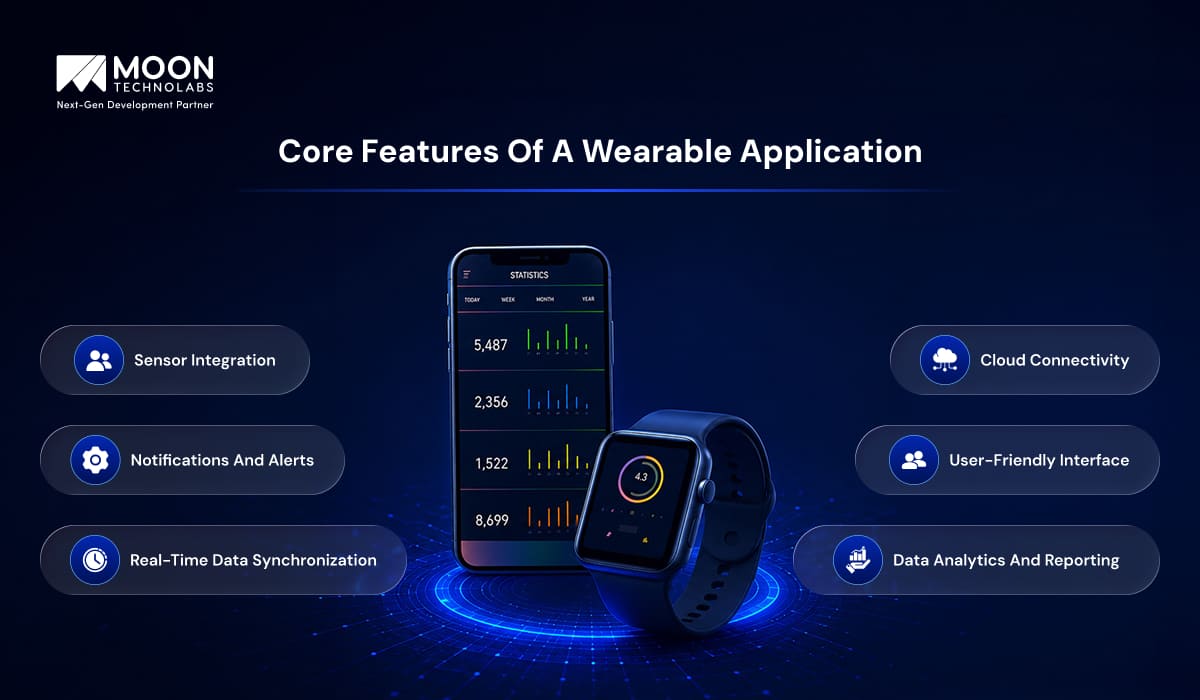
Features are one of the factors that play a vital role in making a wearable app successful. Following are some of the features you can consider to integrate into your app:
Real-time Data Synchronization
Real-time synchronization makes information gathered on a wearable device get reflected immediately on the paired tablet, smartphone, or web dashboard. These details can be a health reading, a workout session, a location update, etc. So, the smooth data flow removes any discrepancies while keeping various connected platforms updated simultaneously.
Sensor Integration
Wearable devices include an array of well-developed apps and built-in sensors for some specific purposes. Some of these sensors are as follows:
- GPS Sensors: It ensures precise location tracking and navigation.
- Heart Rate Monitors: They capture cardiovascular data continuously.
- Motion Sensors: They capture various movement patterns, physical activity levels, and gestures.
Notifications and Alerts
Smart notification management is another must-have feature for any wearable application. It gives your wearable app the capability of delivering actionable, timely, and relevant alerts, whether it’s incoming calls, reminders, performance milestones, safety warnings, or more. These ensure users stay informed even without experiencing any notification fatigue.
Cloud Connectivity
Wearable devices include limited processing power and onboard storage, which makes cloud connectivity a necessary architectural pillar. Cloud connectivity brings a possibility for cross-device accessibility, which allows users to review their data from any platform at any time.
For businesses, it paves the way for scalable infrastructure and centralized data management. Besides, it also pushes any updates remotely without affecting the user experience.
User-friendly Interface
You need to implement many important elements to make your wearable app interface user-friendly. These mainly include high-contrast visuals, bold typography, intuitive gestures, minimal text, or voice controls.
The major objective is to provide accurate information even at a single glance, without the need for the users to navigate through different screens or even perform complex inputs.
Data Analytics and Reporting
Integration of data analytics into your wearable app is something that you can’t ignore, as it facilitates users to track progress, visualize trends, and understand patterns in their user health behavior.
For businesses, these capabilities transform into robust dashboards that inform strategic decisions, determine the impact of wearable technology on KPIs (Key Performance Indicators), and identify operational inefficiencies.
Factors to Consider Before Wearable App Development
Wearable app development is a highly responsible task that requires a proper plan. Let’s have a look at various important factors that you need to consider before you start your project:
Target Audience and Use Case
Before you start your wearable app development project, you need to first define your target audience and a defined purpose. You need to be familiar with who will use your app, whether it’s hospital patients, fitness enthusiasts, everyday consumers, or warehouse workers .
A well-defined use case works effectively in preventing scope creep while ensuring the end product resonates perfectly with users.
Device Compatibility
Wearable landscape is spread across a large number of platforms, such as Apple Watch and Android wearables. Apple Watch works on watchOS, whereas Android wearables run on Wear OS.
Every platform includes its design guidelines, development frameworks, and technical constraints. Businesses need to decide on platforms to prioritize according to the preferences of the audience’s devices.
Battery Optimization
Battery life is another important factor you need to consider while developing a wearable app. Be it live sensor polling, GPS tracking, or frequent data syncing, many features are directly associated with draining the device’s battery.
This is indeed frustrating for users and thus undermines the usability of apps. Developers should adopt standard coding practices, reduce unnecessary resource consumption, and implement smart background processing to ensure the app works smoothly.
Data Privacy and Security
When it comes to data privacy and security, you need to ensure your apps comply with relevant regulations like HIPAA and GDPR. You also need to implement end-to-end encryption for smooth data transmission and adopt a powerful authentication mechanism.
Integration with Mobile Apps or Platforms
Many wearable apps function as an important part of the vast digital ecosystem instead of standalone products. A smooth integration with third-party platforms, companion mobile apps, cloud services, etc., is quite necessary to deliver the smooth user experience. You need to have an effective plan for smooth data handoff between the connected platforms and wearable apps.
Stages of Wearable App Development
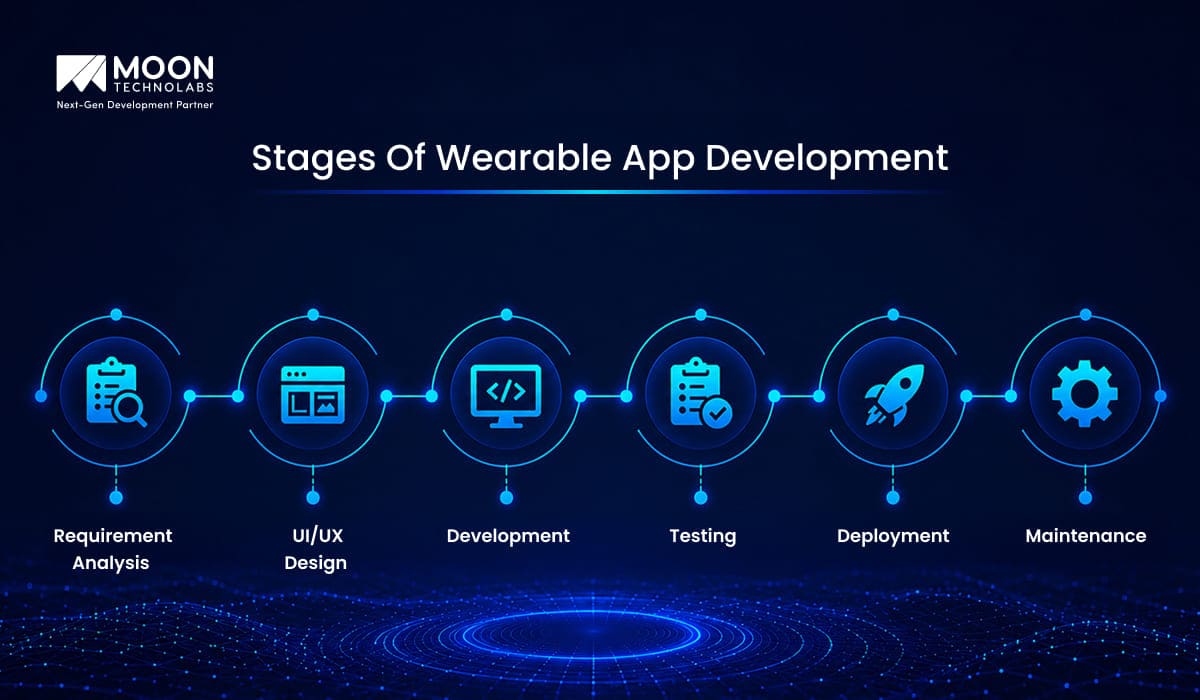
Wearable app development is a process that developers carry out in different phases to perform various specific tasks. Following are the detailed explanation of every important step:
Requirement Analysis
This is the first step that involves gathering the actual objectives of the app. In this, the development team understands the actual requirements of the audience and determines specific use cases that the app needs to address.
A proper requirement analysis step is necessary for removing any ambiguity during the early step and thus prevents any expensive revisions.
UI/UX Design
This stage focuses completely on crafting design, intuitive navigation flows, high-contrast layouts, interaction patterns, and more. These work smoothly with swipe, touch, voice inputs, and more.
Every design element needs to serve a clear purpose while minimizing cognitive load. It allows users to extract the details they require within seconds.
Development
Development takes place after approval of the design. At this step, developers focus on both frontend and backend development. Frontend development emphasizes crafting an on-device experience and thus translates designs into functional interfaces optimized for any specific platforms, which can be Wear OS, watchOS, or any other ecosystem.
On the other hand, backend development involves developing server-side infrastructure that serves a variety of purposes like data storage, processing, cloud connectivity, API management, and more.
Testing
As far as testing of a wearable app is concerned, it’s a rigorous process that works perfectly beyond standard mobile app quality assurance. Since your wearable app is meant to work across multiple devices with different screen sizes, you need to perform thorough testing.
Performance testing determines how the app works under real-world scenarios, including analyzing battery consumption, sensor accuracy, data sync speeds, responsiveness under different network conditions, etc. Usability testing validates that the interface delivers a completely frictionless and intuitive experience.
Deployment
This step involves the submission of apps to the relevant app stores. You need to submit your Android app to the Google Play Store and your iOS app to the Apple App Store.
Don’t forget every app store has its own guidelines and conditions for app submission. Make sure you have a foolproof plan for an app deployment to launch your app smoothly and thus foster its adoption.
Maintenance
The most important thing you need to take into account is that launching an app is just the start of the ongoing commitment to quality and importance. The maintenance steps include regular performance monitoring, security patches, bug fixes, feature updates, and more.
These help apps run smoothly and perform outstandingly with the growing user expectations. Besides, it’s also crucial to check crash reports, user feedback, usage analytics, etc., to gain valuable insights that help you understand the future development priorities.
We are committed to helping you launch your wearable apps with expert developers. We deliver solutions that offer a seamless performance with scalability.
Understanding the Wearable App Development Cost
Well, the average cost to develop a wearable app starts from $30,000 and goes up to $150,000+. When you build a basic app, its cost ranges from $30,000 to $60,000. On the other hand, building an enterprise solution costs range from $60,000 to $150,000.
The actual cost to develop a wearable app varies and depends on various factors, which are as follows:
- Targeted platform
- App’s complexity
- Design
- Expertise of the team
- Feature set
- Testing
- Ongoing maintenance
What are the Most Successful Wearable Apps in the Market?
While developing a wearable app, you should be aware of some of the popular apps in this niche that work well and have gained a huge popularity in the market. The following are different categories of wearable apps:
Popular Fitness Apps
Many popular fitness apps have set a great standard for consumer fitness wearables. Some of them include Nike Run Club, Strava, Apple Fitness+, and others. Their success mainly lies in combining accurate activity tracking with motivating social features, visually engaging progress dashboards, personalized coaching, and more.
Healthcare Wearable Solutions
Many healthcare wearable apps have already reflected the life-changing potential of wearable technology.
These solutions have redefined chronic disease management and also empowered patients to take a higher control of their health outcomes with real-time cardiac monitoring and continuous glucose tracking. Some of the popular healthcare wearable apps include Dexcom G7, Google Fit, Fitbit App, and more.
Smartwatch Ecosystems
Whether it’s Google Wear OS or Apple Watch OS, they have cultivated a flourishing ecosystem of companion apps spanning navigation, productivity, communication, payments, and more. Their success relies on the great value of building within widely adopted and established platforms that users already rely on.
Lessons from Successful Wearable Apps
A purposeful simplicity is something that contributes a lot to making a wearable app successful. The best apps have the capability of solving one issue perfectly while focusing on both clarity and speed. They also evolve continuously as per genuine user feedback.
Future of Wearable Apps
As far as the future of wearable apps is concerned, it’s shaping up to be more predictive, intelligent, and deeply integrated into everyone’s life. Wearable apps are expected to move beyond tracking to deliver personalized recommendations.
They also deliver proactive insights with evolving technologies such as IoT, AI, and advanced sensors. These apps are set to play a lead role in improving decision-making, safety, and user experience, from healthcare to enterprise use.
Take a look at some important trends that define the future of wearable apps:
- Advanced biometric tracking with higher accuracy
- AI-based predictive health and behavior insights
- Growth of AR-based wearable experiences
- Deeper integration with smart environments and IoT
- Improved privacy frameworks and data security.
How can Moon Technolabs Help In Wearable App Development?
With 16+ years of experience, we assist you in turning your wearable app idea into a high-performing wearable app solution. We create tailored solutions based on your specific business objective.
Our team has enormous expertise in both mobile and IoT development. We focus on crafting secure, intuitive, and feature-rich wearable apps. We ensure a smooth integration with platforms and devices while focusing on both user experience and performance. Let’s find out what you can expect from us:
- Custom UI/UX design for small screen devices
- End-to-end wearable application development services
- Integration with IoT, sensors, and cloud platforms
- Cross-platform compatibility
- Ongoing updates, support, and performance optimization
Conclusion
So, by now, you have already understood the significance of wearable apps in redefining how businesses connect with users through personalized experiences. It’s the right time to act and develop your app, which requires a lot of planning, strategy formulation, etc. Partnering with a wearable app development company like us helps you do everything hassle-free and build a powerful solution.
FAQs
01
What is wearable app development?
Wearable app development is a process to craft software for many smart devices, such as watches and fitness trackers, which enable important features like notifications, health monitoring, and smooth integrations with various digital systems.02
What are the 7 stages of app development?
Well, the 7 stages of app development include gathering ideas, research, planning, design, development, testing, and deployment.03
What devices support wearable apps?
There are many devices that support wearable apps. Some of them include fitness trackers, smartwatches, health monitors, smart glasses, and more.




Jayanti Katariya is the CEO of Moon Technolabs, a fast-growing IT solutions provider, with 18+ years of experience in the industry. Passionate about developing creative apps from a young age, he pursued an engineering degree to further this interest. Under his leadership, Moon Technolabs has helped numerous brands establish their online presence and he has also launched an invoicing software that assists businesses to streamline their financial operations.
Submitting the form below will ensure a prompt response from us.
We refine our expertise to deliver innovative business solutions.





205 N Michigan Avenue, #810, Chicago, 60601, Illinois, United States
13500 Long Is Dr, Pflugerville, TX 78660, USA

C/105 Ganesh Meridian, S.G. Highway, Ahmedabad, GJ 380060


Ayse D.
Co-Founder France
“ I highly recommend Moon Technolabs as the quality of service is wonderful. We have hired this company to develop the product based on some complex & technical issues. We get the best quality services as compared with others in the market. Huge Thanks to Moon Technolabs as the team is always ready to give the solution all time.”

Justin G.
Founder & CEO USA
USA“ Moon Technolabs is a pioneer in the WebRTC based project as they have fixed complicated segments of the module by fulfilling different product lines by providing 24X7 customer support. We really recommended Moon Technolabs as they are able to develop products as per the module deadline and project timeline.”

Flavio S.
Founder & Managing Director Germany
“I am happy to recommend Moon Technolabs for their app development services. They successfully developed apps for me, and I am highly satisfied with the overall outcomes. The development team has swiftly addressed the issues with responsive and effective communication to understand the requirement quickly and actively resolve the back-and-forth problems that arose...”

Jay M.
Founder & CEOUSA“Moon Technolabs is the best company that provides advanced apps and websites development services in the USA and Europe. I am a newbie to develop my app with an external team. I am really happy to work with them as I am not that much mobile apps user. Here, the team and specially the CEO of Moon Technolabs helps me to let me know about the benefits of my app to generate revenue....”


Our Offices
India
C/105 Ganesh Meridian,S.G. Highway, Ahmedabad, GJ 380060USA
205 N Michigan Avenue, #810, Chicago, 60601, Illinois, United StatesContact Information


