


Stream Processing: A Complete Guide to Real-Time Data Processing

Software Development Team
Last Updated: Aug 06, 2026 Total Views: 90
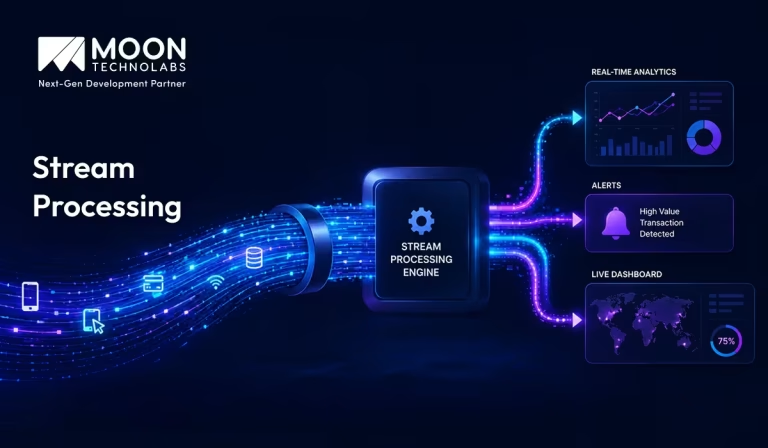
Table of Content


Blog Summary:
Stream processing is pivotal for businesses that need real-time insights and fast decision-making from continuously generated data. To help you implement it more effectively, this guide explains the architecture of stream processing, its functions, benefits, key frameworks, popular use cases, challenges, implementation costs, and more.
Table of Content
Businesses generate vast amounts of data, approximately 402.74 million terabytes (as per Exploding Topics). But this generated data is useful only if it can be understood rapidly and then acted upon. Failing to process data causes several issues, such as delayed fraud detection, missed revenue opportunities, and inefficient operations.
This is where businesses need to adopt stream processing, which helps them overcome these issues by providing real-time insights. It continuously analyzes data and helps businesses act quickly and automate mission-critical workflows, enabling them to stay ahead in data-driven markets.
In this guide, we will discuss data streaming and how implementing it can benefit businesses. Let’s explore.
Why Real-time Data Processing is Essential for Modern Businesses?
Real-time data processing is necessary for businesses to analyze collected data in depth and act accordingly when formulating vital strategies. It helps with decision-making to ensure their future growth.
Businesses today generate vast amounts of data from connected devices, customer interactions, apps, transactions, and more. Failing to analyze data or delaying analysis leads to slower decision-making, missed growth opportunities, and poor customer experiences.
Reasons Why Real-time Data Processing is Necessary for Businesses
- Respond to market changes fast
- Detect anomalies
- Deliver personalized user experience
- Optimize operations
- Gain a competitive edge
What is Stream Processing?
Stream processing is a method of data handling that is fast and continuous. It doesn’t involve waiting for data to be collected in different batches and is quite similar to a live news feed. In this, information flows continuously, and the system quickly analyzes one piece of information at a time.
This enables businesses to detect issues, spot patterns, or trigger actions even within seconds by adopting stream processing. Some of its popular use cases include live dashboards, fraud detection, and tracking user activity.
4 Key Steps of a Data Processing Pipeline
A data processing pipeline consists of multiple stages that transform raw data into meaningful insights. Let’s take a detailed look at each of these stages as follows:
Data Collection
Data collection is the first stage, involving the collection of raw data from multiple sources such as mobile apps, websites, customer transactions, or sensors. The major objective is to gather relevant data points to prevent missing anything important.
Data Ingestion
After data collection, data moves to a system for further processing. Ingestion tools transport this data from its source to the system in real time. The entire process is fast and accurate.
Data Processing and Analysis
In this stage, the collected raw data is cleaned and then organized. The process goes further by analyzing data to capture important insights, filtering out errors, and applying rules to detect trends, patterns, and anomalies.
Data Storage and Visualization
This is the last step in the data processing pipeline, which involves storing the processed data for future use. It’s displayed with reports or dashboards. This makes it convenient for teams to understand what is happening and make fast, informed decisions based on real data.
Stream Processing: A Closer Look
Stream processing is all about analyzing data as it’s collected, enabling real-time insights and quick actions. It’s the most suitable option for businesses with lower latency and fast decision-making. Let’s understand how it works:
How Stream Processing Works
In stream processing, data flows directly from the main sources, and the system processes every important piece of data fast. It analyzes and transforms data even within seconds. The entire process is continuous and referred to as a ‘data stream’.
Core Components of a Stream Processing Architecture
The most common setup for stream processing includes the following important parts:
- Data source
- Message broker
- Stream processing engine
- Output layer (storage)
These components are essential to ensure data moves smoothly.
Popular Stream Processing Frameworks
A number of tools enable businesses to build these systems, including Apache Flink, Apache Kafka, Apache Storm, and Apache Spark Streaming. Apart from this, cloud-based options include Google Cloud Dataflow and Amazon Kinesis.
Stream Processing vs Batch Processing
Whether it’s stream or batch processing, they work differently. We will explore below a detailed comparison of stream processing vs batch processing:
| Aspect | Stream Processing | Batch Processing |
|---|---|---|
| Data Handling | It emphasizes continuous data processing soon after collection. | It focuses on data processing in fixed chunks at scheduled times. |
| Speed | Stream processing yields fast and real-time results. | It offers delayed outcomes. |
| Use Cases | Its popular use cases include live dashboards and fraud detection. | Batch processing is useful in end-of-day reports, payroll, historical analysis, etc. |
| Data Volume | It handles smaller chunks of data continuously. | It can handle even the largest data volume at once. |
5 Benefits of Stream Processing Over Batch Processing
Though batch processing has its own relevance and numerous benefits, stream processing has an edge over it, offering significant advantages to businesses that need both agility and speed. Let’s discuss why companies opt for stream processing most frequently:
Real-time Decision Making
With stream processing, businesses don’t need to wait for scheduled reports to understand what’s happening. The reason is that data is analyzed quickly, enabling teams to make informed decisions quickly.
Low Latency and Faster Response
Speed is another highly sought-after benefit of stream processing, enabling businesses to respond to events within seconds. This speed is crucial for use cases like fraud detection, which requires fast action to prevent any losses.
Improved Customer Experience
With real-time data, businesses can personalize interactions quickly. Be it sending notifications promptly, recommending products, or resolving issues, stream processing enables a range of possibilities. It also helps businesses deliver a more responsive experience.
Scalability for Continuous Data Streams
With the growth of businesses, the volume of generated data also increases. Stream processing can continuously handle high-velocity data without slowing down the system. This makes it easy to scale operations without delays.
Proactive Monitoring and Instant Alerts
Stream processing enables proactive monitoring rather than discovering issues only after they cause damage. It helps systems analyze data continuously and notify when something unusual occurs, whether it’s a security breach, system failure, or data breach.
Unlock Real-time Data Intelligence with Tailored Solutions
We craft tailored stream processing solutions based on your specific business needs and goals. Our solution analyzes data continuously.
Challenges of Stream Processing
Though stream processing offers numerous advantages for business, it also comes with several challenges as well. Getting details of the following challenges helps them prepare better and avoid any of these costly mistakes:
Managing High Data Volumes
The streaming system often struggles to manage vast amounts of data. It affects the entire infrastructure if data is not managed properly.
Solution: You can leverage scalable frameworks such as Apache Kafka or use cloud-based services, including Amazon Kinesis. It helps in distributing load efficiently.
Data Consistency and Fault Tolerance
As we already mentioned, data flows continuously in stream processing. So, even a minor failure can cause duplicate or missing data, affecting accuracy.
Solution: It’s advisable to implement replication and checkpointing, and to use built-in features. These ensure the consistency and recoverability of data.
Infrastructure Complexity
Creating a stream processing system involves connecting a range of components. These mainly include message brokers, data sources, storage, and processing engines.
Solution: Always use managed cloud services, such as Azure Stream Analytics, to minimize the stress of building infrastructure from the outset.
Monitoring and Performance Optimization
Systems that process data require constant monitoring to detect and resolve performance issues as quickly as possible.
Solution: You can set up real-time dashboards and automate alerts to enable teams to continuously analyze system performance.
Higher Initial Implementation Costs
Creating a reliable stream processing system requires a greater investment than its counterpart (batch systems), whether in skilled talent or infrastructure.
Solution: It’s a good option to start with a well-defined yet small use case and then scale gradually to manage costs.
When Should You Use Stream Processing?
Stream processing is a top choice for businesses that rely heavily on analyzing and responding to data as soon as it’s generated. Any delay in insights impacts customer experience, revenue, or operational efficiency.
Business Scenarios That Require Real-time Processing
As we know, stream processing is the right choice for businesses that require fast decision-making. We can take the example of banks that need this option to detect fraudulent activity, especially in cases of suspicious transactions.
On the other hand, e-commerce platforms harness stream processing to recommend products, update inventory, and more. Besides, manufacturers use this process to test equipment, whereas ride-sharing apps use it to track drivers’ locations in real time.
Factors to Consider Before Implementation
Before implementing stream processing, it’s crucial for businesses to consider several important things that are as follows:
- Know whether your business needs real-time insights or only periodic updates are enough.
- Analyze your team’s technical readiness.
- It’s also important to analyze your existing infrastructure.
- Budget
- Future growth
Applications of Stream Processing Across Industries
Stream processing is not limited to a single industry — its applications are widespread across multiple industries, solving everyday, real-world issues. Here’s how different sectors use it:
Retail and E-commerce
By using stream processing, retailers and e-commerce businesses can track customer behavior, offer personalized services, and update inventory in real time.
Banking and Financial Services
Banks use stream processing to perform core tasks, including monitoring transactions and fraud detection. Besides, they use it for stock trading, real-time credit scoring, and instant payment processing.
Healthcare
In healthcare, stream processing is useful for continuously monitoring patient vitals and alerting medical staff when abnormalities occur. It’s used for managing hospital resources and also checking medical equipment.
Manufacturing and IoT
Manufacturing businesses and IoT use stream processing to check sensors and equipment on production lines. They can also check equipment failures before they cause any downtime. It helps in running operations smoothly.
Logistics and Supply Chain
For logistics and supply chain businesses, stream processing enables tracking of vehicles, shipments, inventory, and more across the supply chain. It allows organizations to respond fast to reroute deliveries, address delays, and update customers.
Telecommunications
Stream processing helps telecom companies monitor network performance, prevent service disruptions, detect outages, and more. It helps manage call data and usage patterns to enhance service quality.
Marketing and Customer Analytics
Stream processing helps marketers capture complete information about user interactions across apps and websites in real time. It also helps them provide targeted offers, real-time personalization, and fast campaign adjustment, etc.
Popular Stream Processing Technologies
Selecting the right technology depends entirely on your business requirements, technical setup, scale, and other factors. The following are some of the top stream processing technologies you can consider to use for your business:
Apache Kafka
As one of the most reliable technologies, Apache Kafka can manage real-time data streams. It serves as a reliable messaging system and ensures the smooth movement of data between different applications.
Apache Flink
Apache Flink offers real-time stream processing while maintaining higher speed and accuracy. It has the potential to manage complex event processes better and provides outstanding support for fault tolerance.
Apache Spark Streaming
Spark Streaming can process data in different, small batches. It’s a perfect choice for those businesses that already use Spark for their data processing. It offers a completely unified and smooth experience.
Apache Storm
Apache Storm can process data with lower latency. It’s the right choice for situations where speed is a top priority, including monitoring systems and real-time analytics.
Amazon Kinesis
Managed by none other than AWS, Amazon Kinesis can collect, process, and analyze streaming data smoothly. It’s a best fit for businesses that already leverage AWS infrastructure.
Google Cloud Dataflow
Google Cloud Dataflow offers highly managed services for both batch and stream processing. It makes pipeline development hassle-free and improves resource management.
Azure Stream Analytics
Microsoft’s Azure Stream Analytics is designed mainly for real-time analytics on streaming data. It integrates perfectly with some other Azure services and is popular for its simplicity.
Transform Continuous Data into Actionable Insights
We convert real-time data streams into actionable insights that enable fast decision-making and improve operational efficiency.
How Much Does Stream Processing Implementation Cost?
As far as the cost of implementing stream processing is concerned, it varies vastly and depends on numerous factors. Some of these factors are outlined below:
Cost Based on Infrastructure
On-premises setups require a significant investment in storage, servers, networking equipment, and related infrastructure. On the other hand, cloud-based infrastructure requires less investment as it includes only ongoing usage-based charges.
Cost Based on Data Volume
The total amount of data processed directly impacts costs. For instance, higher data volumes often require more storage, computing power, bandwidth, etc. It indeed increases overall expenses.
Cost Based on Cloud Services
Whether you opt for Google Cloud, Amazon Kinesis, or Azure Stream Analytics, each adds a recurring cost based on usage. Indeed, these services minimize the necessity for in-house infrastructure, pricing varies based on multiple factors. These include processing time, data throughput, and storage needs.
Cost Based on Development Complexity
There’s no denying that the complexity of use cases adversely impacts the cost. Simple solutions like real-time dashboards, alerts, etc., are indeed fast and highly affordable to build.
Meanwhile, building advanced systems involving multiple data sources or custom algorithms requires more skilled talent, time, and testing, which also increases implementation cost as well.
Why Choose Moon Technolabs for Stream Processing Solutions?
As a live video streaming app development company, we build a secure, high-performance stream processing solution tailored to meet unique operational needs. Our seasoned developers have the expertise to harness cutting-edge technologies such as Apache Flink, Apache Kafka, and Apache Spark Streaming to build real-time data pipelines.
Our end solutions offer actionable insights with lower latency. With us, you get end-to-end stream processing development services, right from architecture design to deployment. We are committed to offering future-ready, reliable solutions that accelerate digital transformation and, in turn, drive business growth.
Conclusion
Stream processing is necessary for businesses that wish to act on data quickly rather than wait for delayed insights. Its application is growing widely across every field, right from improving customer experience to predictive maintenance.
Meanwhile, its implementation often presents several challenges that can be easily resolved with the right planning and expert guidance. Partner with a streaming app development company to implement stream processing smoothly with the right approach.
FAQs
01
What is stream processing?
Stream processing is a data processing technique that captures, analyzes, and processes incoming data quickly and in real time. It allows businesses to make fast decisions with automated responses and gain necessary insights from continuous data streams.02
What is the difference between stream processing and batch processing?
Stream processing analyzes data once it’s generated and delivers real-time insights with less delay. On the other hand, batch processing involves collecting data over time and analyzing it at a scheduled interval.03
What are the benefits of stream processing?
There are many benefits of stream processing. Some of them include real-time decision-making, improved customer experiences, reduced processing latency, and support for data pipelines.04
Which tools are commonly used for stream processing?
Some of the most common stream processing tools are Apache Flink, Apache Kafka, Apache Storm, Apache Spark Streaming, Google Cloud Dataflow, Azure Stream Analytics, and more.05
How much does it cost to implement a stream processing solution?
There’s no fixed cost to implement a stream processing solution. The average implementation cost can be up to $100,000 or more, depending on factors such as data volume, infrastructure, development complexity, and cloud services.



The Software Development Team at Moon Technolabs includes experienced developers, solution architects, and technology consultants who contribute content on software engineering, application development, system architecture, and digital innovation. Their articles are based on real-world project experience and aim to help businesses make informed technology decisions.
Submitting the form below will ensure a prompt response from us.
We refine our expertise to deliver innovative business solutions.





205 N Michigan Avenue, #810, Chicago, 60601, Illinois, United States
13500 Long Is Dr, Pflugerville, TX 78660, USA

C/105 Ganesh Meridian, S.G. Highway, Ahmedabad, GJ 380060


Ayse D.
Co-Founder France
“ I highly recommend Moon Technolabs as the quality of service is wonderful. We have hired this company to develop the product based on some complex & technical issues. We get the best quality services as compared with others in the market. Huge Thanks to Moon Technolabs as the team is always ready to give the solution all time.”

Justin G.
Founder & CEO USA
USA“ Moon Technolabs is a pioneer in the WebRTC based project as they have fixed complicated segments of the module by fulfilling different product lines by providing 24X7 customer support. We really recommended Moon Technolabs as they are able to develop products as per the module deadline and project timeline.”

Flavio S.
Founder & Managing Director Germany
“I am happy to recommend Moon Technolabs for their app development services. They successfully developed apps for me, and I am highly satisfied with the overall outcomes. The development team has swiftly addressed the issues with responsive and effective communication to understand the requirement quickly and actively resolve the back-and-forth problems that arose...”

Jay M.
Founder & CEOUSA“Moon Technolabs is the best company that provides advanced apps and websites development services in the USA and Europe. I am a newbie to develop my app with an external team. I am really happy to work with them as I am not that much mobile apps user. Here, the team and specially the CEO of Moon Technolabs helps me to let me know about the benefits of my app to generate revenue....”


Our Offices
India
C/105 Ganesh Meridian,S.G. Highway, Ahmedabad, GJ 380060USA
205 N Michigan Avenue, #810, Chicago, 60601, Illinois, United StatesContact Information


