Staff Augmentation vs Consulting: What’s Right for Your Business?

Jayanti Katariya
Last Updated: Jul 17, 2025 Total Views: 3114
Table of Content


Blog Summary:
The decision between consulting services and staff augmentation represents a critical strategic choice for IT organizations seeking to extend their teams and capabilities. This comparative blog, staff augmentation vs consulting, examines the cost structures, long-term planning implications, and operational impacts of both approaches, providing actionable insights for IT leaders.
Table of Content
Staff augmentation is ideal for organizations that know what needs to be done and require additional hands or specific technical skills to execute projects efficiently. In contrast, consulting is ideal when a business needs expert advice, strategic planning, or specialized solutions to address complex challenges or uncertainty about the best course of action.
Hence, the cost savings and quality gains from external staffing have never been more critical. Here are some numbers to prove that:
- U.S. tech jobs are projected to increase to 7.1 million by 2034, from 6 million in 2023.
- The World Economic Forum reports that the global IT talent shortage is expected to hit 85 million by 2030.
Reflecting this urgency, many organizations now turn to flexible staffing to bridge skills gaps and stay ahead in a fiercely competitive market. This blog delves into an in-depth debate between staff augmentation and consulting, helping you and your organization determine when to choose the right approach.
What is Staff Augmentation?
Unlike traditional consulting, staff augmentation primarily focuses on extending your team by embedding skills directly into your internal teams. Instead of only providing strategic advice or project deliveries, these professionals work under your organization’s project managers and adopt your workflows and tools.
Whether your in-house organizational teams deal with tight deadlines, skill gaps, or budget restrictions, staff augmentation can solve all these points through:
- Immediate scaling without any delays in ramp-ups.
- Providing niche skills that your team doesn’t have and filling skill gaps.
- Avoiding full-time overhead and recruitment costs.
Staff augmentation also lowers fixed payroll overheads and cuts hiring time by almost half, resulting in a 2.4 times revenue boost. It’s the biggest reason why 37% of US IT leaders and 45% of financial firms use this model.
Since the current landscape is driven by remote work, speedier hiring, and the availability of niche talent, companies are moving towards staff augmentation. Post-pandemic, the workforce is more distributed across both local and global talent.
Niche tasks that require specialized skills are on the rise as tech stacks evolve through AI/ML, Blockchain, Cloud DevOps, and even cybersecurity, which are both expensive and time-consuming.
Benefits of Staff Augmentation
Hiring external professionals to augment in-house teams has helped many small and large companies address skill gaps and meet urgent needs. From saving hours and thousands of dollars to increasing deployments and reducing bottlenecks, numerous organizations have achieved significant success.
Whether you’re looking to build industry-based or on-demand solutions, the success stories and benefits of staff augmentation are the same across all industries. Let’s understand the benefits these examples provide us through some real-life examples:
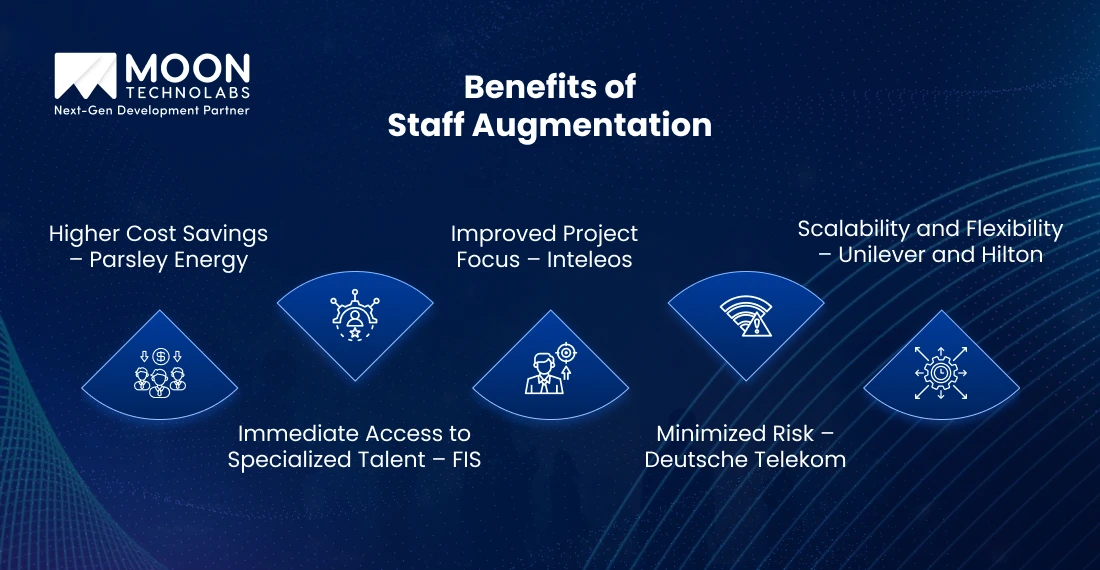
Higher Cost Savings – Parsley Energy
Austin-based oil and gas company Parsley Energy expanded its IT staff by hiring project managers, analysts, and QA experts who relocated to Texas, thereby fulfilling its need to double the size of its IT team.
Staff augmentation helped Parsley save approximately USD 1.85 million in its first year. Cost savings from lower consulting fees and reduced travel expenses are one of the biggest benefits this model provides.
Immediate Access to Specialized Talent – FIS
One of the stalwarts in the financial services sector is Fidelity National Information Services (FIS). It used staff augmentation to provide support to their mortgage software, EMPOWER.
Fulfilling their .NET developer roles from augmentation enabled them to complete their project with no downtime. A major benefit of staff augmentation is providing immediate access to specialized talent that might be difficult to source quickly.
Improved Project Focus – Inteleos
Similarly, a healthcare non-profit organization, Inteleos, used staff augmentation services to clear the backlog of QA and Back testers in their tech team.
It helped them meet their service deadlines within weeks and brought a 27% increase in code standards. With staff augmentation, internal teams can focus on core objectives and improve outcomes.
Minimized Risk – Deutsche Telekom
Deutsche Telekom, the IT branch of a telecommunications organization in Hungary, had to develop a USD 300 million intergovernmental project. With staff augmentation, it was able to acquire over 2,50,000 engineering hours.
This scale-up enabled them to minimize the risks associated with project delays or failures by ensuring that the right skills were available at the right time.
Scalability and Flexibility – Unilever and Hilton
Unilever’s HR team employed AI to save about 1,00,000 hours in one year. Similarly, Hilton automated its screening and interview scheduling processes, resulting in a 75% reduction in hiring times.
Staff augmentation with AI accelerates the recruiting and onboarding process, enabling organizations to scale up or down with flexibility.
Skip Lengthy Recruitment Cycles
Don’t let skill gaps delay your IT projects. Free your team to focus on delivery while we fill critical roles.
Scale Your Teams Faster
What is Consulting?
Consulting is the model where IT organizations hire external experts who enable them to analyze their technology landscape. They offer strategic advice on how to improve their existing systems and operations by identifying gaps and inefficiencies. In addition to providing guidance, they also conduct technology audits and optimize IT investments.
Consulting is particularly effective when:
- Your organization is seeking advice on highly strategic goals.
- Your organization needs expert guidance to transform your existing technology.
- Your organizational teams are seeking external perspectives on cost savings and innovation.
Unlike staff augmentation, which fills temporary positions and skill gaps by introducing external members, consulting brings subject matter experts to solve complex problems and build roadmaps. Consultants take full ownership of diagnosing issues and ensuring successful executions.
Whether a sudden regulatory change affects your organization or you’re facing a resource crunch, bringing in IT consultants will ensure hands-on support. Since in-house teams are focused on ongoing tasks, consulting services ensure that all deadlines are met.
Benefits of Consulting

Consulting services justify their higher upfront costs by delivering superior quality through specialized expertise, objective analysis, proven methodologies, dedicated focus, and strategic alignment with long-term business objectives.
Strategic Guidance and Expertise
Consultants bring extensive, specialized experience in specific domains, allowing them to apply best practices and innovative approaches that may not be available within the client organization.
Faster Problem Solving
Consultants are dedicated solely to the project at hand, free from internal distractions or competing responsibilities. This focus enables them to deliver results more efficiently and to a higher standard, being contractually accountable for both the quality and outcomes.
Scalable Engagements
Consultants not only solve immediate problems but also help organizations avoid costly mistakes, optimize processes, and align technology initiatives with broader business goals, resulting in sustained quality improvements over time.
Innovative Solutions
Consultants provide an impartial, outside viewpoint. Unlike internal teams, which may be too close to existing problems or have organizational biases, consultants can objectively identify core issues and opportunities, leading to more effective and higher-quality solutions.
Greater Insight into your Business
Consulting firms typically utilize proven methodologies, frameworks, and quality assurance processes that have been developed over years of experience. This structured approach ensures consistency, reduces errors, and drives projects toward high-quality deliverables.
Key Differences: Staff Augmentation vs Consulting
The staff augmentation framework offers a more straightforward cost model. These range from USD 15 per hour to USD 40 per hour. Project costs can start from as low as USD 15,000 to USD 1,50,000 depending on the scope and duration.
However, consulting services offer a more strategic approach but may or may not translate into faster project deliveries. Here’s a detailed comparison of how both models impact the projects:
| Particulars | Staff Augmentation | Consulting |
|---|---|---|
| Division of Responsibilities and Involvement |
|
|
| Integration with in-house teams |
|
|
| Project Planning |
|
|
| Control and Authority |
|
|
| Flow of Communication |
|
|
| Cost Structures |
|
|
| Project Deliveries |
|
|
| Orientation of Outcomes |
|
|
Staff Augmentation or Consulting? Key Factors to Consider
Deciding between staff augmentation and consulting depends on various factors. However, more important than that is the type of organization that seeks to augment its IT teams or add consultants. It also depends on their needs, including the on-demand niche skills they want to fill, their global reach, and cost efficiency.
Let’s understand this in detail:
| Features | Staff Augmentation | Consulting |
|---|---|---|
| Team Structure | Designers and developers can be brought in without any long-term commitments. | Consultants can help you validate your approach and build a go-to-market plan for your MVP. |
| Project Duration | It is ideal for building rapid prototypes and Minimum Viable Products (MVPs). | Perfect option when you’re uncertain whether your product and tech stack are a market fit or not |
| Cost efficiency | Professionals can be integrated into internal teams, helping to meet deadlines without incurring the full-time costs associated with hiring. | Specialized expertise and complex projects require variable pricing, making costs unpredictable. |
| Risk factors | Low risk since it’s ideal for modular workstreams and allows time-zone flexibility | Consultants may have different priorities and interests, which can lead to conflicts and increased risks. |
| Scalability | Augmented teams help scale engineering capacity more quickly. | It’s highly valuable when you want to rethink your IT strategy or seek to launch complex digital transformations. |
| Global Reach | Great option when you want to leverage offshore and nearshore talent to expand teams | Great for strategic transformations with global cloud migration and legacy modernization |
| Type of Skills | Great for bringing cloud architects, DevOps developers, data analysts, and cybersecurity experts | Consulting is an efficient approach for delivering comprehensive audits, assessments, frameworks, and change management strategies. |
Get a Clear IT Strategy Before Scaling
We help you choose and compare augmentation vs consulting for your needs to fill the hiring gaps.
Book a Call NOW
When to Choose Staff Augmentation?
The staff augmentation model is ideal when your organization has already established the direction but needs a smooth execution. Resources hired under this model play a crucial role in planning initiatives for organizational transformation. Hence, staff augmentation is ideal when:
- You have a clear project direction and need to scale execution capacity.
- The primary challenge is a temporary resource or skill gap.
- You want to retain direct control over project management and delivery.
- Knowledge transfer and team integration are priorities.
When to Choose Consulting?
Consulting services are especially valuable when organizations are looking for multi-year initiatives. It also serves as the best option when organizations seek changes to their technology stacks. Hence, IT consulting is ideal when:
- You need strategic guidance for digital transformation or major technology shifts.
- Your organization is facing complex, cross-functional challenges that require holistic solutions.
- Your teams are seeking innovation, process optimization, and business direction.
- Your project outcomes must be guaranteed, and risk needs to be minimized.
How Moon Technolabs Helps You With Staff Augmentation and Consulting?
Both staff augmentation and consulting services offer valuable paths for companies aiming to innovate, scale, or solve complex problems. Staff augmentation is best suited when your team needs skilled, hands-on support quickly, while consulting is ideal for strategic guidance before execution.
At Moon Technolabs, we help you navigate both with a curated approach. Whether you’re building a product or re-architecting systems, we provide vetted professionals and expert consultants tailored to your business goals.
Our flexible engagement models reduce overhead, enhance project outcomes, and bring global expertise directly into your workflow. Contact us today.
FAQs
01
Can I combine staff augmentation and consulting?
Yes, staff augmentation and consulting can be combined, as both approaches allow you to leverage the guidance of consultants while also extending the team simultaneously. The best way to combine both is to start by consulting to create a roadmap for the project and then augment the staff to bring in the necessary technical resources.02
What is the difference between staff augmentation and contractors?
Staff augmentation and contractors differ in the ways they can be integrated into a project. The former is a cost-effective option for long-term projects that need continuous expertise and direct supervision. The latter is best for short-term projects that have clear objectives and often operate independently.03
Which approach is more effective for long-term strategic planning: staff augmentation or consulting?
Consulting is a more effective approach for long-term strategic planning, as it involves in-depth analysis and building roadmaps to achieve long-term goals. In contrast, staff augmentation focuses on filling immediate resource gaps with a temporary workforce.04
Can the staff augmentation model support hybrid teams?
Yes, the staff augmentation model is perfectly suitable for hybrid teams, as it offers a hybrid approach that combines on-site and remote staff. Under this model, your business can have both an in-house team for some tasks and an external team for handling specific project functions.




Jayanti Katariya is the CEO of Moon Technolabs, a fast-growing IT solutions provider, with 18+ years of experience in the industry. Passionate about developing creative apps from a young age, he pursued an engineering degree to further this interest. Under his leadership, Moon Technolabs has helped numerous brands establish their online presence and he has also launched an invoicing software that assists businesses to streamline their financial operations.
Submitting the form below will ensure a prompt response from us.
We refine our expertise to deliver innovative business solutions.




205 N Michigan Avenue, #810, Chicago, 60601, Illinois, United States
13500 Long Is Dr, Pflugerville, TX 78660, USA

C/105 Ganesh Meridian, S.G. Highway, Ahmedabad, GJ 380060


Ayse D.
Co-Founder France
“ I highly recommend Moon Technolabs as the quality of service is wonderful. We have hired this company to develop the product based on some complex & technical issues. We get the best quality services as compared with others in the market. Huge Thanks to Moon Technolabs as the team is always ready to give the solution all time.”

Justin G.
Founder & CEO USA
USA“ Moon Technolabs is a pioneer in the WebRTC based project as they have fixed complicated segments of the module by fulfilling different product lines by providing 24X7 customer support. We really recommended Moon Technolabs as they are able to develop products as per the module deadline and project timeline.”

Flavio S.
Founder & Managing Director Germany
“I am happy to recommend Moon Technolabs for their app development services. They successfully developed apps for me, and I am highly satisfied with the overall outcomes. The development team has swiftly addressed the issues with responsive and effective communication to understand the requirement quickly and actively resolve the back-and-forth problems that arose...”

Jay M.
Founder & CEOUSA“Moon Technolabs is the best company that provides advanced apps and websites development services in the USA and Europe. I am a newbie to develop my app with an external team. I am really happy to work with them as I am not that much mobile apps user. Here, the team and specially the CEO of Moon Technolabs helps me to let me know about the benefits of my app to generate revenue....”


Our Offices
India
C/105 Ganesh Meridian,S.G. Highway, Ahmedabad, GJ 380060USA
205 N Michigan Avenue, #810, Chicago, 60601, Illinois, United StatesContact Information