


Robotic Process Automation in Healthcare: Benefits, Use Cases, and Future Trends

Artificial Intelligence
Last Updated: Jul 20, 2026 Total Views: 91

Table of Content


Blog Summary:
Robotic Process Automation in Healthcare is transforming the way healthcare organizations manage daily operations by automating repetitive tasks, reducing errors, and improving efficiency. This blog explores how RPA streamlines processes such as patient onboarding, claims processing, billing, and data management while enhancing compliance and patient experiences. Discover the benefits, use cases, and future impact of RPA in healthcare.
Table of Content
Healthcare organizations are facing growing challenges in managing administrative workloads, improving efficiency, and maintaining quality patient care. Processes like patient registration, claims processing, billing, and records management often involve repetitive tasks that can be time-consuming and error-prone.
Robotic process automation (RPA) helps healthcare providers automate these workflows, improve accuracy, and allow staff to focus on more critical patient needs. The adoption of robotic process automation in healthcare is growing rapidly.
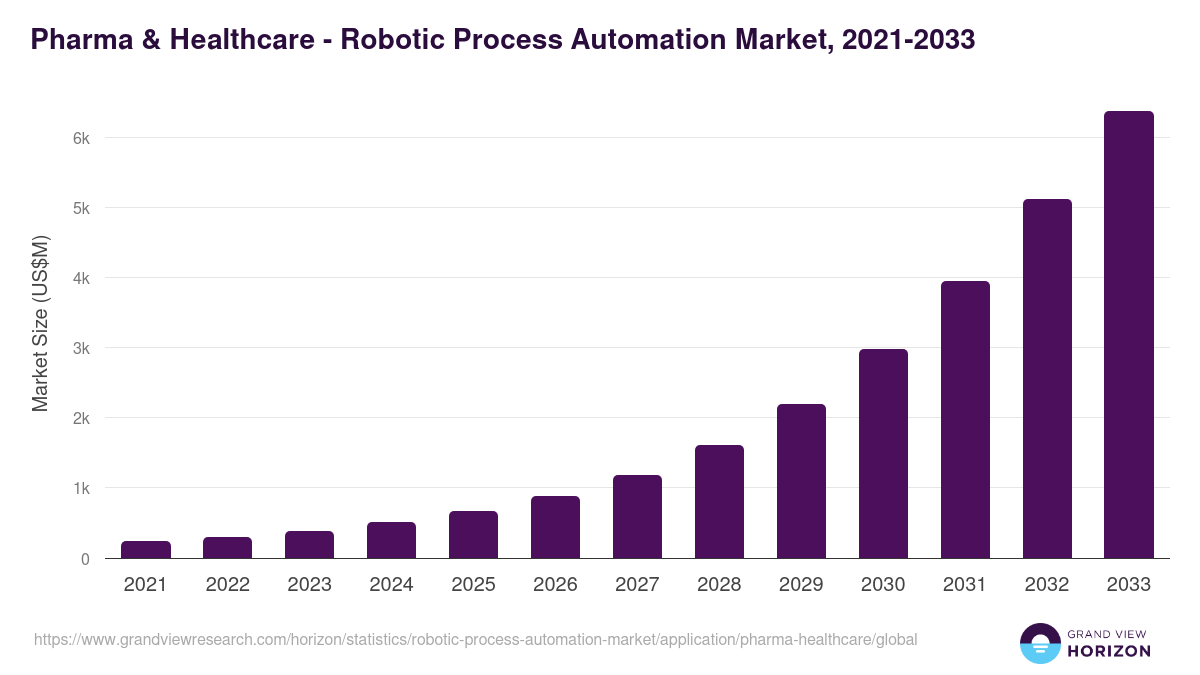
According to Grand View Research, the global pharma and healthcare RPA market is expected to grow from USD 664 million in 2025 to USD 6.38 billion by 2033, at a CAGR of 32.6%. With its ability to streamline operations and enhance productivity, RPA is becoming an essential technology for healthcare digital transformation.
What is Robotic Process Automation in Healthcare?
RPA in healthcare is a technology that uses software robots to automate repetitive and time-consuming tasks. It helps healthcare organizations manage processes such as patient data entry, appointment scheduling, billing, and claims processing more efficiently.
RPA improves accuracy by reducing manual errors and allowing healthcare staff to focus more on patient care. It can also help hospitals and clinics save time, reduce operational costs, and improve the overall quality of healthcare services.
By integrating with existing healthcare systems, RPA enables faster workflows and better management of medical records and administrative tasks. As healthcare continues to adopt digital solutions, RPA plays an important role in creating smarter and more efficient healthcare operations.
Benefits of Robotic Process Automation in Healthcare
RPA is addressing some of the biggest operational challenges in healthcare by automating time-consuming tasks and improving the way critical processes are managed.
Let’s explore how robotic process automation helps healthcare providers reduce inefficiencies, improve data accuracy, enhance patient interactions, and empower teams to deliver better care:
Lower Operational Costs
RPA helps healthcare organizations reduce operational expenses by automating repetitive, rule-based tasks such as patient registration, appointment scheduling, claims processing, billing, and data entry.
By minimizing manual effort, healthcare providers can lower administrative costs, reduce processing time, and allocate resources more efficiently. This enables organizations to focus their budgets on improving patient care and expanding healthcare services.
Enhanced Data Accuracy
Healthcare operations rely heavily on accurate patient and clinical data. Robotic process automation in healthcare eliminates many of the errors associated with manual data entry by consistently capturing, validating, and transferring information across multiple systems. Improved data accuracy supports better clinical decisions, ensures regulatory compliance, reduces claim denials, and enhances the overall quality of healthcare records.
Better Patient Experience
Robotic process automation in healthcare streamlines patient-facing processes, resulting in faster service and improved satisfaction. Automated appointment scheduling, quicker insurance verification, timely billing, and rapid access to medical records reduce waiting times and administrative delays.
Healthcare professionals can spend more time interacting with patients rather than managing paperwork, leading to a more personalized patient experience. AI-powered healthcare platforms further enhance these processes with seamless appointment management and secure access to medical records.
Increased Workforce Productivity
By automating routine administrative tasks, RPA allows healthcare staff to focus on higher-value activities that require human expertise and critical thinking. Medical professionals, administrative teams, and support staff can dedicate more time to patient care, care coordination, and strategic initiatives rather than repetitive manual tasks. This improves overall productivity, reduces employee burnout, and creates a more efficient healthcare environment.
Modernize Healthcare Workflows with Robotic Process Automatio
Achieve smarter healthcare operations with our experts creating customized RPA solutions that improve efficiency and support digital growth.
Why are Healthcare Organizations Adopting Robotic Process Automation?
Healthcare organizations are adopting RPA to simplify time-consuming administrative tasks like appointment scheduling, insurance verification, claims processing, and billing. By automating these repetitive processes, healthcare teams can reduce manual workload, minimize errors, and spend more time focusing on patient care.
RPA also helps healthcare providers maintain accuracy and meet compliance requirements. Automated workflows ensure consistent data handling, improve record management, and reduce the risk of mistakes in sensitive processes. This leads to faster operations and better coordination across departments.
As patient expectations continue to grow, robotic process automation in healthcare enables hospitals and clinics to deliver quicker, more efficient services. From speeding up patient onboarding to processing claims faster, automation improves both operational performance and the overall patient experience, making it a valuable part of modern healthcare.
Robotic Process Automation in Healthcare Use Cases
Healthcare organizations handle a wide range of repetitive and data-intensive processes every day, creating opportunities for automation to improve speed, accuracy, and efficiency.
The following RPA use cases highlight how automation is transforming healthcare workflows, reducing administrative burdens, and enabling teams to focus on more critical responsibilities:
Patient Registration and Onboarding
RPA simplifies patient registration by automating the collection, verification, and entry of patient information into hospital systems. Bots can extract data from online forms, identify documents and insurance cards, reducing manual errors and registration time. Automated workflows also ensure that patients complete all required documentation before their appointments, improving the overall onboarding experience.
Appointment Scheduling and Management
Robotic process automation in healthcare streamlines appointment scheduling by coordinating calendars, checking physician availability, and confirming bookings across multiple systems. It can automatically send reminders, process cancellations, reschedule appointments, and notify patients of changes. This reduces administrative workload, minimizes missed appointments, and improves resource utilization.
Medical Billing and Claims Processing
Healthcare organizations process thousands of billing transactions every month. RPA automates invoice generation, coding validation, claims submission, and payment reconciliation. By reducing manual intervention, bots accelerate reimbursement cycles, minimize billing errors, and improve overall financial efficiency while ensuring compliance with healthcare billing standards.
Insurance Eligibility Verification
Insurance verification is a repetitive yet critical administrative task. RPA bots access payer portals, verify patient coverage, check policy validity, identify co-pay requirements, and update healthcare systems in real time. Automated verification reduces patient wait times, prevents claim denials, and improves billing accuracy.
Electronic Health Record (EHR) Management
Managing electronic health records involves continuous data updates across multiple applications. RPA automates the transfer, synchronization, and validation of patient information between EHR systems, laboratories, pharmacies, and diagnostic platforms. This ensures accurate patient records, reduces duplicate entries, and supports better clinical decision-making.
Prescription and Medication Management
RPA enhances medication management by automating prescription processing, refill requests, medication reconciliation, and pharmacy notifications. Bots can verify prescription details, identify potential discrepancies, and ensure that medication records remain up to date. This reduces delays, improves patient safety, and supports efficient pharmacy operations.
Patient Data Entry and Validation
Healthcare providers often receive patient information from multiple sources, including online portals, paper forms, and external providers. RPA extracts, validates, and enters this information into hospital systems with high accuracy. Automated validation identifies missing or inconsistent data, improving record quality while reducing administrative effort.
Laboratory Report Processing
Laboratories generate large volumes of diagnostic reports daily. RPA automates report collection, result validation, EHR updates, and physician notifications. Critical test results can be flagged for immediate attention, ensuring faster clinical response while reducing manual processing time and reporting errors.
Hospital Inventory and Supply Management
Hospitals rely on the timely availability of medical supplies and equipment. RPA monitors inventory levels, tracks stock usage, generates purchase orders, and automatically updates inventory records. This helps prevent shortages, reduce excess inventory, lower operational costs, and ensure uninterrupted patient care.
Revenue Cycle Management
RCM involves multiple administrative processes from patient registration to final payment collection. RPA automates patient billing, payment posting, claim tracking, denial management, and financial reporting. By improving process efficiency, healthcare organizations can accelerate cash flow, reduce revenue leakage, and enhance financial performance.
Compliance Reporting and Audit Preparation
Healthcare organizations must comply with strict regulatory requirements and maintain detailed documentation. RPA automates data collection, report generation, audit trail maintenance, and compliance monitoring. Automated reporting ensures timely submission of regulatory documents, reduces compliance risks, and simplifies audit preparation.
Patient Follow-Ups and Automated Notifications
RPA improves patient engagement by automating follow-up communications after consultations, surgeries, or treatments. Bots send appointment reminders, medication alerts, vaccination notifications, lab result updates, and feedback requests through email, SMS, or patient portals. Automated communication enhances patient satisfaction, improves treatment adherence, and reduces missed follow-up appointments.
You Might Also Like:
RPA in Human Resources: Benefits, Use Cases, and Implementation Guide
Challenges of Implementing Robotic Process Automation in Healthcare
While robotic process automation offers significant benefits for healthcare organizations, implementing it successfully requires addressing challenges related to system integration, data security, compliance, and process standardization.
Understanding these challenges helps healthcare providers build effective automation strategies and ensure smoother adoption across their operations:
Data Security and Privacy
Healthcare organizations handle sensitive patient data, making security and privacy a major concern when implementing RPA. Bots access electronic health records and other confidential information, so organizations must comply with regulations such as HIPAA and GDPR. Strong encryption, access controls, and regular security monitoring are essential to protect patient data.
Legacy System Interoperability
Many healthcare providers still use outdated legacy systems that are difficult to integrate with modern RPA solutions. Limited compatibility and inconsistent data formats can increase implementation time and costs. Proper integration planning and system upgrades can help ensure smooth communication between systems.
Poor Process Standardization
RPA works best with standardized and rule-based processes. However, healthcare workflows often differ across departments and involve many exceptions. Without consistent processes, automation may lead to errors and require frequent updates. Standardizing workflows before implementing RPA improves efficiency and reliability.
The Future of Robotic Process Automation in Healthcare
RPA is transforming healthcare by automating repetitive administrative tasks such as patient registration, appointment scheduling, billing, and insurance claims. This reduces manual errors, saves time, and allows healthcare professionals to focus more on patient care.
In the future, RPA will work alongside technologies such as artificial intelligence (AI) and data analytics to improve healthcare services. It can help manage patient records, support decision-making, and streamline hospital operations, leading to greater efficiency and better patient outcomes.
Despite its benefits, RPA also presents challenges, including protecting patient data and integrating with existing systems. With proper security measures and implementation, RPA has the potential to make healthcare faster, more accurate, and more patient-centered.
Transform Healthcare Operations With Moon Technolabs’ RPA Solutions
Healthcare organizations need automation solutions that improve efficiency without disrupting critical operations. At Moon Technolabs, we help automate processes like patient registration, claims processing, appointment scheduling, medical billing, and records management to reduce manual effort, improve accuracy, and enhance patient experiences.
Our team works closely with healthcare providers to understand their existing workflows and implement automation that integrates seamlessly with their systems. This approach helps minimize operational bottlenecks, improve data accuracy, and support compliance with industry standards.
Our RPA automation services are designed to help healthcare organizations scale with confidence by automating repetitive tasks and optimizing resource utilization. Whether you’re modernizing administrative functions or accelerating digital transformation, we deliver secure, reliable solutions that drive measurable business value.
Work with our experts to create scalable RPA solutions that optimize workflows and help your organization grow.
A Final Word
As healthcare systems face increasing pressure to improve efficiency without compromising patient care, robotic process automation offers a practical way to modernize everyday operations.
By automating high-volume tasks such as appointment management, medical records processing, claims validation, and compliance reporting, healthcare organizations can reduce delays, improve accuracy, and free up staff for higher-value responsibilities.
Choosing the right RPA development services ensures these automation initiatives are tailored to existing workflows, integrate seamlessly with healthcare systems, and support long-term digital transformation goals.
FAQs
01
Is RPA being replaced by AI?
No, RPA is not being replaced by AI. Instead, RPA and AI are increasingly being combined to create intelligent automation. RPA is best suited for repetitive, rule-based tasks, while AI adds capabilities such as learning, decision-making, natural language processing, and data analysis. Together, they help automate more complex processes.02
What is a key difference between RPA and intelligent automation in healthcare?
The key difference is that RPA follows predefined rules to automate repetitive tasks. At the same time, intelligent automation uses AI and machine learning to handle complex tasks that require analysis, prediction, or decision-making. In healthcare, RPA can automate tasks such as appointment scheduling and billing, while intelligent automation can assist with clinical documentation, patient data analysis, and personalized care recommendations.03
What are the three types of RPA?
Attended, unattended, and hybrid RPA are the three main types of robotic process automation.04
Which is the most popular RPA tool?
UiPath is widely considered one of the most popular RPA tools because of its user-friendly interface, strong automation capabilities, large community, and extensive enterprise adoption. Other widely used RPA platforms include Automation Anywhere and Blue Prism.



Explore the latest insights on Artificial Intelligence, including Generative AI, Agentic AI, natural language processing, computer vision, automation, and enterprise AI solutions. This category covers industry trends, practical applications, implementation strategies, and innovations that help businesses leverage AI for smarter decision-making and digital transformation. Stay updated with evolving AI technologies that are reshaping industries worldwide.
Submitting the form below will ensure a prompt response from us.
We refine our expertise to deliver innovative business solutions.





205 N Michigan Avenue, #810, Chicago, 60601, Illinois, United States
13500 Long Is Dr, Pflugerville, TX 78660, USA

C/105 Ganesh Meridian, S.G. Highway, Ahmedabad, GJ 380060


Ayse D.
Co-Founder France
“ I highly recommend Moon Technolabs as the quality of service is wonderful. We have hired this company to develop the product based on some complex & technical issues. We get the best quality services as compared with others in the market. Huge Thanks to Moon Technolabs as the team is always ready to give the solution all time.”

Justin G.
Founder & CEO USA
USA“ Moon Technolabs is a pioneer in the WebRTC based project as they have fixed complicated segments of the module by fulfilling different product lines by providing 24X7 customer support. We really recommended Moon Technolabs as they are able to develop products as per the module deadline and project timeline.”

Flavio S.
Founder & Managing Director Germany
“I am happy to recommend Moon Technolabs for their app development services. They successfully developed apps for me, and I am highly satisfied with the overall outcomes. The development team has swiftly addressed the issues with responsive and effective communication to understand the requirement quickly and actively resolve the back-and-forth problems that arose...”

Jay M.
Founder & CEOUSA“Moon Technolabs is the best company that provides advanced apps and websites development services in the USA and Europe. I am a newbie to develop my app with an external team. I am really happy to work with them as I am not that much mobile apps user. Here, the team and specially the CEO of Moon Technolabs helps me to let me know about the benefits of my app to generate revenue....”


Our Offices
India
C/105 Ganesh Meridian,S.G. Highway, Ahmedabad, GJ 380060USA
205 N Michigan Avenue, #810, Chicago, 60601, Illinois, United StatesContact Information


