


What is a Retail Analytics Platform? A Complete Guide

Software Development Team
Last Updated: Nov 25, 2026 Total Views: 126
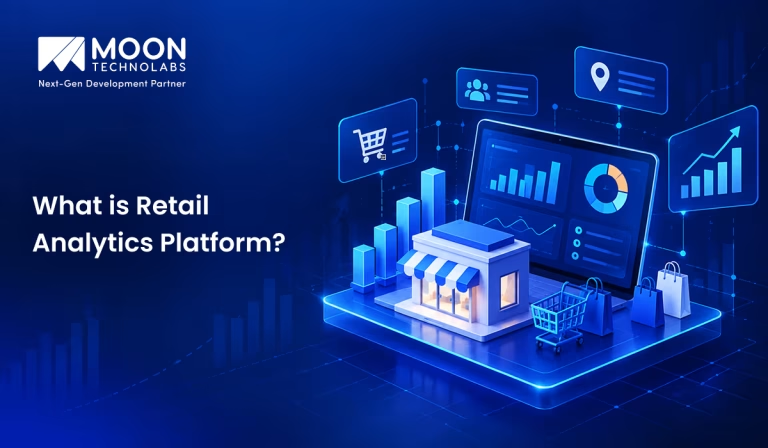
Table of Content


Blog Summary:
A retail analytics platform helps businesses transform sales, inventory, and customer data into actionable insights. This guide explains how these platforms work, their key types, common applications, and the top solutions worth considering. Discover how retailers can use analytics to understand customer behavior, forecast demand, optimize pricing, improve store performance, and make informed decisions that support business growth and operational efficiency.
Table of Content
Every purchase, product search, and store visit generates valuable data that can reveal how customers shop and what drives sales. A retail analytics platform brings this information together, helping businesses uncover purchasing patterns, identify underperforming products, anticipate demand, and discover opportunities to improve profitability. Instead of guessing, retailers can use data-backed insights to make smarter operational decisions.
According to Deloitte’s 2026 Global Retail Industry Outlook, 71% of surveyed retail executives reported gaining a competitive edge through stronger cost control, highlighting the importance of data-driven operational decisions.
In this guide, we’ll explore What is Retail Analytics Platform and how it works, and the top platforms businesses can consider to improve performance and drive sustainable growth.
Retail Analytics Explained
Retail analytics is the process of collecting, analyzing, and interpreting data related to sales, customers, inventory, and store operations. It helps businesses understand customer preferences, identify market trends, monitor performance, and make informed decisions.
By using data analytics tools and technologies, retailers can optimize inventory, forecast demand, personalize marketing campaigns, and improve pricing strategies. These insights help increase sales, reduce operational costs, enhance customer satisfaction, and improve overall business performance.
How Does a Retail Analytics Platform Work?
A retail analytics platform collects data from sources such as sales systems, websites, mobile apps, customer databases, and inventory systems. This data provides a comprehensive view of business operations and customer activities.
The platform processes and analyzes the collected data using analytical tools, statistical methods, and machine learning. It identifies sales trends, customer preferences, inventory issues, and purchasing patterns through reports, dashboards, and visualizations.
Finally, the platform converts these insights into actionable recommendations that help businesses improve pricing, forecast demand, optimize inventory, and personalize marketing. This enables retailers to make informed decisions, enhance customer satisfaction, and increase profitability.
Types of Retail Analytics and Their Applications
Retail analytics is the process of collecting and analyzing retail data to understand customer behavior, improve sales, manage inventory, and support better business decisions. There are four major types of retail analytics:
Descriptive Analytics
Descriptive analytics explains what has happened in the past by analyzing historical data through reports, charts, and dashboards.
Applications:
- Analyzing sales performance and revenue.
- Identifying customer purchasing patterns.
- Monitoring inventory and stock levels.
- Comparing the performance of different stores.
Example: A retailer analyzes monthly sales reports to identify the best-selling products during festive seasons.
Diagnostic Analytics
Diagnostic analytics explains why something happened by identifying the causes of changes in sales, customer behavior, or business performance.
Applications:
- Identifying reasons for declining sales.
- Understanding customer dissatisfaction.
- Analyzing inventory shortages.
- Evaluating marketing campaign performance.
Example: A retailer discovers that sales have decreased because competitors are offering lower prices.
Predictive Analytics
Predictive analytics uses historical data, statistical methods, and machine learning to estimate what is likely to happen in the future.
Applications:
- Forecasting future sales and demand.
- Predicting customer purchasing behavior.
- Estimating inventory requirements.
- Identifying customers likely to stop purchasing.
Example: A retailer predicts increased demand for smartphones during a festive sale and stocks products in advance.
Prescriptive Analytics
Prescriptive analytics recommends what actions should be taken to achieve the best business outcomes using data, predictive models, and optimization techniques.
Applications:
- Optimizing product prices and discounts.
- Determining ideal inventory levels.
- Planning promotional campaigns.
- Improving supply chain and resource allocation.
Example: A retailer uses analytics to determine the best discount for increasing sales while maintaining profits.
Discover how a tailored analytics solution can help your business understand sales trends, manage inventory, and improve daily operations.
Top Retail Analytics Platforms to Consider
Choosing a retail analytics platform depends on your business goals, data needs, and reporting requirements. Here are some platforms worth considering, each offering different capabilities to support retail operations and decision-making:
Oracle Retail Analytics
Oracle Retail Analytics helps businesses analyze sales, inventory, customer behavior, and merchandising performance. Its analytical capabilities support demand forecasting, stock optimization, and trend identification. Retailers can use these insights to improve operational efficiency, manage inventory effectively, and make data-driven business decisions.
ThoughtSpot
ThoughtSpot is an analytics platform that enables users to explore business data through natural-language searches and interactive dashboards. Retailers can identify sales trends, monitor key performance indicators, analyze customer behavior, and discover product insights to support faster, data-driven decision-making.
Tableau
Tableau is a business intelligence and data visualization platform that transforms complex retail data into interactive dashboards and reports. It helps businesses analyze sales performance, customer preferences, inventory trends, and store operations, enabling teams to identify opportunities and make informed decisions.
Microsoft Power BI
Microsoft Power BI enables retailers to connect data from multiple sources and create interactive reports and dashboards. It supports sales tracking, inventory analysis, financial reporting, and performance monitoring, helping businesses identify trends, improve operational efficiency, and make informed decisions.
Looker
Looker is a business intelligence platform that allows retailers to explore business data through customizable dashboards and reports. It supports sales analysis, customer behavior tracking, and performance measurement, helping organizations gain valuable insights, monitor business outcomes, and improve decision-making.
Aptos Analytics
Aptos provides retail analytics solutions supporting merchandising, planning, inventory management, and store operations. Its analytics capabilities help businesses evaluate performance, improve product availability, and understand demand patterns, enabling better merchandising decisions and streamlined operations.
RetailNext
RetailNext specializes in in-store analytics that uses shopper traffic and behavior data to evaluate store performance. It helps retailers measure foot traffic, analyze conversion rates, assess store layouts, and optimize staffing, ultimately improving operational efficiency and enhancing customer shopping experiences.
SiteZeus
SiteZeus uses artificial intelligence, predictive analytics, and location intelligence to support retail site selection and expansion. It helps businesses evaluate potential store locations, analyze demographics, assess market opportunities, and identify promising areas for expansion and long-term growth.
CARTO
CARTO is a location intelligence platform that enables businesses to analyze geographic and spatial data. Retailers can use it to understand customer distribution, evaluate store locations, identify underserved markets, and optimize territory planning to support expansion strategies and improve market coverage.
Sisense
Sisense is an analytics platform that integrates data from multiple sources to create interactive dashboards and reports. Retailers can use it to monitor sales performance, analyze customer trends, track key performance indicators, and generate actionable insights that support better business decisions.
Common Use Cases of Retail Analytics Platforms
Whether it’s personalizing customer experiences or measuring performance across sales channels, retail analytics helps businesses connect data with everyday decisions. Let’s explore the most common use cases and their practical applications:
Customer Segmentation and Personalization
Analytics platforms group customers based on demographics, purchasing behavior, preferences, and spending patterns. This lets businesses provide personalized product recommendations, targeted marketing campaigns, and special offers that boost customer satisfaction and loyalty.
Sales Trend Analysis
Sales trend analysis examines historical data to identify popular products, seasonal patterns, and changes in customer demand. These insights help businesses develop effective sales strategies, increase revenue, and plan for the future.
Demand Forecasting and Inventory Planning
Predictive models estimate future product demand using historical sales, seasonal patterns, and market trends. This helps businesses maintain optimal stock levels, prevent shortages, reduce excess inventory, and improve inventory management.
Pricing and Promotion Optimization
Data analysis helps determine appropriate product prices, discounts, and promotions. By evaluating customer responses, competitor pricing, and sales performance, businesses can attract more customers, increase sales, and maintain profitability.
Store Performance and Foot Traffic Analysis
Store performance analysis examines sales figures, customer visits, conversion rates, and foot traffic. These insights help businesses improve store layouts, optimize staffing, enhance customer experiences, and identify underperforming locations.
Omnichannel Performance Measurement
Measuring performance across physical stores, websites, mobile apps, and online marketplaces helps businesses understand customer journeys. It also lets them compare channel performance, improve the shopping experience, and maintain consistent marketing strategies across channels.
How to Choose the Right Retail Analytics Platform
The right retail analytics platform should align with your business goals, existing systems, and data requirements. Here are the key factors to consider before making your choice:
Define Your Retail Business Goals
Identify your primary business objectives before selecting a retail analytics platform. Focus on improving sales performance, optimizing inventory, understanding customer behavior, reducing operational costs, and supporting data-driven decision-making across your retail operations.
Evaluate Data Sources and Integration Requirements
Choose a platform that integrates seamlessly with your existing POS systems, CRM software, e-commerce platforms, ERP solutions, and inventory management tools. Ensure it consolidates data efficiently to provide accurate, consistent, and actionable business insights.
Assess Analytics and AI Capabilities
Evaluate the platform’s reporting, predictive analytics, and artificial intelligence capabilities. Look for features such as demand forecasting, customer segmentation, sales trend analysis, and real-time dashboards that help identify opportunities and improve retail performance.
Compare Scalability and Customization Options
Choose a retail analytics platform that scales with your business. Consider its ability to handle growing data volumes, support multiple store locations, adapt to changing requirements, and provide customizable dashboards, reports, and analytical workflows.
Review Pricing and Total Cost of Ownership
Compare subscription fees, implementation expenses, training costs, maintenance charges, and potential upgrade fees. Assess the platform’s overall value, not just the initial price, to ensure long-term affordability, measurable returns, and sustainable business growth.
Check Security and Data Governance
Prioritize platforms with strong security, role-based access controls, data encryption, and reliable backup systems. Verify compliance with relevant data protection regulations and evaluate governance features that maintain data accuracy, privacy, and accountability.
Retail Analytics Platform Implementation Challenges
Implementing a retail analytics platform can help retailers improve decision-making, understand customer behavior, and optimize operations. However, successful implementation requires addressing several challenges related to data integration, accuracy, costs, security, and employee adoption, which include:
Integrating Data from Multiple Systems
Retailers often use different systems for sales, inventory, customer relationship management, e-commerce, and supply chain operations. Combining data from these sources into a single analytics platform can be complex. Seamless integration is essential to create a unified view of business performance and enable accurate, data-driven decisions.
Maintaining Data Quality and Accuracy
Inaccurate, incomplete, or outdated data can lead to misleading insights and poor business decisions. Retailers must establish data validation processes, standardize data formats, and regularly update records. Consistent, high-quality data ensures analytics platforms deliver reliable insights for sales forecasting, inventory planning, and customer analysis.
Managing Implementation Costs
Implementing a retail analytics platform may involve software subscriptions, system integration, infrastructure upgrades, employee training, and ongoing maintenance. These expenses can be challenging, particularly for small retailers with limited budgets. Businesses should evaluate pricing, prioritize essential features, and choose scalable solutions that deliver measurable ROI.
Addressing Data Privacy and Security
Retail analytics platforms handle sensitive information, including customer details, purchase histories, and payment-related data. Protecting this information is essential to maintain customer trust and meet applicable privacy regulations. Retailers should implement access controls, encryption, secure data storage, and regular security assessments to reduce the risk of data breaches.
Encouraging Team Adoption
Employees may resist adopting a new retail analytics software because the technology is unfamiliar, they have limited technical skills, or they worry about changing established workflows. Retailers can overcome these challenges through practical training, clear communication, and ongoing support. Demonstrating how analytics simplifies daily tasks helps employees embrace the platform and use insights effectively.
Have an idea for a retail analytics platform? Connect with Moon Technolabs to discuss your objectives, features, and next steps.
How Can Moon Technolabs Help Businesses Build Retail Analytics Solutions?
Moon Technolabs helps businesses identify opportunities to make retail operations more data-driven. By developing solutions that connect business data to practical insights, companies can better understand sales patterns, track inventory movement, and recognize shifting customer preferences.
As retail businesses grow, their technology needs may change too. Understanding the role of retail software development can help businesses build flexible digital systems, streamline daily processes, and support future expansion without unnecessary complexity.
A Final Word
A retail analytics platform helps businesses understand what is working, where improvements are needed, and how customer preferences are changing. Using these insights, retailers can manage inventory more effectively, improve the shopping experience, and make better business decisions.
Choosing the right platform depends on your business goals and operational needs. For businesses that need workflow-specific solutions, hiring the best retail app development services can help build tools that support better data analysis and long-term growth.
FAQs
01
What are examples of analytics platforms?
Examples include Google Analytics, Microsoft Power BI, Tableau, Adobe Analytics, and Salesforce. These retail analytics tools help businesses collect, analyze, and visualize data to understand customer behavior, monitor sales performance, identify trends, and make informed decisions that improve operational efficiency and profitability.02
How does Walmart use data analytics?
Walmart uses data analytics to forecast demand, manage inventory, optimize pricing, and understand customer purchasing patterns. By analyzing historical sales data, weather conditions, and seasonal trends, Walmart improves supply chain efficiency, reduces stockouts, personalizes promotions, and ensures products are available when customers need them.03
What are the four main types of retail customers?
The four main types of retail customers are loyal customers, impulse buyers, discount seekers, and need-based customers. Loyal customers frequently return, impulse buyers make unplanned purchases, discount seekers prioritize savings, and need-based customers shop for specific products. Understanding these groups helps retailers develop effective marketing strategies.04
Can small retailers benefit from retail analytics platforms?
Yes, small retailers can benefit significantly from retail analytics platforms. These tools help track sales, understand customer preferences, manage inventory, identify popular products, and forecast demand. Affordable analytics solutions let small businesses make data-driven decisions, reduce waste, improve customer satisfaction, and increase profitability without large budgets.



The Software Development Team at Moon Technolabs includes experienced developers, solution architects, and technology consultants who contribute content on software engineering, application development, system architecture, and digital innovation. Their articles are based on real-world project experience and aim to help businesses make informed technology decisions.
Submitting the form below will ensure a prompt response from us.
We refine our expertise to deliver innovative business solutions.




205 N Michigan Avenue, #810, Chicago, 60601, Illinois, United States
13500 Long Is Dr, Pflugerville, TX 78660, USA

C/105 Ganesh Meridian, S.G. Highway, Ahmedabad, GJ 380060




Ayse D.
Co-Founder France
“ I highly recommend Moon Technolabs as the quality of service is wonderful. We have hired this company to develop the product based on some complex & technical issues. We get the best quality services as compared with others in the market. Huge Thanks to Moon Technolabs as the team is always ready to give the solution all time.”

Justin G.
Founder & CEO USA
“ Moon Technolabs is a pioneer in the WebRTC based project as they have fixed complicated segments of the module by fulfilling different product lines by providing 24X7 customer support. We really recommended Moon Technolabs as they are able to develop products as per the module deadline and project timeline.”

Flavio S.
Founder & Managing Director Germany
“I am happy to recommend Moon Technolabs for their app development services. They successfully developed apps for me, and I am highly satisfied with the overall outcomes. The development team has swiftly addressed the issues with responsive and effective communication to understand the requirement quickly and actively resolve the back-and-forth problems that arose...”

Jay M.
Founder & CEOUSA“Moon Technolabs is the best company that provides advanced apps and websites development services in the USA and Europe. I am a newbie to develop my app with an external team. I am really happy to work with them as I am not that much mobile apps user. Here, the team and specially the CEO of Moon Technolabs helps me to let me know about the benefits of my app to generate revenue....”


Our Offices
India
C/105 Ganesh Meridian,S.G. Highway, Ahmedabad, GJ 380060USA
205 N Michigan Avenue, #810, Chicago, 60601, Illinois, United StatesContact Information


