Product Roadmap: A Complete Guide to Planning, Strategy & Execution

Jayanti Katariya
Last Updated: May 20, 2026 Total Views: 170
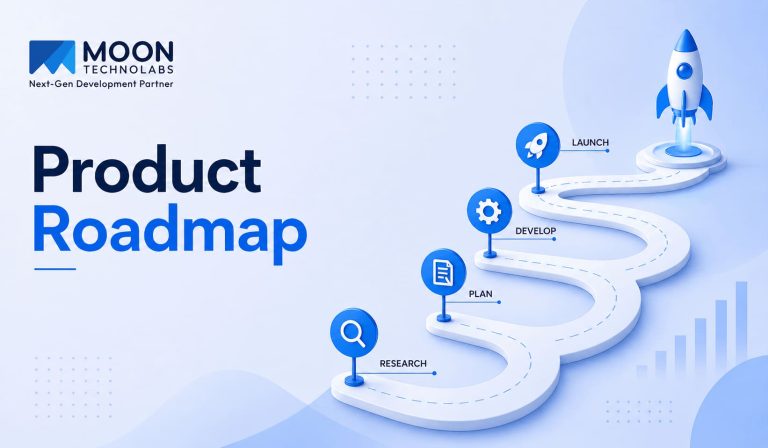
Table of Content


Blog Summary:
- A product roadmap is a strategic document that aligns all teams around product vision, priorities, and timelines.
- Four main types exist: strategic, agile, feature-based, and technology roadmaps – each serves a different audience and purpose.
- The strongest roadmaps focus on outcomes (metrics and goals), not just a list of features.
- Tools like Jira, Productboard, Aha!, and Notion make roadmap creation collaborative and stakeholder-friendly.
- Moon Technolabs offers end-to-end product roadmap consulting, MVP planning, and agile execution for SaaS products, mobile apps, and enterprise software.
Table of Content
Every successful product starts with a plan. But a plan without strategic direction is just a list of tasks.
That’s where a product roadmap changes everything.
Whether you’re building a SaaS platform, a mobile app, or enterprise software, a product roadmap gives your team a shared source of truth – a clear picture of what you’re building, why you’re building it, and when key milestones will land.
The stakes are real. According to Atlassian’s State of Product 2026 report, 84% of product teams are concerned that what they’re building won’t succeed in the market. Productboard found that 39% of product investments are already failing due to a lack of clear company strategy – up from 25% the year prior. A well-structured roadmap is one of the most direct tools for preventing either outcome.
In this guide, you’ll learn what a product roadmap is, the different types, how to build one from scratch, the best tools teams use today, and how Moon Technolabs helps companies build roadmaps that actually ship.
What is a Product Roadmap?
A product roadmap is a strategic, high-level document that communicates the vision, direction, priorities, and timeline of a product over a defined period. It shows where a product is headed, what the team will build next, and why those decisions connect to business goals.
Think of it as the bridge between your product vision and your day-to-day development work. It doesn’t prescribe every task – it communicates direction.
Roadmap vs. Product Plan vs. Backlog
A product roadmap outlines the key stages involved in taking a product from idea to launch. It provides a structured flow from research and planning to development and final release. Each stage focuses on a specific objective, ensuring teams stay aligned and move systematically toward delivering value.
| Stage | Scope | Focus | Primary Audience |
|---|---|---|---|
| Research | Discovery, insights | Market analysis, user needs, validation | Product, UX, Strategy |
| Plan | Strategic, structured | Goals, roadmap, timelines, prioritization | Product & leadership |
| Develop | Execution, build | Feature development, testing, iteration | Development team |
| Launch | Delivery, release | Deployment, marketing, performance tracking | All stakeholders |
This roadmap shows the journey from understanding the problem (Research) to delivering the solution (Launch), ensuring clarity at every stage of product development.
You Might Also Like:
Types of Product Roadmaps
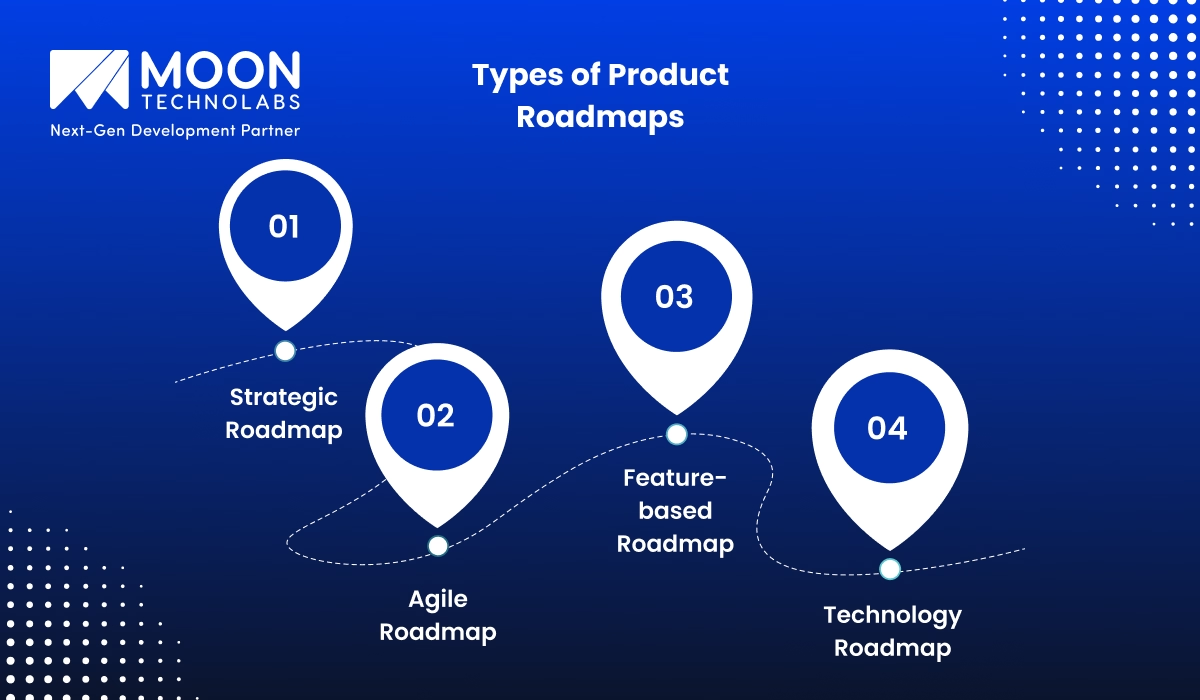
Product roadmaps can take different forms depending on the goals, audience, and working style of a team. Each type serves a specific purpose, from guiding long-term strategy to managing short-term execution. Choosing the right roadmap ensures better communication, alignment, and decision-making.
Below are the most common types used across product teams.
Strategic Roadmap
A strategic roadmap focuses on the long-term vision and overall direction of the product. It highlights major initiatives and business goals rather than specific features or deadlines. This type of roadmap is primarily used by executives and stakeholders to understand how the product supports company objectives. It helps align multiple teams around shared priorities and ensures everyone is moving in the same direction. Because it stays high-level, it remains flexible and adaptable over time.
Agile Roadmap
An agile roadmap is designed for teams that work in fast-paced, iterative environments. It is built around short cycles like sprints, allowing teams to continuously adapt to feedback and changing priorities. Instead of fixed timelines, it focuses on near-term goals and evolving deliverables. This makes it highly flexible and responsive to user needs and market shifts. Agile roadmaps are especially useful for product teams practicing continuous delivery and improvement.
Feature-based Roadmap
A feature-based roadmap organizes the product development process around specific features or functionalities. It clearly communicates what new capabilities are planned and when they might be delivered. This type is often used for customer-facing communication, helping users understand upcoming improvements. However, it requires careful prioritization to avoid overpromising. When used correctly, it provides clarity and transparency about product evolution.
Technology Roadmap
A technology roadmap focuses on the technical foundation of the product rather than user-facing features. It includes infrastructure upgrades, system improvements, and efforts to reduce technical debt. This type is commonly used in engineering-driven or enterprise environments where scalability and performance are critical. It helps teams plan for long-term stability and innovation. By aligning technical investments with business goals, it ensures the product remains reliable and future-ready.
Why is a Product Roadmap Important?
A product roadmap is more than just a planning document-it acts as a central tool for communication, alignment, and decision-making. It helps teams stay focused on what truly matters while navigating complex product development processes. By connecting strategy with execution, a roadmap ensures everyone is working toward the same goals. Below are the key reasons why every product team should rely on one.
Aligns Teams Across Functions
In most organizations, different teams such as product, engineering, marketing, and sales often have competing priorities. A product roadmap brings everyone onto the same page by clearly outlining what is being built and why. It eliminates confusion and reduces constant back-and-forth about priorities. With a shared understanding, teams can collaborate more effectively and avoid working in silos. This alignment ultimately leads to smoother execution and better outcomes.
Prioritizes Features Against Business Goals
Not every idea or feature request deserves immediate attention. A roadmap helps teams evaluate initiatives based on their impact on business goals like revenue, growth, or user retention. It ensures that decisions are driven by strategy rather than urgency or internal pressure. By prioritizing effectively, teams can focus on delivering the highest value work. This leads to smarter use of time, budget, and resources.
Improves Transparency with Stakeholders
Stakeholders such as executives, investors, and customers often want visibility into product direction. A roadmap provides a clear and structured view of upcoming plans without overwhelming them with technical details. It builds trust by showing that the team has a well-thought-out strategy. Regular updates to the roadmap also keep everyone informed about progress and changes. This transparency strengthens confidence and supports better collaboration.
Reduces Product Development Risk
Without clear direction, product development can easily become inefficient and error-prone. A roadmap helps teams plan ahead, identify risks early, and avoid unnecessary rework. It minimizes wasted effort by ensuring that everyone is aligned before execution begins. Structured planning also reduces the chances of missed deadlines or poorly coordinated launches. Overall, it creates a more predictable and controlled development process.
Supports Better Decision-Making
A well-defined roadmap provides context for making tough decisions. When priorities, timelines, and dependencies are clearly mapped, it becomes easier to evaluate trade-offs. Teams can quickly decide what to build now, what to delay, and what to drop entirely. This clarity speeds up decision-making and reduces uncertainty. As a result, teams can move forward with greater confidence and focus.
Key Components of a Product Roadmap
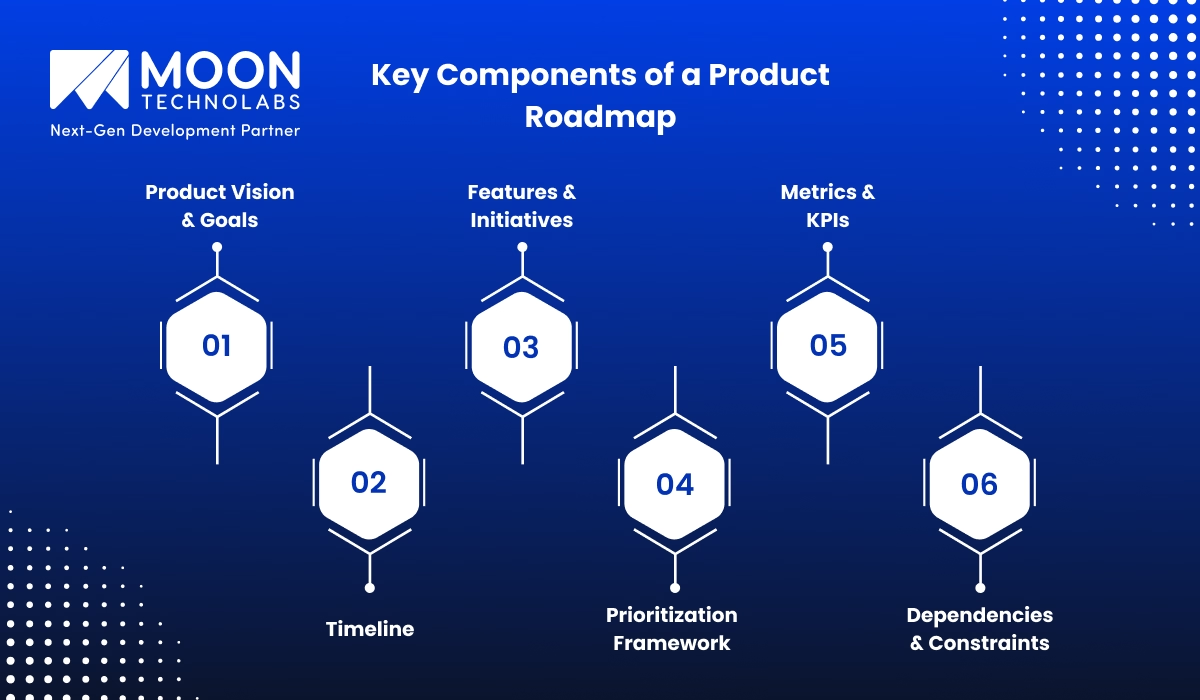
A strong product roadmap is not just a list of features arranged over time-it’s a strategic framework that connects vision with execution. Each component plays a critical role in ensuring clarity, alignment, and measurable progress. When these elements are clearly defined, teams can make better decisions and stay focused on outcomes rather than just outputs. Below are the essential components that make a roadmap effective.
Product Vision & Goals
This is the foundation of the entire roadmap-the “North Star” that guides all decisions. It defines what the product aims to achieve in the long run and why it matters. Every initiative on the roadmap should directly connect back to this vision. Without clear goals, the roadmap can easily turn into a random collection of ideas. A strong vision ensures consistency, purpose, and long-term direction.
Timeline
A roadmap should be structured across different time horizons, such as short-term, mid-term, and long-term. This helps teams balance immediate priorities with future planning. Short-term timelines focus on execution, while long-term timelines provide strategic direction. However, the further out you plan, the more flexible the roadmap should be. This layered timeline approach keeps teams both focused and adaptable.
Features & Initiatives
These represent the actual work planned within the roadmap. Instead of listing isolated features, it’s more effective to group them into broader initiatives or themes. This helps teams focus on outcomes rather than just outputs. Organizing work this way also makes it easier for stakeholders to understand the bigger picture. It ensures that every feature contributes to a meaningful objective.
Prioritization Framework
Not everything can be built at once, which makes prioritization essential. A clear framework helps teams decide what to work on first based on impact and effort. Methods like RICE scoring or MoSCoW provide structured ways to evaluate initiatives. This reduces bias and prevents decisions driven by urgency or internal pressure. With a solid prioritization approach, teams can focus on delivering maximum value.
Metrics & KPIs
A roadmap should always be tied to measurable outcomes. Metrics and KPIs define what success looks like for each initiative. These could include user adoption, retention rates, revenue growth, or engagement levels. Tracking these metrics ensures that the team is not just building features, but driving real impact. It also provides data for continuous improvement and decision-making.
Dependencies & Constraints
Every product initiative depends on certain conditions being met before it can move forward. These could include technical requirements, third-party integrations, or regulatory approvals. Identifying these dependencies early helps prevent delays and bottlenecks. It also allows teams to plan more realistically and coordinate across functions. Making constraints visible ensures smoother execution and fewer surprises during development.
Types of Product Roadmaps (Use Cases)
Different organizations need different types of product roadmaps depending on their pace, complexity, and audience. A roadmap that works well for a startup may not suit an enterprise environment, and a customer-facing roadmap is very different from an internal execution plan. Choosing the right format ensures better alignment, realistic planning, and clearer communication. Below are the most common roadmap types based on real-world use cases.
Roadmap for Startups
Startups operate in highly dynamic environments where priorities can change quickly based on user feedback or market shifts. Because of this uncertainty, rigid timelines often don’t work well. A Now–Next–Later format is commonly used, as it focuses on what is happening now, what comes next, and what is planned in the future. This approach keeps teams focused on immediate priorities while allowing flexibility for future changes. It helps startups stay agile without overcommitting to fixed plans.
Roadmap for SaaS Products
SaaS products need to balance continuous feature development with improving user retention and customer experience. A theme-based roadmap works particularly well in this case, where work is grouped around outcomes rather than individual features. For example, instead of listing features, a theme like “Improve onboarding experience” is used. This makes it easier to communicate value to both internal teams and customers. It also ensures that every initiative contributes to a measurable business outcome.
Roadmap for Enterprise Software
Enterprise software development is typically more structured, with longer release cycles and multiple stakeholders involved. These products often require strict compliance, security checks, and coordination across departments. As a result, timeline-based roadmaps are commonly used to track delivery schedules and dependencies. This format helps manage complexity and ensures accountability across teams. It also supports better planning in environments where changes need careful evaluation and approval.
Internal vs. External Roadmap
An internal roadmap is designed for product, engineering, and leadership teams and includes detailed execution-level information such as timelines, owners, and dependencies. It serves as a working document for planning and delivery. In contrast, an external roadmap is customer-facing and focuses on high-level themes rather than specific dates or commitments. It helps communicate product direction without overpromising features. Both versions are aligned with the same strategy but differ in the level of detail shared.
How to Build a Product Roadmap (Step-by-Step)
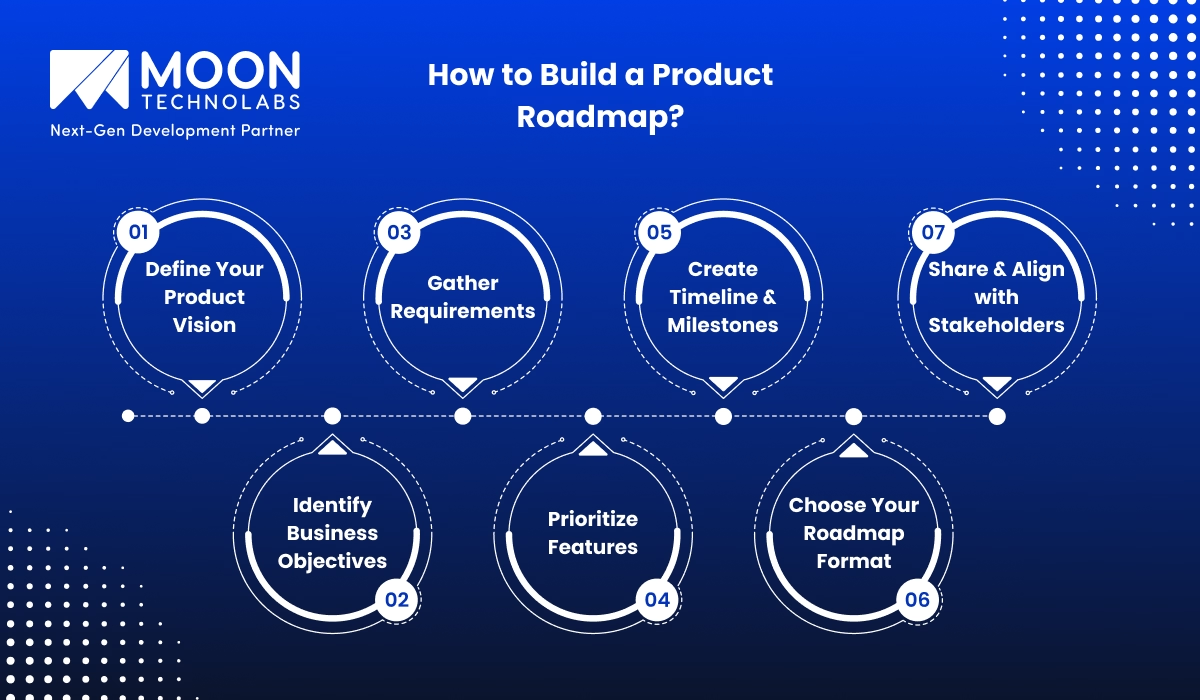
Here’s a practical, repeatable process for building a product roadmap that actually gets used – and keeps getting used.
Step 1: Define Your Product Vision
Start with the destination. Your product vision is the long-term mission your product exists to fulfill. It should be specific enough to guide decisions but broad enough to survive market changes. Write it as a single, memorable sentence that any team member could recite.
Step 2: Identify Business Objectives
Translate that vision into concrete, measurable goals for the next 6–12 months. These might include hitting a revenue milestone, reducing churn by 20%, or expanding into a new customer segment. Objectives give the roadmap its why – without them, prioritization is just guesswork.
Step 3: Gather Requirements
Pull input from multiple structured sources: customer support tickets, NPS survey responses, sales team feedback, user interviews, competitor analysis, and market research. One in five product teams say their roadmap is frequently derailed by reactive decisions – structured input gathering prevents exactly that pattern.
Step 4: Prioritize Features
Two frameworks dominate here:
RICE Scoring:
- Reach – How many users will this feature impact over a set period?
- Impact – How significantly will it move the target metric?
- Confidence – How certain are you of the impact estimate?
- Effort – How many person-weeks will it take?
Score = (Reach × Impact × Confidence) ÷ Effort. Higher scores get prioritized.
MoSCoW Method:
- Must-have: Non-negotiable for this cycle or release
- Should-have: High value but not critical to launch
- Could-have: Worthwhile if capacity allows
- Won’t-have: Explicitly out of scope – documenting this is as important as documenting what’s in
Step 5: Create Timeline & Milestones
Map initiatives to quarterly or monthly horizons. Build buffer into every quarter for bugs, technical debt, and emerging opportunities. Milestones should be outcome-based (“Payment integration live” beats “Start payment integration work”).
Step 6: Choose Your Roadmap Format
Pick the format that serves your audience:
- Timeline-based: Best for stakeholder communication and multi-team planning
- Kanban-style: Best for agile teams visualizing workflow and flow state
- Theme-based: Best for customer-facing communication without hard date commitments
Step 7: Share & Align with Stakeholders
A roadmap that lives in a Google Sheet nobody reads is worthless. Present it at all-hands meetings, reference it in every sprint planning session, share it in Slack channels, and embed it in the product wiki. The roadmap only delivers value if the whole organization actively uses it.
Moon Technolabs helps you define product vision, prioritize features, and execute scalable roadmaps for SaaS, mobile, and enterprise solutions.
Product Roadmap Example
Here’s a simple Python representation of a product roadmap -useful for teams building internal tooling or integrating roadmap data with project management APIs:
In a production roadmap, each feature entry carries additional metadata: owner, estimated effort, priority score, linked OKR, and dependency flags. As the product evolves, Q3 items get refined into sprint-ready tasks and Q4 emerges – the roadmap is always one quarter ahead in full detail and two quarters ahead in directional shape. That rolling horizon is what separates maintained roadmaps from abandoned ones.
Best Tools for Product Roadmapping
| Tool | Best For | Key Strength |
|---|---|---|
| Jira | Engineering-heavy teams | Deep Agile and sprint integration |
| Trello | Small teams and early-stage startups | Visual simplicity, low learning curve |
| Productboard | Customer-driven prioritization | Centralizes user feedback directly into roadmap |
| Aha! | Enterprise-scale roadmapping | Full product lifecycle and strategy management |
| Notion | Flexible, cross-functional teams | All-in-one workspace combining docs and roadmap |
Most mature product teams use a combination: Jira for sprint-level execution, Productboard or Aha! for strategic roadmapping, and Notion for documentation and stakeholder-facing views. The tool is secondary – what matters most is that the team actually maintains and references it.
Benefits of a Product Roadmap
A well-designed product roadmap is not just a planning tool-it creates real business impact across teams, customers, and leadership. It ensures that everyone is aligned on direction, priorities, and outcomes, which ultimately leads to more efficient execution. When maintained properly, it reduces confusion, improves focus, and strengthens decision-making at every level. Below are the key benefits of using a product roadmap effectively.
Clear Product Direction
A product roadmap gives every team member a clear understanding of what is being built and why it matters. It eliminates ambiguity by connecting initiatives to a shared vision and strategic goals. Instead of guessing priorities, teams can see how decisions are made. This clarity improves alignment across product, engineering, and business teams. As a result, everyone moves in the same direction with confidence.
Faster Development Cycles
When priorities and objectives are clearly defined in advance, development becomes much smoother. Teams spend less time revisiting decisions or dealing with late-stage changes. This reduces rework and helps sprints stay focused on execution rather than clarification. A roadmap ensures that the “why” behind each feature is already agreed upon before development starts. This leads to faster delivery and more predictable releases.
Better Stakeholder Communication
A roadmap acts as a shared communication tool between product teams and stakeholders such as executives, investors, and customers. Instead of scattered updates, it presents a unified and structured view of product direction. This helps build trust and reduces misunderstandings about priorities or timelines. Stakeholders can clearly see how the product is evolving over time. It also improves alignment between business strategy and product execution.
Improved Customer Satisfaction
A strong roadmap ensures that product decisions are driven by real user needs rather than internal assumptions or pressure. By tying features to validated customer problems, teams can build more meaningful solutions. This reduces the risk of developing features that don’t deliver value. As a result, users experience a product that better solves their pain points. Over time, this leads to higher satisfaction and stronger customer retention.
Data-Driven Decision Making
A product roadmap connects every initiative to measurable outcomes such as revenue, engagement, or retention. This makes it easier to evaluate priorities objectively rather than subjectively. Teams can quickly decide whether to proceed with, delay, or drop an initiative based on data. Research from industry reports like ProductPlan shows that revenue growth is a key success metric for product teams, and roadmaps aligned with revenue drivers are considered more effective. This data-driven approach improves clarity, speed, and confidence in decision-making.
Common Challenges in Product Roadmapping
Even well-established product teams face recurring challenges when building and maintaining a roadmap. A roadmap is a living document, and without proper discipline, it can quickly lose clarity, relevance, or alignment. These challenges often come from shifting business priorities, communication gaps, or lack of real user input. Understanding them helps teams build more realistic and usable roadmaps.
Changing Priorities
One of the biggest challenges in roadmapping is constantly shifting priorities due to evolving business needs or market conditions. While change is natural, it can impact the credibility of the roadmap if not managed properly. Teams often struggle when frequent updates create confusion about direction. The key is to treat the roadmap as a flexible tool rather than a fixed plan. Regular updates should be seen as healthy adjustments, not failures in planning.
Misalignment Between Teams
Misalignment occurs when different teams-such as product, engineering, and sales-start working from their own version of the roadmap. This creates confusion, duplicated effort, and conflicting priorities. Without a single source of truth, teams lose synchronization and efficiency drops. A shared, actively maintained roadmap helps ensure everyone is aligned. It acts as a central reference point for decision-making and planning.
Overloading the Roadmap
A common mistake is trying to fit too many features and ideas into a short timeframe. This creates unrealistic expectations and makes delivery difficult to achieve. When everything is marked as a priority, nothing truly is. Overloading the roadmap often leads to missed deadlines and stakeholder frustration. A focused and prioritized roadmap is far more effective than an overcrowded one.
Lack of Real User Feedback
Roadmaps that are built without strong user input often rely on internal assumptions rather than actual customer needs. This increases the risk of building features that do not solve real problems. Teams may end up investing time in low-impact work. Incorporating feedback from user interviews, analytics, and satisfaction metrics is essential. Continuous input from users ensures the roadmap stays relevant and value-driven.
Poor Communication
Even a well-designed roadmap loses value if it is not actively used in day-to-day work. In many cases, roadmaps exist but are not referenced during planning, meetings, or reviews. This disconnect reduces their impact and leads to misalignment over time. A roadmap should be a living document integrated into regular workflows. Consistent communication ensures it remains a guiding tool rather than a static artifact.
You Might Also Like:
Best Practices for Product Roadmap Planning
A strong product roadmap is not created once and left unchanged-it is continuously refined based on learning, feedback, and business needs. The most effective product teams follow clear practices that keep their roadmaps realistic, outcome-driven, and trustworthy. These habits help ensure that the roadmap remains a practical tool rather than just a presentation document. Below are some of the best practices for effective roadmap planning.
Keep It Flexible, Not Rigid
A roadmap should guide direction, not lock teams into fixed decisions that may become irrelevant over time. Business priorities, market conditions, and user needs often change, and the roadmap should adapt accordingly. Many teams use a rolling horizon approach to balance clarity and flexibility. This means detailed planning for the short term, directional planning for the mid-term, and high-level ideas for the long term. This structure allows teams to stay focused while remaining adaptable.
Focus on Outcomes, Not Just Features
A common mistake in roadmap planning is focusing too much on feature delivery instead of business impact. A feature alone does not define success unless it solves a meaningful problem. Outcome-driven roadmaps shift the focus toward measurable goals such as improving conversion rates, retention, or engagement. For example, increasing trial-to-paid conversion is more valuable than simply adding a UI feature. This approach ensures that every initiative contributes to real business value.
Update Regularly
A roadmap should never remain static for long periods of time. Regular updates ensure that it reflects the latest priorities, insights, and constraints. Most teams review their roadmap at least every quarter to reassess direction and progress. High-performing teams often do lighter monthly check-ins for near-term adjustments. This continuous review process helps keep the roadmap accurate, relevant, and actionable.
Build Customer Feedback Loops
Successful roadmaps are strongly connected to real user feedback. Insights from support tickets, NPS surveys, user interviews, and product analytics should directly influence prioritization. This ensures that decisions are based on actual user behavior rather than assumptions. When customer feedback is integrated into planning, teams are more likely to build features that solve real problems. This leads to better product-market fit and stronger user satisfaction.
Avoid Over-Promising
One of the fastest ways to lose trust is by committing to more than what can realistically be delivered. External roadmaps, in particular, should be carefully managed to avoid setting unrealistic expectations. It is better to underpromise and overdeliver than the other way around. Any changes to timelines or scope should be communicated proactively rather than after delays occur. Maintaining transparency and consistency helps build long-term trust with customers and stakeholders.
Product Roadmap vs. Product Backlog
These two tools are frequently confused but serve fundamentally different purposes:
The product roadmap is a strategic artifact. It communicates direction, business priorities, and themes across a multi-month horizon. Its primary audience is stakeholders – executives, investors, sales, and marketing teams who need context, not task lists.
The product backlog is an ordered list of granular development tasks, user stories, and bug fixes. It drives day-to-day sprint planning and is the working document owned by the development team.
In Agile environments, the two tools work in tandem. The roadmap defines quarterly themes and goal metrics; the backlog breaks those themes into the specific user stories and acceptance criteria that fuel individual sprints. The roadmap is the what and why. The backlog is the how and when.
How Moon Technolabs Helps with Product Roadmap Development?
Building a successful product is not just about execution-it starts with making the right strategic decisions early on. Many teams struggle with prioritization, sequencing, and aligning product development with business goals. This is where structured roadmap guidance becomes critical to avoid wasted effort and missed opportunities.
Moon Technolabs, an AI-powered software development company, partners with startups, scale-ups, and enterprises globally to transform product ideas into clear, actionable roadmaps. Through product strategy consulting, they work closely with founders and product leaders to define vision, identify high-impact opportunities, and ensure the roadmap is aligned with business outcomes rather than just feature lists.
For early-stage products, Moon Technolabs focuses on MVP roadmap planning, helping teams decide what to build first-and equally important, what not to build-to reduce risk and optimize time-to-market. Alongside planning, they provide agile development execution by translating roadmaps into sprint-ready backlogs and maintaining transparency through iterative delivery and regular progress updates.
The team also integrates AI-driven feature prioritization to make roadmap decisions more data-backed, focusing on features that improve retention, revenue, and engagement. From initial planning to post-launch iterations, Moon Technolabs supports the entire product lifecycle, ensuring continuous improvement and long-term product success.
Partner with Moon Technolabs for MVP planning, roadmap strategy, and agile execution tailored to your business goals.
Conclusion
A product roadmap is one of the most powerful tools in a product team’s arsenal – not because it tells you what to build, but because it forces the clarity needed to make smart decisions under uncertainty.
The best roadmaps are living documents: updated regularly, grounded in data, focused on measurable outcomes, and communicated widely across the organization. Teams that treat their roadmap as a strategic coordination system -rather than a static feature list – ship better products, reduce wasted effort, and respond faster to change.
The future of product roadmapping is increasingly AI-driven. Predictive analytics can now suggest which features are most likely to move key metrics based on historical performance data, shifting prioritization from instinct to evidence. Teams that adopt these capabilities now will build a durable competitive advantage.
FAQs
01
What is the main purpose of a product roadmap?
A product roadmap's core purpose is alignment. It serves as a shared strategic document that communicates a product's vision, direction, and priorities to all stakeholders - from engineering to executives to investors. It ensures every team understands what is being built, why it was chosen, and roughly when it will ship.02
How often should a product roadmap be updated?
A product roadmap should be reviewed at least once per quarter, with major revisions triggered by significant business strategy changes, market shifts, or pivotal customer feedback. High-performing product teams often do a lighter monthly review to keep near-term items accurate, and treat every sprint retrospective as a chance to surface roadmap adjustments.03
What is the difference between a roadmap and a release plan?
A product roadmap is a strategic, high-level view of product direction across months or quarters - focused on themes, goals, and priorities. A release plan is a detailed, operational document specifying exactly what features, bug fixes, and improvements are included in a specific version, with precise dates, owners, and acceptance criteria. The roadmap drives the release plan, not the other way around.04
Which tools are best for creating a product roadmap?
The best tools depend on team size and workflow. Aha! and Productboard lead for dedicated strategic roadmapping with stakeholder management features. Jira works well for Agile teams needing tight sprint integration. Notion suits smaller, flexible teams preferring a wiki-style setup. Most mature teams pair a strategic tool (Productboard or Aha!) with Jira for sprint-level execution.05
Can startups benefit from product roadmaps?
Absolutely - roadmaps are often more valuable for startups than for established companies. A lean roadmap keeps early-stage teams focused on their core value proposition, prevents feature creep, and communicates traction and direction to investors. A simple Now-Next-Later format works well for pre-revenue startups where priorities shift frequently and hard dates create unnecessary pressure.




Jayanti Katariya is the CEO of Moon Technolabs, a fast-growing IT solutions provider, with 18+ years of experience in the industry. Passionate about developing creative apps from a young age, he pursued an engineering degree to further this interest. Under his leadership, Moon Technolabs has helped numerous brands establish their online presence and he has also launched an invoicing software that assists businesses to streamline their financial operations.
Submitting the form below will ensure a prompt response from us.
We refine our expertise to deliver innovative business solutions.





205 N Michigan Avenue, #810, Chicago, 60601, Illinois, United States
13500 Long Is Dr, Pflugerville, TX 78660, USA

C/105 Ganesh Meridian, S.G. Highway, Ahmedabad, GJ 380060


Ayse D.
Co-Founder France
“ I highly recommend Moon Technolabs as the quality of service is wonderful. We have hired this company to develop the product based on some complex & technical issues. We get the best quality services as compared with others in the market. Huge Thanks to Moon Technolabs as the team is always ready to give the solution all time.”

Justin G.
Founder & CEO USA
USA“ Moon Technolabs is a pioneer in the WebRTC based project as they have fixed complicated segments of the module by fulfilling different product lines by providing 24X7 customer support. We really recommended Moon Technolabs as they are able to develop products as per the module deadline and project timeline.”

Flavio S.
Founder & Managing Director Germany
“I am happy to recommend Moon Technolabs for their app development services. They successfully developed apps for me, and I am highly satisfied with the overall outcomes. The development team has swiftly addressed the issues with responsive and effective communication to understand the requirement quickly and actively resolve the back-and-forth problems that arose...”

Jay M.
Founder & CEOUSA“Moon Technolabs is the best company that provides advanced apps and websites development services in the USA and Europe. I am a newbie to develop my app with an external team. I am really happy to work with them as I am not that much mobile apps user. Here, the team and specially the CEO of Moon Technolabs helps me to let me know about the benefits of my app to generate revenue....”


Our Offices
India
C/105 Ganesh Meridian,S.G. Highway, Ahmedabad, GJ 380060USA
205 N Michigan Avenue, #810, Chicago, 60601, Illinois, United StatesContact Information