


New Product Development Process: A Complete Step-by-Step Guide

Jayanti Katariya
Last Updated: May 26, 2026 Total Views: 390
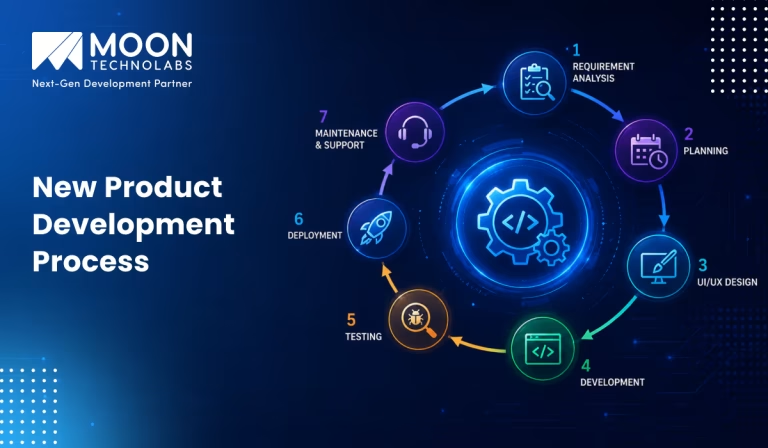
Table of Content


Blog Summary:
The blog provides complete details of the new product development process, covering the steps from planning through development to launch. It also covers important considerations for businesses to create products that work better for real users and align with their tech objectives.
Table of Content
Today, if you wish your business to grow adequately, launching an innovative product is not a choice but a necessity. Meanwhile, the actual problem is that most companies often jump directly into the development process without performing any necessary work, whether it’s research, planning, or validation. And that’s where things become worse.
As a result, products often fail to meet customer expectations and market demand. This is where the New Product Development (NPD) process becomes vital – it helps businesses in reducing risks and developing products based on market demand.
The growing significance of digital products is also evident in current market trends. According to Mordor Intelligence, the digital goods market is expected to reach $511.43 billion by 2031, highlighting the increasing demand for innovative digital solutions.
The stats reflect the importance of developing a digital product for business. For this, they need to understand the various development phases that enable their team to make informed decisions, boost efficiency, and thus increase the product’s success rate. In this blog, we will discuss each stage in depth. Let’s explore.
What is New Product Development?
New product development is a structured process that brings a unique product idea to life, from initial concept to final market launch. It consists of several steps, such as identifying a market gap, designing, developing, testing, and commercializing products that meet real customer requirements.
The process mainly includes numerous important activities, which are as follows:
- Conducting thorough market research to grasp customer pain points.
- Analyzing product ideas according to feasibility.
- Designing and prototyping products for testing
- Redefining products according to user feedback
- Planning and implementing a successful market launch
Whether you seek to launch your first product or expand your portfolio, you need a well-defined NPD process. It minimizes risks, saves resources, and improves your chances of creating something that the market truly seeks.
8 Key Steps of the New Product Development Process
Creating a successful product requires a repeatable, clear process that keeps the team aligned. It minimizes overall costly mistakes and provides real value to end users. Let’s have a detailed look at various new product development phases:
Step 1: Strategy and Idea Definition
A powerful foundation is necessary for a good product. Before you initiate the coding process or sketch a design, your team requires the finest clarity on what you actually build and also why. They do the following things:
- Identify Goals: Before you do anything else, you need to be clear about what success means for the product you develop. You need to decide whether you want to solve a specific customer issue or build on what you already have. Make sure you have a clear objective that keeps your every decision better aligned with your broader business objectives.
- Research the Market and Competitors: Gather details about your target audience, understand their pain points, and identify where your existing solutions fall short. Once you explore what competitors actually do, you start identifying gaps they have missed. That’s exactly where your product can stand out. You don’t need to start it from scratch.
- Select Product Platform or Type: You need first to determine what you build, whether it’s a SaaS tool, mobile app, IoT product, or a web platform. This is an important decision that shapes various things, be it your tech stack, your approach to design, or how long it takes to complete.
- Select Business Model: It’s important to know how you want to make money. You should decide whether you wish to go for freemium, subscription, flat one-time price, or ads. This is an important decision that shapes everything from how you develop the product to the way users experience it.
Step 2: Analysis and Planning
Once you define your strategy, you should translate your vision into a concrete action plan. As one of the new product development stages, it lays the operational groundwork for everything that follows:
- Functional and Non-Functional Requirements: Document what the product should do and how it should perform, covering key aspects such as security, speed, scalability, and reliability.
- Product Roadmap: Create a phased roadmap that includes key milestones, delivery timelines, feature priorities, and more. A well-structured roadmap keeps the team fully focused and stakeholders informed.
- Technology Stack: Now, you should select the best frameworks, technologies, tools, etc., according to your product’s requirements. It’s also important to identify human resources, including designers, developers, QA engineers, and others. They are required to implement your plan.
- Project Estimation: Develop realistic time and cost estimates for each key phase of the project. Accurate estimation is necessary to prevent budget overruns and timeline slippages down the road.
- Development Methodology: Now, it’s time to decide on the actual development approach. You need to decide whether to use Waterfall, Agile, Scrum, or a Hybrid model. The best methodology enables your team to adapt to changes without losing momentum.
Step 3: Product Design
Design is much more than how a product appears. It’s also about how a product functions and the feeling it delivers to users when they interact with it. A proper design process is what differentiates a good product from an outstanding one. It involves the following things:
- Information Architecture and Workflows: It’s important to organize content and features into a logical structure that feels intuitive to users. Make sure you fully define user journeys and workflows to ensure a smooth navigation experience.
- Concept Designs: Create low-fidelity wireframes to visualize product layouts and functionality before investing in detailed design. It ensures fast iterations and early feedback.
- Style Guides: Create a visual language with consistency across colors, typography, component styles, and iconography. They craft a perfect and cohesive brand experience across every screen.
- Mockups: You should always develop high-fidelity mockups that bring the design to life with real visual elements. Mockups work as a precise blueprint for the development team.
- Prototypes: Create interactive prototypes to enhance real user experience. Testing prototypes with actual users lets you discover usability issues before development starts. It saves both time and cost.
Step 4: Product Development
With the design approved, an engineering team goes into action. This is where your product comes to life through clean, scalable code. The team performs the following activities:
- Backend Development: It involves creating server-side logic, APIs, databases, and business rules. A powerful backend gives you confidence that your product can handle real-world usage reliably.
- Frontend Development: It involves crafting client-side interfaces that users interact with directly. It serves the actual purpose of converting approved designs into accessible and responsive experiences.
- Development Approach: Always select the perfect development approach for your budget and target audience. As far as custom native development is concerned, it delivers outstanding performance. On the other hand, a hybrid, cross-platform approach offers longer timelines and broader reach.
- DevOps: Make sure you set up CI/CD pipelines, deployment environments, and cloud infrastructure early in the development cycle. A robust DevOps foundation enables smooth releases and rapid recovery from issues.
Step 5: Product Testing
Testing is essential, regardless of the quality of the development work. Make sure every product you deliver has undergone rigorous testing. This step provides comprehensive details on your product’s stability, security, and readiness in the real world. The stage involves a variety of tests that are as follows:
- Functional Testing: It includes verification that every important feature works as per your defined requirements.
- Performance Testing: It involves analyzing how the product works under different loading conditions to ensure it remains responsive and fast at scale.
- Security Testing: In this, you need to identify vulnerabilities and ensure your product can protect sensitive user data from potential threats.
- Compatibility Testing: It serves the core purpose of confirming whether your products work consistently across multiple browsers, devices, or operating systems.
- Regression Testing: It’s performed to determine whether new updates or bug fixes affect existing functionality.
- Beta Testing: It’s now time to release your final product to the selected group or real users. It helps you gather actionable feedback for making a final improvement before you launch your product.
Step 6: Product Launch / Deployment
Once testing is successful, the product is deployed to the production environment and introduced to end users. A successful product launch strategy is essential for a smooth adoption and fewer operational disruptions.
This stage mainly includes the following activities:
- Production Deployment: It’s performed either by submitting apps to app stores or by deploying to live servers.
- Infrastructure Monitoring: It includes monitoring server uptime, health, and deployment stability during app launches.
- Data Migration: It involves securing business or user data in the live environment.
- Go-to-Market Implementation: It includes onboarding strategies, coordinated marketing campaigns, and various promotional activities.
- User Training and Documentation: Provide guides, tutorials, and other support materials for both internal teams and users.
Step 7: Localization & Scalability
Businesses need to enter the new market to support increasing user demand as the product grows. This stage focuses mainly on preparing the product for global adoption and long-term scalability. The following are the important considerations:
- Localization Support: It includes adapted currency, language, regional settings, and content for different markets.
- Scalable Infrastructure: It involves upgrading databases, cloud resources, server architecture, etc., to handle increased traffic.
- Performance Optimization: It includes maximizing application speed and minimizing latency across regions.
- Multi-region Deployment: It’s done primarily to improve availability and user experience through a distributed infrastructure.
- Compliance and Regulations: It involves aligning with regional accessibility, data privacy, and industry-specific compliance standards.
Step 8: Support and Performance Monitoring
The product development lifecycle continues even after the product is successfully launched. Therefore, you need to continue to perform monitoring, maintenance, and updates. These are necessary to keep products stable and secure. It mainly includes the following things:
- Performance Monitoring: It involves monitoring app performance, user activity, uptime, system health, and more.
- Customer Support: It offers technical assistance through support chat, channels, or ticketing systems.
- Bug Fixes and Maintenance: It resolves various technical issues and also releases regular updates.
- Feature Enhancements: It includes the introduction of new features in response to market demand and user feedback.
- Analytics and Reporting: It involves overviewing user engagement, KPIs, retention rates, business performance metrics, etc.
We are committed to turning your unique idea into a scalable product through sound development strategies. We build your products fast and launch them successfully.
Key Considerations Before Starting the Product Development Process
When you go for development directly without considering a couple of important questions, it can indeed be one of the biggest mistakes you commit. The following are some of these considerations:
Strategic Importance of the Product
Before you allocate your budget and resources to products, you need to ask yourself how each product fits into your broader business strategy. You need to decide whether it’s an important revenue driver, a tool to improve customer retention, or a market expansion play.
Once you understand the strategic weight of products, you can focus entirely on your portfolio, secure the right level of organizational commitment, and make smart trade-off decisions when challenges arise during development.
Target Users
Understanding your target audience helps you build your products accordingly. Always remember, customer products demand emotional design appeal, intuitive interfaces, and frictionless onboarding, since users make quick, personal decisions.
On the other hand, enterprise products focus on security, role-based access, integration capabilities, scalability, etc. So, if you don’t have enough information about your audience at this stage, it results in a product that works technically but often fails to cater to the people for whom it is built.
In-house vs Outsourcing Decision
You need to be clear about who will make it, whether your in-house team or an external company. Having an in-house team gives you full control and great coordination. But the downside is that hiring talented professionals is time-consuming and expensive.
On the other hand, hiring a professional development company means you get access to a talented development team, even without spending your own money. It also helps you launch your product successfully without any delay. The most important thing is that you don’t need to sacrifice the quality of the newly launched product.
Therefore, the best choice between in-house and outsourcing depends on many factors, such as timeline, budget, and complexity.
We create user-centric products that improve customer experience, engagement, and boost your business growth. Let’s have expert digital solutions.
Conclusion
A robust product development process allows businesses to convert their ideas into market-ready, scalable solutions with greater efficiency and reduced risk. Be it planning, design, development, or post-launch support, every stage of product development is crucial to long-term success.
All you need to do is follow a systematic approach to carry out different stages of new product development. It drives innovation, accelerates time-to-market, and delivers a better user experience. Partnering with a professional company like ours helps you develop a high-performing digital product tailored to meet emerging market demands and customer expectations.
FAQs
01
What are the four types of product development processes?
Well, the four types of product development processes include new product development, product development, platform development, and breakthrough innovation. Every process focuses on improving existing products, creating new offerings, developing scalable product families, and introducing disruptive market-changing innovations.02
What is a product development strategy?
A product development strategy is a structured plan that primarily defines how an organization creates, launches, and enhances a product. It aligns perfectly03
What's the difference between NPD and R&D?
New Product Development (NPD) focuses mainly on turning ideas into market-ready products through planning, design, testing, and launch. On the other hand, Research and Development (R&D) primarily focuses on discovering new technologies, improvements, and innovations.04
What is the best way to launch a new product?
Well, the best way to launch a new product involves various steps, like strategic planning, market validation, targeted marketing, and customer feedback. A successful product launch includes audience engagement, clear messaging, competitive positioning, and post-launch optimization to boost adoption, visibility, and long-term growth.05
What are the key things to consider before launching a new product?
Before launching a new product, you need to determine several things. These include target audience needs, market demand, pricing strategy, competitor positioning, product quality, development cost, legal compliance, and more.




Jayanti Katariya is the CEO of Moon Technolabs, a fast-growing IT solutions provider, with 18+ years of experience in the industry. Passionate about developing creative apps from a young age, he pursued an engineering degree to further this interest. Under his leadership, Moon Technolabs has helped numerous brands establish their online presence and he has also launched an invoicing software that assists businesses to streamline their financial operations.
Submitting the form below will ensure a prompt response from us.
We refine our expertise to deliver innovative business solutions.





205 N Michigan Avenue, #810, Chicago, 60601, Illinois, United States
13500 Long Is Dr, Pflugerville, TX 78660, USA

C/105 Ganesh Meridian, S.G. Highway, Ahmedabad, GJ 380060


Ayse D.
Co-Founder France
“ I highly recommend Moon Technolabs as the quality of service is wonderful. We have hired this company to develop the product based on some complex & technical issues. We get the best quality services as compared with others in the market. Huge Thanks to Moon Technolabs as the team is always ready to give the solution all time.”

Justin G.
Founder & CEO USA
USA“ Moon Technolabs is a pioneer in the WebRTC based project as they have fixed complicated segments of the module by fulfilling different product lines by providing 24X7 customer support. We really recommended Moon Technolabs as they are able to develop products as per the module deadline and project timeline.”

Flavio S.
Founder & Managing Director Germany
“I am happy to recommend Moon Technolabs for their app development services. They successfully developed apps for me, and I am highly satisfied with the overall outcomes. The development team has swiftly addressed the issues with responsive and effective communication to understand the requirement quickly and actively resolve the back-and-forth problems that arose...”

Jay M.
Founder & CEOUSA“Moon Technolabs is the best company that provides advanced apps and websites development services in the USA and Europe. I am a newbie to develop my app with an external team. I am really happy to work with them as I am not that much mobile apps user. Here, the team and specially the CEO of Moon Technolabs helps me to let me know about the benefits of my app to generate revenue....”


Our Offices
India
C/105 Ganesh Meridian,S.G. Highway, Ahmedabad, GJ 380060USA
205 N Michigan Avenue, #810, Chicago, 60601, Illinois, United StatesContact Information


